Hegesdi Castle: A Medieval and Ottoman Frontier Fortress in Hungary


Site at a Glance
- Rating
- 4.8
- Popularity
- Low
- Country
- Hungary
- Primary era
- Medieval
- External website
- Open
- Eras represented
- Medieval, Early Modern
- Civilizations
- Hungarian, Ottoman
- Site type
- Military
- Remains
- Castle
On this page9 sections
History
Hegesdi Castle in Hegyesd, Hungary, was probably built by the Atyusz kindred in the second half of the thirteenth century, after the Mongol invasion, as part of a defensive system against further attacks. The Atyusz were a medieval Hungarian aristocratic lineage associated with the early Hungarian conquest tradition. The castle became one of the fortified centers through which local authority and frontier defense were organized.
Early Royal Castle
Hegesdi Castle was first mentioned in 1282 in a document issued by the Veszprém chapter. The Atyusz kindred had become extinct in 1276, and the castle was described again in 1329 as a royal possession. During the first third of the fourteenth century, it was controlled by the Kőszegi kindred, another powerful Hungarian aristocratic lineage that had established extensive territorial authority in western Hungary.
The Kőszegis eventually lost their power in Transdanubia when the forces of Charles of Anjou, also known as Charles I of Hungary, consolidated royal authority. Afterward, a royal castellan administered Hegyesd. This official commanded the garrison and also exercised authority over the inhabitants of seven surrounding serf villages.
Medieval Landholders
The castle changed hands several times during the later medieval period. King Louis I granted it to the sons of Mikcsi Ákos in exchange for Vöröskő. From 1433, the Rozgonyi family held Hegyesd as a pledge, meaning that they controlled it temporarily as security for an obligation. In 1451, Miklós Újlaki redeemed the castle and obtained it as a royal grant. It remained with the Újlaki family until that lineage became extinct in 1524.
In 1525, King Louis II granted Hegyesdi Castle to Ambrus Sárkány of Ákosháza. Marriage brought it to Ferenc Mezőlaky in 1543. A dispute between the two families in 1544 ended with the Mezőlaky family retaining the castle as a pledge for 100 florins. During the 1550s, members of the Mezőlaky family repeatedly committed acts of violence against local inhabitants. Ferenc Mezőlaky later withdrew from secular life, became a Benedictine monk, and served as abbot of Zalavár. The castle itself passed through marriage to the Czobor family.
Ottoman Occupation and Destruction
On the night of 16–17 April 1561, Ottoman troops from Veszprém unexpectedly captured the privately held castle in a raid. Their commander, Pajazit, a voivode, ordered the position to be strengthened. Christian serfs forcibly gathered from the surrounding area built a lower palisaded fort at the foot of the hill by the end of that year. This outer work, known as a huszárvár, was a small wooden fortification intended to support or protect the main stronghold.
Ottoman cavalry stationed at Hegyesd raided the surrounding region. On 18 July 1561, about 400 Hungarian horsemen and infantrymen from nearby castles surprised the cavalry at Hosszúberek near present-day Lesencefalu as they returned from an expedition against Zalaszentgrót. In the Battle of Szántó, the Hungarian force killed about 300 Ottomans, including their commanders.
The Hungarian army began its siege of Hegyesdi Castle on 31 March 1562. The force numbered 2,159 troops drawn from Transdanubian frontier fortresses, county forces, and the private armies of local landowners. It bombarded the castle for a week under commanders including Bálint Magyar, Józsa Ormányi, András Perneszi, László Gyulaffy, János Csoron, Gáspár Vázsonykői Horváth, Benedek Búza, and Lieutenant Ferenc Török.
On 8 April, Eck Salm, the chief captain of Győr, arrived from the direction of Sopron with additional cannon. Pajazit then began negotiations to surrender, but Hungarian troops launched an assault that same day and captured the castle by evening. Salm judged it unsuitable for rebuilding, and the fortress was blown up in the following days. Hegyesdi Castle was never reconstructed. It disappeared from later military chronicles, while its surviving remains gradually deteriorated.
Later Literary Appearance
Hegyesdi Castle also appears as one of the settings in Péter Bogáti’s novel Hello, Here Is King Matthias. The novel presents the castle as belonging to a character named Bertalan Drágffy, who is portrayed as younger than the historical nobleman of that name.
Remains
Castle Hill and Defensive Works
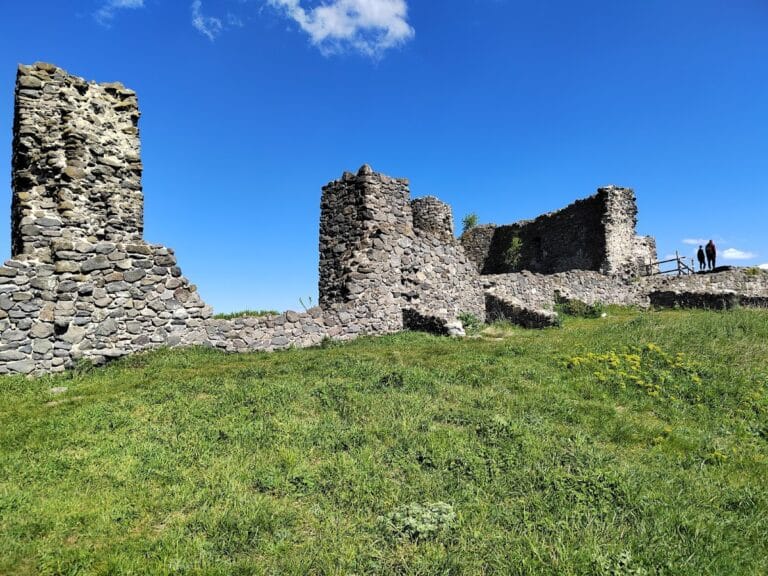
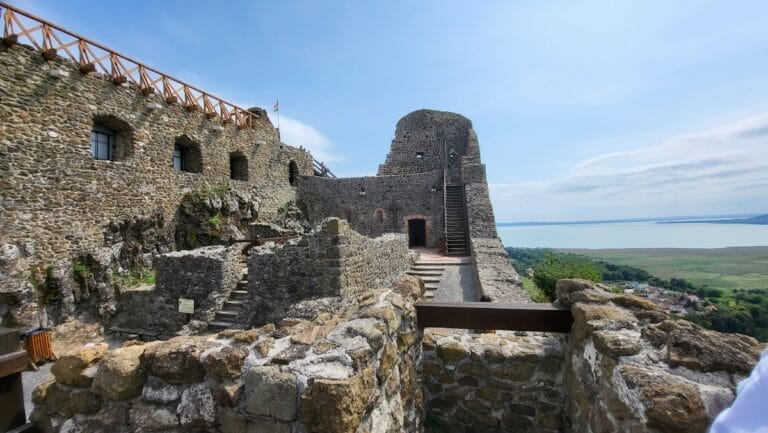
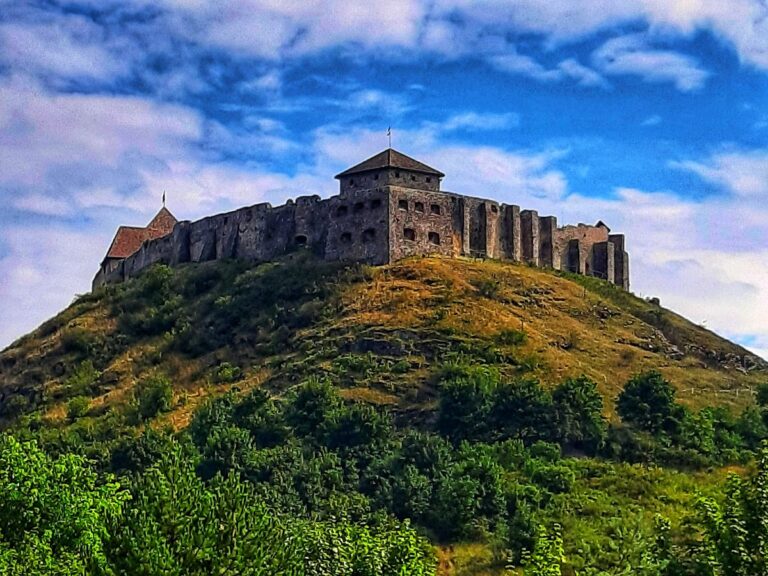
The ruins stand on a volcanic cone that rises to 281 metres at the northeastern entrance to the Tapolca Basin. The summit occupied by the castle covered approximately 190 square metres, leaving room for only a relatively small infantry force rather than a substantial army. A serpentine road once climbed toward the summit, where the stone castle was protected by a thin upper wall reinforced with small towers.
Upper Castle
The upper fortress was built of stone on the summit of the cone. Its surviving fabric is heavily deteriorated and crumbling, and the remains are difficult to see from a distance. The narrow summit, the thin defensive wall, and the small reinforcing towers reflect the limited scale of the stronghold. The position was destroyed after its capture in April 1562 and was not rebuilt.
Lower Palisaded Fort
At the foot of the castle hill, Ottoman defenders added a lower palisaded fort by the end of 1561. This huszárvár consisted of thick wooden stakes and formed an outer defensive work below the stone summit fortress. It belonged to the Ottoman strengthening of Hegyesd after the 1561 capture and was constructed by Christian serfs forcibly assembled from the surrounding area.