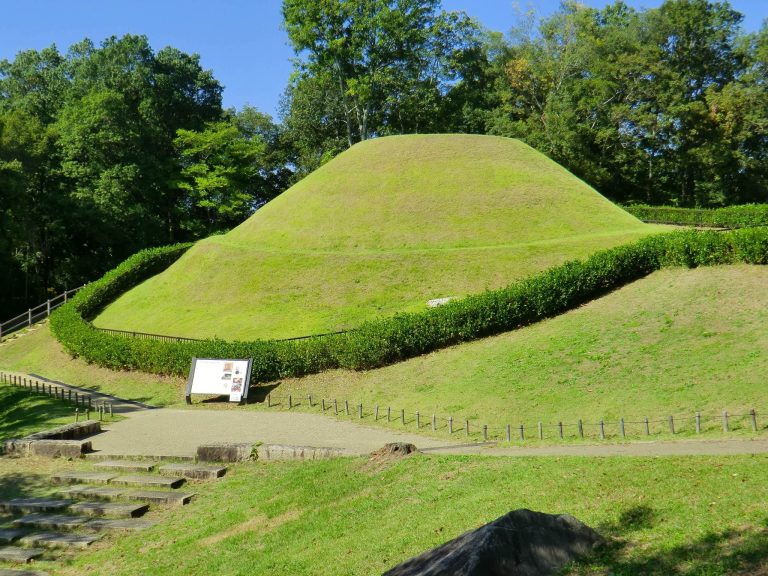
Kengoshizuka Kofun: An Octagonal Royal Burial Mound in Japan


Site at a Glance
- Rating
- 4.2
- Popularity
- Low
- Country
- Japan
- Primary era
- Medieval
- External website
- Open
- Eras represented
- Medieval
- Civilizations
- Yamato
- Site type
- Burial
- Remains
- Burial Mound
On this page10 sections
History
Kengoshizuka Kofun is an octagonal Japanese burial mound in Asuka, Nara Prefecture, Japan, built between the middle of the seventh century and the beginning of the eighth century, probably in the late seventh century. Its form belongs to the Asuka period, when octagonal mounds were closely associated with imperial tombs. The monument is widely considered a possible joint burial place for Empress Saimei, also known by her earlier reign name, Empress Kogyoku, and her daughter Princess Hashihito, the empress consort of Emperor Kotoku.
Identification as an Imperial Tomb
The proposed identification rests on several features considered together: the octagonal plan, the carefully arranged double burial, the quality of the grave goods, and the mound’s location. The Nihon Shoki, an early eighth-century chronicle of court traditions and imperial genealogies, describes the joint burial of Saimei and Princess Hashihito. Local tradition also identifies Kengoshizuka Kofun as their tomb.
The attribution is not conclusive. The Imperial Household Agency, the Japanese institution responsible for the imperial household and its mausolea, designates Kurumaki Kenno Kofun, 2.5 kilometers southwest of Kengoshizuka Kofun in Takatori, as Empress Saimei’s tomb. Its Archives and Mausolea Department recognizes Kengoshizuka Kofun as a strong alternative, but has not proposed changing the designation without decisive evidence such as an inscribed epitaph.
The possibility of a royal burial is also supported by the form of related tombs. The mounds traditionally associated with Saimei’s husband, Emperor Jomei, and her sons, Emperors Tenji and Temmu, are likewise octagonal. Kengoshizuka Kofun’s extensive worked-stone construction further distinguishes it as an unusually substantial monument.
Later Accounts and Archaeological Confirmation
The Nihon Shoki records that Emperor Tenji followed an instruction from his mother Saimei not to undertake major construction. This passage has informed discussion about who arranged her burial. The Shoku Nihongi, an eighth-century court chronicle and the second of Japan’s officially commissioned national histories, records the repair or reconstruction of Saimei’s tomb in 699. Some researchers have interpreted this entry as a possible indication that her remains were reburied during the reign of Emperor Monmu, her great-grandson.
The mound was long described as circular. An investigation carried out in 1977 and 1978 during environmental improvement works had already indicated that an octagonal plan was likely. Excavations conducted by the Asuka Village Board of Education from September 2009 to September 2010 confirmed that the monument was an octagonal mound built in three tiers.
In December 2010, the Asuka Village Board of Education announced the discovery of the adjacent Koshitsukagomon Kofun. Its position corresponds to the location given in the Nihon Shoki for the tomb of Princess Ota, Saimei’s granddaughter. This discovery strengthened the interpretation of Kengoshizuka Kofun as Saimei’s tomb, although it did not resolve the identification conclusively.
Protection and Reconstruction
Kengoshizuka Kofun became a National Historic Site in 1923. The protected area was enlarged in 2014 and 2015, when the designation was extended to include Koshitsukagomon Kofun. The site is also part of the UNESCO World Heritage property “Asuka-Fujiwara: Archaeological Sites of Ancient Japan.” Excavation, conservation, and reconstruction restored the mound to an appearance considered close to its original form. The complete restoration ended in February 2022, and the reconstructed site opened on 6 May 2022.
Remains
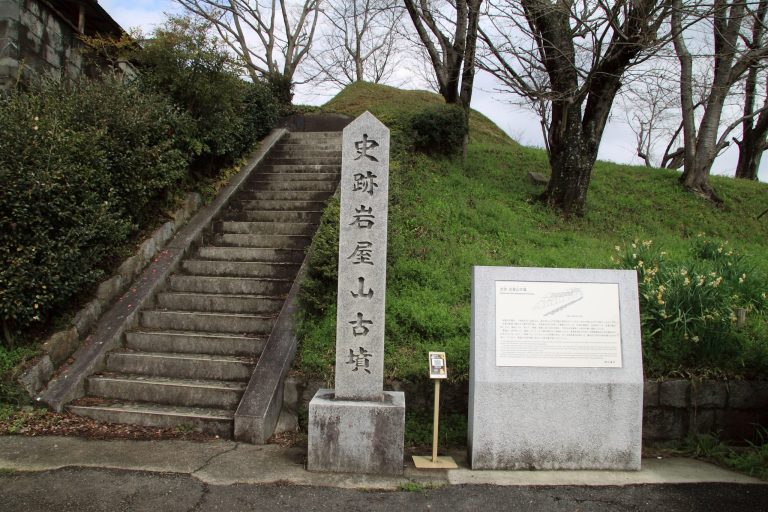
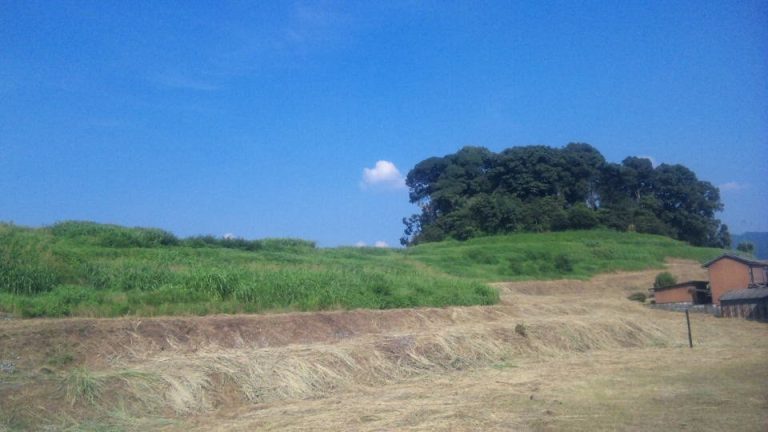
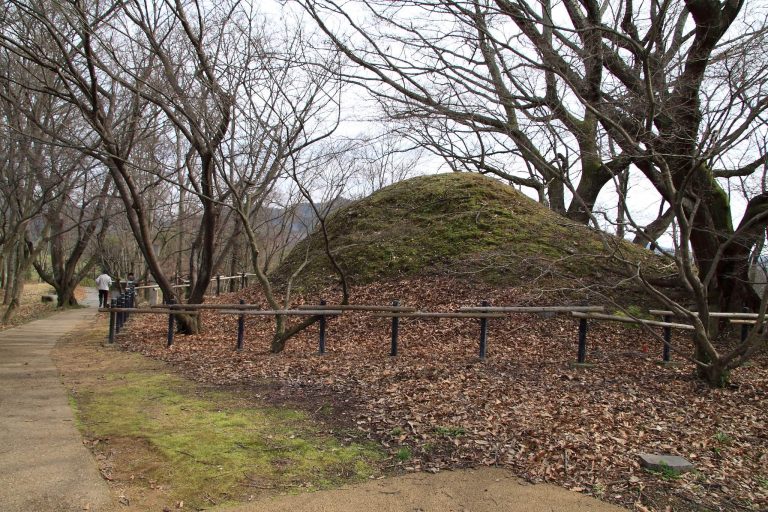
Kengoshizuka Kofun stands at an elevation of 126.3 meters on a broad, stable high point at the end of a branch ridge near the boundary between Asuka Village and Kashihara City. It lies about 500 meters west of Iwayayama Kofun. The mound is a three-tiered octagon made from tamped earth. Its original height is estimated at about 4.5 meters, although an earthquake caused the mound to collapse before its reconstruction.
Mound and Stone-Paved Surrounding
The base was cut into an octagonal plan with opposing sides about 22 meters long. The first tier had sides measuring 12.2 meters and a diagonal of about 33 meters. The second tier had sides of approximately 7 meters, a diagonal of about 18.5 meters, and a height of about 4 meters. Together, the three earthen levels created a deliberately ordered form rather than a simple circular mound.
An octagonal paved installation surrounded the mound. Three sides survived along the northwestern foot, including one side about 9 meters long and 1 meter wide, formed from three tightly packed rows of block-like cut stones. The paving turned through angles of about 135 degrees to form a regular octagon. In plan, the three mound tiers and the three paving rows created similar octagons of different sizes around a common center. Gravel beyond the paving brought the estimated overall width of the monument to about 32 meters.
Decorative Stonework
More than several hundred fragments of white tuff cut into triangular prisms were recovered from the mound. These pieces are thought to have been arranged in pyramid-like stacks on the slopes as decoration. The original installation may have used approximately 7,200 such pieces, creating a surface treatment that depended on carefully shaped volcanic stone rather than earth alone.
Burial Chamber
The south-facing burial facility is a horizontal-entrance stone chamber, meaning that it was entered through an opening in the side rather than from above. It was carved from a single tuff-breccia monolith, a volcanic rock made from consolidated ash and rock fragments, weighing about 80 tons. The stone was probably transported from the western foot of Mount Nijō, approximately 15 kilometers away. The complete burial installation is described as weighing about 70 tons.
The chamber measures approximately 5 meters wide, 3.5 meters deep, and 2.5 meters high. A central partition wall, 44.7 centimeters wide and 152.5 centimeters long, divided the interior into eastern and western spaces. The principal hollowed section measured 1.41 meters wide, 1.01 meters high, and 0.63 meters long. Each burial space was about 2 meters long, with walls covered by two layers of plaster and rounded ceilings approximately 1.3 meters high.
The left chamber measured 2.1 meters by 1.14 meters, while the right measured 2.08 meters by 1.16 meters. Each contained a sarcophagus base carved directly from the floor. The bases were approximately 1.95 meters long, 0.78 meters wide, and 0.08 meters high, providing fixed supports within the two burial spaces.
Doors and Outer Stone Ring
The entrance was sealed by an inner door and an outer door. The inner door was made of tuff and measured approximately 1.12 meters high, 0.62 meters thick, and 1.47 meters wide. Square holes at its four corners indicate that fittings had been installed. The outer door was made of andesite and measured about 2.4 meters high, 0.63 meters thick, and 2.69 meters wide.
Three carefully worked rectangular blocks of dacite were found around the exterior of the monolith. Each measured approximately 2.7 meters long, 1.2 meters wide, and 0.7 meters thick. Their orderly placement indicates that sixteen comparable blocks may originally have formed a ring around the burial facility. Dacite and andesite are volcanic stones, like the tuff used elsewhere in the tomb.
The total quantity of stone used throughout Kengoshizuka Kofun is estimated at more than 550 tons. Moving this material on rollers would have required several hundred people, while dragging it across the ground may have required as many as 1,400. The scale of this labor has been interpreted as a possible expression of the power of the ritsuryo state, a centralized Japanese government organized through administrative and legal codes influenced by continental East Asian models.
Burial Goods and Human Remains
Excavated and previously collected material includes fragments of a dry-lacquer coffin, gilt-bronze and copper fittings, cloisonne ornaments with a tortoiseshell pattern, eight-flower and six-flower fittings, circular and corner fittings, iron clamps, iron nails, and glass beads. A dry-lacquer coffin was made by repeatedly layering hemp cloth with lacquer rather than carving a solid block of wood. This type of coffin was associated with elite funerals in the late Kofun period.
Human remains, including molars, were also found. The molars have been interpreted as possibly belonging to Princess Hashihito. The double burial arrangement, the coffin materials, and the carefully made fittings contribute to the interpretation of the chamber as an elite or royal tomb.
The archaeological assemblage from Kengoshizuka Kofun was designated a National Important Cultural Property on 14 November 1953. The designated material includes one cloisonne tortoiseshell-pattern fitting, one gilt-bronze eight-flower fitting, copper-fitting fragments, and a group of dry-lacquer coffin fragments. These objects are kept at the Nara Prefectural Kashihara Archaeological Institute Museum. Cloisonne ornaments, coffin fittings, glass beads, and dry-lacquer coffin fragments are also identified as displayed at the Asuka Village Buried Cultural Property Exhibition Room.