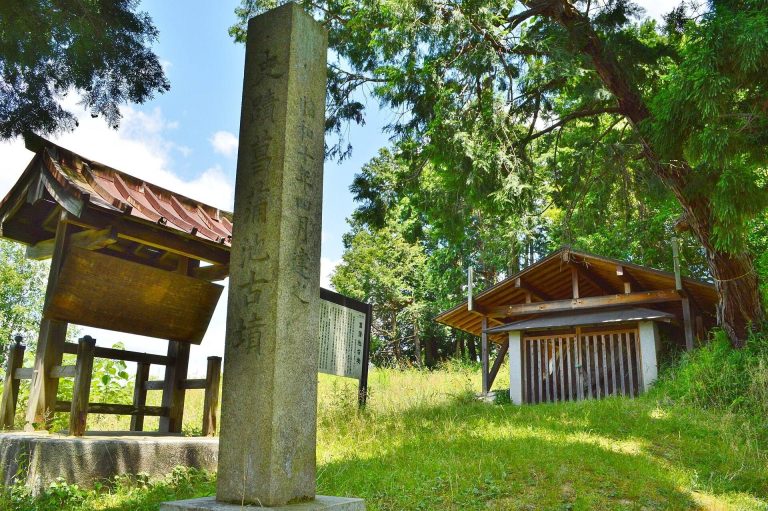
Nakaoyama Kofun: An Octagonal Imperial-Style Burial Mound in Japan


Site at a Glance
- Rating
- 3.9
- Popularity
- Very Low
- Country
- Japan
- Primary era
- Medieval
- External website
- Open
- Eras represented
- Medieval
- Civilizations
- Yamato
- Site type
- Burial
- Remains
- Burial Mound
On this page12 sections
History
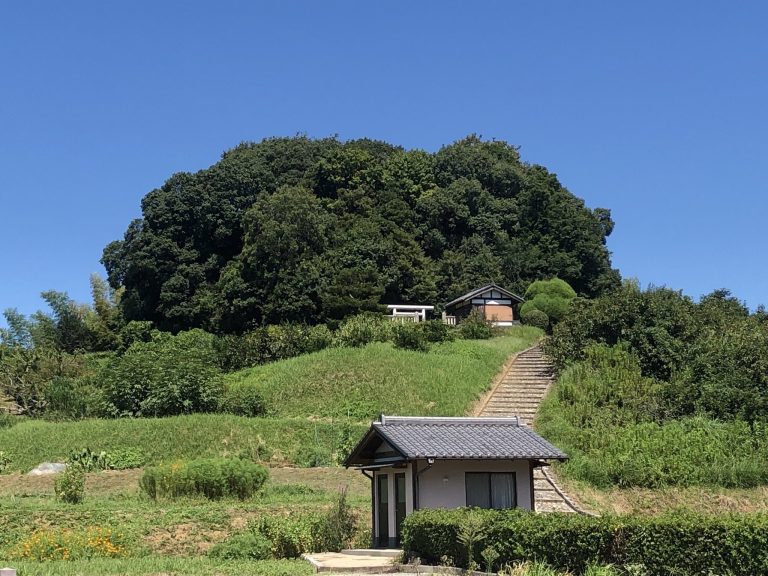
Nakaoyama Kofun is a Japanese burial mound in Hirata, Asuka Village, Japan, built around the beginning of the eighth century during the final phase of the Kofun period. The Kofun period was Japan’s era of large elite burial mounds, conventionally dated from about the third to the seventh century. Nakaoyama stands on a ridge at the southeastern edge of the Nara Basin, about 1.5 kilometers southwest of the ruins of Asuka-kyo. Its octagonal plan, a form especially associated with imperial tombs at the end of the Kofun period, and its elaborate cremation chamber indicate a burial of exceptionally high status.
Construction and the Tomb of Emperor Mommu
The occupant of Nakaoyama Kofun remains uncertain, but the theory that it is the actual mausoleum of Emperor Mommu has gained strong academic support. The mound’s octagonal shape, first considered possible after a 1970 survey and confirmed by excavation in 1974, was central to this interpretation. Further investigation took place in fiscal year 2020, following additional survey work in fiscal year 2009.
Emperor Mommu, Japan’s forty-second emperor, died in 707 at the age of 25. The Shoku Nihongi, an official Japanese chronicle, records the appointment of officials to build his mausoleum on October 3. It places his cremation at Asuka Hill on November 12 and the burial of his remains in the mausoleum on November 20. The Engishiki, a tenth-century compilation of laws, administrative regulations, and court and religious procedures, later described his mausoleum as a distant imperial tomb in Takaichi District, Yamato Province.
The area around the ridge has been known as Hinokuma since ancient times. It also contains or is associated with the tomb of Emperor Mommu and Takamatsuzuka Kofun, while the ruins of Asuka-kyo lie nearby. These associations have made the identification of Nakaoyama an important question in the history of the Asuka region and its early imperial burials.
Forgotten Location and Changing Identifications
The location of Mommu’s mausoleum was forgotten during the medieval period. A robbery took place during the Kamakura period, and a stone burial chamber was inspected during the Genroku period by Tamai Yozaemon, a yoriki, or assistant official, attached to the Nara magistrate’s office.
In 1697, an investigation of imperial tombs identified Takamatsuzuka Kofun as the unidentified tomb of Mommu. That conclusion remained in place during later reviews in the eighteenth and early nineteenth centuries, although other antiquarian interpretations proposed Nakaoyama Kofun or Noguchi Kofun. Noguchi Kofun is now regarded as the joint tomb of Emperor Tenmu and Empress Jito. During the Ansei-period review, Noguchi was designated as Mommu’s mausoleum, but after the Meiji Restoration the designation moved in 1881 to Kurihara Tsukaana Kofun, south of Nakaoyama, where it remains.
Investigation and Heritage Protection
Field surveys were carried out during the Meiji period, followed by measurements of the mound in the Taisho period. The 1974 excavation established the octagonal plan and strengthened the proposed connection with Emperor Mommu. Nakaoyama Kofun was designated a National Historic Site of Japan on April 8, 1927, and the protected area was expanded on February 21, 2024. It is also part of the UNESCO World Heritage property Asuka-Fujiwara: Archaeological sites of Japan’s Ancient Capitals, which protects archaeological remains associated with Japan’s early centralized state and imperial capitals in the Asuka and Fujiwara regions.
For preservation, the burial chamber has been backfilled. Drainage works, walking paths, and protective fencing have also been added to safeguard the mound and its archaeological remains.
Remains
Octagonal Mound and Surrounding Paving
Three-tiered mound
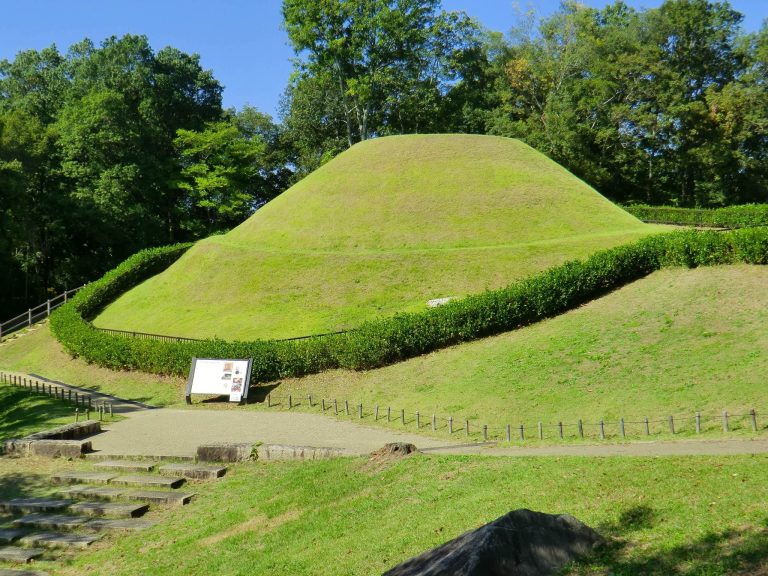
Nakaoyama Kofun is an octagonal mound measuring approximately 19.5 meters between opposite sides and at least 4 meters high. An earlier survey recorded a width of about 22 meters and a height of 3.2 meters. The mound was formed in three tiers using tamped earth, a method in which layers of soil are repeatedly compacted. The first and second tiers are low, platform-like stone foundations. Granite footing stones form the base, followed by small stones and stones as large as a person’s head set with their narrow faces outward, with additional stones placed above them. The upper tier consists of tamped earth shaped into an octagon.
Much of the gravel that once covered the mound has been lost, but vertical stonework terraces survive. A robbery pit from the Kamakura period remains on the eastern side of the third tier, providing a physical trace of the disturbance that affected the burial.
Concentric stone bands
Three concentric bands of stone paving surround the mound. The outermost, or third, band measures approximately 32.5 meters between opposite sides. Their arrangement frames the octagonal burial platform and forms a carefully ordered zone around the raised mound.
Clog-shaped stone objects
Two clog-shaped stone objects were found around the mound. One lay on the upper surface of the innermost paving band. Made from volcanic lapilli tuff known as Tatsuyama stone, it is approximately 95 centimeters wide and 67 centimeters high. Its surface was smoothly finished, and its end faces were cut at about 135 degrees. It is thought to have served as decoration at the summit of the mound.
Burial Chamber and Grave Passage
Horizontal-entry stone chamber
The burial facility is a horizontal-entry stone chamber, meaning that it is reached through a passage from the side rather than from above. Its interior is approximately 90 centimeters wide and 90 centimeters deep. The chamber originally consisted of ten stones: one floor stone, two side-wall stones, one rear-wall stone, one blocking stone, one ceiling stone, and four corner or pillar stones. One corner stone is missing, leaving nine in existence.
The rectangular floor stone is made of gneiss-like quartz diorite. The side walls, rear wall, blocking stone, and corner stones are rectangular blocks of volcanic lapilli tuff, or Tatsuyama stone, while the ceiling stone is fine-grained biotite granite. The side walls retain L-shaped shaping. The interior was carefully polished and coated throughout with vermilion, a vivid red pigment traditionally made from mercury sulfide.
A square depression approximately 60 centimeters on each side and 1 centimeter deep was cut into the center of the floor stone. It apparently received a platform for an ossuary, a container used to hold cremated human remains. The ossuary’s location is unknown because of the robbery. A theory connects it with a gilt-bronze four-ringed jar now held by the Sannomaru Shozokan, although that association remains interpretive.
Grave passage and drainage channel
A grave passage extends south from the blocking stone. It is approximately 3.2 meters wide and 1.3 meters deep, and it was filled with tamped earth after the burial. Beneath the passage is a culvert drainage channel about 1 meter wide and 20 centimeters deep. Fist-sized river stones filled the channel, helping carry water beneath the approach to the chamber.
Sue ware is included among the excavated materials. The burial goods themselves are not known.