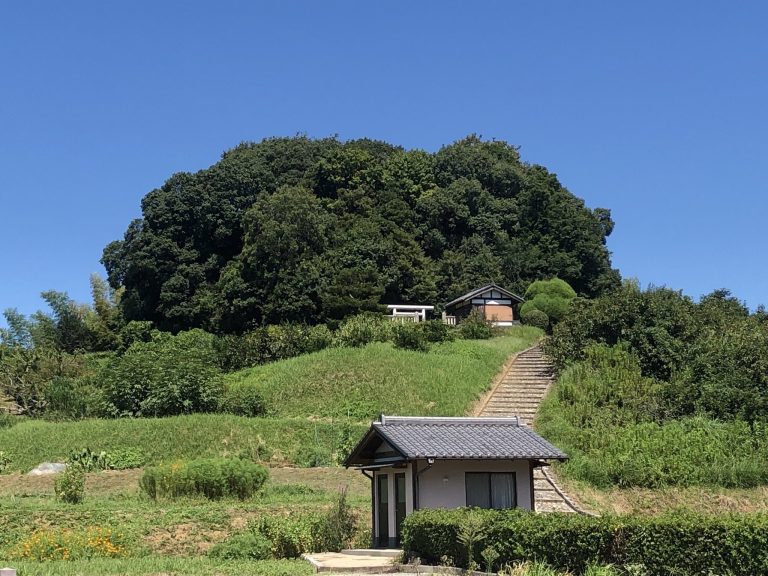
Iwayayama Kofun: A Late Kofun-Period Burial Mound in Asuka, Japan


Site at a Glance
- Rating
- 4.4
- Popularity
- Very Low
- Country
- Japan
- Primary era
- Medieval
- External website
- Open
- Eras represented
- Medieval
- Civilizations
- Yamato
- Site type
- Burial
- Remains
- Burial Mound
On this page8 sections
History
Iwayayama Kofun is a late Kofun-period burial mound in Asuka, Japan, constructed around the middle to the third quarter of the seventh century. A kofun was a monumental burial mound built in ancient Japan, and Iwayayama is distinguished by its horizontal-entry stone chamber, a tomb chamber reached through a passage from the mound’s side. The tomb was open for a long period and became widely known in the local area from ancient times.
Construction and dating
The date of construction is generally placed between the middle of the seventh century and its third quarter. This chronology draws on the house-shaped stone sarcophagus from the related Kotani Kofun and on the development of Sue ware, a high-fired ancient Japanese pottery whose forms help archaeologists establish dates for comparable stone chambers.
A different interpretation places the Iwayayama-style chambers in the first quarter of the seventh century. This earlier dating partly depends on proposed dates for Eifukuji-Kita Kofun, associated with Prince Shōtoku, who died in 621 or 622, and Tsukaana Kofun, associated with Prince Kume, who died in 603. It also depends on dating the construction of Ishibutai Kofun to 572, when Soga no Umako became a minister, rather than to around 626, the approximate year of his death. The chronology therefore remains open to research and debate.
Proposed identification and classification
Archaeologist Taichiro Shiraishi proposed that Iwayayama Kofun might be the burial place of Empress Saimei. She was traditionally said to have been buried at the Ochi-no-oka-no-ue mausoleum in 667, but the connection with Iwayayama remains a proposal rather than an established attribution. If the earlier chronology is accepted, the tomb could not be identified with Empress Saimei’s burial place.
Shiraishi grouped Iwayayama Kofun and several other tombs under the name “Iwayayama style.” He regarded this form as representative of the horizontal-entry stone chambers used during the final phase of the Kofun period. Tombs such as Kusabaka Kofun and Nishinomiya Kofun have simpler wall arrangements and are classified as a later Iwayayama sub-style. Iwayayama Kofun is designated as a National Historic Site of Japan.
Damage and investigation
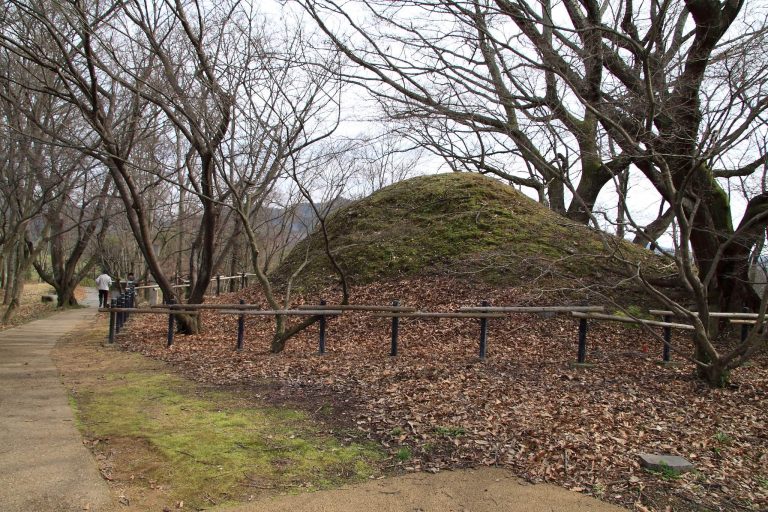
By the twentieth century, erosion had heavily weakened the mound. Flooding in 1978 caused the western side to collapse, leading to environmental improvement work and archaeological excavation. The investigation clarified the mound’s two-stage construction and examined the form and workmanship of its granite burial chamber. The burial facility had already been robbed or disturbed in antiquity, and a grave thought to date from the medieval period was dug into the centre of the chamber.
Remains
The mound
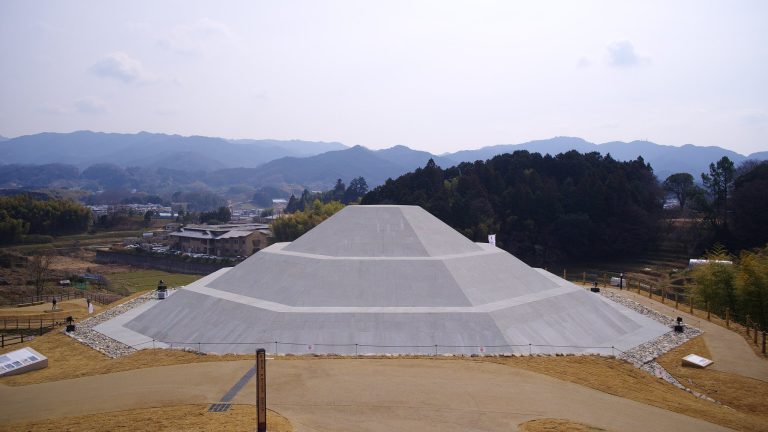
Iwayayama Kofun is generally understood as a square tumulus, with sides measuring about 45 metres. Another interpretation identifies a square lower section surmounted by an octagonal upper section. Excavation showed that the mound originally had two stages, rose to approximately 12 metres, and was built from carefully tamped earth. Its western side has suffered substantial damage.
The granite burial chamber
The burial facility is a double-sleeved horizontal-entry stone chamber built entirely from granite. In this arrangement, projecting side sections mark the junction between the burial chamber and its passage. The interior faces were carefully finished with cut stone. The chamber walls have two courses: the rear wall uses one cut stone in each course, while each side wall has two stones in the upper course and three in the lower. The upper stones incline inward, and a single large stone forms the ceiling.
The passage measures 12 metres in length and 1.9 metres in width. Its side walls have one tier in the rear half and two tiers in the front half. The burial chamber itself is 4.9 metres long, 2.7 metres wide, and 3 metres high. Its disturbed condition includes the medieval grave cut into the chamber floor area.
Related chamber forms
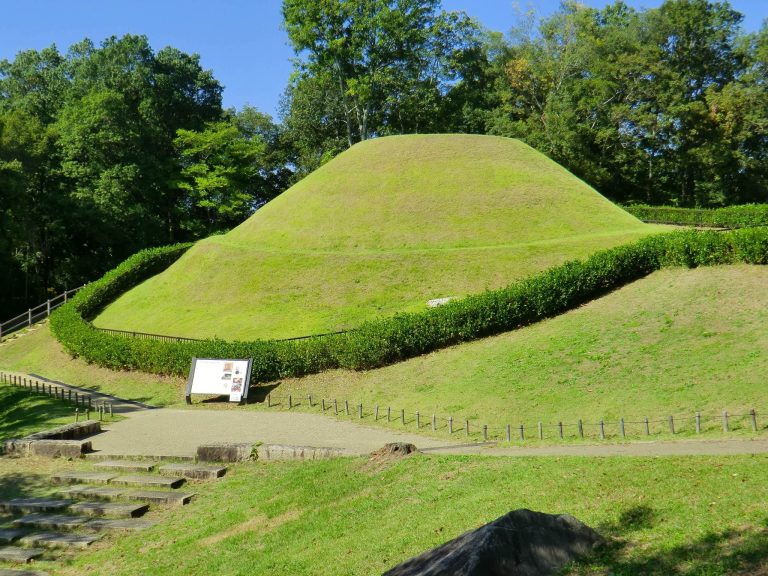
Comparable chambers extend across the region from Nara Prefecture to southern Osaka. Munesaka No. 1 Kofun in Sakurai has a horizontal-entry chamber with the same form and dimensions as Iwayayama. The chambers at Kotani Kofun in Kashihara and Minezuka Kofun in Tenri are smaller versions of the same design. Eifukuji-Kita Kofun in Osaka could not be examined directly, although older records place its chamber in the same category.
The chambers at Kusabaka Kofun and Nishinomiya Kofun simplify Iwayayama’s arrangement of wall stones. Their construction represents the later Iwayayama sub-style within the development of horizontal-entry burial chambers.