Sanzen-in Temple: A Tendai Monzeki Temple in Kyoto


Site at a Glance
- Rating
- 4.5
- Popularity
- Medium
- Country
- Japan
- Primary era
- Early Modern
- External website
- Open
- Eras represented
- Medieval, Early Modern
- Civilizations
- Unclassified
- Site type
- Religious
- Remains
- Monastery
On this page9 sections
History
Sanzen-in Temple is a Tendai monzeki temple in Kyoto, Japan, with origins traditionally placed in the Enryaku period, around 782–806. A monzeki temple is a Buddhist institution whose abbots traditionally came from the imperial family or the high aristocracy. Sanzen-in is counted with Shoren-in and Myoho-in among the three Tendai monzeki temples and is regarded as the oldest of them. Its principal image is Yakushi Nyorai, the Buddha associated with healing and the alleviation of suffering.
Origins on Mount Hiei
The institution’s beginnings are traditionally linked to Saicho, the monk who established the Tendai school in Japan and founded Enryakuji on Mount Hiei. During the Enryaku period, he is said to have founded a small building called Enyu-bo beside a pear tree in the southern valley of the Eastern Pagoda. The foundation is also dated to 804. In 860, the monk Joun built a hall at the site and enshrined an image of Yakushi Nyorai traditionally attributed to Saicho, naming the establishment Enyu-in.
Joun also created a residential branch at Kajii on the eastern foot of Mount Hiei. In 1086, the institution moved its base there and became known as Entoku-in. The names Kajii-no-miya and Kajii Monzeki developed from the place-name and from a ritual well associated with esoteric Buddhist practice. Earlier names included Enyu-in, Enyu-bo, and Nashimoto Monzeki.
Imperial abbots and the rise of Ohara
In 1118, Saiun Hoshinno, a son of Emperor Horikawa, entered the institution, becoming its fourteenth Kajii Monzeki in 1130. Thereafter, imperial princes and members of the Sekkan aristocratic families served successively as abbots. A Hoshinno was an imperial prince who had entered Buddhist religious life. Saiun became Tendai-zasu, the highest ecclesiastical office in the Tendai school, in 1156.
That same year, a Kajii Monzeki administrative office was established in Ohara. It regulated resident nenbutsu practitioners, whose devotion centered on invoking the name of Amida Buddha, and administered the older temples of Raigo-in and Shorin-in. The office stood beside Gokuraku-in, now called Ojo Gokuraku-in. Ohara had long served as a retreat from the capital for aristocrats and Buddhist practitioners. Prince Koretaka, the eldest son of Emperor Montoku, was traditionally associated with retreating there, an episode mentioned in the Ise Monogatari.
Ohara also became a center of Yuzu Nenbutsu and Tendai shomyo, a form of Buddhist liturgical chanting. The monk Ryonin, who systematized Tendai shomyo, lived in the area. The temple’s mountain name, Gyozan, refers to a traditional story about Cao Zhi hearing heavenly Buddhist chants at Fish Mountain in China. The Imperial Court Repentance Rite was first performed by Emperor Go-Shirakawa in 1157. This rite involves reciting the Lotus Sutra, repenting wrongdoing, and praying for the removal of karmic impediments, with the head of the Kajii Monzeki traditionally serving as ritual leader.
Relocations and the early modern institution
After a fire in 1232, the Kajii Monzeki moved from Sakamoto into Kyoto. It relocated several times within the capital and eastern Kyoto before settling in 1331 at the eastern foot of Mount Funaoka. The site was believed to occupy the former detached palace of Emperor Junna. Destruction during the Onin War, the civil conflict of 1467–1477, brought this phase to an end. Afterward, the Ohara administrative office became the institution’s main residence.
In 1698, Shogun Tokugawa Tsunayoshi granted Prince Jiin, the then Kajii Monzeki, land in the aristocratic district near the Kyoto Imperial Palace. The main residence consequently moved from Ohara and remained in the capital through the early modern period. The former capital site is now occupied by Kyoto Prefectural University of Medicine and its affiliated hospital.
Sanzen-in in the modern period
During the Meiji Restoration, the then Kajii Monzeki left the Buddhist clergy and founded the Nashimoto-no-miya family. Buddhist images and ritual implements from the former capital residence were transferred to the Ohara office. In 1871, the Ohara establishment became the new main residence, was renamed Sanzen-in, and absorbed the adjoining Gokuraku-in. The name Sanzen-in came from an imperial plaque written by Emperor Reigen and from the former name of a Kajii Monzeki devotional hall.
Gokuraku-in had originally been an independent temple. Temple tradition attributes its foundation in 986 to Genshin and his sister Anyoni, who established it for the memorial benefit of their parents. Historical evidence places its construction later, in the late twelfth century, by Shinnyobo, the wife of Fujiwara Sanetaira, to commemorate her deceased husband. The relationship is recorded in the diary of her nephew, Yoshida Tsunefusa. After the 1871 merger, the hall became part of Sanzen-in and was renamed Ojo Gokuraku-in in 1885.
The Imperial Court Repentance Rite was suspended after the Meiji government prohibited Buddhist rites at court. It was revived at Ohara in 1898 and moved to the Shinden after that hall was built in 1926. Following an imperial memorial service for Emperor Meiji at Sanzen-in in 1979, the rite became an annual observance there on May 30. The gardens were designated a Kyoto City Place of Scenic Beauty in 2000. Sanzen-in also participates in the Saigoku Yakushi, Kinki Thirty-Six Fudo, and Shinto-Buddhist pilgrimage circuits.
Remains
Valley setting and grounds
Sanzen-in stands in the mountainous Ohara valley between the Ryo-sen stream to the south and the Ritsu-sen stream to the north. Their names derive from the ryo and ritsu tonal systems used in Buddhist shomyo. The grounds include Ojo Gokuraku-in, its front gate called the Sujaku Gate, the Kyakuden guest hall, the Shinden main hall, the Benzaiten shrine, Konshiki Fudo Hall, Kannon Hall, the Enyu-bo sutra-copying hall, and Ennyuzo, a repository and exhibition facility. An Amida stone image, also called the Charcoal Seller stone Buddha, stands along the Ritsu-sen.
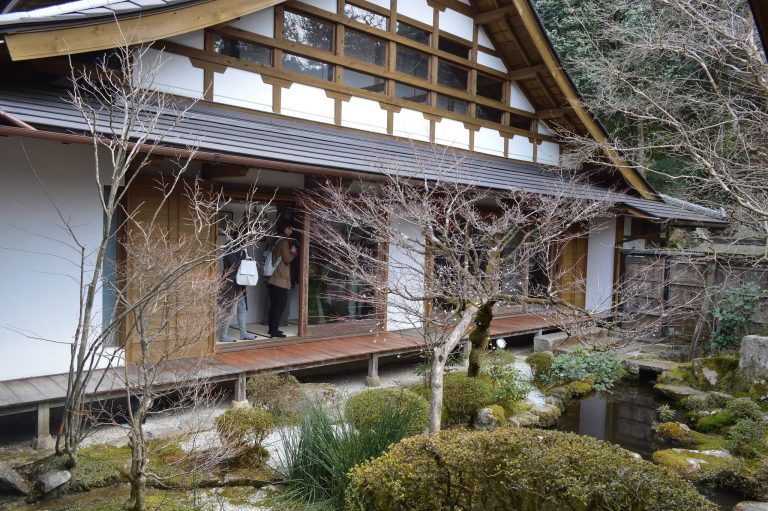
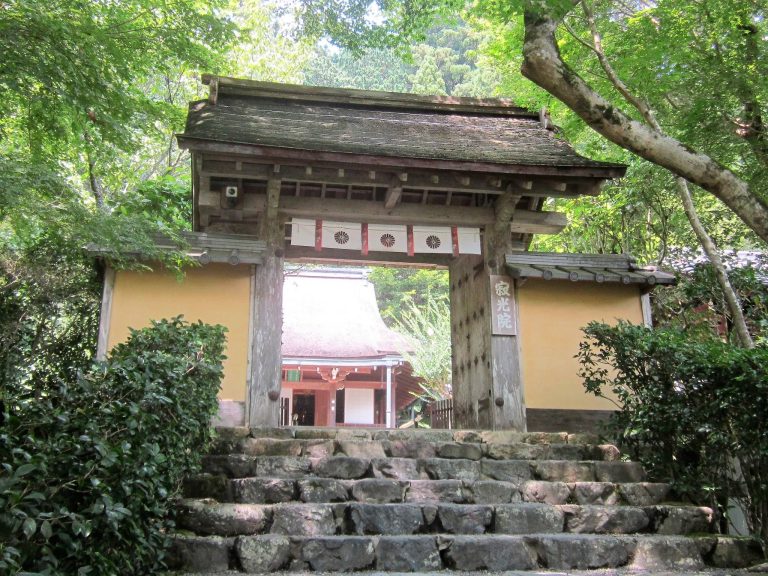
The southern garden contains Ojo Gokuraku-in and the Sujaku Gate. The western Goten Gate is a heavy gate of the yakui-mon type, with a relatively low asymmetrical roof supported by principal and side posts. Stone walls and white plaster walls flank it, while the stonework was made by the Anoshu stoneworkers of Sakamoto. The grounds contain the Yuseien and Shuheki-en gardens, both included in the Kyoto scenic designation. Shuheki-en surrounds a pond and a small hill. The grounds also contain rows of small Kannon statues donated by visitors and several small stone figures known as warabe Jizo.
Ojo Gokuraku-in
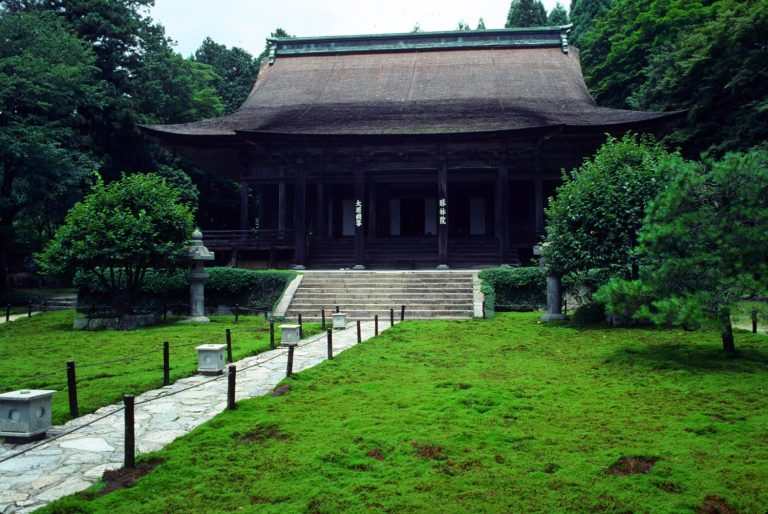
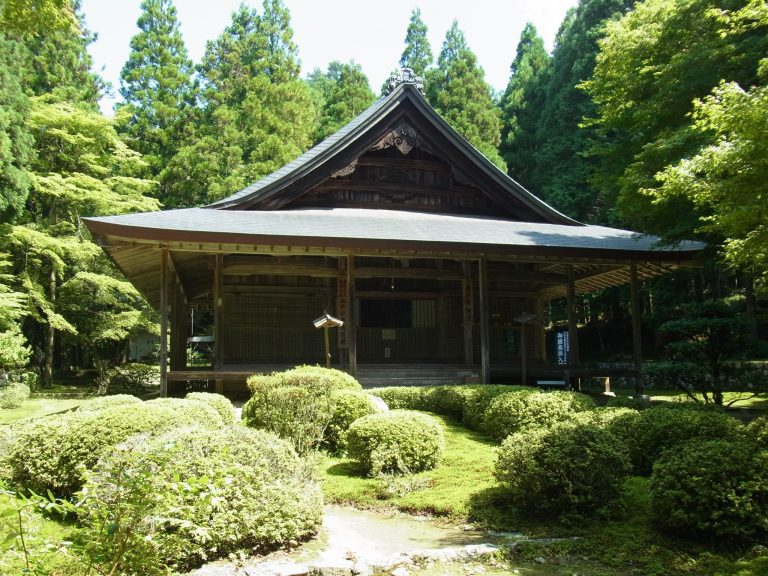
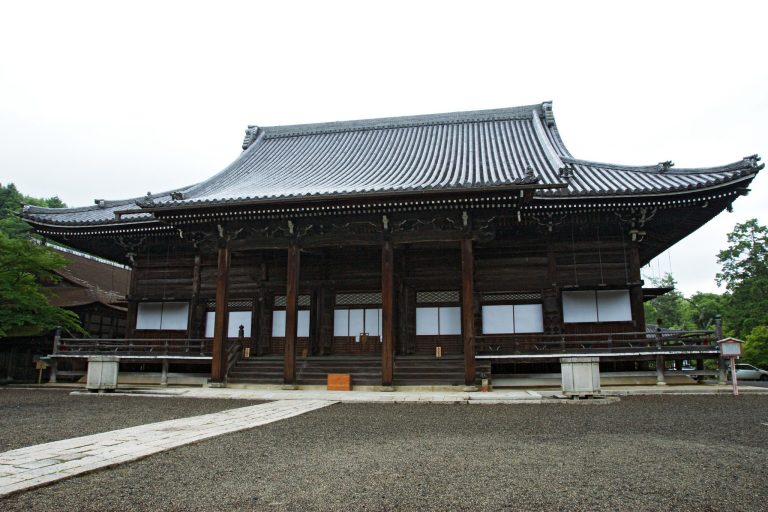
Ojo Gokuraku-in is a single-story hall measuring four bays by three bays. Its hip-and-gable roof combines sloping roof planes with triangular gabled ends, and its gabled side faces the front. An entrance opens through the gable end, with a one-bay projecting porch and shingle roofing. The hall underwent major repairs in 1616, after which most of its exterior was replaced with Edo-period fabric. It is an Important Cultural Property.
Inside, a ship-bottom ceiling has a boarded, concave form that rises toward the center like the underside of a boat. The space is filled by an Amida triad, whose central Amida image measures 2.3 meters in height. The triad is the hall’s principal image and was designated a National Treasure in 2002.
The central Amida makes the welcoming hand gesture associated with receiving the dead into the Pure Land, the western paradise of Amida. Kannon, the embodiment of compassion, appears on the viewer’s right and places a deceased person on a lotus pedestal. Seishi, who embodies wisdom, stands on the viewer’s left with hands joined in prayer. Both attendants kneel in the forward-leaning posture called Yamato-zuwari.
Vivid paintings of heavenly maidens and bodhisattvas in the Pure Land decorate the ceiling. Reconstructed copies are exhibited in Ennyuzo. A path from Ojo Gokuraku-in leads toward the rear buildings, including Konshiki Fudo Hall and, farther uphill, Kannon Hall.
Connected halls and collections
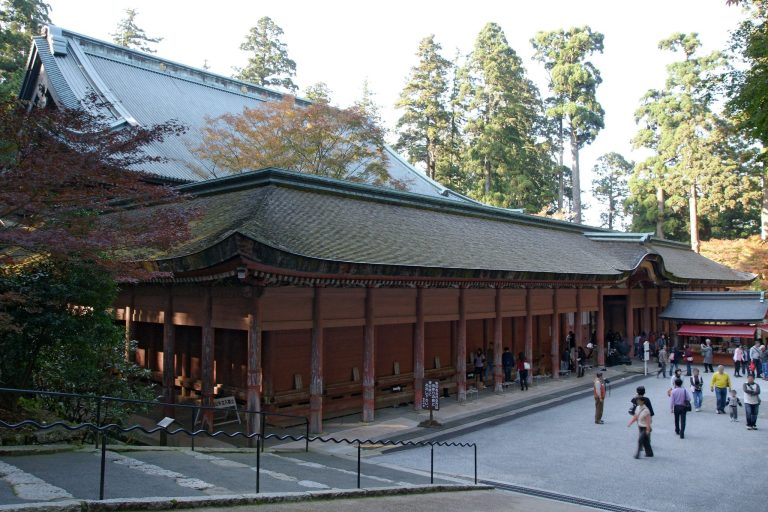
Kyakuden and Shinden are connected buildings surrounded by gardens. Kyakuden contains Japanese calligraphy and paintings on sliding screens and opens onto Shuheki-en. From Shinden, Ojo Gokuraku-in is seen across a moss garden through maple and cedar trees. Shinden contains three Buddhist images, with Amida as the central figure and Kannon and Fudo Myoo as attendants.
Ennyuzo preserves the Ennyuzo manuscript and document collection, which spans the Heian through Edo periods and contains 8,371 items. The collection is an Important Cultural Property. Together with the halls, gardens, images, ritual spaces, and manuscript holdings, it reflects the long development of the Kajii Monzeki institution at its present Ohara residence.