Enryaku-ji Temple: Head Temple of Japanese Tendai Buddhism


Site at a Glance
- Rating
- 4.4
- Popularity
- Medium
- Country
- Japan
- Primary era
- Early Modern
- External website
- Open
- Eras represented
- Classical, Medieval, Early Modern, Modern
- Civilizations
- Ashikaga shogunate, Japanese, Tokugawa, Toyotomi regime
- Site type
- Religious
- Remains
- Monastery
On this page32 sections
History
Enryaku-ji Temple, in Otsu, Japan, is the head temple of the Tendai school of Buddhism, founded on Mount Hiei by the monk Saicho in 788 during the early Heian period. Its formal name is Hieizan Enryaku-ji, and its principal object of worship is Bhaisajyaguru, the Buddha associated with healing and medicine. The monastery developed into a major centre of Japanese Buddhism and is now part of the UNESCO World Heritage property Historic Monuments of Ancient Kyoto.
Saicho and the foundation of Tendai
Mount Hiei was associated with mountain worship before the Buddhist complex was established. Hiyoshi Taisha, at the eastern foot of the mountain, enshrined Oyamakui-no-kami, the mountain’s tutelary deity. Tradition also holds that Saicho brought a manifestation of Ommononushi-no-kami from Mount Miwa and established it on Mount Hiei.
Saicho was born in the Sakamoto area in 766 or 767. He entered religious life at 15, received full monastic precepts at Todai-ji in Nara in 785, and withdrew to Mount Hiei that same year for study and practice. He regarded the Lotus Sutra as the highest Buddhist teaching. In 788, he founded a small monastery called Ichijo Shikan-in in the northern valley of the present Todo area. Its buildings included a hall for Yakushi, a hall for Manjusri, and a scripture repository. This institution formed the beginning of Enryaku-ji, which was initially also known as Hieizan-ji or Hieizan-dera.
Saicho travelled to Tang China in 804 as a short-term student. He studied Tiantai doctrine, the Chinese tradition on which Japanese Tendai was based, together with Mahayana bodhisattva precepts, esoteric Buddhism, and Zen meditation. He returned to Japan in 805 and established a Japanese Tendai tradition combining these four teachings. Tendai is a Mahayana school centred especially on the Lotus Sutra, while also incorporating meditation, esoteric ritual, monastic precepts, and Pure Land practices.
Imperial support and institutional independence
With support from Emperor Kanmu and the Wake family, the monastery became associated with the protection of Heian-kyo, the imperial capital, particularly against dangers believed to come from the northeast. In 807, Saicho ordained 100 disciples. They were expected to remain in seclusion on Mount Hiei for 12 years of study and meditation.
Saicho’s principal unfinished objective was the creation of a Mahayana ordination platform. Permission was granted seven days after his death in 822, allowing Tendai monks to receive the Perfect and Sudden Mahayana precepts independently of the older Buddhist institutions of Nara. In 823, the monastery received the imperial plaque bearing the name Enryaku-ji. Gishin became the first holder of the office later known as the Tendai chief abbot. In 833, Gishin and Ennin obtained imperial permission to conduct independent ordinations, further consolidating the school’s institutional independence.
Expansion during the Heian period
During the Heian period, Enryaku-ji became a major centre of Japanese Buddhism alongside Kongobu-ji on Mount Koya. It taught Lotus Sutra doctrine, esoteric Buddhism, Zen meditation, and Pure Land practice, and received support from the imperial family and aristocracy. Its esoteric tradition later became known as Taimitsu, distinguishing it from the To-mitsu tradition associated with Shingon Buddhism.
The institution expanded into a large monastic network known as the Three Pagodas and Sixteen Valleys. About 150 halls and pagodas survive within the wider complex, while its greatest extent is said to have included more than 3,000 subordinate temples and monastic establishments. Ennin established the Yokawa area and built Yokawa Chudo in the ninth century. Another tradition places the foundation of the Yokawa complex in his Shuryogon-in of 850. Encho, the second chief abbot, was associated with the development of the Saito area. By about the tenth century, the basic three-area organization of Enryaku-ji had taken shape.
Rivalry with Mii-dera
After the deaths of Ennin and Enchin, their followers became bitter rivals. In 993, the Ennin faction destroyed buildings associated with Enchin and expelled about 1,000 of his followers. The Enchin faction moved to Onjo-ji, also called Mii-dera, a former subsidiary temple of Enryaku-ji. This division produced the rival Sanmon, or Mountain Order, centred on Enryaku-ji, and Jimon, or Temple Order, centred on Mii-dera.
The rivalry repeatedly became violent. Enryaku-ji attacks and fires destroyed Mii-dera on numerous occasions, including seven large-scale burnings by the end of the medieval period and approximately 50 attacks when smaller incidents are included. Within Enryaku-ji, Ryogen, also known as Ganzan Daishi and Jie Daishi, was regarded as a restorer of the institution. He rebuilt halls destroyed by fire, strengthened monastic discipline, and promoted scholarship. Other major religious figures associated with the monastery included Genshin, author of Essentials for Rebirth, and Ryonin, founder of the Yuzu Nembutsu school.
Enryaku-ji trained many later founders of Japanese Buddhist schools, including Honen of Jodo-shu, Shinran of Jodo Shinshu, Eisai of Rinzai Zen, Dogen of Soto Zen, Nichiren, and Ryonin. This long connection with later Buddhist movements led to the description of Enryaku-ji as the “mother mountain of Japanese Buddhism.”
Political and military power
From the late Heian period, Enryaku-ji acquired substantial political, economic, and military power. Its warrior monks, or sohei, were armed religious forces associated with powerful medieval institutions. They used the shrine palanquins of the Hiyoshi shrine in forceful petitions to the court and other rulers. Enryaku-ji controlled extensive resources and was often treated as a semi-independent religious power.
In 1191, the monks demanded punishment for Sasaki Tsunetsuna, a leading supporter of the Kamakura shogunate. Minamoto no Yoritomo ultimately yielded and ordered Sasaki’s exile. In 1336, Emperor Go-Daigo took refuge at Enryaku-ji while opposing Ashikaga Takauji, and the monastery supported the imperial side.
Ashikaga Yoshinori, the sixth shogun of the Muromachi shogunate and a former Tendai chief abbot, attempted to suppress Enryaku-ji. In 1435, he had leading monks executed. Other monks barricaded themselves in Konponchudo, and several set fire to the hall and died by self-immolation. The fire destroyed or badly damaged several buildings and almost all of the images regarded as principal icons since Enchin’s time. Yoshinori ordered Konponchudo rebuilt later that year. The work was completed within several years through taxation imposed across the provinces. In 1450, a new principal image was carved from fragments of the surviving image and installed in the hall.
In 1499, Hosokawa Masamoto attacked Enryaku-ji through his commander Akazawa Tomotsune. The resulting fire destroyed major buildings in the mountain complex, including Konponchudo, Daikodo, Jogyodo, Hokkedo, Enmeiin, Shi-o-in, the scripture repository, and the bell tower.
The destruction of 1571
During the conflict between Oda Nobunaga and the Asai and Asakura families, Enryaku-ji sheltered troops allied with Nobunaga’s opponents. After the monastery rejected repeated demands for neutrality, Nobunaga placed his headquarters at Mii-dera and attacked Mount Hiei on September 12, 1571. The assault burned the buildings of Enryaku-ji and Hiyoshi Taisha and killed many monks and warrior monks. Archaeological evidence has also led to the interpretation that destruction on the summit may have been concentrated mainly on Konponchudo and Daikodo.
A related tradition holds that Kakujo, the 166th chief abbot and brother of Emperor Ogimachi, was forced to leave for Kai Province, where Takeda Shingen protected him. Enryaku-ji remained without a chief abbot for 11 years after the destruction.
Reconstruction and the Edo period
After Nobunaga’s death in 1582, Prince Soncho of Shoren-in promoted the restoration of Enryaku-ji. Hashiba Hideyoshi authorized reconstruction in 1584, and Tendai monks organized the work. Emperor Ogimachi also solicited contributions from provincial lords. Reconstruction of the Todo Konponchudo began in 1585 and was completed in 1589. The perpetual ritual flame was rekindled with fire transferred from Risshaku-ji, also called Yamadera, in Yamagata.
Yokawa Chudo was rebuilt during the Tensho era and remodeled in 1604 by Yodo-dono. In 1595, the former main hall of Mii-dera was transferred to Enryaku-ji and became the Shakado in the Saito area. Hideyoshi granted Enryaku-ji an estate of 1,573 koku, a historical unit used to assess agricultural income. Tokugawa Ieyasu later granted a further 3,427 koku, producing a combined estate of 5,000 koku. Under the monk Tenkai, reconstruction continued during the early Edo period.
Tenkai founded Kanei-ji in Edo in 1625 to protect the shogunal capital from the northeast, and administrative authority within the Tendai school temporarily shifted toward that temple. Tokugawa Iemitsu nevertheless ordered a major reconstruction of Konponchudo, carried out from 1634 to 1642.
Separation of Buddhism and Shinto
In the late seventeenth century, Enryaku-ji and Hiyoshi Taisha disputed the status of syncretic worship and Sanno Shinto, a tradition combining Buddhist and Shinto beliefs centred on the mountain deity. Hiyoshi Taisha lost the dispute in 1684, and in 1685 Enryaku-ji ordered it to continue observing Sanno Shinto.
The 1868 policy separating Buddhism and Shinto made Hiyoshi Taisha, formerly Enryaku-ji’s guardian shrine, independent. Buddhist images and ritual implements were discarded there, contributing to the wider anti-Buddhist movement known as Haibutsu Kishaku. After Kanei-ji was severely damaged in the 1868 Ueno War, Enryaku-ji again assumed the Tendai school’s central administrative role and recovered its status as the school’s head temple.
Modern damage, heritage, and practice
A typhoon on September 21, 1934, caused the monastery headquarters, Monju-ro, Mudo-ji, Daijoshi, and lodgings at the foot of the mountain to collapse. Many old trees were also blown down. Repairs to Konponchudo and other halls began in 1937. Lightning caused a fire on July 30, 1942, destroying one building and one craft object. On October 11, 1956, arson destroyed Daikodo, the bell platform, and other halls, along with 21 Buddhist images, including an image of Amitabha.
In 1987, the Hieizan Religious Summit brought religious leaders from around the world to Mount Hiei for the monastery’s 1,200th anniversary. An annual Prayer for World Religious Peace subsequently continued there. Enryaku-ji became part of the UNESCO World Heritage property Historic Monuments of Ancient Kyoto in 1994, a property that includes Kyoto, Uji, and Otsu. In 2015, it also became a component of the Japan Heritage property Lake Biwa and Its Waterside Landscapes: Water Heritage of Prayer and Life.
A large construction-soil disposal problem developed beside the Enryaku-ji cemetery after 2004. Repeated soil collapses caused injuries and increased risks to worshippers. A 2014 pollution-mediation settlement provided for government-enforced slope stabilization and water-quality monitoring. The monastery continues demanding forms of training, including 12 years of mountain residence and the thousand-day circumambulation practice. In this discipline, monks walk through the mountain precincts for a total of 1,000 days over seven years. A practitioner who completes the associated ordeal is called an Ajari of the Living Fudo Myoo, and one who completes the full course receives the title Hokurei Great Practice Grand Ajari.
Remains
Enryaku-ji extends across Mount Hiei, whose summit reaches approximately 848 metres, from the mountain to its eastern foothills. The principal areas are Todo, Saito, and Yokawa, collectively called the Three Pagodas. The wider organization is known as the Three Pagodas, Sixteen Valleys, and Two Detached Areas. Todo, the birthplace of the monastery, is centred on Konponchudo. Saito lies about 1 kilometre north of Todo and is centred on Shakado, while Yokawa lies about 4 kilometres north of Saito and is centred on Yokawa Chudo. At the eastern foot of the mountain, Sakamoto contains the headquarters temple Shigain and numerous satobo, or foothill residences.
Todo and the central halls
Konponchudo
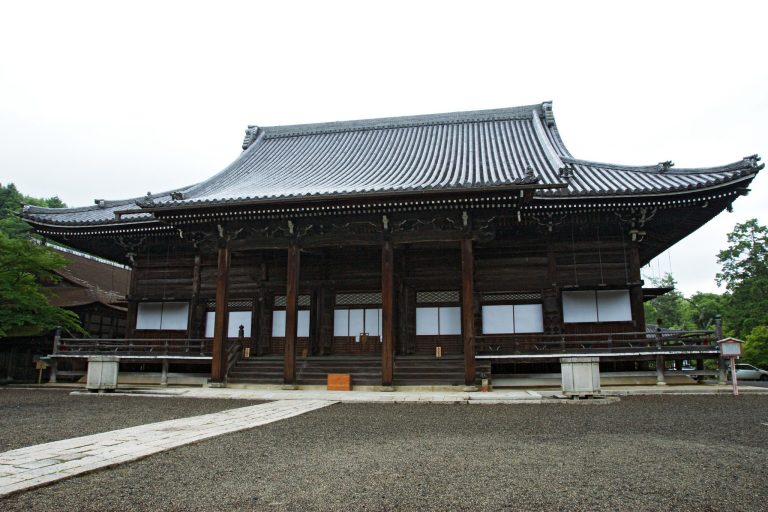
Konponchudo is the principal hall of Enryaku-ji and stands on the site of Saicho’s original Yakushi hall. The original Yakushi hall, Manjusri hall, and scripture repository were gradually rebuilt, enlarged, and united into the present central hall. The current building was reconstructed under Tokugawa Iemitsu between 1634 and 1642 and is made entirely of zelkova wood. With its inner court and southern gallery, it forms a structure in the Shinden-zukuri style.
The hall has three interior parts. The innermost and most sacred area is paved with stone and lies about 3 metres below the other areas. This arrangement places the image of Bhaisajyaguru at approximately the eye level of worshippers in the middle area. The central bridge is decorated with flowers painted in natural colours. The principal image, traditionally attributed to Saicho, is Bhaisajyaguru. A lamp in front of it is traditionally said to have been lit by Saicho and kept continuously burning for more than 1,200 years. After the hall’s destruction and rebuilding, the flame was relit from one brought from Risshaku-ji.
Monju-ro
Monju-ro is a two-storey gate-like building east of Konponchudo. Steep stairways run inside both sides, one leading upward and the other downward, while the upper floor contains an altar with an image of Manjusri, the bodhisattva associated with wisdom. The original gate was built in 866 and burned in February 1668. It was rebuilt soon afterward, although the present structure is smaller and less elaborately decorated than its predecessor.
Daikodo
Daikodo stands west of Konponchudo with its facade facing south. Gishin erected the first building on this site in 824. The building of 1634 burned in 1956, and the present hall was transferred in 1964 from Hiyoshi Toshogu at Sakamoto, where it had originally stood. An inscription found during the transfer confirmed the foundation date of the earlier hall.
Daikodo’s principal image is Vairocana. Portraits of major monks who studied at Enryaku-ji and later founded or led Buddhist traditions are also kept there, including Nichiren, Dogen, Eisai, Enchin, Honen, Shinran, Ryonin, and Shinsei. The building functions as a venue for ceremonies and religious meetings.
Kaidan-in
Kaidan-in stands north of the road between Daikodo and Amida-do and faces south. Emperor Saga ordered the original ordination hall shortly after Saicho’s death. Built under Gishin, it was completed in 828. The present building dates from 1678 and stands on a substantial stone foundation. Its plan is three bays by three bays, although the lower exterior appears to contain five bays. Inside are a stone altar and images of Shakyamuni, Manjusri, and Maitreya.
Hokke Soj-in pagoda
The eastern pagoda of the Hokke Soj-in was originally built by Ennin in 862 and modelled on Qinglong Temple in Chang’an. It burned in 970, 1323, and 1435, was destroyed by Nobunaga in 1571, and remained unrestored for more than 400 years. The present tahoto, a Japanese pagoda with a square lower section and rounded upper section, was built in 1980. Its lower level is dedicated to Vairocana, while the upper level represents a stupa and contains 1,000 manuscripts of the Lotus Sutra.
Amida-do and the bell tower
Amida-do was built in 1937 for the 1,150th anniversary of Enryaku-ji. Its principal image of Amitabha was made by the sculptor Koseki Naito. The hall is used for Tendai merit-transfer ceremonies and rites held during the Higan and Obon observances. A purification basin and a small garden with a water-filled musical feature called a suikinkutsu stand at its entrance.
The bell tower in front of Amida-do was originally built at the foot of Mount Hiei and transferred with Daikodo. It is designated as a cultural property of Shiga Prefecture.
Jodo-in
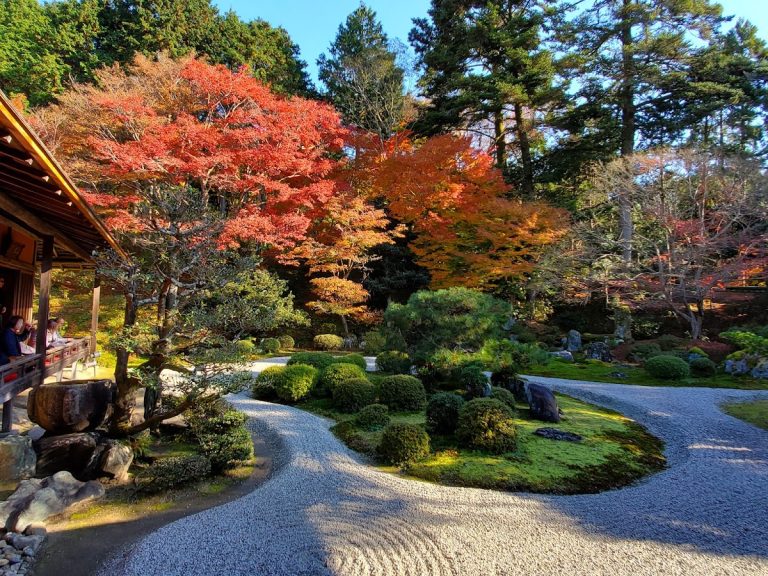
Jodo-in lies about 15 minutes from Konponchudo and contains Saicho’s tomb. Its original building was erected in 854 by Enshin after the model of Zhulin Temple on Mount Wutai in China. The complex includes a dry garden whose gravel is maintained as part of monastic training. Jodo-in also serves as the place where monks undertake the 12-year period of mountain residence and training.
Saito and its surviving buildings
Shakado
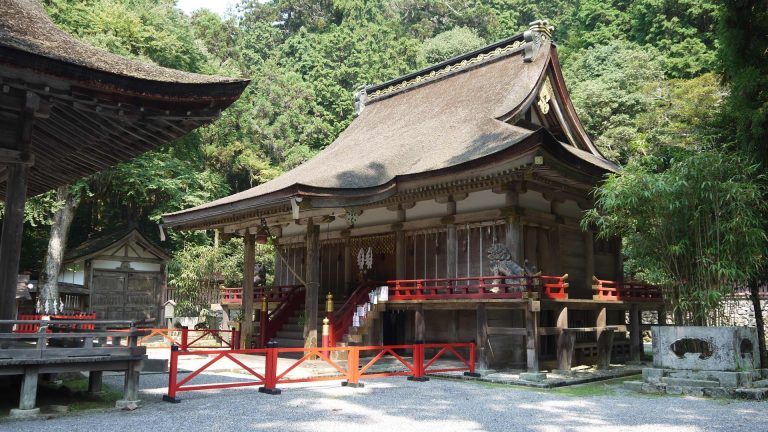
Saito’s principal building is Tenporindo, commonly called Shakado. It was originally built at Mii-dera in 1347 as the Mirokudo, dismantled and transferred to Enryaku-ji in 1595 on Hideyoshi’s orders. It is the oldest surviving building in the complex. The earlier Saito hall was destroyed in a later fire.
Shakado contains a principal image of Shakyamuni traditionally attributed to Saicho. Its structural frame divides the building into seven bays by seven bays. A bay, or ken, is the interval between structural posts. The interior has a public outer section measuring two by seven bays and an inner five-by-seven-bay section reserved for monks and containing the principal image.
Ninaido
Ninaido is the shared name for Jogyodo and Hokkedo, two similar buildings that face south and are joined by a covered gallery. Ennin erected the original buildings in 851. Nobunaga destroyed them in 1571, and they were rebuilt in 1595. A later legend associates the pair with the warrior monk Benkei, who was said to have lifted both halls by using the gallery as a lever.
Jogyodo, the right-hand building, enshrines Amitabha and is used for continuous-walking meditation lasting 90 days while practitioners recite the nembutsu. Hokkedo, on the left, enshrines Samantabhadra, the bodhisattva associated with practice and vows, and is used for meditation centred on recitation of the Lotus Sutra.
Eryodo
Eryodo was built in the early Edo period and is dedicated to the monk Eryo, a member of Ennin’s line known for mastery of both esoteric and exoteric Buddhist practices.
Rurido
Rurido is the oldest surviving building in the monastery and the only existing building said to have escaped Nobunaga’s destruction of 1571. Its construction date is uncertain, although it existed by the Muromachi period and may be as early as the thirteenth century. Repeated repairs have left mainly the architectural form of the original structure. The square building has a three-by-three-bay plan, an irimoya roof combining a hipped roof with gabled ends, and an image of Bhaisajyaguru.
Tsubakido
Tsubakido is a small building south of and in front of Ninaido. It enshrines Senju Kannon, the thousand-armed form of Avalokiteshvara, the bodhisattva associated with compassion. Its name reflects a tradition that Prince Shotoku planted a camellia staff on Mount Hiei, where it took root. Camellias grow around the building. A Kannon temple associated with Prince Shotoku existed by the Kamakura period, although the present building’s construction date is unknown.
Seiryu-ji
Seiryu-ji in Kurodani lies about 1.5 kilometres from Shakado. Although it belongs to the Tendai school, Chion-in of the Jodo-shu school manages it. Ryogen established the original building, which Nobunaga destroyed in 1571. Chion-in monks reconstructed the present building in 1967. It enshrines Amitabha and is used to introduce young monks to Nembutsu practice. The site is also associated with Honen’s religious training.
Two images formerly associated with Seiryu-ji, a ninth-century image of Vimalakirti and an image of Ryogen, are preserved in the Enryaku-ji treasure hall.
Yokawa and the mountain practice areas
Yokawa Chudo
Yokawa Chudo is the main hall of Yokawa and enshrines Avalokiteshvara. The original building was destroyed by lightning in 1942, and the present hall was reconstructed on a reinforced-concrete foundation.
Eshin-in
Eshin-in, also called Eshin-do, is associated with Genshin and his practice of Nenbutsu meditation.
Shikikodo
Shikikodo, also called Ganzan Daishi-do, was built in 967 on the orders of Emperor Murakami for public Lotus Sutra lectures held four times a year. Emperor Go-Mizunoo ordered the present building reconstructed in 1652. It has a square plan, a central altar, and meditation spaces for hermit monks on both sides.
Mudo-ji
Mudo-ji in Mudojidani was founded in 865 by the monk Soo, who established the kaihogyo practice. This ascetic discipline involves repeated circumambulation of Mount Hiei and surrounding mountain routes. Mudo-ji is dedicated to Acala and Sarasvati and serves as the starting point for the thousand-day mountain circumambulation.
Objects and associated precincts
Associated treasures include a gilt-bronze scripture case excavated at Yokawa, a lacquer scripture case decorated with floral designs, Saicho’s imported Tang-period robes, manuscripts and catalogues he brought back from China, and the handwritten Annual Origins of the Tendai Lotus School. Together these objects relate to the monastery’s early Chinese connections, doctrine, and material culture.
The monastery’s associated buildings include the Great Lecture Hall, the ordination hall, Shakado, Konponchudo, and other halls and pagodas. Designated sculptural works include images of Shakyamuni, Avalokiteshvara, Yakushi, the Four Heavenly Kings, Acala, the wisdom kings, Senju Kannon, Vimalakirti, Ryogen, Amitabha, and other Buddhist figures. Buildings and residences managed by affiliated institutions or other Tendai establishments include the Sakamoto satobo.
A detached precinct at Misaka in Nakatsugawa, Gifu Prefecture, preserves the presumed site of a foundation established by Saicho in 817 and includes a monument commemorating him that was erected in 1958.