Hōkan-ji Temple: Kyoto Zen Temple and Yasaka Pagoda


Site at a Glance
- Rating
- 4.6
- Popularity
- Medium
- Country
- Japan
- Primary era
- Medieval
- Eras represented
- Medieval
- Civilizations
- Ashikaga shogunate, Yamato
- Site type
- Religious
- Remains
- Temple
On this page9 sections
History
Hōkan-ji Temple is a Rinzai Zen temple in Kyoto, Japan, whose origins reach the seventh century, before Kyoto became the imperial capital. Formally known as Reiōzan Hōkan Zenji, it belongs to the Kennin-ji branch, and its principal religious images are the Five Wisdom Buddhas, a group representing transformed aspects of wisdom in esoteric Buddhism.
Early origins and Yasaka-dera
Tradition attributes the temple’s foundation to Prince Shotoku, an imperial prince associated with the promotion of Buddhism and the establishment of early Buddhist institutions in Japan. According to this tradition, he received a revelation in a dream from Nyoirin Kannon, a form of Avalokiteshvara associated with compassion and wish fulfillment, then built a pagoda and enshrined Buddhist relics. The traditional foundation date is 589, although the medieval records supporting the story are of uncertain reliability.
Archaeological investigations in 2009 confirmed that the temple began before Kyoto was established as the imperial capital. The dates of excavated roof tiles make a foundation during the reign of Emperor Tenmu, in the late seventh century, a strong possibility. A date around 678 and a foundation during Prince Shotoku’s lifetime remain competing interpretations.
One leading interpretation connects the temple’s early development with members of a Goguryeo immigrant clan. Goguryeo was an ancient Korean state, and the clan was a continental-origin lineage that settled in Japan and became associated with the Yasaka area. During the Heian period, it developed into the Yasaka miyatsuko lineage, a hereditary local clan office or title. The temple’s original plan remains unknown, and proposed comparisons with Shitennoji- and Horyuji-style layouts have not been resolved.
The name Yasaka-dera first appears in written records in 837. The Engishiki, a Heian-period administrative and ritual compendium, lists the temple among fifteen receiving iris offerings and seven receiving funds for Bon observances. These provisions placed Yasaka-dera among temples receiving treatment comparable to that given to officially supported institutions.
Zen re-establishment and repeated rebuilding
The temple later declined, until Saiō Shōkyū, the eighth head priest of Kennin-ji, revitalized it in 1240. He re-established it as a Zen temple affiliated with the Kennin-ji branch, and the name Hōkan-ji dates from this phase.
The pagoda was repeatedly destroyed and rebuilt. A conflict involving Kiyomizu-dera and Gion Shrine caused a fire in 1179, and the pagoda was rebuilt in 1191 with support from Minamoto no Yoritomo. Lightning destroyed it again in 1291, after which it was rebuilt in 1309 with assistance from Emperor Go-Uda.
A major fire in the Higashiyama area destroyed the pagoda in 1436. The present tower was rebuilt in 1440 with support from Ashikaga Yoshinori, the sixth shogun of the Muromachi shogunate. It was the only building in the precinct rebuilt at that time.
Rishōtō and later traditions
From 1338, Ashikaga Takauji established Ankokuji temples and Rishōtō pagodas throughout Japan at the recommendation of the Zen monk Musō Soseki. Ankokuji temples and Rishōtō pagodas formed part of a nationwide religious and political program. Hōkan-ji’s pagoda served as Kyoto’s Rishōtō, a pagoda intended to promote Buddhist welfare and protect the realm, and Buddhist relics were enshrined there.
During the Sengoku period, an era of prolonged warfare among competing regional powers, warlords reportedly announced their seizure of power by displaying banners bearing their family crests on the pagoda. Ōshima Mitsuyoshi is also said to have shot ten arrows into its windows on the orders of Toyotomi Hidetsugu.
In the Heian period, the temple boundary adjoined a training hall called Yasaka Toin, later also known as Unkyō-ji. A tradition preserved in the Genkō Shakusho states that the monk Jōzō used ritual empowerment in 948 to restore the leaning body of the Yasaka-dera pagoda.
Kyoto City designates the precinct a historic site. The pagoda and a hand-colored paper painting depicting Yasaka Pagoda are Important Cultural Properties, while Taishi-do and Yakushi-do are designated tangible cultural properties by Kyoto City.
Remains
Pagoda
Hōkan-ji stands on a plateau at the western foot of the Higashiyama hills. Its present precinct is small, with the five-story pagoda forming its principal landmark. Popularly called the Yasaka Tower, the existing pagoda dates from 1440 and rises approximately 46 meters. It has a pure Japanese-style design and a tiled roof, and is among Japan’s tallest pagodas, surpassed in height by those at Tō-ji and Kōfuku-ji.
The tower continues to use a central foundation stone believed to be the original. Beneath it is an underground foundation stone for the central pillar, a feature characteristic of ancient temple architecture. Its survival suggests that successive pagodas were rebuilt on the same tower site from the temple’s foundation onward.
The first story houses the Five Wisdom Buddhas, with Dainichi Nyorai, the central cosmic buddha in this arrangement, at the center. A projecting veranda and balustrade occur only at the fifth story, creating an unusual arrangement within the tower.
Early archaeological evidence
Excavated seventh-century molded Buddhist objects, foundation stones, and ancient roof tiles provide physical evidence for the early temple. These remains support the view that Buddhist activity at the site began before Kyoto became the imperial capital, while the original arrangement of its buildings remains unresolved.
Religious buildings
Yakushi-do, the hall dedicated to Yakushi Nyorai, the Buddha of healing, houses Yakushi Nyorai together with the bodhisattvas Nikko and Gakko, associated respectively with sunlight and moonlight. The hall also contains a Jizo image associated with dreams and images of the Twelve Heavenly Generals.
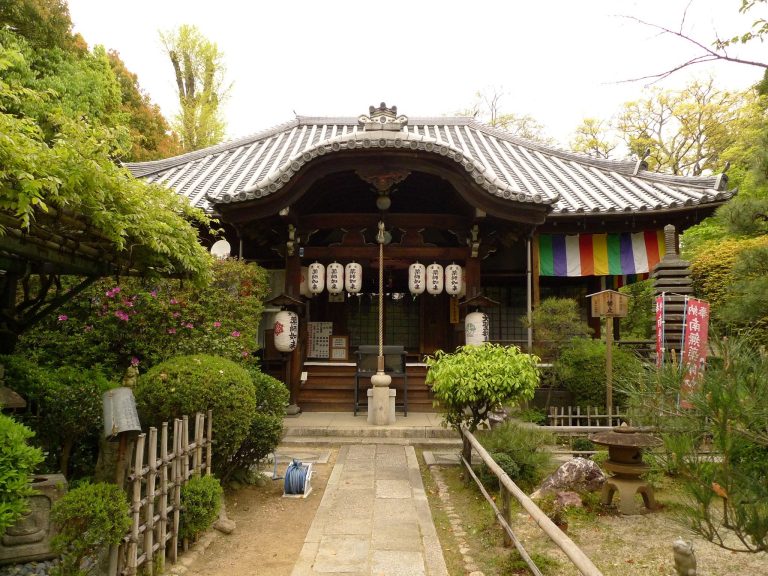
Taishi-do, the hall dedicated to Prince Shotoku, contains images of him at the ages of three and sixteen. Yasaka Inari Shrine serves as the temple’s guardian shrine and enshrines Yasaka Inari Sonten. The tea room Chotaku-an takes its name from the sound of wind bells suspended from the pagoda.
Precinct features and setting
The precinct also contains a traditional burial mound for Kiso Yoshinaka, known as Asahi-zuka. The mound is said to have been moved there from a location in front of a nearby inn. A grave associated with the Fujiwara family, along with a temple kitchen and residential service building, also forms part of the surviving precinct.
Hōkan-ji lies approximately midway along the roughly one-kilometer route between Yasaka Shrine and Kiyomizu-dera. The road known as Yasaka-dori passes alongside the precinct, which occupies the western foothill edge of the Higashiyama area.