Jōman-ji Temple: A Jōdo Buddhist Temple in Inuyama, Japan


Site at a Glance
- Rating
- 4
- Popularity
- Very Low
- Country
- Japan
- Primary era
- Early Modern
- External website
- Open
- Eras represented
- Early Modern, Modern
- Civilizations
- Tokugawa
- Site type
- Religious
- Remains
- Monastery
On this page9 sections
History
Jōman-ji Temple is a Jōdo Buddhist temple in Inuyama, Japan, traditionally founded in 1291. Jōdo Buddhism is a Japanese tradition centered on devotion to Amitabha Buddha and the hope of rebirth in his Pure Land. The temple belongs to the Seizan Zenrinji branch of Jōdo Buddhism, and its principal image is Amitabha, the Buddha of Infinite Light associated with the western Pure Land.
Foundation and Names
According to tradition, the founding monk spent seven days and seven nights in a prayer retreat at Zenkoji in Shinshu. A revelation then instructed him to teach the people of the Inuyama area. The temple’s mountain name is translated as “Sun-Wheel Mountain,” while the names of the mountain and temple are linked to the founder’s words, “May the sun always be full.”
Edo-Period Buildings
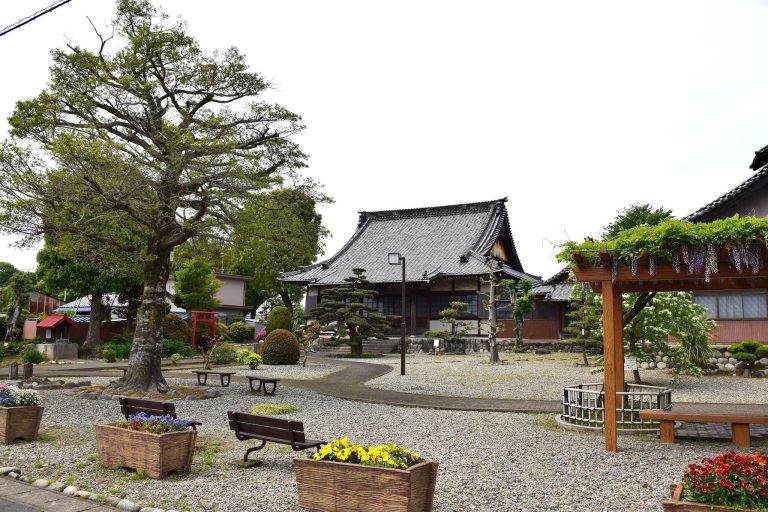
The main hall was built in 1596 through a donation from a wealthy local resident. Its roof was retiled in 1729, followed by further repairs in 1816. The Kannon Hall, an early Edo-period structure, was first moved from Uoyacho in Inuyama’s castle town to Naguricho during the Kan’ei era, from 1624 to 1645, and was relocated again in 1690.
Fire and Heritage Registration
A fire on February 1, 2018, destroyed the main hall, guest hall, monastic quarters, Kannon Hall, Daishi Hall, and entrance. Rebuilding of the main hall, guest hall, and monastic quarters was underway afterward. The main hall, Kannon Hall, Daishi Hall, monastic quarters, and entrance had received registration as tangible cultural properties on December 5, 2007. Their registrations were cancelled on August 27, 2018, after the fire. The bell tower and temple gate remained registered buildings.
The bell tower and gate received national registered tangible cultural-property status in 2007. Measurement drawings of the gate were being prepared with cooperation from the Nagoya Institute of Technology as part of research on the temple’s cultural properties.
Remains
The surviving architectural remains include the bell tower and the temple gate, both retained as registered tangible cultural properties. Other documented features of the grounds include camellia trees associated with local religious and horticultural traditions.
Surviving Architectural Features
Bell Tower
The bell tower was built in 1796. Its date is preserved by an inscription on the ornamental ridge-end roof tile, linking the surviving structure directly to the late Edo period.
Temple Gate
The temple gate is a mid-Edo-period gate in the yakui-mon form, a traditional design with one main roof over the central passage and smaller roofs over the side sections. Before reaching Jōman-ji, it served as the rear gate of the Matsuno-maru enclosure at Inuyama Castle. It was moved to the temple in 1877.
Camellia Trees
The temple grounds contain the “Sekido Taroan” camellia, which is said to derive from the “Taroan” camellia of Atsuta Shrine. A wealthy merchant of Owari is associated with its transfer. The grounds also contain the original tree of the “Jōman-ji” camellia, described as a representative cultivar of central Japan.