Nishi Ōtani: A Honganji Mausoleum and Cemetery in Kyoto


Site at a Glance
- Rating
- 4.3
- Popularity
- Medium
- Country
- Japan
- Primary era
- Early Modern
- External website
- Open
- Eras represented
- Early Modern, Modern
- Civilizations
- Japanese, Tokugawa
- Site type
- Religious
- Remains
- Tomb
On this page18 sections
History
Nishi Ōtani is a cemetery and mausoleum in Kyoto, Japan, associated with Honganji, one of the major institutional branches of Jodo Shinshu, a Japanese Buddhist tradition centered on reliance on Amida Buddha. The site preserves the burial place of Shinran, the medieval teacher traditionally regarded as the founder of Jodo Shinshu, and developed from a mausoleum established at Higashiyama Otani in 1272.
Shinran’s burial and the Otani Mausoleum
Shinran died aged 90 on November 28, 1262, at Zenpo-bo, the residence of his younger brother Jinyu in what is now Kakubo. He was cremated the next day at Enninji, traditionally identified with the present cremation site at Nishi Ōtani. His remains were collected and buried at Otani on November 30.
In the winter of 1272, Shinran’s daughter Kakushinni, working with his disciples and followers from eastern Japan, moved the grave from Otani north of Toribeno to land north of Yoshimizu. There they built a hexagonal hall known as the Otani Mausoleum. In 1321, Kakushinni’s grandson Kakunyo converted the mausoleum into a temple and renamed it Honganji, also called Otani Honganji.
Destruction and the Otani Dojo
In 1465, during the leadership of Rennyo, the eighth head of Honganji, monks from Enryakuji’s Western Pagoda attacked and demolished Otani Honganji in the Kanshō Persecution. Enryakuji is a major Tendai Buddhist complex on Mount Hiei near Kyoto. Rennyo fled to Omi Province, while Inoue Ganchi protected Shinran’s mausoleum. A hermitage was built beside it and became known as Otani Dojo.
Rennyo re-established Honganji at Yamashina Honganji in 1483. In 1532, during the Tenbun Disturbance under Honganji’s tenth head, Shonyo, the Otani Dojo, then called the Lower Ikko Hall, was burned by the Lotus League. Yamashina Honganji was later completely destroyed by the combined forces of Hosokawa Harumoto, Rokkaku Sadayori, and the Lotus League.
Yugan, a descendant of Ganchi, restored the Otani Dojo. Honganji moved to Osaka and became Osaka Honganji, while the dojo continued to protect Shinran’s mausoleum. During the conflict between Kennyo, Honganji’s eleventh head, and Oda Nobunaga, the dojo was attacked and burned in 1571 as part of the Ishiyama War, a late-sixteenth-century struggle between Nobunaga and Honganji.
Relocations and the formation of Nishi Ōtani
Osaka Honganji surrendered to Nobunaga in 1580. Kennyo moved the institution successively to Sagimori in Kii Province in 1581, Kaizuka in Izumi Province in 1583, and Tenma in 1585 with the assistance of Toyotomi Hideyoshi. In 1589, Yugan’s wife Myoyu and their son Yusei rebuilt the Otani Dojo. Hideyoshi granted it a seal exempting the property from land-tax payments.
In 1591, Kennyo moved Tenma Honganji to land donated by Hideyoshi at Horikawa-Rokujo in Kyoto, establishing what is now Nishi Honganji. In 1600, Tokugawa Ieyasu ordered the expansion of Chion-in, a major Pure Land Buddhist temple in Kyoto. The Otani Dojo, which stood west of the temple precinct, was dismantled. Yusei moved its halls to Shijo-Tomino-koji on the orders of Kyonyo, who had been forced by Hideyoshi to retire as Honganji’s abbot. The relocated complex became Tokushoji, but Shinran’s mausoleum remained in place.
In 1602, Kyonyo separated from the Honganji branch and founded the Otani branch of Jodo Shinshu, establishing a new Honganji that is now Higashi Honganji. A temporary grave for Shinran and the successive heads of Honganji was constructed there.
In 1603, at the request of Yusei’s brother-in-law Zenryo, Ieyasu granted the Otani Dojo an alternative site on Toribeyama, traditionally identified with the former location of Enninji. Shinran’s mausoleum was moved there, and the place came to be called Otani. Zenryo renamed the hall that had protected the grave from Otani Dojo to Shokyuji. Chion-in established the subtemple Sutai-in on the former dojo site, while a section containing Shinran’s grave was retained there as a historical grave site through the efforts of Chion-in construction official Shoyo Doshin.
A Buddhist hall was added to Shokyuji in 1605. In 1639, the temple became directly affiliated with Nishi Honganji and was later designated a detached precinct, meaning a temple property institutionally linked to a main temple but located elsewhere. It was developed as Shinran’s mausoleum and eventually renamed Nishi Ōtani.
The cemetery and later rebuilding
In 1661, Nishi Honganji authorized burial mounds outside the mausoleum at the request of Saikoji in Kujo. This began Otani Cemetery, and the mausoleum was moved to its present location. A new mausoleum hall followed in 1694, and a plaque reading “Founders’ Altar” was installed in 1698. In 1709, the Meichodo was built beside Shinran’s grave as a worship hall and burial facility. Its plaque, written by Jakunyo, the fourteenth head of Nishi Honganji, was installed in 1716.
A fire that began at the Niten Gate in 1867 destroyed the Buddhist hall and other buildings. The Buddhist hall and bell tower were rebuilt in 1870. The Niten Gate was rebuilt in 1872, then reconstructed again in 1937 after the Muroto Typhoon destroyed it in 1934. The bell tower was repaired in 1957.
Nishi Ōtani offers burial near Shinran’s grave at the Founders’ Altar, institutional or individual interment in the First and Second Muryoju Halls, and grave interment in the cemetery, where cremated remains are placed. The name distinguishes this site as “western Otani” from Otani Sobo, the burial site associated with the Otani branch at Higashi Honganji. Together, the names reflect the separate Nishi Honganji and Higashi Honganji lineages.
Remains
The mausoleum and worship buildings
Founders’ Altar and Meichodo
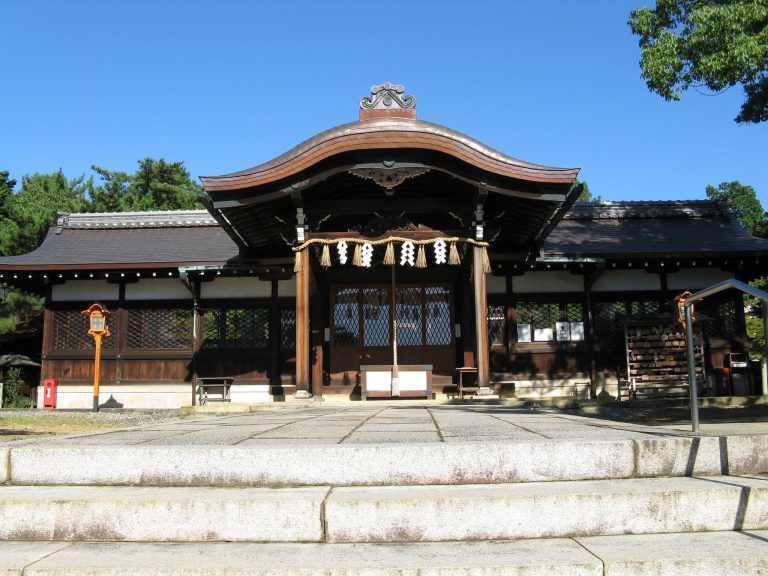
The Founders’ Altar is the mausoleum and burial place of Shinran. Mausoleums for successive heads of Honganji and their wives surround it, together with the burial facility used for interment near Shinran’s grave. Meichodo, built in 1709, serves as the altar’s worship hall and forms part of this interment system. The communal interment cannot later be removed or reburied elsewhere. The hall bears the “Meichodo” plaque written by Jakunyo and installed in 1716.
Buddhist Hall
The Buddhist Hall was rebuilt in 1870 after the 1867 fire. It contains a standing statue of Amida Buddha made by Jakunyo and a plaque reading “Ryukoku-zan,” also written by him. Nishi Ōtani treats the Amida Hall at Nishi Honganji as the main hall of the detached precinct, so this building is designated the Buddhist Hall.
Gates, towers, and associated features
Main Gate and Niten Gate
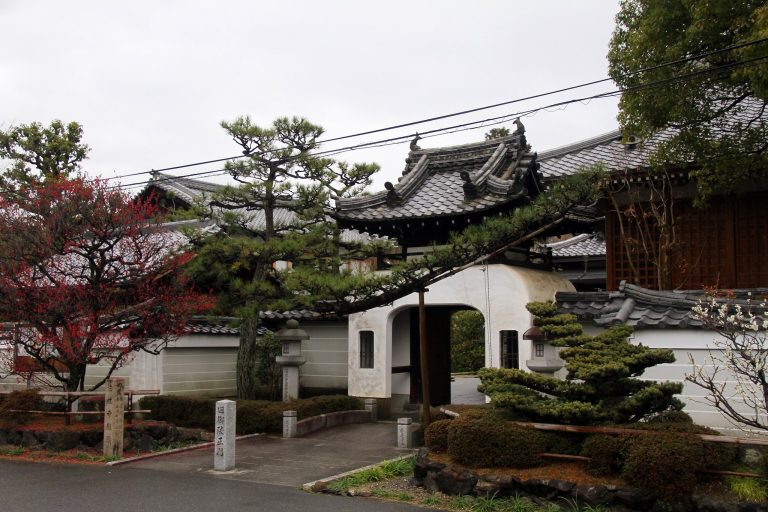
The Main Gate was built in March 1710 in preparation for Shinran’s 450th memorial service. Followers in Settsu Province funded its reconstruction as the present four-legged gate in 1796. Its plaque, reading “Otani Mausoleum,” was written by Kujo Hisatada in September 1860.
The North Gate is another entrance to the precinct. The Niten Gate originally received two guardian statues transferred from Rokudo Chinnoji in 1785. After the gate burned in 1867, the remaining statues, Komokuten and Zochoten, were transferred from the same temple in 1872. The gate collapsed in the 1934 Muroto Typhoon and was rebuilt in December 1937.
Liturgical buildings and bridge
The Reading Sutra Hall and Drum Tower are separate precinct buildings. The Drum Tower was rebuilt in 1870 and repaired in 1957. Entsu Bridge, commonly called the “Spectacles Bridge,” was built in 1856 through a donation from Harimaya Gohei of Osaka.
Stone Cave and Cremation Site
The Stone Cave is traditionally identified as a place where Shinran studied. During the Edo period, it was moved from Sutai-in, the Chion-in subtemple established on the former site of Otani Honganji. The Cremation Site is a detached area traditionally identified with the former Enninji, where Shinran is said to have been cremated.
Interment buildings and cemetery
First and Second Muryoju Halls
The First Muryoju Hall is a ten-story reinforced-concrete building constructed in 1968 for institutional, group, and individual interment in dedicated containers. It connects with the Honbyo Hall on the fifth floor and with the Second Muryoju Hall, Buddhist Hall, Reading Sutra Hall, and Meichodo on the sixth floor.
The Second Muryoju Hall is a seven-story reinforced-concrete building constructed in 1990. Its seventh floor contains a worship hall that can also be used for Buddhist weddings. Together, the First and Second Muryoju Halls contain approximately 32,000 or more burial compartments.
Honbyo Hall and Otani Cemetery
The Honbyo Hall is a building with two floors above ground and two underground floors. It contains the general reception area, shop, tearoom, dining room, large hall, training hall, and underground parking area. Otani Cemetery provides institutional, group, and individual grave interment and contains approximately 13,000 graves.
Landscape feature
Kogetsu Pond
Kogetsu Pond contains ancient Oga lotus plants grown from seeds estimated to be 2,000 years old. The seeds were revived and brought to flowering by the botanist Ichiro Oga.