Shrines and Temples of Nikkō: A Sacred Mountain Complex of Shinto and Buddhism


Site at a Glance
- Rating
- 4.4
- Popularity
- Low
- Country
- Japan
- Primary era
- Early Modern
- Eras represented
- Medieval, Early Modern
- Civilizations
- Tokugawa
- Site type
- Religious
- Remains
- Sanctuary
On this page21 sections
History
Shrines and Temples of Nikkō is a religious and historical complex in Nikkō, Japan, whose earliest buildings date from the eighth century and whose principal structures belong to the Edo period, especially the seventeenth century. The 103 buildings and structures include 23 associated with Futarasan Shrine, 42 with Tōshō-gū, and 38 with Rinnō-ji. Set among wooded mountain slopes, the complex developed through the close association of Buddhism with the worship of local mountain deities.
Origins as a Sacred Mountain Site
The Buddhist monk Shōdō Shōnin founded the institution now known as Rinnō-ji in 766. Tradition also credits him with founding Futarasan Shrine and Chūzen-ji. Nikkō’s remote mountain setting attracted ascetic monks who sought isolation and meditation, and the area became an important center of Shugendō, a mountain-based religious tradition combining Buddhist, Shinto, and other ascetic practices.
Futarasan Shrine preserves an ancient Shinto tradition devoted to Nikkō’s mountains. Its foundation is traditionally placed in the eighth century, and a tenth-century description of the shrines of the former Shimotsuke Province already identified it as the province’s principal shrine and Nikkō’s original shrine. The shrine is dedicated to the kami, or sacred presences in Shinto, Ōkuninushi, Ajisukitakahikone, and Tagorihime. Their associations include national development, agriculture, commerce, medicine, and thunder, while the shrine’s identity remains rooted in the sacred character of the surrounding mountains and forests.
A foundation legend connects Futarasan Shrine with Shinkyō, the Sacred Bridge. In 766, Shōdō Shōnin and his followers were unable to cross the turbulent Daiya River while travelling toward Mount Futarasan to pray for national prosperity. After Shōdō prayed, the deity Jinja Daiyu appeared with a red snake and a blue snake, which formed a bridge across the river. The tradition links this miraculous crossing with the origin of the bridge.
Rinnō-ji and Religious Authority
Rinnō-ji developed as a Tendai Buddhist institution, Tendai being a major school of Japanese Buddhism. It was historically organized into 15 subtemples and became Nikkō’s effective religious power center during the Edo period. It regulated numerous affairs connected with the shrines, and at the height of its authority as many as 500 subtemples were under its control. Its continuing association with monastic practice reflects the earlier attraction of Nikkō’s mountains to religious ascetics.
The Tokugawa Transformation
Tōshō-gū was founded in 1617, during the Edo period, as a shrine dedicated to Tokugawa Ieyasu, the founder and first shogun of the Tokugawa shogunate, the military government that ruled Japan for more than two and a half centuries. Ieyasu died in 1616 and was initially buried on Mount Kunō. In accordance with his wishes, his remains were transferred to Nikkō in 1617 and ceremonially enshrined in the presence of his son, the second shogun Tokugawa Hidetada, together with officials connected with the shogunate and imperial court. The shrine received the name Tōshō-gū in 1645.
The transfer gave Nikkō national importance and made it the spiritual center of the Tokugawa dynasty, which ruled Japan from 1600 to 1867. Ieyasu was worshipped there after death as Tōshō Daigongen, a divine manifestation associated with the protection of the dynasty. Tōshō-gū’s historical conception was influenced by the Tendai monk Tenkai, who prevailed in the debate over Ieyasu’s posthumous divine identity and the location of his mausoleum.
The third shogun, Tokugawa Iemitsu, ordered a near-total rebuilding of Tōshō-gū in 1636, twenty years after Ieyasu’s remains had been transferred to Nikkō. Fifty-five buildings, including Yōmeimon, were completed in one year and five months. Akimoto Yasutomo, governor of Tajima Province, directed the project, while the master carpenter Kōra Munehiro was entrusted with its carpentry and construction. The rebuilding established the elaborate architectural character associated with the complex.
Tōshō-gū remained officially a Shinto shrine, but its buildings and religious formation retained strong Buddhist elements. This combination continued even after the Meiji-period policy that formally separated Shinto and Buddhism. Iemitsu also ordered his own mausoleum at Nikkō. Taiyūinbyō was built in 1653 and became a Buddhist subtemple of nearby Rinnō-ji, incorporating the wider complex’s interwoven religious traditions.
Heritage Protection
Shrines and Temples of Nikkō and its surrounding landscape were inscribed on the UNESCO World Heritage List in 1999 under cultural criteria (i), (iv), and (vi). The designated area covers 50.8 hectares and has a 373.2-hectare buffer zone. The buildings are also protected as a Historic Site, while other parts of the cultural landscape lie within Nikkō National Park. The designation recognizes the complex’s architectural and artistic quality, its relationship with the Tokugawa shogunate, and the continuing religious tradition of the site.
Remains
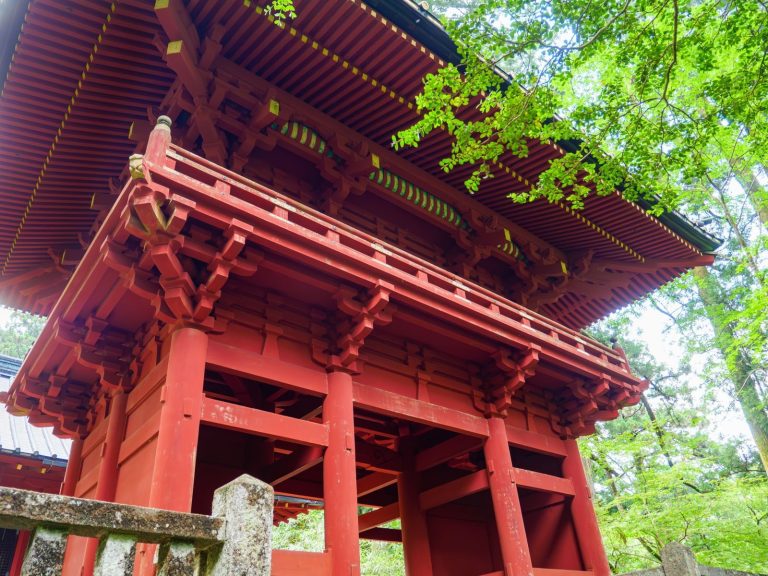
The 103 buildings and structures occupy wooded mountain slopes, where their placement connects shrines and temples with cedar forests and the surrounding mountains. The complex is regarded as an outstanding expression of Edo-period architectural thought applied to both Shinto shrines and Buddhist temples. The Gongen-zukuri style of the Tōshō-gū and Taiyūin mausoleums reached a particularly developed form at Nikkō. Gongen refers to a pre-modern Buddhist-Shinto concept in which a kami is understood as a manifestation of a buddha.
Futarasan Shrine and the Sacred Bridge
Futarasan Shrine
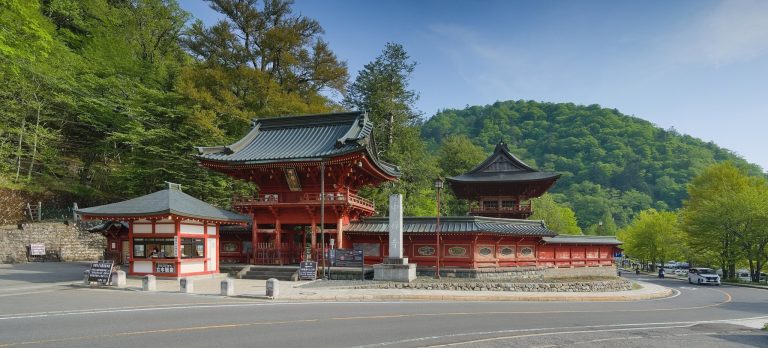
Futarasan Shrine comprises 23 buildings and structures beside Tōshō-gū in central Nikkō. Its mountain-centered religious character is expressed through its association with the three deities Ōkuninushi, Ajisukitakahikone, and Tagorihime. The shrine is also physically connected with Shinkyō, the Sacred Bridge, which stands about one kilometre from the main shrine precinct.
Shinkyō
Shinkyō crosses the Daiya River and measures 28 metres long, 7.4 metres wide, and 10.6 metres above the river. Bridges have been rebuilt repeatedly while retaining the original form, and the structure standing today dates from 1636. It is entirely coated in cinnabar-red lacquer. Historically, it was reserved for high-ranking nobles and occasional ceremonies, and public access began in 1973.
Tōshō-gū
Approach and Pagoda
Tōshō-gū contains 42 buildings and structures. Hundreds of stone steps rise through the cedar forest toward Ieyasu’s mausoleum, and an inscribed torii marks the beginning of the route. The original five-storey pagoda was donated by a daimyō, a powerful feudal lord, in 1650. Fire destroyed it, and it was rebuilt in 1818. Its five levels represent earth, water, fire, wind, and ether, or emptiness.
Carved Decorations
The Sacred Horses’ stable carries a relief of the three wise monkeys, shown seeing no evil, hearing no evil, and speaking no evil. Near the route toward Ieyasu’s Buddhist-style tomb is the sleeping cat, or Nemuri Neko, traditionally attributed to the sculptor Hidari Jingorō and associated with peace. A storehouse bears two grey elephants whose unusual forms have led to their description as imagined elephants, suggesting that the artist reconstructed them without having seen a living example.
Yōmeimon and Karamon
Yōmeimon is the richly decorated gate leading into the central part of Tōshō-gū. Its extensive decoration explains the associated name Higurashimon, meaning “the gate where one spends the whole day.” Dragons, lions, komainu, kirin, elephants, and baku share the gate with human figures, including Confucius and his disciples. Other scenes represent playing the lute, board games, calligraphy, and painting, described as the four accomplishments of a cultivated person. Japanese archers take the place of the more usual Buddhist gate guardians, bringing indigenous, Buddhist, and Chinese imagery together.
One of Yōmeimon’s twelve white-painted supporting columns carries an upside-down monkey-face ornament. Known as the inverted demon-repelling pillar, it embodies an anti-perfection device based on the belief that excessive symmetry or completeness could invite misfortune. Beyond Yōmeimon, the smaller Karamon, or Chinese gate, guards the approach to the innermost area and the Gongen-style shrine buildings.
Inner Sanctuary
The inner sanctuary lies behind the shrine buildings on the mountainside and contains a stupa-shaped tomb associated with Ieyasu’s remains. Tōshō-gū therefore brings together a main shrine where Ieyasu is worshipped as a kami and a separate mausoleum area with strongly Buddhist formal characteristics.
Taiyūinbyō
Gates and Worship Buildings
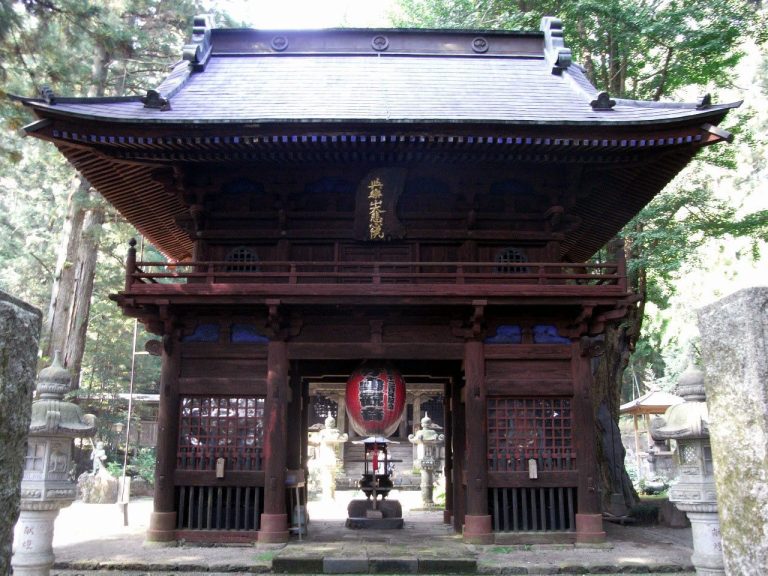
Taiyūinbyō is smaller and more restrained than Tōshō-gū, although its buildings remain densely and richly decorated. The cinnabar-red Niōmon marks its entrance, followed by the more ornate Nitenmon, guarded by two heavenly kings. A drum tower stands to the left beyond the gate and a bell tower to the right.
The worship hall, or haiden, is screened by another Karamon whose principal feature is a celebrated white-dragon sculpture. Inside, gold-lacquered columns and walls support elaborate carvings and a decorated coffered ceiling. The main sanctuary, or honden, stands directly behind the hall and connects to it by a short corridor. It is viewed from outside.
Iemitsu’s Mausoleum
Iemitsu’s mausoleum occupies the innermost part of Taiyūinbyō. Its arrangement and architectural style recall Tōshō-gū, while its smaller scale and more enclosed appearance distinguish it from Ieyasu’s mausoleum. The sanctuary’s name and institutional status identify it as a Buddhist foundation belonging to Rinnō-ji, even as its form reflects the pre-modern combination of Buddhist and Shinto elements.
Rinnō-ji
Sanbutsudō
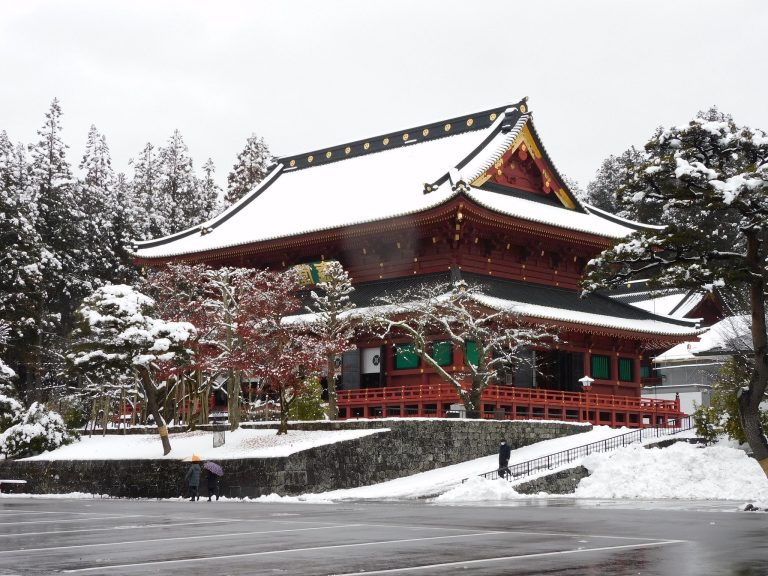
Rinnō-ji’s best-known building is Sanbutsudō, the Hall of the Three Buddhas. It houses three wooden statues more than eight metres high, each finished with gold lacquer. They represent Amida Buddha and two forms of the bodhisattva Kannon, Senju-Kannon, or Thousand-Armed Kannon, and Batō-Kannon, or Horse-Headed Kannon. These figures are regarded as Buddhist manifestations of the mountain kami worshipped at Futarasan Shrine.
Treasury and Shōyōen
The Rinnō-ji treasury stands opposite Sanbutsudō and preserves Buddhist and Tokugawa-related objects, including artworks, sculptures, paintings, manuscripts, and scrolls mainly dating from the eighth century. Behind the treasury, Shōyōen is a small Japanese-style garden arranged around a central pond and numerous maple trees. Stone lanterns, bridges, bamboo fences, a pagoda, and a teahouse form part of its layout.
Cedar Forest Landscape
The shrine and temple buildings stand within a forested cultural landscape dominated by cedar trees planted during the early seventeenth-century construction of Tōshō-gū. The wooded setting forms part of the complex’s physical character, joining its elaborate architecture with the mountain environment that has shaped Nikkō’s religious identity since the eighth century.