Kitano Tenmangū: A Historic Tenjin Shrine in Kyoto


Site at a Glance
- Rating
- 4.5
- Popularity
- High
- Country
- Japan
- Primary era
- Early Modern
- External website
- Open
- Eras represented
- Early Modern
- Civilizations
- Tokugawa, Toyotomi regime
- Site type
- Religious
- Remains
- Sanctuary
On this page21 sections
History
Kitano Tenmangū is a Shinto shrine in Kyoto, Japan, founded in 947 during the Heian period to pacify the spirit of Sugawara no Michizane. It stood northwest of the imperial palace, at a location regarded as protecting the “Heavenly Gate,” and became one of the principal centers of the Tenjin tradition, which associates Michizane with scholarship, literature, and calligraphy.
The enshrinement of Sugawara no Michizane
Michizane was a Heian-period court official, scholar, and poet. In 901, political accusations by Fujiwara no Tokihira, a member of the powerful aristocratic family that dominated court politics, led to Michizane’s exile to Dazaifu. He died there in 903. Disasters, lightning strikes, and deaths at court were later interpreted as manifestations of his vengeful spirit.
His demotion was revoked after his death in 923. He was restored to the rank of minister of the right and awarded the Senior Second Rank. Following a lightning strike at the imperial palace in 930, the court increasingly associated Michizane with the thunder deity and with Tenman Daijizaiten.
Traditions surrounding the shrine describe several oracles calling for Michizane’s enshrinement. Tajihi no Ayako received one in 942, and a child associated with a Shinto priest in Omi Province received a similar oracle around 946 or 947. At the imperial command, the monk Saichin and other religious figures of Asahi-dera built a shrine in 947. Asahi-dera, a Buddhist temple on the site of present-day Tōkōkannon-ji, served as the shrine’s Buddhist temple.
Two earlier shrines already stood at the location. Jinushi-sha was dedicated to the deities of heaven and earth, while Hinomiko-sha was dedicated to the thunder deity. Zesan, a monk of the Sugawara family associated with Manshu-in, became the first Kitano bettō, or senior religious administrator. The office remained associated with Manshu-in, and the shrine was enlarged under Fujiwara no Morosuke in 959.
Imperial recognition and the growth of Tenjin worship
An imperial festival took place in 987, when Emperor Ichijō granted the shrine the title “Kitano Tenman Daijizaiten.” In 993, Michizane received the Senior First Rank and the office of minister of the left, followed in October by the posthumous title of grand minister of state. Kitano was later included among the Twenty-Two Shrines, a medieval group of sanctuaries regarded as especially important by the imperial court.
Kitano Tenmangū became a major center of Tenjin worship alongside Dazaifu Tenmangū. Branch shrines spread the worship of Michizane throughout Japan. From the Edo period onward, he was increasingly revered as a deity of scholarship, literature, and calligraphy. His spirit was also worshipped in terakoya schools, and students continue to pray at the shrine for success in examinations.
The shrine received patronage from the Sugawara and Fujiwara families and from the Ashikaga shoguns. In 1401, Ashikaga Yoshimitsu founded the Kitano Sutra Hall and Ganjōju-ji temple within the precincts to commemorate Yamana Ujikiyo and those killed in the Meitoku Disturbance.
Conflict, destruction, and reconstruction
A dispute over the monopoly of the koji producers’ guild led to a shogunal military attack in 1444, during the Koji Disturbance. Kitano-sha was burned and entered a temporary period of decline.
On 1 October 1587, Toyotomi Hideyoshi held the Great Kitano Tea Gathering on the shrine grounds. During the Keichō period, Izumo no Okuni performed her dance style at Kitano. The performance is connected with the early history of kabuki dance, and the shrine is consequently regarded as one of the places associated with kabuki’s beginnings.
Toyotomi Hideyori rebuilt the Kitano Sutra Hall and Ganjōju-ji in 1605 under the supervision of Katagiri Katsumoto. He commissioned the present principal shrine buildings in 1607, creating the major architectural complex that survives today. An earthquake damaged the shrine buildings in 1662. Seven years later, many formerly independent subsidiary shrines were rebuilt together in longhouse-style structures by order of the Edo shogunate.
Modern religious changes and continuing traditions
In 1868, the Meiji government abolished the Kitano bettō office and separated the shrine from Manshu-in. This policy, known as shinbutsu bunri, separated kami worship from Buddhism after centuries of shinbutsu shūgō, the historical combination of the two traditions. The three hereditary priestly families associated with Shōbai-in, Tokushō-in, and Myōzō-in were abolished as Buddhist institutions, and Buddhist buildings in the precinct were dismantled. The Sutra Hall and Ganjōju-ji were moved in reduced form to Daihōon-ji, the bell tower to Daiun-in, and part of the dismantled tahōtō to Jizō-in.
In 1871, the shrine was classified as a Kanpei-chūsha, a government-supported shrine of the second rank, and renamed Kitano Jinja. The name Kitano Tenmangū returned after the postwar end of state-controlled Shinto. In 1948, it became a Beppyo shrine of the Association of Shinto Shrines. Its first chief priest was Awataguchi Sadataka, a baron of the Nara aristocracy and former abbot of Kōfuku-ji’s Yōken-in, who initially served concurrently as chief priest of Yasaka Shrine.
The traditional Kitano Goryō-e, once held jointly with Enryaku-ji to pacify the spirit believed to cause epidemics and disasters, ceased after the Ōnin War. Buddhist rites at the shrine ended during the Meiji separation, but a joint Shinto-Buddhist observance was revived in 2020 after roughly 550 years. Priests and monks then prayed for public safety and an end to the COVID-19 pandemic.
Annual observances include the principal festival on 4 August, the Plum Blossom Festival on 25 February, the Zuiki Festival in early October, and the calligraphy rites Fudehajime-sai and Tenmagaki in January. Other ceremonies mark thunder protection on 1 June, Michizane’s birth on 25 June, the Yokōsai poetry observance on 29 October, and the tea-offering ceremony on 1 December, which commemorates Hideyoshi’s 1587 gathering. The 25th of each month is also a regular festival day associated with Michizane’s traditional birth and death dates.
Modern conservation has adapted traditional structures to new materials. In 1998, the treasure hall roof was repaired with titanium sheets designed to resemble patinated copper. The historic Garden of Flowers, destroyed during the modern period, was recreated as the Garden of Flowers plum garden in 2022.
Remains
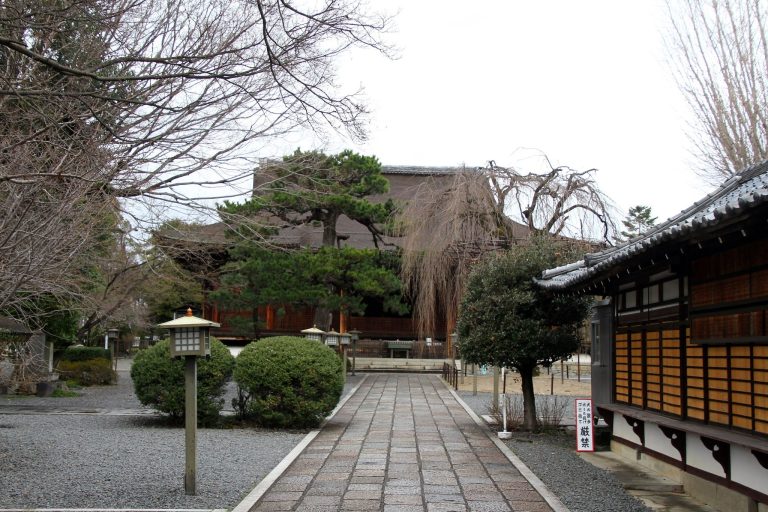
Kitano Tenmangū occupies approximately 20,000 tsubo on the northwestern edge of Kyoto’s historic urban area. The Kamiya, or Tenjin, River runs along the western side, where part of Toyotomi Hideyoshi’s defensive earthwork, the Odoi, survives. About 250 maple trees grow beside the river. A south-to-north approach begins at Imadegawa Street and passes through a sequence of gates and torii toward the wooden enclosure of the principal shrine.
Approach and gates
Torii and main entrances
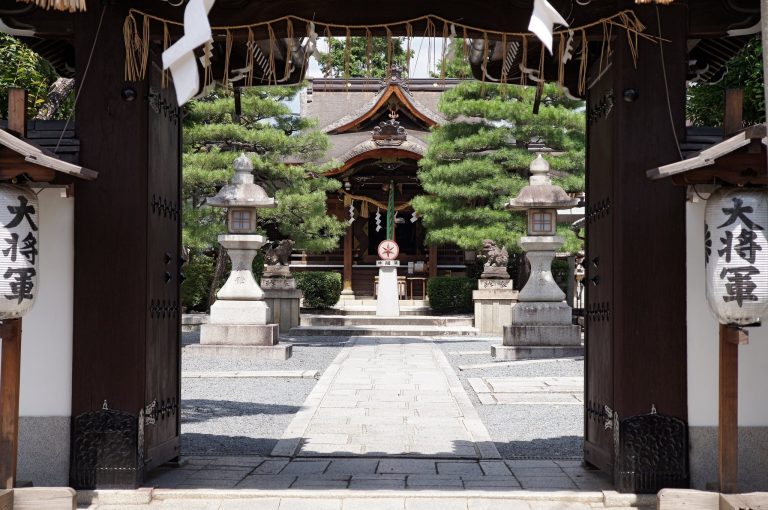
The first torii is a stone gateway 11.4 metres high. Two further torii stand along the approach before the principal shrine enclosure. The precinct has three principal entrances: the southern main gate, called the rōmon; the eastern tōmon; and the northern kitamon. The western corridor, the tōmon, the hirakaramon, the Sankōmon, and the surrounding fences form part of the designated architectural fabric of the shrine.
Sankōmon courtyard
A rectangular courtyard south of the worship hall is enclosed by a covered kairō corridor. It is entered through the chūmon, also called the Sankōmon, or Gate of the Three Lights. Carvings associated with the sun, moon, and star appear on the gate. A traditional explanation says that the star carving is absent because the Pole Star would have appeared directly above the gate when viewed from the direction of the Heian Palace. Wear is also considered a possible explanation.
Principal shrine complex
Honden and worship hall
The principal shrine is a unified yatsumune-zukuri, or gongen-zukuri, complex completed in 1607. This arrangement connects the honden, or main sanctuary, and the haiden, or worship hall, with the lower ishi-no-ma, an intervening space, beneath one large and complex roof. Two gaku-no-ma, or music rooms, flank the haiden, an unusual arrangement among shrines using this plan.
The complex is largely made of unpainted wood, with selected decoration and gable elements. The interior of the honden is finished in black and red lacquer, while the roofs are covered with Japanese cypress bark. The honden, ishi-no-ma, haiden, and gaku-no-ma together constitute one National Treasure building.
Misaligned sanctuary
The honden stands beside rather than at the end of the main approach. Jinushi-sha occupies the approach’s terminus, reflecting its existence before the foundation of Kitano Tenmangū and its status as the oldest shrine in the precinct. This unusual arrangement is traditionally called the “misaligned honden.” A pine tree stands to the right of the haiden, and a plum tree to its left. Inside the haiden is a wooden ox carving traditionally known as the shrine’s “only standing ox,” distinguishing it from the many seated or reclining ox images elsewhere in the grounds.
Subsidiary shrines
Older shrines and ancestral worship
Fifty-one subsidiary and auxiliary shrines occupy the precinct, most around the principal complex and especially to its north and west. Jinushi-sha enshrines the deities of heaven and earth together with associated imperial figures. Toyotomi Hideyori rebuilt it during the Keichō period. Hinomiko-sha is dedicated to the thunder deity. Ayako Tenmangū, transferred from Nishikyō during the Meiji period, is associated with Tajihi no Ayako’s first worship of Michizane.
Behind the honden, Gokō no mihashira enshrines Michizane’s ancestral and family deities, including the deity regarded as his ancestor, his grandfather, and his father. A Buddhist reliquary kept there until November 1869 was later moved to Jōshōkōji. Tomouji-sha enshrines Michizane’s mother and has a lotus-base torii, one of Kyoto’s three unusual torii.
Other subsidiary shrines
Other principal groups and structures include Oimatsu-sha, Shiradayū-sha, Fukube-sha, Kamado-sha, the Twelve Shrines, the Eight Shrines, the Four Shrines, the Seven Shrines, Shinmei-sha, Ayako-sha, Toyokuni-jinja, Ichiyamatsu-jinja, Nomi no Sukune-jinja, Ichinoho-jinja, Kushimitama-jinja, Inari-jinja, Sarutahiko-sha, Ushi-sha, Munakata-sha, Ōsugi-sha, and Tomouji-sha. Shiradayū-sha is dedicated to Watarai no Haruhiko, who accompanied Michizane to Dazaifu, while Toyokuni-jinja is dedicated to Toyotomi Hideyoshi. Mikoshigaoka-jinja, the otabisho, or festival destination for a portable shrine, lies outside the main precinct.
Buildings, gardens, and landscape features
Eastern buildings and tea houses
On the eastern side of the principal shrine are the shrine office, the kaguraden used for ritual dances, and the hōmotsuden, or treasure hall, which houses shrine art treasures. Along the southern edge, the emadokoro, completed in 1699, displays numerous ema, wooden votive tablets bearing prayers or wishes. It is regarded as one of the best-preserved examples of its building type. Three tea houses are associated with the grounds: Baikōken beside the Tenjin River, Meigetsusha northeast of the principal shrine, and Shōkōken near the entrance.
Plum trees and Tenguyama
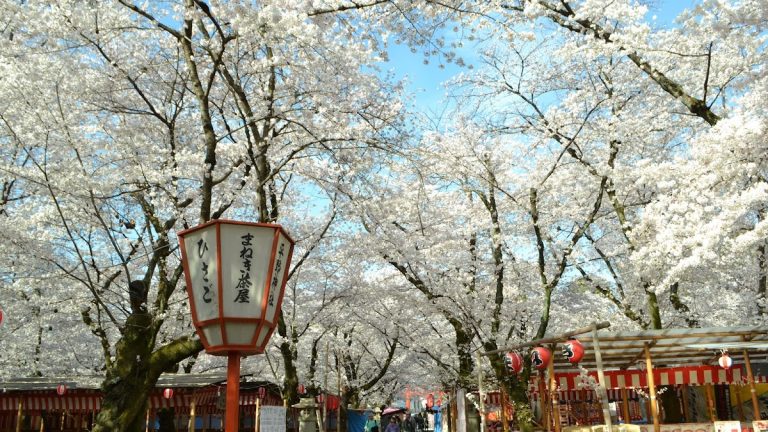
The grounds contain approximately 1,500 plum trees representing about 50 varieties. Michizane’s association with plum trees derives from his affection for them and from the Flying Plum legend, in which a plum tree is said to have followed him to Dazaifu. The ume fruits are dried and made into pickles offered from 13 December for the New Year, and consuming them with tea is traditionally believed to ward off illness.
A small hill called Tenguyama stands at the northwestern edge of the grounds. It is associated with a Muromachi-period painting depicting tengu beings appearing at the shrine. Tenguyama forms one of the shrine’s traditional Seven Wonders, alongside the sacred Yōgōmatsu pine beside the first torii, the supposedly misaligned honden, the supposedly missing star carving of the Sankōmon, a stone lantern carved with Daikokuten, the standing ox, and the rear shrine of Gokō no mihashira.
Paintings, manuscripts, and votive objects
National Treasure picture scrolls
Kitano Tenmangū preserves the eight-scroll National Treasure set Kitano Tenjin engi emaki, an illustrated account of Michizane’s life and his enshrinement as a kami. The Jōkyū version was painted in 1219, and its scrolls are approximately eight to eleven metres long.
Other cultural objects
The shrine also holds an eleventh-century copy of the Nihon Shoki, a Muromachi-period Kitano mandala, a Momoyama-period votive tablet painted by Hasegawa Tōhaku, a mid-Kamakura-period sword presented by Maeda Tsunayori in 1702, and a bronze mirror dedicated by Toyotomi Hideyori. Two mathematical votive tablets, dating from 1686 and 1878, are displayed in the emadokoro.
The ox is regarded as Michizane’s divine messenger. Traditions connect it with his birth and death dates, an episode in which an ox concealed him from assassins, and the stopping of the ox cart carrying his remains. These traditions account for the many ox images throughout the shrine. Another custom concerns the Daikokuten lantern: a small stone is placed in the carved deity’s mouth and carried in a wallet if it does not fall out.