Shinnyo-ji Temple: A Rinzai Zen Temple in Kyoto


Site at a Glance
- Rating
- 4.3
- Popularity
- Very Low
- Country
- Japan
- Primary era
- Early Modern
- Eras represented
- Medieval, Early Modern
- Civilizations
- Ashikaga shogunate, Tokugawa
- Site type
- Religious
- Remains
- Monastery
On this page10 sections
History
Shinnyo-ji Temple is a Rinzai Zen temple in Kyoto, Japan, founded in 1286 and associated with the medieval Five Mountains and Ten Temples system, a shogunal network that ranked and administered major Zen monasteries. It belongs to the Shokokuji branch of Rinzai Zen and is an outlying subtemple of Shokokuji, together with Kinkaku-ji and Ginkaku-ji.
Memorial Cloister and Reorganization
The institution began after the death of the Zen master Mugaku Sogen. His disciple Muga Nyodai founded Sho Myaku-an as a memorial cloister, a monastic institution dedicated to posthumous rites, for Mugaku’s fingernails and hair. Muga Nyodai was abbess of Keiaiji, the leading convent in Kyoto’s women’s Five Mountains network. Successive abbots and patrons, including Mugaku’s disciple Koho Kennichi, maintained Sho Myaku-an, but it gradually declined.
On April 15, 1342, Muso Soseki moved Sho Myaku-an east of its former location and reorganized it as a full temple. The project received protection from Kō no Moronao, the steward of Ashikaga Takauji, and from Takauji’s younger brother, Ashikaga Tadayoshi. The institution took the name Shinnyo-ji from a now-defunct temple in Taizhou, Zhejiang, China, where Mugaku Sogen had first served as abbot. Mugaku was named the invited founding abbot, Muga Nyodai the invited founding patron, and Muso Soseki became the second abbot. These honorary foundation titles formally associated revered figures with the temple even though later leaders carried out its establishment and management.
In 1343, Ashikaga Takauji established Hokuto Toji-ji, the predecessor of present-day Toji-in, on the former site of Sho Myaku-an, with Muso Soseki as its founding abbot. Toji-in stood west of Shinnyo-ji, and Takauji was later buried there. Kō no Moronao, who died in 1351, received a Buddhist name associated with Shinnyo-ji.
Muromachi Shogunate Patronage
Funerals for Ashikaga Takauji in 1358 and for Ashikaga Yoshiakira, the second shogun of the Muromachi shogunate, in 1367 took place at Shinnyo-ji. The temple’s place within the Kyoto Ten Temples changed repeatedly. It was listed eighth in 1342, sixth in 1343, seventh in 1380, and third in 1410, after Toji-ji and Rinsen-ji. The Muromachi shogunate provided substantial protection, and Shinnyo-ji possessed subordinate cloisters.
A fire destroyed the temple in 1461. During the disorder of the Onin War, a conflict that fractured authority in medieval Kyoto, Shinnyo-ji temporarily fell into abandonment. Its abbot’s quarters and Buddha Hall were gradually restored from 1499.
Hokyo-ji and the Edo Period
In 1576, a nun who had become abbess of Hokyo-ji in 1535 was buried at Shinnyo-ji because of her close association with Mugaku Sogen and Muga Nyodai. Shinnyo-ji thereafter served as the memorial temple for successive abbesses of Hokyo-ji, including several imperial princesses. After the death of a daughter of Emperor Go-Mizunoo, who was the twentieth abbess of Hokyo-ji, the emperor substantially rebuilt Shinnyo-ji’s Dharma Hall in 1656. The temple contained her tomb and had become dilapidated by that time.
Throughout the Edo period, Shinnyo-ji served within the Gozan Zen system as the principal temple for the Seidō office, a clerical rank among Rinzai monks. Its Dharma Hall hosted the conferral ceremony associated with the office. Zen monks whose Dharma names began with “Former Shinnyo” had received that appointment there before entering other temples.
Meiji Period and Religious Continuity
In 1918, Shinnyo-ji invited an emanation of the guardian deity Hansōbō Daigongen from Hōkō-ji, the head temple of the Hōkō-ji branch of Rinzai Zen in present-day Hamana Ward, Hamamatsu. It became the temple’s new guardian deity. Shinnyo-ji bears the mountain name Mannenzan and the interlocking-rings crest. Its principal devotional image is a crowned Shakyamuni Buddha, an iconographic form showing the Buddha wearing a crown.
Remains
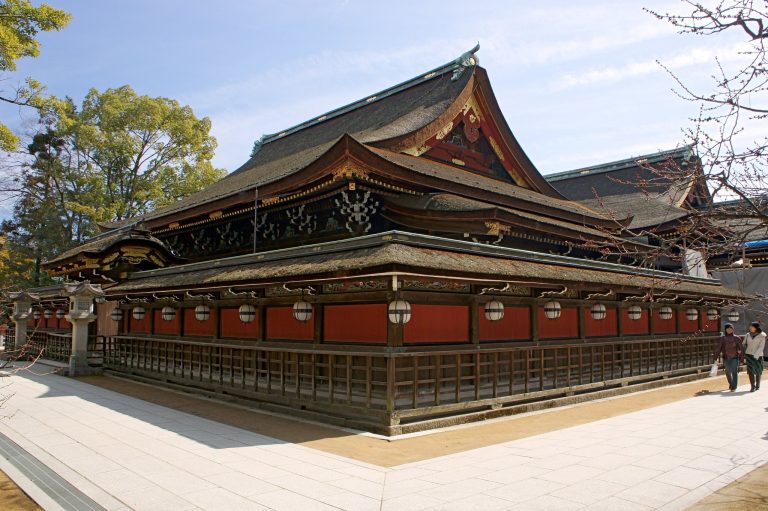
Shinnyo-ji was arranged as a full Buddhist temple when Sho Myaku-an was moved in 1342. Its documented principal buildings included an abbot’s quarters, a Buddha Hall for enshrining and worshipping Buddhist images, and a Dharma Hall for Zen teaching, sermons, and important monastic ceremonies. The abbot’s quarters and Buddha Hall were restored from 1499, while the Dharma Hall was substantially rebuilt in 1656.
Temple Buildings and Grounds
Principal Halls
The Dharma Hall received a set of Shaka triad images from the Sento Imperial Palace on July 2, 1662. The group consists of a seated crowned Shakyamuni Buddha flanked by the disciples Mahakasyapa and Ananda. Shinnyo-ji’s principal image is also a crowned seated Shakyamuni Buddha.
Subordinate Cloisters
The grounds historically contained six subordinate cloisters. They were Hoko-an, Seika-in, Choshinken, the founder’s memorial cloister Sho Myaku-an, Kigen-in, which served as Kō no Moronao’s memorial hall, and Shinko-an, which functioned as a monks’ hall. All six became defunct during the Meiji period as a result of the anti-Buddhist movement, which suppressed Buddhist institutions and led to the destruction or closure of many religious buildings in Japan.
Landscape Design
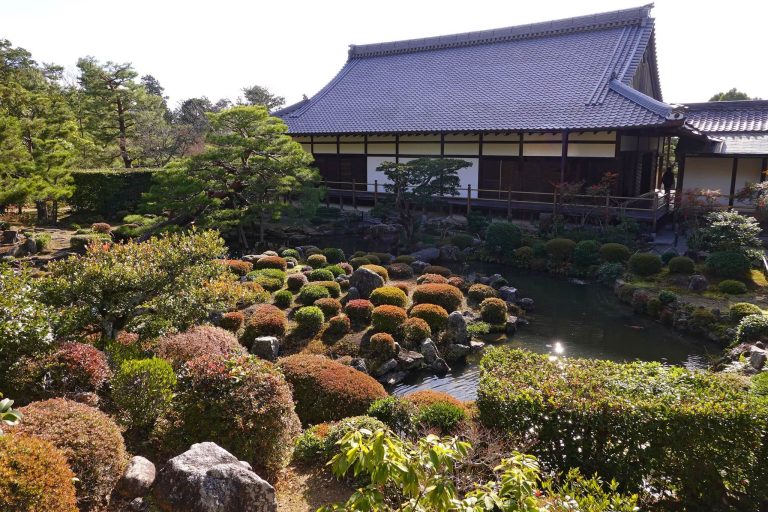
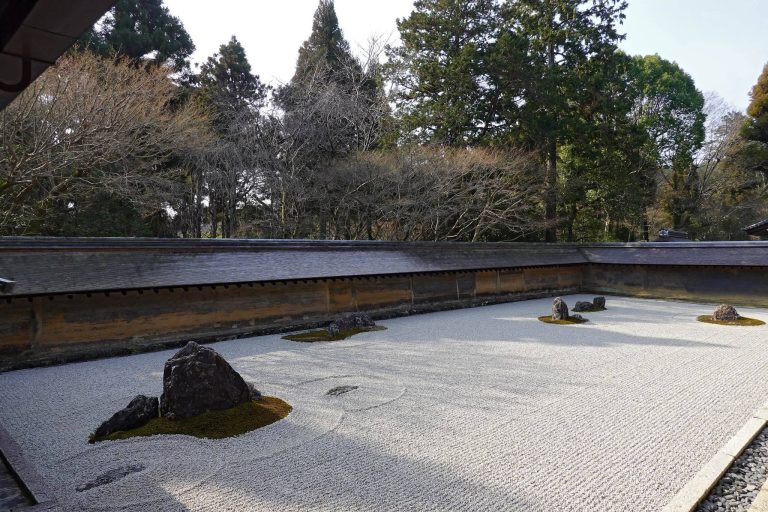
The temple grounds used Mount Kinugasa as borrowed scenery, a garden-design technique that incorporates a distant natural feature into the composition of the grounds. The setting was described as having rich scenery and ten notable scenic features attributed to Muso Soseki.