Yanagi no Gosho Site: A Northern Fujiwara Administrative and Residential Complex in Japan


Site at a Glance
- Rating
- 3.7
- Popularity
- Low
- Country
- Japan
- Primary era
- Medieval
- External website
- Open
- Eras represented
- Medieval
- Civilizations
- Unclassified
- Site type
- Civic
- Remains
- Palace
On this page12 sections
History
Yanagi no Gosho Site is a late-Heian administrative and residential complex in Hiraizumi, Japan, built and developed by the Northern Fujiwara clan during the second half of the twelfth century. The clan ruled Hiraizumi, which became a major political and cultural center in northern Japan. The complex is identified with the Hiraizumikan, or “Hiraizumi residence,” mentioned in the Azuma Kagami, a medieval chronicle concerned with the Kamakura shogunate and its political and military predecessors.
Kiyohira’s Move to Hiraizumi
After the Gosannen War, an eleventh-century conflict in northern Japan that helped establish his political position, Fujiwara no Kiyohira moved his seat from an earlier residence in the Esashi area of present-day Oshu to Hiraizumi. The relocation probably took place between 1090 and 1100. Hiraizumi stood on the Oshu Kaido, a major highway linking northern Japan with the capital region, and occupied a central position within Kiyohira’s realm. Its location south of the Koromo River also placed it in territory traditionally regarded by the central court as Japanese rather than Emishi, a term used for peoples of northeastern Honshu who were viewed as outside its political and cultural sphere.
Kiyohira established his residence at Yanagi no Gosho. His son Motohira, grandson Hidehira, and great-grandson Yasuhira subsequently used the complex. Hidehira later redeveloped it as the Hiraizumikan, an administrative center. Archaeological investigation places the site’s principal period in the second half of the twelfth century, especially during Hidehira’s time.
Destruction and Rediscovery
The complex was destroyed in 1189 during Minamoto no Yoritomo’s campaign against the Northern Fujiwara, which ended the clan’s rule. Fujiwara no Yasuhira set fire to the residence himself, and it burned. The site was later lost, and erosion along the Kitakami River was once thought to have swept its remains away.
Archaeological investigation began in 1969 under the Hiraizumi Archaeological Research Association, represented by the University of Tokyo emeritus professor Fujishima Kaijiro. Emergency excavations connected with the Ichinoseki flood-control project and the Hiraizumi Bypass began in 1988 and continued for six years. Forty-four investigations established the importance and chronology of the site.
Public preservation efforts led the Construction Ministry, now the Ministry of Land, Infrastructure, Transport and Tourism, to alter the planned routes of the embankment and bypass. Yanagi no Gosho and the Hiraizumi Sites group became a National Historic Site in 1997. The place was added to Japan’s tentative World Heritage list in 2001 as part of “Hiraizumi: Cultural Landscape Associated with Pure Land Buddhist Cosmology.” After inscription was deferred in 2008, it was excluded from the property inscribed in 2011 as “Hiraizumi: Temples, Gardens and Archaeological Sites Representing the Buddhist Pure Land.” It returned to the tentative list in 2012 with other archaeological sites in Iwate Prefecture.
To protect the historic landscape, part of the Hiraizumi Bypass was placed underground, and its route was modified to limit the visibility of vehicles from the archaeological park. Concerns nevertheless remained that large-scale development, including changes to the course of the Kitakami River, had altered the historic cultural landscape.
Remains
Setting and Layout
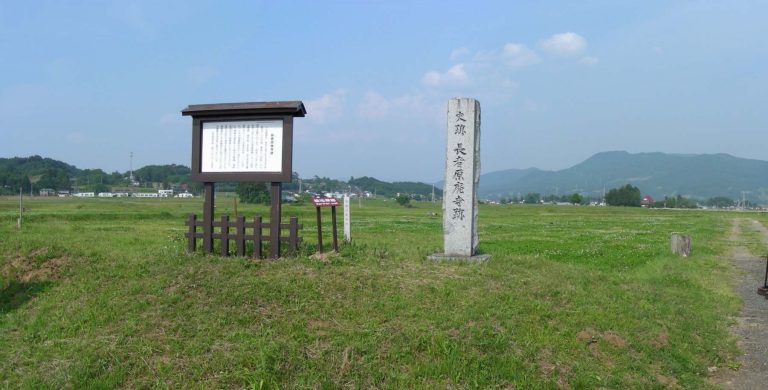
The complex occupies land between the west bank of the Kitakami River and the Nekomagafuchi River, southeast of Chusonji and Takadachi, at an elevation of about 25 metres. It was deliberately positioned so that Konjikido, the Golden Hall of Chusonji on the mountain to the northwest, could be seen from the residence. The archaeological area covers approximately 112,000 square metres, or about 10 hectares, extending about 725 metres in length and up to 212 metres in width.
Boundaries and Circulation
Waterways and Palisade
The Kitakami and Nekomagafuchi rivers formed major boundaries of the complex. Moats connected these waterways, while a wooden palisade protected the central section. Together, the rivers, moats, and palisade defined the compound’s edges and helped organize its internal spaces.
Roads and Bridge
Excavations have revealed roads and a bridge as well as a large moat. These features belonged to an extensive administrative and residential compound rather than to a single isolated palace building.
Buildings and Garden
Residences and Administrative Buildings
The site contains foundations for numerous buildings constructed with upright posts and groups of residences. Their remains represent the buildings of a complex where residential and administrative functions were combined. The buildings survive archaeologically, while the Yanagi no Gosho Historic Site Park covers approximately 5 hectares of the wider area.
Pond and Restored Landscape
One of the excavated features is a garden pond. Within the historic site park, ponds, moats, and roads have been reconstructed or restored to reflect elements of the excavated layout. The buildings themselves remain archaeological remains rather than completed reconstructions.
Excavated Objects
Excavation produced more than 10 tonnes of kawarake, unglazed earthenware dishes used in medieval Japanese contexts. Other finds include Chinese ceramics such as white-porcelain vessels, large Tokoname and Atsumi pottery vessels, wooden artefacts, an eboshi headpiece, and shogi pieces. The assemblage also includes the seal of Iwamae Village, identified as the first discovery of its kind in Japan.
These objects form part of the nationally designated Important Cultural Property collection titled “Excavated Objects from the Hiraizumi Sites in Iwate Prefecture.” Many of the finds are displayed at the Yanagi no Gosho Museum within the site.