Tenmyōkoku-ji Temple: A Kempon Hokke Buddhist Temple in Tokyo

Site at a Glance
- Rating
- 4
- Popularity
- Low
- Country
- Japan
- Primary era
- Unclassified
- External website
- Open
- Eras represented
- Unclassified
- Civilizations
- Unclassified
- Site type
- Religious
On this page8 sections
History
Tenmyōkoku-ji Temple is a Kempon Hokke Buddhist temple in Tokyo, Japan, traditionally founded in 1285 as Myōkoku-ji. Its formal name is Hōōzan Tenmyōkoku-ji, and its principal object of worship is the Three Treasures. Hōōzan is the temple’s mountain name, an honorific element of its formal title that does not necessarily describe its physical setting.
Foundation and Nichijū Lineage
Temple tradition attributes the foundation of Myōkoku-ji to a disciple of Nichiren, the thirteenth-century Japanese Buddhist reformer whose teachings gave rise to several later sects and lineages. During the tenure of the second patriarch, the temple entered the lineage of Nichijū, the founder of the Kempon Hokke tradition.
In the fifteenth century, the Shinagawa harbor merchant Suzuki Dōin supported the temple. His donations enabled the creation of a seven-building complex that included a five-story pagoda, and the institution was further developed in 1444. A temple bell was cast in 1446, adding to the complex’s religious and institutional equipment.
Tokugawa Connections and Edo Development
The temple’s relationship with the Tokugawa family began in 1590, when Tokugawa Ieyasu stayed there on the day before entering Edo. Ieyasu was the founder and first shogun of the Tokugawa shogunate, Japan’s early-modern military government. The precincts and their associated settlement subsequently became bestowed lands, and the temple received a ten-koku estate grant in 1591. A koku was a historical measure used to assess land and agricultural revenue. Temple records also preserve accounts of visits by Ieyasu, Tokugawa Hidetada, and Tokugawa Iemitsu, the second and third Tokugawa shoguns.
The five-story pagoda was built in 1459. A severe storm caused it to collapse in 1614, after which it was rebuilt in 1634 on the orders of Tokugawa Iemitsu. The pagoda was destroyed again by the great fire of Edo in 1702. Repeated urban fires and the financial difficulties of the Edo shogunate prevented its reconstruction.
During the Edo period, the temple had four subtemples, Shinryō-in, Shūjō-in, Chūshō-in, and Anryū-in. Shinryō-in was later renamed Shinryō-ji. In 1668, Myōkoku-ji became the Edo representative temple for Myōman-ji, the head temple of the Nichijū lineage. A representative, or touch-head, temple acted as an intermediary for a religious school in dealings with authorities and other institutions.
Modern Sectarian History
In 1941, the Kempon Hokke Sect, Honmon Sect, and Nichiren Sect merged under the official name Nichiren Sect, and Myōkoku-ji became a head temple within the resulting organization. In 1948, it left that organization with Myōman-ji and about 200 former Myōman-ji branch temples. A head temple is the principal institutional temple of a Buddhist school or lineage, while a branch temple is subordinate to it. Shinryō-in remained affiliated with the Nichiren Sect. Myōkoku-ji joined the reconstituted Kempon Hokke Sect in 1950 and changed its name to Tenmyōkoku-ji in 1972.
Remains
Main Hall and Historic Complex
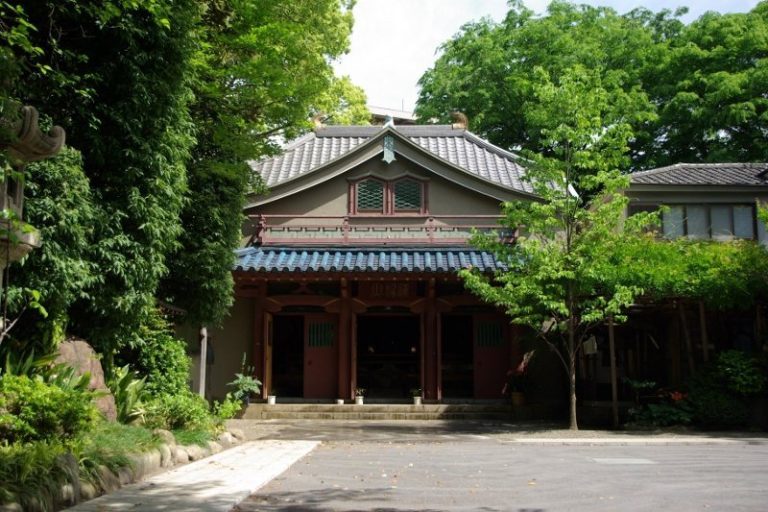
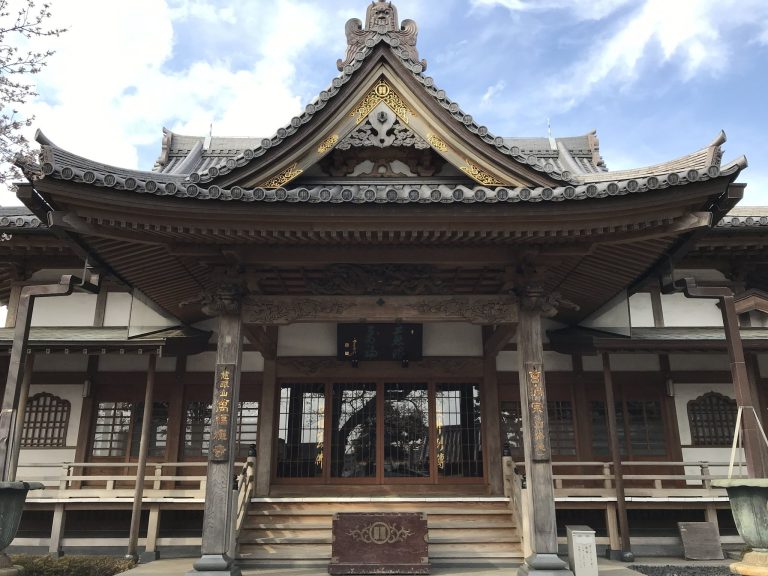
Tenmyōkoku-ji includes a main hall within the temple precincts. Its historic fifteenth-century arrangement consisted of seven principal buildings and incorporated a five-story pagoda. The pagoda belonged to the earlier architectural complex, was rebuilt once after a storm, and was ultimately lost in the 1702 fire. The surviving temple therefore preserves the history of a complex whose form changed through collapse, rebuilding, and fire.
Temple Bell
A temple bell cast in 1446 is associated with the site’s fifteenth-century development. Its date places it within the period when Suzuki Dōin’s support was enabling the expansion of the temple complex.
Former Subtemple
The former subtemple Shinryō-in survives under the name Shinryō-ji. It is the surviving member of the four subtemples associated with Tenmyōkoku-ji during the Edo period, and its continued existence preserves part of the temple’s former institutional arrangement.