Negoro-ji Temple: Head Temple of the Shingi Shingon School in Japan


Site at a Glance
- Rating
- 4.2
- Popularity
- Medium
- Country
- Japan
- Primary era
- Medieval
- External website
- Open
- Eras represented
- Medieval, Early Modern
- Civilizations
- Ashikaga shogunate, Tokugawa
- Site type
- Religious
- Remains
- Monastery
On this page22 sections
History
Negoro-ji Temple in Iwade, Wakayama, Japan, is the head temple of the Shingi Shingon school of Japanese Buddhism. Founded in 1130 during the Heian period, it originated as a small chapel on Mount Kōya and later became the centre of an independent Shingon tradition. Its formal name is Ichijō-zan Daidenbō-in Negoro-ji, and its principal Buddhist images are Dainichi Nyorai, Kongōsatta, and Sonshō Butchō.
Foundation and separation from Mount Kōya
The monk Kakuban founded Shōdenbō-in on Mount Kōya in 1130. The following year, Emperor Toba made the institution an imperial prayer temple, and its title changed to Daidenbō-in. Kakuban became head of Kongōbu-ji on Mount Kōya in 1134 and sought to reform what he considered declining religious practice. He promoted the teachings of Kūkai, attempted to bring the Ōno and Hirosawa branches of Shingon closer together, and challenged Kōyasan’s authority over Tō-ji in Kyoto. His reforms also incorporated Pure Land elements, including the esoteric nembutsu ritual.
These initiatives caused opposition within the Shingon hierarchy. Kakuban resigned his offices in 1135 and withdrew to Mitsugon-in. In 1140, forces opposed to his movement burned Mitsugon-in and other buildings connected with his followers. Kakuban and his community then left Mount Kōya for Bufuku-ji in Hirota Estate, a Daidenbō-in estate granted to him by the retired Emperor Toba in 1132. They also established Enmyō-ji as a training hall for transmitting their teachings. The temple communities that grew around these institutions developed into the wider Negoro-ji complex.
Kakuban died at Enmyō-ji in 1144, aged 49. In 1288, more than a century after his death, the Daidenbō-in scholar Raiyū transferred the institution’s register and headquarters from Mount Kōya to Negoro-ji. The Mitsugon-in and Daidenbō-in chapels were moved there as well. This transfer established the independent Shingi Shingon school, whose name means “New Shingon.” The branch developed around Negoro-ji after its separation from the Mount Kōya establishment.
Medieval expansion and military power
During the late Muromachi period, an era shaped by the Ashikaga shogunate and strong regional military powers, Negoro-ji became a major religious city. It contained about 450 subsidiary buildings, although another estimate gives as many as 2,700. Its estates were assessed at 720,000 koku, a historical measure of land and agricultural income based on rice production. The institution also controlled more than 10,000 warrior monks, known as the Negoro-shū. Such armed followers were characteristic of some powerful medieval Buddhist institutions, which could exercise both military and political influence.
The temple’s intellectual reputation attracted Jesuit missionaries who arrived in Japan after 1549. European descriptions called Negoro the seat of Japan’s largest “university,” and early European maps used names such as “Negru,” “Neguru,” and “Negru academia” for the institution.
Negoro-ji also became involved in the spread of firearms. After matchlock guns reached Japan in 1543, the monks acquired a weapon and organized a firearm unit. Craftsmen associated with Negoro later produced matchlock guns for the temple’s own use, while the nearby Saika Estate became another important centre of firearm manufacture.
Conflict and destruction in 1585
Negoro-ji maintained friendly relations with Oda Nobunaga and supported him during the Ishiyama Hongan-ji War, a conflict in which Nobunaga fought the fortified Buddhist institution Ishiyama Hongan-ji. In 1584, the temple allied with Tokugawa Ieyasu and Oda Nobukatsu during the Battle of Komaki and Nagakute. Negoro forces attacked the temporarily undefended Kishiwada Castle and tried to advance into southern Settsu. These actions contributed to Toyotomi Hideyoshi’s decision to campaign against the Negoro and Saika forces.
Hideyoshi’s army reached Negoro-ji in 1585. The temple resisted alongside the Saika firearm troops but was defeated, and most of the complex burned. The cause of the fire is uncertain. It may have followed Hideyoshi’s orders, deliberate burning by members of the temple community, or arson by attacking soldiers. The defenders offered little resistance, so a punitive burning was not necessary for military purposes.
The Daidenpō-dō survived the destruction but was dismantled and removed for use as the main hall of Tenshō-ji, a mausoleum Hideyoshi planned for Oda Nobunaga at Funaokayama in Kyoto. Tenshō-ji was never built, and the building materials were left beside the Nakatsugawa River in what is now Denpō in Osaka.
Restoration under Tokugawa rule
After Tokugawa forces won the Battle of Sekigahara in 1600, Tokugawa Ieyasu granted the land and buildings of the temple attached to the Toyokuni Shrine in eastern Kyoto to Gen’yū, the former abbot of Chishaku-in. Negoro monks had burned Chishaku-in, and the transfer allowed its temple complex to be restored in Kyoto.
Following the Siege of Osaka and the destruction of the Toyotomi family in 1615, Ieyasu donated Shōun-ji to Negoro-ji. Hideyoshi had built Shōun-ji to commemorate his son Tsurumatsu. Chishaku-in later received the temple and incorporated it into its enlarged precinct.
During the Edo period, the era of Tokugawa rule from the early seventeenth to the mid-nineteenth century, the Kishū Tokugawa family supported the rebuilding of Negoro-ji’s principal buildings. Some rebuilding is dated to 1623, although the main surviving halls were reconstructed later. Emperor Higashiyama also granted Kakuban the posthumous title Kōgyō Daishi. Kakuban is remembered as a major Shingon reformer and as the founding figure of the Shingi Shingon tradition.
Excavation and conservation
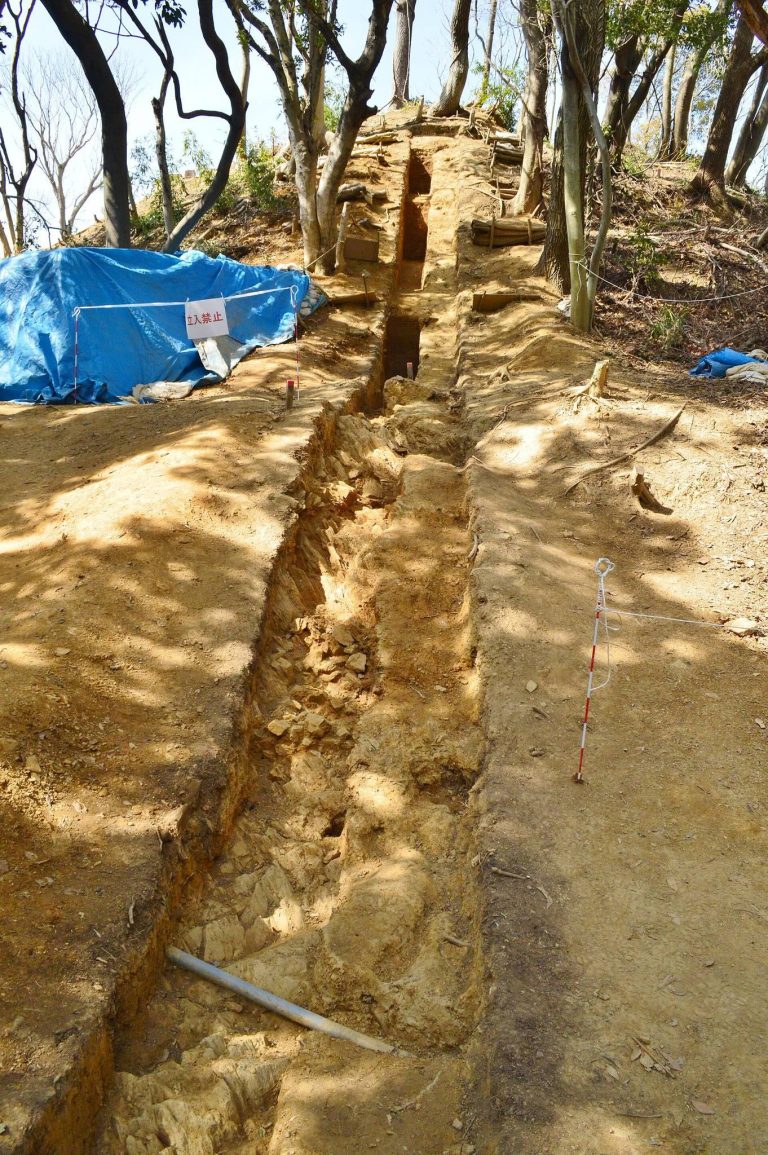
Archaeological excavations around the temple began in 1976 and showed that the historical complex covered more than 4 million square metres. Excavated materials include large quantities of pottery, porcelain, lacquerware, Buddhist ritual implements, and weapons. These finds are preserved and displayed at the Iwade Civic Museum.
Negoro-ji’s grounds were designated a National Historic Site and a National Place of Scenic Beauty in 2007. Urban encroachment, a major agricultural road in front of the grounds, quarrying in the hills behind them, and other development around the precinct have raised concerns about protecting and transmitting Negoro culture. A ceremony is held each year on the morning of June 17, Kakuban’s traditional birthday, with nearly 40 monks taking part.
Remains
Negoro-ji lies in northern Iwade, Wakayama Prefecture, among the peaks of the Katsuragi Mountains. The surviving precinct brings together temple grounds, a designated garden, principal halls, subsidiary shrines, ritual spaces, and the Great Pagoda. The buildings represent several rebuilding phases, while the surviving medieval structures and excavated material preserve evidence of the complex before and after its destruction in 1585.
Entrances and shrine area
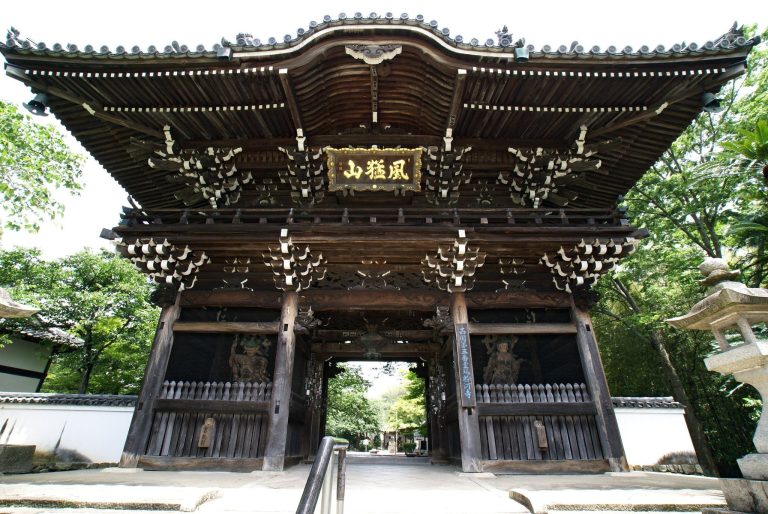
Great Gate
The Great Gate, also called the Niō Gate, was rebuilt in 1850. It measures 16.88 metres in height, 17.63 metres in width, and 6 metres in depth. Its scale defines the principal entrance area of the surviving precinct.
Gongen Shrine and related buildings
The Three-Part Gongen Shrine stands in the Great Gate area and serves as the temple’s principal tutelary shrine. A Gongen shrine is dedicated to a Buddhist-shinto syncretic manifestation, and a tutelary shrine protects a temple or locality. The Fudō Hall area also contains the Kasuga Myōjin Shrine, the Konpira Shrine on raised ground reached by steps behind it, and a bell tower.
Fudō and principal halls
Fudō Hall
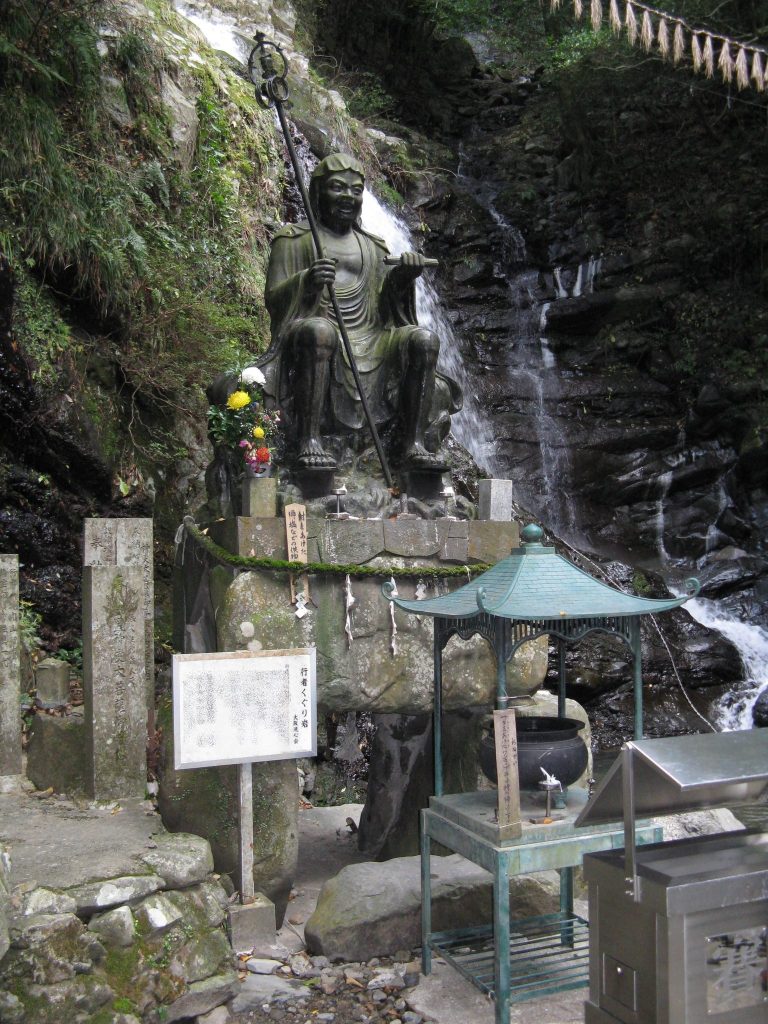
Fudō Hall was rebuilt in 1850. Its rear sanctuary is octagonal and circular, while the worship hall in front is square. The principal image is Fudō Myōō, a Buddhist Wisdom King, or wrathful protective deity, traditionally known as the “Kirimo-mi Fudō.” Tradition associates the image with the conflict of 1140, when it was believed to have saved Kakuban’s life by taking his place.
The worship hall contains images of Monju Bosatsu and Aizen Myōō, and four Wisdom Kings flank the shrine containing the principal image. A north-facing Fudō is worshipped through a window immediately behind the octagonal sanctuary.
Daidenpō-dō
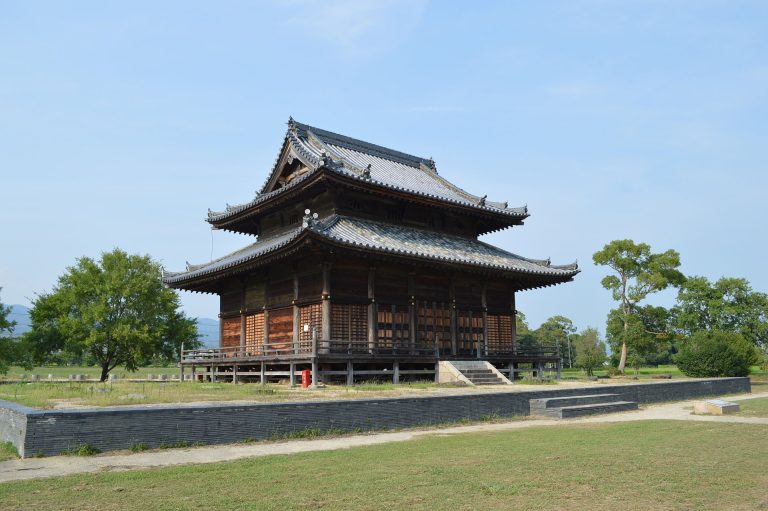
The Daidenpō-dō is the main hall of Negoro-ji. Rebuilt in 1827, it houses the temple’s central triad of Dainichi Nyorai, Kongōsatta, and Sonshō Butchō. Dainichi Nyorai is the Cosmic Buddha Vairocana, the central Buddha of Shingon esoteric doctrine. Kongōsatta is Vajrasattva, a bodhisattva associated with esoteric teachings, while Sonshō Butchō is a Buddha-form connected with victory and protection.
Daishi Hall
The Daishi Hall houses an image of Kōbō Daishi, the posthumous title of Kūkai, who is traditionally regarded as the founder of Shingon Buddhism in Japan. The hall survived the destruction of 1585. An inscription on its principal image indicates that the building was probably constructed around 1391.
Pagoda and sacred images
Great Pagoda
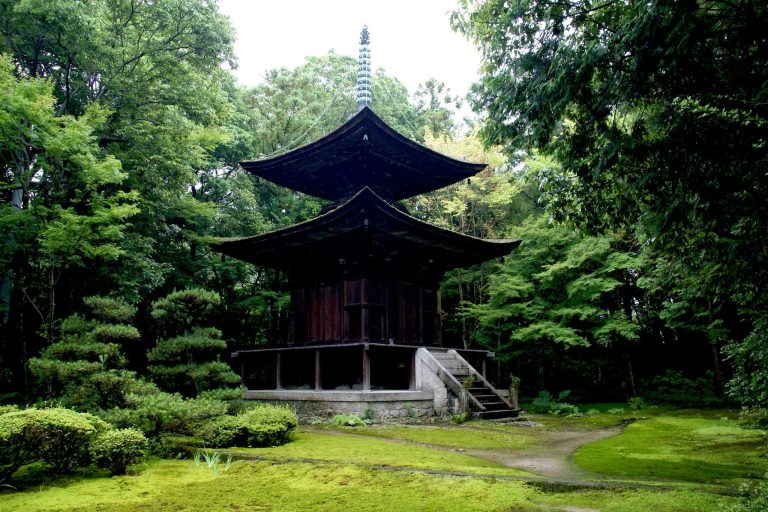
The Great Pagoda, formally the Great Vairocana Dharma-Realm Nature Pagoda, is a wooden Tahōtō, a two-storeyed Buddhist pagoda with a normally square lower level and a cylindrical or circular upper tower. It is 40 metres high and 15 metres wide. The pagoda houses an image of Womb-Realm Dainichi Nyorai and is Japan’s largest wooden pagoda of this type.
Although the exterior of its first storey is square, the interior contains a circular sanctuary. Twelve columns form an inner circle, with four central pillars within it. Ink inscriptions found on the timbers during dismantling and repair indicate that construction probably began around 1480 and was completed around 1547. Matchlock bullet marks from Hideyoshi’s attack in 1585 remain on the base.
Inner Sanctuary
The Inner Sanctuary contains Kakuban’s mausoleum. Its presence preserves the connection between the surviving temple and the monk whose reforms, departure from Mount Kōya, and teachings gave rise to the Negoro-ji community.
Daidenpō-dō statues
The three wooden statues in the Daidenpō-dō are seated figures of Dainichi Nyorai, Kongōsatta, and Sonshō Butchō. They measure approximately 3.50 metres, 3.43 metres, and 3.35 metres in height respectively. Ink inscriptions inside the Dainichi Nyorai and Kongōsatta indicate that they were made between 1387 and 1405. The statues survived the destruction of the complex and are considerably older than the present hall.
The grouping is unusual, particularly because Sonshō Butchō rarely survives as a sculptural image. The same triad was associated with the Daidenbō-in founded by Kakuban on Mount Kōya, and the arrangement reflects his distinctive interpretation of Buddhist doctrine.
Later buildings and material traditions
Ichijōkaku
The former Wakayama Prefectural Assembly Hall was built in 1898. Called Ichijōkaku, it was moved into the Negoro-ji precinct in 1962. Preservation work carried out from 2012 to 2015 led to its relocation to a site west of the temple.
Other historic buildings
Other identified buildings include the Hall of the Light Mantra, the Ascetic Hall, and the Shōten Hall. The Ascetic Hall and Shōten Hall were completed or rebuilt during the Edo period. The Hall of the Light Mantra is also among the complex’s designated historic buildings. Together with the Daidenpō-dō, Great Gate, Fudō Hall, and Daishi Hall, they form part of the surviving cultural-property buildings of the precinct.
Negoro lacquerware
Negoro lacquerware developed as a red-lacquer tradition associated with artisans of the temple. The craft continued on the Kii Peninsula, extending the material legacy of the religious community beyond the buildings that remain in the precinct.