Jigen-in Temple: A Historic Shingon Buddhist Temple in Izumisano


Site at a Glance
- Rating
- 4.1
- Popularity
- Low
- Country
- Japan
- Primary era
- Medieval
- External website
- Open
- Eras represented
- Medieval, Early Modern
- Civilizations
- Ashikaga shogunate, Toyotomi regime
- Site type
- Religious
- Remains
- Monastery
On this page12 sections
History
Jigen-in Temple is a historic Shingon Buddhist temple in Izumisano, Osaka, Japan. Traditionally founded in 673 as an imperial prayer temple and as the attached Buddhist temple of neighboring Hine Shrine, it is now part of the Omuro branch of Shingon, a Japanese school of Esoteric Buddhism associated with the monk Kukai. The temple’s principal image is Yakushi Nyorai, the Buddha of healing and medicine.
Foundation and Imperial Patronage
Tradition attributes the foundation of the temple to the priest Kakugo Ajari, who established it under the name Isekiyama Ganjojuji Mugenko-in. As an attached Buddhist temple, or jinguji, it served Hine Shrine within Japan’s former religious system, in which Buddhist temples and Shinto shrines operated together.
During the Tenpyo era, from 729 to 749, Emperor Shomu designated the temple an imperial prayer temple and reportedly increased its estate income by 1,000 koku, a historical measure used especially for rice-based land or estate revenue. Tradition also holds that Kukai reconstructed the main hall, tahoto pagoda, and other buildings in 815.
Medieval Destruction and the Hine Estate
Jigen-in stood within Hine Estate, a privately held manor whose revenues and administrative rights belonged to the Kujo family. The Kujo were one of the Five Regent Houses, the principal branches of the Fujiwara aristocracy that traditionally supplied regents to the imperial court. From 1501 to 1505, the former regent Kujo Masamoto stayed at Hine to administer the estate directly. His diary, Masamoto-ko Tabihikitsuke, records this period.
Warfare brought major destruction in 1353, when the temple was burned. Imperial commands under Emperor Go-Murakami and Emperor Go-Kameyama led to its subsequent rebuilding. In 1585, the complex was again burned during Toyotomi Hideyoshi’s conquest of Kishu. The main hall and tahoto pagoda survived, while the rest of Mugenko-in was destroyed.
Reconstruction and the Name Jigen-in
Reconstruction of the monastic complex began in 1602 under Toyotomi Hideyori. This phase established a group of halls, residences, subtemples, shrines, and ritual buildings, including Okunobo, Yamanobo, Myo-o-in, Kaitai-in, Inano-bo, Nakanobo, Shimonobo, Tohoji, Kaminobo, Myojin Shrine, Kannon Hall, Bishamonten Hall, and the goma hall. A goma hall was used for Buddhist fire ceremonies in which offerings were made into a sacred fire.
Repairs followed during the Kanbun era, from 1661 to 1673, under Okabe Yukitaka, lord of Kishiwada Domain. In 1665, Nakanobo received the title Jigen-in from Shojo, a monzeki of Ninna-ji. A monzeki was a high-ranking Buddhist cleric, often from the imperial family or aristocracy, who headed an important temple. Nakanobo then became a branch temple of Ninna-ji, the Kyoto institution historically connected with the Omuro branch of Shingon.
Meiji Transformation
The Meiji-era separation of Buddhism and Shinto ended Mugenko-in’s institutional connection with Hine Shrine. Mugenko-in and its associated subtemples were subsequently abolished, leaving Jigen-in as the surviving temple. Its formal name is Daihizan Ganjojuji Jigen-in, while Isekiyama Ganjojuji Mugenko-in was its earlier formal name.
Today, Jigen-in is affiliated with the Omuro branch of Shingon Buddhism. It is also stop 12 on the 18 Ancient Buddhist Pagodas and Temples pilgrimage and an additional stop on the Izumi Saigoku Thirty-Three Kannon pilgrimage. Kannon, the bodhisattva associated with compassion, and Bishamonten, a Buddhist guardian deity, are reflected in the names of buildings that formed part of the temple’s historic religious complex. The temple precinct forms part of the Hine Estate Site, a national historic site.
Remains
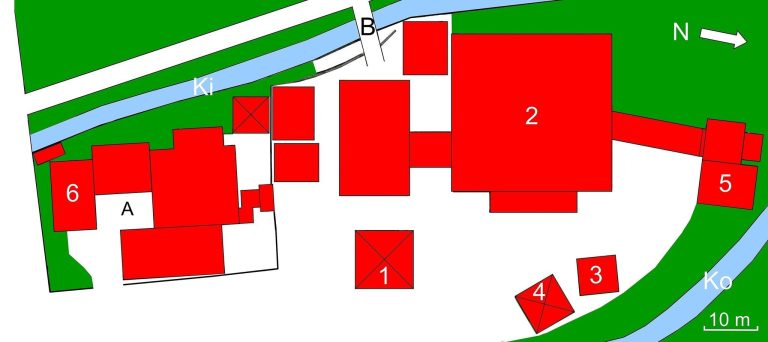
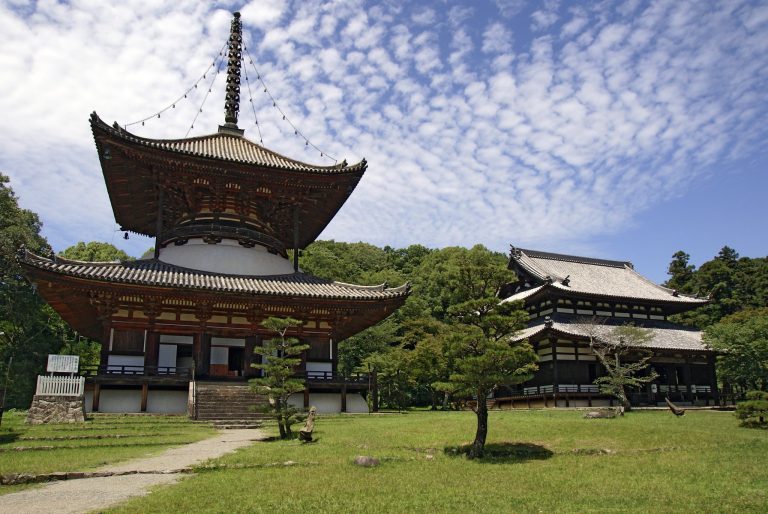
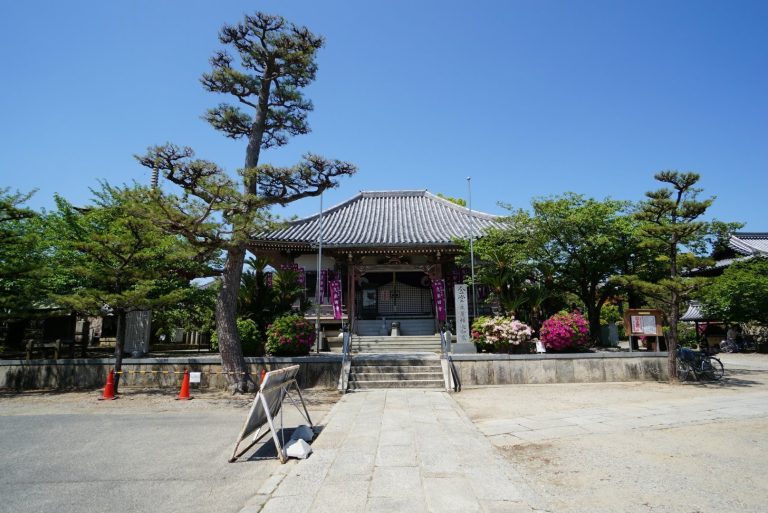
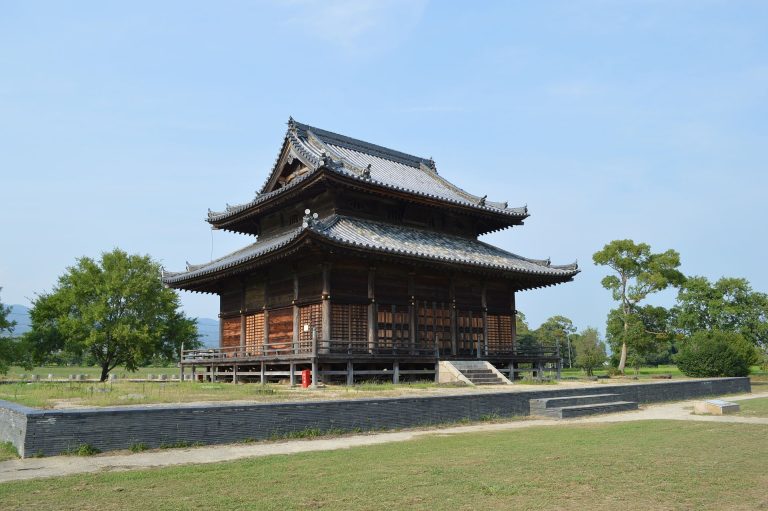
The surviving complex centers on a tahoto pagoda and the main hall, while the historical precinct once contained numerous halls, residences, subtemples, shrines, and ritual buildings. A tahoto is a Japanese pagoda form with a square lower section, a cylindrical upper section, and a pyramidal roof. The pagoda and main hall are the principal surviving architectural elements of Jigen-in.
Pagoda and Main Hall
Tahoto Pagoda
Jigen-in’s tahoto is designated a National Treasure and is regarded as one of Japan’s three famous tahoto pagodas, together with those at Ishiyama-dera and Kongosanmai-in. Its survival through the destruction of 1585 preserves a key part of the temple’s earlier architectural history. The pagoda is part of the surviving complex associated with the former Mugenko-in.
Main Hall
The main hall is designated an Important Cultural Property and is another major surviving element of the temple. Tradition attributes its reconstruction, together with that of the tahoto pagoda and other buildings, to Kukai in 815. The hall houses the temple’s principal devotional tradition centered on Yakushi Nyorai.
Former Monastic Buildings
Subtemples and Halls
The reconstruction begun in 1602 created an extensive group of buildings, including Okunobo, Yamanobo, Myo-o-in, Kaitai-in, Inano-bo, Nakanobo, Shimonobo, Tohoji, and Kaminobo. The complex also included Myojin Shrine, Kannon Hall, Bishamonten Hall, and the goma hall. Together, these names preserve the range of residential, devotional, shrine-related, and ritual functions once associated with the temple precinct.
Former Shimonobo
The former Shimonobo survives with a changed institutional function as the office of Hine Shrine. Its present role reflects the historical transformation that followed the Meiji separation of Buddhism and Shinto, when the former Mugenko-in complex and its associated subtemples were abolished while Jigen-in remained as the surviving temple.