Shippōryū-ji Temple: Head Temple of the Shingon Inunaki School


Site at a Glance
- Rating
- 4.5
- Popularity
- Low
- Country
- Japan
- Primary era
- Medieval
- External website
- Open
- Eras represented
- Medieval
- Civilizations
- Ashikaga shogunate
- Site type
- Religious
- Remains
- Monastery
On this page15 sections
History
Shippōryū-ji Temple is a great head temple of the Shingon Inunaki school in Izumisano, Japan, traditionally founded in 661 by En no Ozunu, the semi-legendary ascetic regarded as the founder of Shugendō, a Japanese tradition of mountain practice combining Buddhist, Shinto, and ascetic elements. Its principal object of worship is the Kurikara Great Dragon Fudō Myōō, a Buddhist wisdom king associated with firm resolve and protection. The temple is also known by its mountain name, Inunaki-san, and has long been a principal center of mountain asceticism in the Katsuragi range.
Foundation and sacred mountain tradition
The foundation tradition places Shippōryū-ji six years before the opening of Mount Omine’s Sanjō-ga-take. For this reason, the temple became known as the “original Sanjō.” Its origins are also connected with the eighth sutra mound at Mount Tōmyō-ga-take, where En no Ozunu was said to have deposited the “Chapter on the Five Hundred Disciples Receiving Prophecy.” The temple therefore occupies a place within a wider sacred geography linking mountain practice, pilgrimage, and Buddhist scripture.
The mountains of Izumi, including Inunaki-san, were formerly called Katsuragi. Inunaki-san had eastern and western training grounds where practitioners performed ascetic exercises, and the area became one of the principal centers of Katsuragi Shugendō. A north-south route connecting Senshū and Kishū crossed the mountain routes used by ascetics. During the medieval period, Shippōryū-ji was regarded as an important junction within this network.
Names, legends, and medieval revival
An early-Heian tradition links the name Shippōryū-ji with a successful prayer for rain during a drought. Rain fell after the prayer, and Emperor Junna, the ninth emperor of Japan, was said to have learned of the event and granted the temple its name.
Another tradition, dated to March 890 during the reign of Emperor Uda, explains the name Inunaki-san. A hunter from Kii became angry when his dog’s barking allowed a deer to escape and cut off the dog’s head. The severed head then sprang at a large snake preparing to attack the hunter and bit it. Understanding that the dog had warned him of the danger, the hunter became a monk at Shippōryū-ji and held memorial rites for the animal. Emperor Uda, the fifty-ninth emperor of Japan, was reportedly moved by the story and granted the mountain the name “Inunaki-san.”
In 1362, during the Northern and Southern Courts period, the Southern Court figure Hashimoto Masataka, presented as a figure modeled on a historical person, invited the Buddhist teacher Shiichi Shōnin to Inunaki-san. Shiichi established a hall dedicated to Fudō Myōō and revived the temple. Fourteen subsidiary cloisters were also said to have been founded during this restoration.
Growth, destruction, and restoration
Shippōryū-ji prospered during the Muromachi period as Kumano worship and Katsuragi mountain asceticism expanded. The temple came to possess twenty monastic buildings, and its main hall was repaired. An early-modern memorandum states that practitioners making the annual Katsuragi circuit from Mount Kōya stayed at Inunaki-san for seven days each May and performed goma, ritual fire ceremonies in which offerings were burned before a sacred image or altar. The account identifies Inunaki-san as the only place in the Katsuragi mountains where these ascetics remained for seven days, reflecting the temple’s high standing within the tradition.
The temple suffered a major reversal during the Warring States period. Oda Nobunaga, a leading military and political figure of sixteenth-century Japan, confiscated its estates. In 1585, Toyotomi Hideyoshi, the national unifier who succeeded Nobunaga, conducted a campaign against Negoroji. The campaign burned every hall at Shippōryū-ji except the main hall and left the temple almost abandoned. Hideyoshi later contributed to the rebuilding of Takimoto-bō and provided an annual donation of 30 koku, a historical Japanese measure of rice-based land and revenue assessment.
During the Edo period, Okabe Yukitaka, lord of Kishiwada Domain, donated five tan of newly cultivated fields. The temple was restored to approximately its present extent. It later suffered under the Meiji-era suppression of Buddhism and the prohibition of Shugendō, but was revived during the later Meiji period.
Modern institutional role
On August 7, 1950, the Shingon Inunaki school was established, and Shippōryū-ji became its headquarters. It also became the principal training center of Katsuragi mountain asceticism. The temple is associated with the Twenty-Eight Stations of Katsuragi, the Pilgrimage of Sacred Sites of En no Gyōja, the Thirty-Six Fudō Pilgrimage of the Kinki Region as station 33, the Nankai Railway Seven Lucky Gods pilgrimage through Hotei, and the Pilgrimage Route of Buddhist and Shinto Sacred Sites as station 54, or Osaka station 13.
On May 20, 2019, Shippōryū-ji was recognized as a component cultural property of the Japan Heritage regional story “A Town Conveyed through the Tabi Hikitsuke and Two Picture Maps: The Medieval Landscape of the Hine Estate.” The Inunaki Valley ravine is also included among the Osaka Greenery 100 selections.
Remains
Shippōryū-ji lies in the mountains north of Mount Tōmyō-ga-take, where the eighth sutra mound is located. The temple grounds extend through the Inunaki Valley and are crossed by the Inunaki River. The surviving setting combines temple buildings, small shrines, Buddhist images, waterfalls, and mountain training grounds, preserving the close relationship between religious practice and the surrounding landscape.
Approach and temple grounds
Stone-lined approach
Stone pillars line both sides of the approach in a form compared with the sacred fences of a shrine. Red and black banners carry the names “Kurikara Great Dragon Fudō Myōō” and “Namu Jinpen Daibosatsu.” Together, these features lead into a sacred precinct shaped by both Buddhist worship and mountain asceticism.
Shrines and Buddhist images
Numerous small shrines and rows of Buddhist statues occupy the grounds. A stone torii, a traditional Shinto gateway, stands within the temple precinct, with a statue of Hotei visible beyond it. Hotei is one of Japan’s Seven Lucky Gods and is traditionally associated with happiness, contentment, and abundance. The arrangement expresses the site’s strongly syncretic combination of Buddhist and Shinto elements.
River and training landscape
Inunaki River and waterfalls
The Inunaki River passes through the grounds, where seven waterfalls form part of the associated sacred landscape. Gyōja-no-taki is among the named waterfalls. The river, ravine, and falls are integrated with the religious geography of Inunaki-san rather than functioning as separate natural features.
Eastern and western training grounds
The training grounds are arranged on both sides of the river. The front training ground lies north of the watercourse, while the rear training ground is on the south side. Some sections are described as extremely dangerous, reflecting the demanding physical character of the mountain austerities practiced at Inunaki-san.
Historic buildings
Main hall
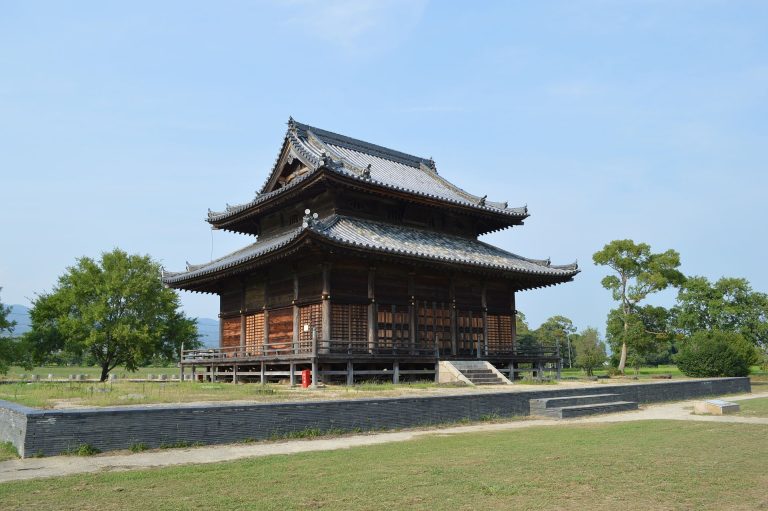
The main hall survived the destruction of 1585, when the other halls were burned during Hideyoshi’s campaign against Negoroji. It belongs to the architectural history of the temple’s medieval and early-modern center and remained the principal surviving building through the later reconstruction of the precinct.
Takimoto-bō and subsidiary cloisters
Takimoto-bō was reconstructed after Hideyoshi’s campaign, following his contribution to the rebuilding. Fourteen subsidiary cloisters were associated with the revival led by Shiichi Shōnin in 1362, while the temple later reached a height of twenty monastic buildings during the Muromachi period. These buildings formed the institutional setting for the temple’s role in Katsuragi asceticism.