Ishite-ji Temple: A Shingon Buddhist Pilgrimage Temple in Japan


Site at a Glance
- Rating
- 4.1
- Popularity
- Medium
- Country
- Japan
- Primary era
- Medieval
- External website
- Open
- Eras represented
- Medieval
- Civilizations
- Kamakura shogunate
- Site type
- Religious
- Remains
- Monastery
On this page24 sections
History
Ishite-ji Temple is a Shingon Buddhist temple in Matsuyama, Japan, traditionally founded in 729 by the monk and sculptor Gyōki. It venerates Yakushi Nyorai, the Buddha associated with healing and medicine, and serves as Temple 51 of the Shikoku 88-temple pilgrimage, a circuit of Buddhist temples across Shikoku traditionally associated with Kūkai.
Origins and religious traditions
Temple tradition places the beginning of the sacred site in 728, when Ochi no Tamazumi, governor of Iyo Province, recognized it after a dream and enshrined twelve Kumano deities. The sanctuary then became an imperial prayer site. In 729, Gyōki carved and installed an image of Yakushi Nyorai and founded the temple. Another version states that Ochi no Tamazumi commissioned Gyōki to consecrate the image and establish the precinct.
The institution was first called Annoyō-ji and was affiliated with Hossō Buddhism, an East Asian school concerned with consciousness and the interpretation of experience. A later tradition says that Kūkai visited in 813 and converted the temple to Shingon Buddhism, an esoteric tradition centered on ritual, mantra, mandala, and initiation.
An alternative account, preserved in a 1688 pilgrimage guide, places the earliest foundation during the reign of Empress Genmei, when Ochi no Tamaoki invited the Hakusan deity, a mountain deity associated with Mount Hakusan, in 712. This tradition was questioned because Hakusan worship is first historically attested elsewhere in 717. A Hakusan shrine appears in an illustration in the 1688 guide, while an 1800 guide does not show it.
The Emon Saburo tradition
Ishite-ji’s name is linked to the story of Emon Saburo, a legendary figure traditionally associated with the beginnings of pilgrimage on Shikoku. One tradition says that the son of a lord of the Kōno clan received prayers at the temple in 892. A stone bearing the words “Emon Saburo is reborn” then appeared from his clenched hand, prompting the change from Annoyō-ji to Ishite-ji, or “Stone Hand Temple.” A casket at the temple houses the stone associated with the story, and a 1567 inscription records the legend.
Another chronology places the child’s birth around 832 and identifies him as Okikata. In this version, he later revered and revived the temple, invited the twelve Kumano deities, and changed its name from Annoyō-ji to Kumanozan Ishite-ji. The different traditions preserve the temple’s enduring connection with Emon Saburo and with the religious origins attributed to the Shikoku pilgrimage.
Medieval prosperity and destruction
The Kōno family protected Ishite-ji from the Heian through the Muromachi periods. During this era, the temple reportedly grew into a large monastic complex with seven principal halls and sixty-six subsidiary residences.
In 1566, a military campaign led by Chōsokabe Motochika caused a fire that destroyed most of the buildings. The main hall, Niōmon, and three-storey pagoda survived the conflagration, preserving important parts of the medieval complex.
Continuing religious life
Ishite-ji remains a pilgrimage and worship site. Religious observances include New Year visits and prayers for protection against misfortune, together with practices connected to the principal Yakushi prayer formula and the pilgrimage verse. The temple also holds an annual opportunity for interior worship in the main hall in late October, while pilgrimage practices take place around the three-storey pagoda.
The Shikoku pilgrimage, including Ishite-ji and the other eighty-seven temples, became a Japan Heritage story in 2015. The temple’s cultural-property designations include the Niōmon as a National Treasure and the main hall, bell tower, three-storey pagoda, Kariteimotendō, and Gomadō as Important Cultural Properties.
The main sanctuary contains a secret seated image of Kūkai that is opened for viewing once every fifty years. Tradition says that Kūkai made it as a keepsake for Emperor Saga when they parted and gave it to the emperor. The imperial line transmitted the image until the reign of Emperor Horikawa, when it was bestowed on Ishite-ji in 1089. The image was displayed for four months in 2023 to commemorate 1,250 years since Kūkai’s birth. The sanctuary was repaired in 2021.
Remains
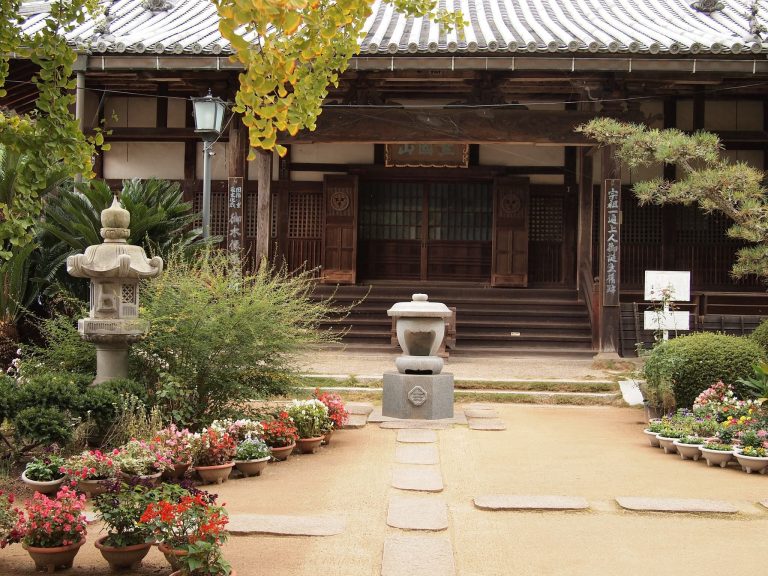
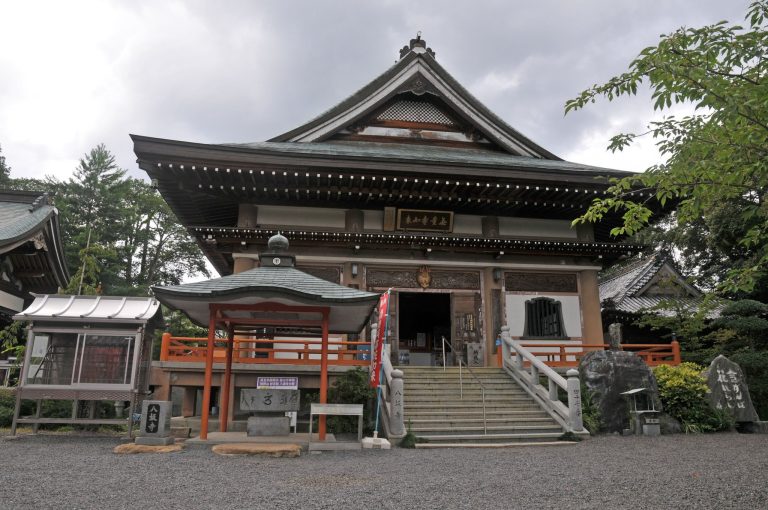
The precinct extends from the prefectural road across Watarazu-no-hashi bridge and past a statue of Emon Saburo. A shopping approach leads to the Niōmon, a gate guarded by two Buddhist guardian figures. Beyond it are the main sanctuary and reception office, with bell towers on both sides and the Amidado farther ahead. The main hall occupies a higher level reached by steps, while the Ema-do and Daishido stand beside and beyond it. The Treasure Hall and Great Lecture Hall occupy the rear-left part of the grounds.
Medieval buildings and entrance area
Niōmon
The Niōmon is a three-bay, single-door, two-storey gate with an irimoya roof, a hipped-and-gabled form covered with traditional tiles. Its broad upper galleries, strongly curving roof lines, and three-step bracket complexes supporting the eaves display characteristic Kamakura-period architecture. The gate is dated to around 1318. Its upper front bays use frog-leg struts, while the side bays contain struts between the bracket complexes.
Inside are wooden standing images of the two Guardian Kings, measuring approximately 253.3 and 251 centimetres high. They date from around 1240, and their style displays characteristics associated with the school of Unkei.
Main hall
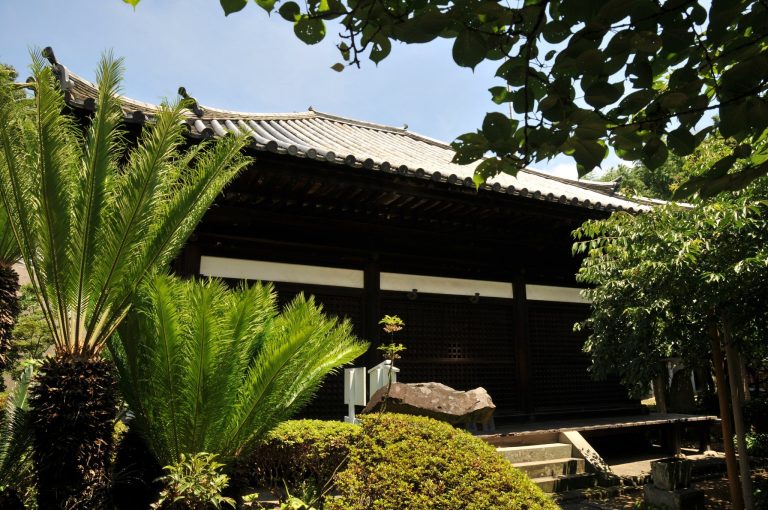
The main hall is a single-storey Buddhist building with five bays across the front and five bays along the sides. Its tiled irimoya roof belongs to the late Kamakura period. The hall houses the seated image of Yakushi Nyorai and stands above the lower precinct on a raised level reached by steps.
Three-storey pagoda
The late-Kamakura three-storey pagoda stands beside the lower steps. The Issaikyō-dō, Gomadō, and Mirokudō are positioned on its opposite side. A sand-stepping pilgrimage representing the eighty-eight temples of Shikoku can be performed around the pagoda.
Bell towers
One bell tower has a lower structure shaped like a hakama and houses a bronze bell measuring 104.6 centimetres in height, with a mouth 59.8 centimetres in diameter. Its inscription is dated June 1251. Only the head priest may ring it. A second, open-sided bell tower stands to the left after the Niōmon and contains a bell that visitors may ring freely.
Sanctuaries and ritual buildings
Main sanctuary
The main sanctuary houses the secret seated image of Kūkai. The entirely lacquer-black figure has open eyes, and worshippers can enter the building to pray. Tradition holds that incense smoke offered before the sanctuary never ceases. The building underwent repairs in 2021.
Amidado
The Amidado contains an image of Amida Buddha. Before the Meiji period, the building housed the seated Yakushi Nyorai image that served as the principal image of the pilgrimage sanctuary.
Daishido
The Daishido contains a large image of Kūkai that closely reproduces the size and appearance of the secret image in the main sanctuary. It was once known as the “Graffiti Hall,” because cultural figures including Masaoka Shiki and Natsume Sōseki wrote on its walls. The walls were replastered during the Second World War, and a white board now provides the place for graffiti.
Kariteimotendō
The Kariteimotendō is a shrine-like structure rather than a hall and enshrines Kariteimo, also known as Kishimojin, a Buddhist protective deity associated especially with children and childbirth. A custom allows pregnant women to take stones from around the structure and return two stones after a safe childbirth.
Issaikyō-dō and Gomadō
The Issaikyō-dō contains a rotating repository for Buddhist scriptures and an image of Fudaishi, a figure associated with sixth-century China. The Gomadō is used for goma fire rituals and contains a standing Fudō Myōō, a wrathful Buddhist protector deity, with two child attendants. The figures were carved from single blocks of wood. The Fudō image is 51.8 centimetres high, while the attendants measure 27 and 27.6 centimetres. The group dates from the mid-Kamakura period.
Mirokudō and Mantra Cave
The Mirokudō bears a plaque referring to Chisoku-ten, identified with Tushita Heaven, the realm associated with Miroku Bosatsu, the future Buddha. Behind the main hall and Daishido is the Mantra Cave, with an entrance behind the main hall and an exit behind the Daishido.
Inner sanctuary, collections, and cemetery
Shōjō-ji
Behind the mountain lies the inner sanctuary, Shōjō-ji. It contains a mantra tower used for perpetual memorial services, an image of Shaka Nyorai, and wooden sculptures of the five hundred arhats.
Treasure Hall
The Treasure Hall holds wooden masks representing heavenly persons and lion heads, twenty-four wooden bodhisattva masks, a ritual platform, a raiban used in Buddhist ceremonies, and a bronze three-pronged ritual bell. Its collection also includes a Kamakura-period hanging painting of the Buddha’s parinirvana, measuring 206.5 by 157.5 centimetres. The stone associated with the Emon Saburo rebirth legend and bones attributed to the great serpent of Waka-ga-fuchi are also displayed there.
Gorintō and burial mounds
A gorintō, a five-part Buddhist memorial stone representing the elements, is associated with a memorial service for Minamoto no Yoshiie, an eleventh-century Minamoto warrior. Made of granite, it dates from the late Kamakura period and stands 273 centimetres high. In 1995 it was moved from the temple entrance to a position beside the road near the centre of the Ishite-ji cemetery behind the precinct.
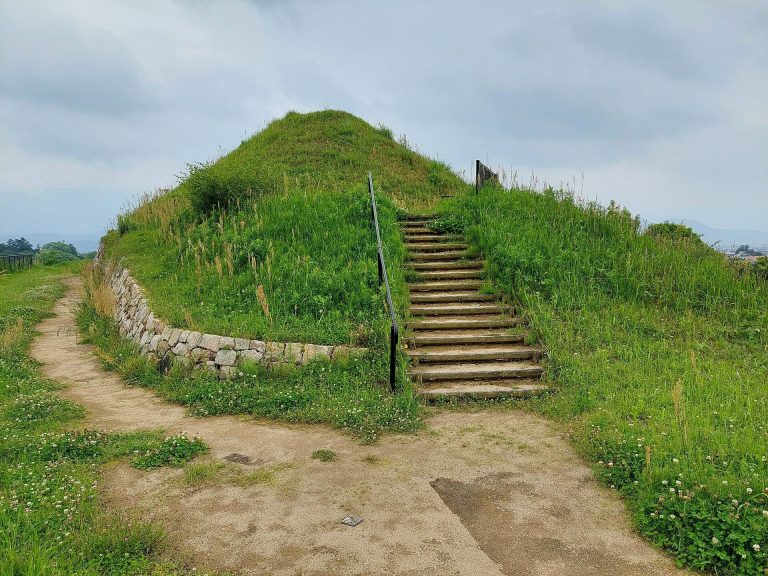
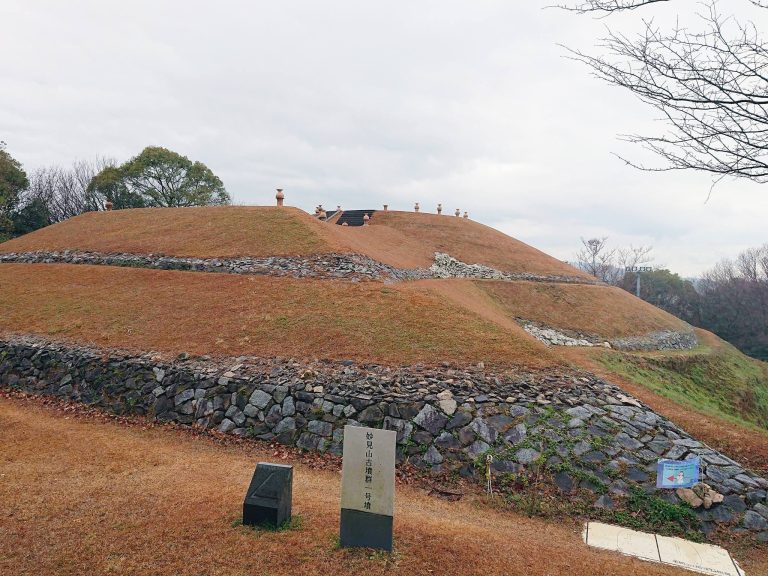
Two Ishite-ji burial mounds are circular tombs approximately 10 metres in diameter, each with a horizontal stone chamber.
Commemorative features
The Ehime Pagoda is a large brick building dedicated to the war dead of Burma. Nearby are a peace monument, a monument inscribed with eighty-four linked-verse poems, and numerous monuments bearing haiku, tanka, and senryū by poets and writers including Masaoka Shiki, Yosano Akiko, Matsuo Bashō, Taneda Santōka, and Natsume Sōseki. The old “Mikaeri” cherry tree stands in front of the Great Lecture Hall.
Traditional wonders and sacred objects
Several physical features are associated with Ishite-ji’s traditional “seven wonders.” Watarazu-no-hashi is said to cause the feet to rot if crossed, while the Fudō Stone is believed to reveal the form of Fudō Myōō. A large straw sandal at the Niōmon is associated with relief from leg and lower-back ailments. Incense smoke is traditionally believed to cure illness.
At the Suitendō, a water jar was once believed to reveal the rise and fall of the tide, although it is now dry. The child-bearing stones beside the Kariteimotendō form another of the wonders, and the Yuon Stone is traditionally said to carry the sound of the waters of Dōgo Onsen. Together with the Emon Saburo stone and the objects preserved in the Treasure Hall, these features connect the physical precinct with the temple’s legends and continuing religious traditions.