Myōtsū-ji Temple: A Kamakura-Period Buddhist Temple in Japan


Site at a Glance
- Rating
- 4.4
- Popularity
- Low
- Country
- Japan
- Primary era
- Medieval
- External website
- Open
- Eras represented
- Medieval, Early Modern
- Civilizations
- Kamakura shogunate, Tokugawa
- Site type
- Religious
- Remains
- Temple
On this page13 sections
History
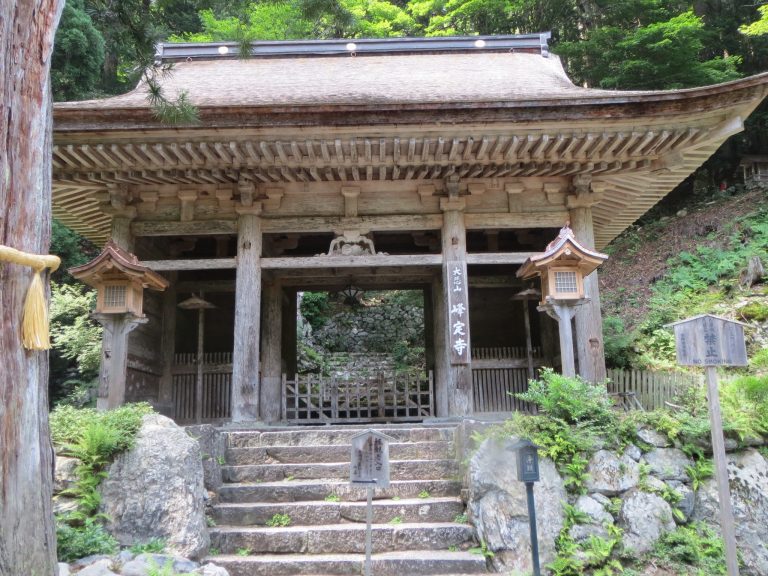
Myōtsū-ji Temple is a Buddhist temple in Obama, Fukui Prefecture, Japan, belonging to the Omuro branch of the Shingon school. Its formal name is Yuzurisan Myōtsū-ji, and its principal image is Yakushi Nyorai, the Buddha of healing and medicine. The temple’s surviving main hall and three-storey pagoda belong to the Kamakura period, Japan’s era of warrior government conventionally dated from 1185 to 1333.
Foundation and medieval revival
The date of Myōtsū-ji’s foundation and much of its early history remain uncertain. A temple record completed in 1374 traditionally places its foundation in 806 and attributes the act to Sakanoue no Tamuramaro, an early Heian-period general and court official, during his journey through the Hokuriku region. The pre-medieval history of the temple is otherwise poorly documented.
The main hall and three-storey pagoda were erected during a medieval revival associated with the monk Raizen, who is regarded as the temple’s reviver. The main hall is dated to 1258 and was completed between 1258 and 1265, while the pagoda dates to 1270. Myōtsū-ji is traditionally said to have suffered destruction by fire three times. The principal image of Yakushi Nyorai is thought to have been made after one of those fires.
Later changes and religious heritage
A fire in 1872 destroyed the temple’s Buddha hall and its principal image of Fudō Myōō, a wrathful Buddhist deity associated with protection and overcoming obstacles. The Fudō statue now enshrined at Myōtsū-ji was transferred from Haga-dera. It had previously been kept at Shōrin-ji, which declined during the Meiji period.
Myōtsū-ji’s main hall and three-storey pagoda are National Treasures and are the only buildings in Fukui Prefecture to hold that designation. Several Heian-period statues at the temple are Important Cultural Properties. In 2015, Myōtsū-ji was included in the Japan Heritage group “Wakasa’s Corridor Heritage Linking the Sea and the Capital: Wakasa, the Miketsukuni, and the Mackerel Road.”
Donations, paintings, and institutional memory
The temple’s 396 donor plaques preserve offerings made between 1309 and 1694, spanning the Kamakura through Edo periods. Their inscriptions mention money, rice, and other goods, as well as prayers such as wishes for the repose of donors’ parents. Together, they illuminate patterns of regional religious practice from the medieval period into the early-modern era.
Myōtsū-ji also preserves six picture scrolls copied in the Edo period. They tell the story of Urashima Taro, the legendary fisherman, and Hoori, a figure known from early Japanese chronicles. The copy was made after the original formerly kept at the temple was presented to Tokugawa Iemitsu, the third shogun of the Tokugawa shogunate, by the feudal lord Sakai Tadakatsu. The painter Kanō Taneyasa, a member of the major Kanō school of Japanese painting, is associated with the copy, which is thought to date from the period between 1634 and 1651, when Tadakatsu was in his thirties.
Remains
Myōtsū-ji’s surviving buildings and objects combine Kamakura-period timber architecture, later repairs, Heian-period Buddhist sculpture, donor records, and Edo-period painting. The principal architectural group consists of the main hall, also called the Yakushi-dō, and a three-storey pagoda, while the temple grounds also include a garden with a pond.
Main hall
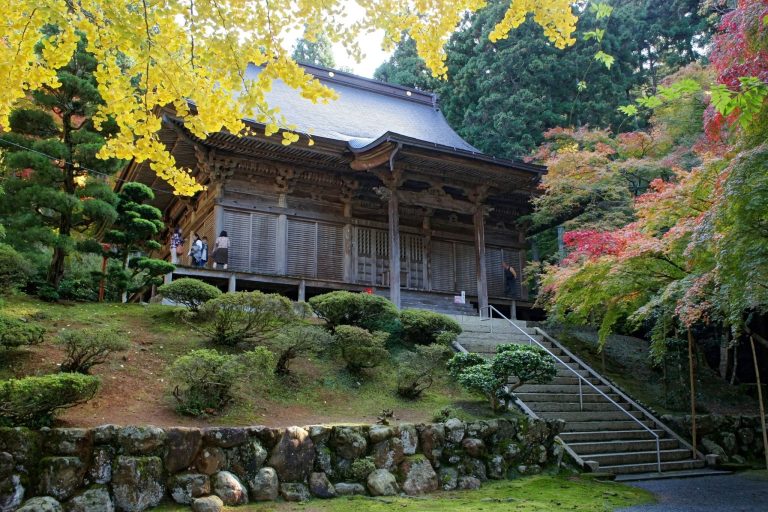
The main hall is a Kamakura-period structure dated to 1258 and completed between 1258 and 1265. It has a gabled roof covered with thin layers of hinoki-cypress bark, known as bark-shingle roofing, and rests on a stone-wall foundation. Its floor plan is five bays wide and six bays deep. The term bay refers to a regular structural space between supporting posts.
Sliding doors extend across the entire front of the building, giving it a residential appearance. Its design uses Japanese architectural forms, while the interior incorporates Zen elements. The space is divided between an inner sanctuary and an outer sanctuary, or prayer hall, an arrangement characteristic of medieval Buddhist temples. The inner sanctuary was enlarged in 1799, and the entire building was dismantled and repaired in 1923.
Three-storey pagoda
The three-storey pagoda was built in 1270 during the Kamakura period and rises 22.12 meters. Its first storey has fist-shaped carvings at the ends of structural members. Called kobushibana, these decorations recall Daibutsu-style architecture and are believed to be the oldest example of the motif on a pagoda.
Four pillars surround the Buddhist altar inside the first storey. Known as Shitenbashira, or the four altar pillars, they stand with a Shaka Triad and an Amida Triad. A Shaka Triad presents Shakyamuni Buddha with attendants, while an Amida Triad presents Amitabha Buddha with attendants. The pillars and walls also carry paintings of the Twelve Heavenly Kings, protective figures associated with Yakushi’s religious circle, although these paintings are not original. Repairs took place in 1539 and 1702. The roof was tiled in 1894 and returned to cypress-bark roofing in 1957.
Buddhist sculptures
Yakushi Nyorai
The seated wooden statue of Yakushi Nyorai dates from the late Heian period or the transition between the late Heian and early Kamakura periods. It is 144.5 centimeters high and uses yosegi-zukuri, a technique in which a sculpture is assembled from several joined wooden blocks. Its forceful, masculine appearance differs from the gentler style associated with the Fujiwara period.
Gōzanzei Myōō
The standing wooden statue of Gōzanzei Myōō dates from the late Heian period and measures 252.4 centimeters in height. Carved from a single block of wood, it stands to the viewer’s right of the principal image. It is not thought to have been one of the original attendants and may instead have been created as one of the Five Wisdom Kings. Gōzanzei Myōō is a wrathful Buddhist deity associated with protection and the overcoming of obstacles.
Jinja-taishō
The standing wooden statue of Jinja-taishō dates from the late Heian period and is 256.6 centimeters high. It was carved from a single block of wood and stands to the viewer’s left of the principal image. Jinja-taishō is a guardian deity represented in Japan among the Sixteen Guardian Deities. The figure wears a skull on its head and bears the head of a young girl on its abdomen, an unusual form that makes sculptures of this deity rare in Japan.
Fudō Myōō
The standing wooden statue of Fudō Myōō is 161.8 centimeters high and dates from the late Heian period. It was carved from a single block of hinoki cypress. Transferred from Haga-dera, the statue is now enshrined at Myōtsū-ji.
Donor plaques and picture scrolls
The 396 donor plaques are wooden boards fixed to beams and other structural members inside the main hall. Their forms include rectangular boards with ink inscriptions, horse-shaped boards, and boards with red writing on black backgrounds. These changing forms accompany the inscriptions that record offerings and prayers from 1309 to 1694.
The six Edo-period picture scrolls are painted in color on silk and measure 32.4 by 5,076.1 centimeters. They present the story of Urashima Taro and Hoori through traditions associated with the Kojiki and Nihon Shoki, early Japanese chronicles. The set preserves the temple’s Edo-period copy of a work that had formerly been kept at Myōtsū-ji.