Taisan-ji Temple in Matsuyama: A Shingon Buddhist Pilgrimage Site
Site at a Glance
- Popularity
- Medium
- Country
- Japan
- Primary era
- Medieval
- Eras represented
- Medieval, Early Modern, Modern
- Civilizations
- Japanese, Kamakura shogunate, Tokugawa
- Site type
- Religious
- Remains
- Temple
On this page12 sections
History
Taisan-ji Temple in Matsuyama, Japan, belongs to the Chizan branch of Shingi Shingon, a lineage within Shingon, the Japanese school of esoteric Buddhism. Its principal image is an Eleven-faced Kannon, a Buddhist figure associated with compassion. Taisan-ji is the 52nd temple on the Shikoku 88-temple pilgrimage and the third on the regional Thirteen Buddhist Sites of Iyo circuit.
Foundation traditions and imperial patronage
A foundation tradition dates the temple’s beginnings to 587. It tells of a wealthy merchant from Usuki in Bungo who was sailing to Naniwa when a storm arose off Takahama. After he prayed to Kannon, a light from a mountain summit calmed the sea, and he reached shore safely. At the summit, he found a small thatched shrine containing an Eleven-faced Kannon image said to be one sun and eight bu tall. A sun and bu are traditional Japanese units, with ten bu to a sun. The place is identified with the present inner sanctuary.
In the story, the merchant vowed to build a temple, returned to Bungo to bring craftsmen and prepare timber joinery, then sailed back to Takahama. The account says that the hall was built overnight. A later foundation tradition places the monk Gyōki at the temple in 739, when he enshrined its principal Eleven-faced Kannon under the patronage of Emperor Shōmu, an eighth-century Japanese ruler. In 749, according to tradition, Shōmu’s daughter Empress Kōken donated another Eleven-faced Kannon and established a seven-hall temple compound at the present site.
Rebuilding and later patronage
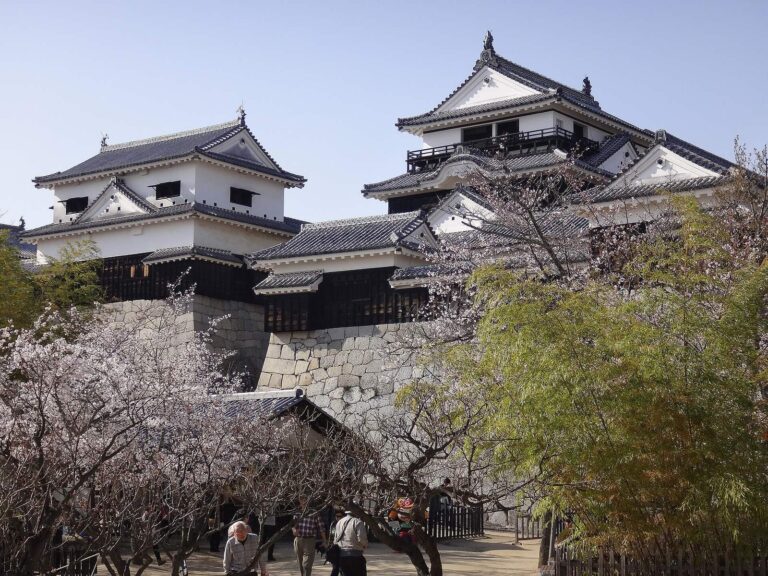
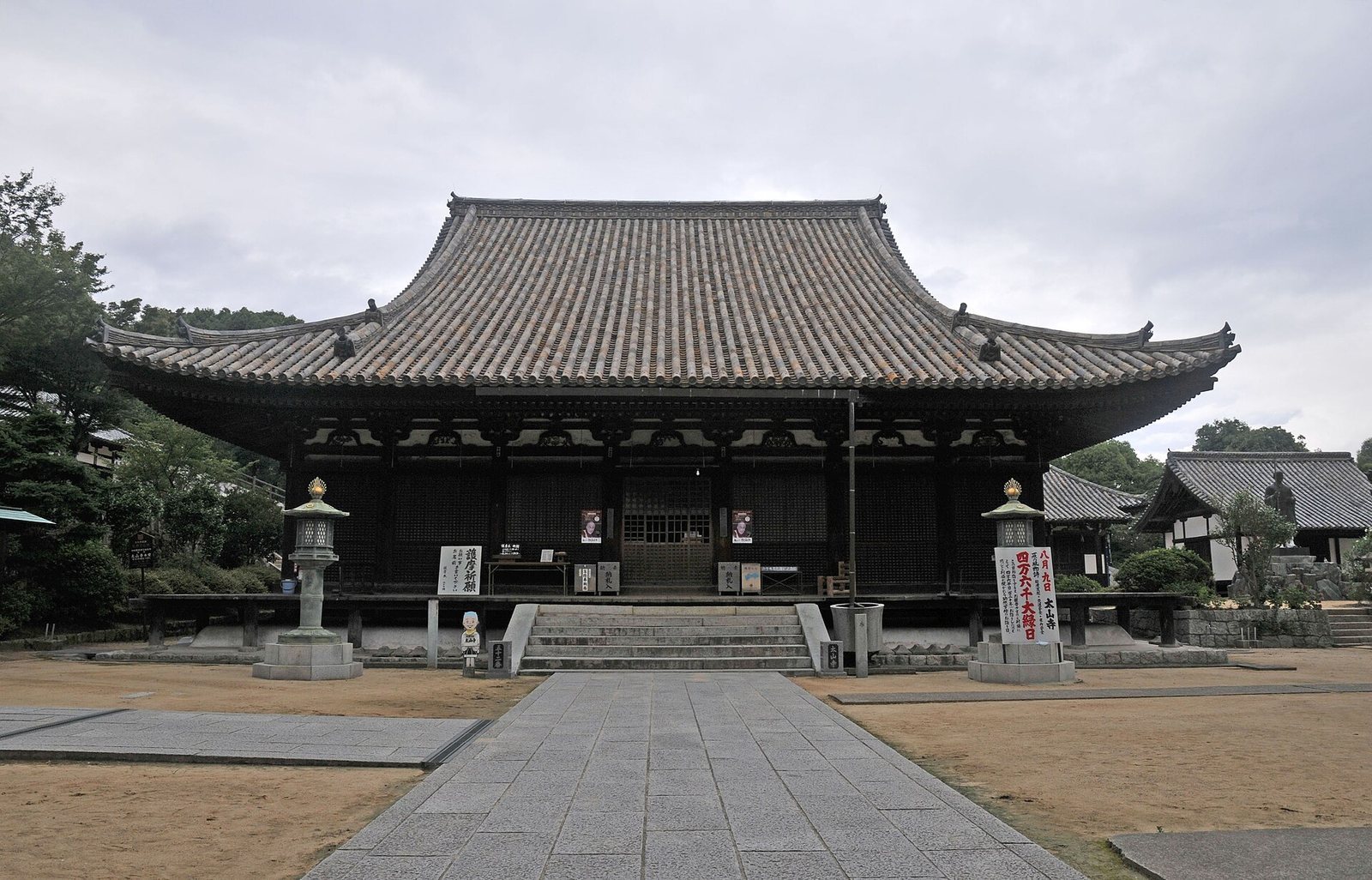
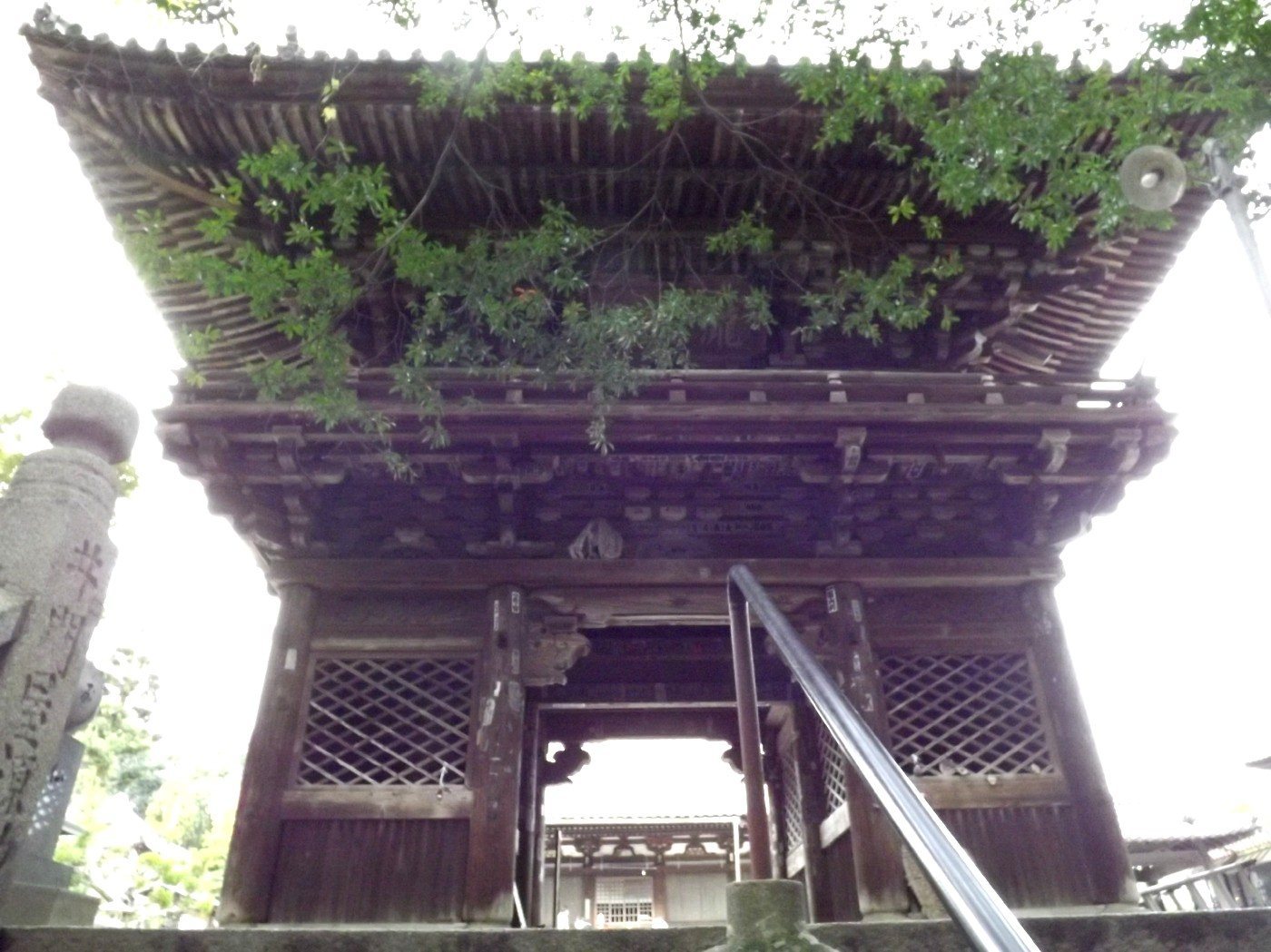
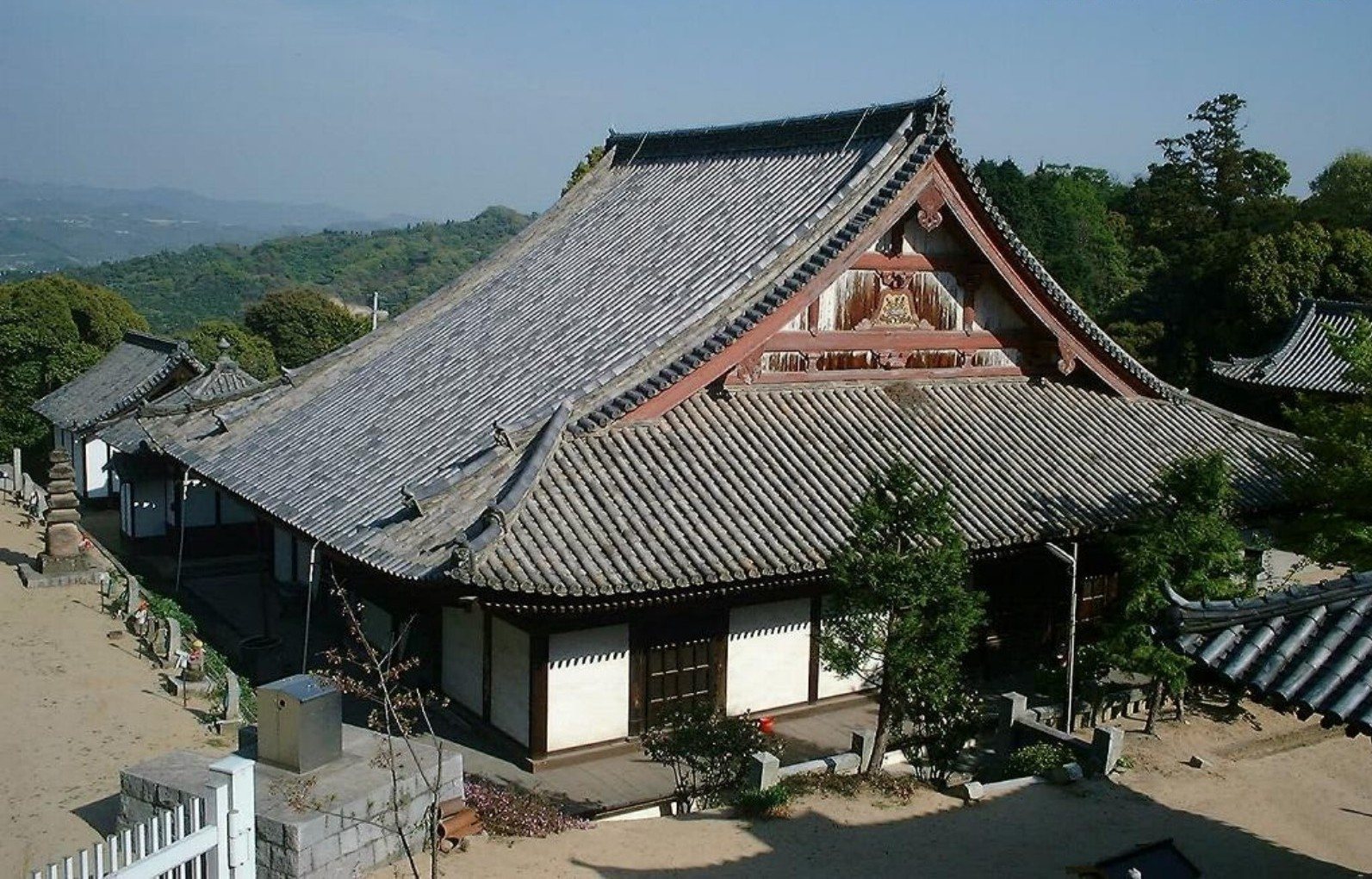
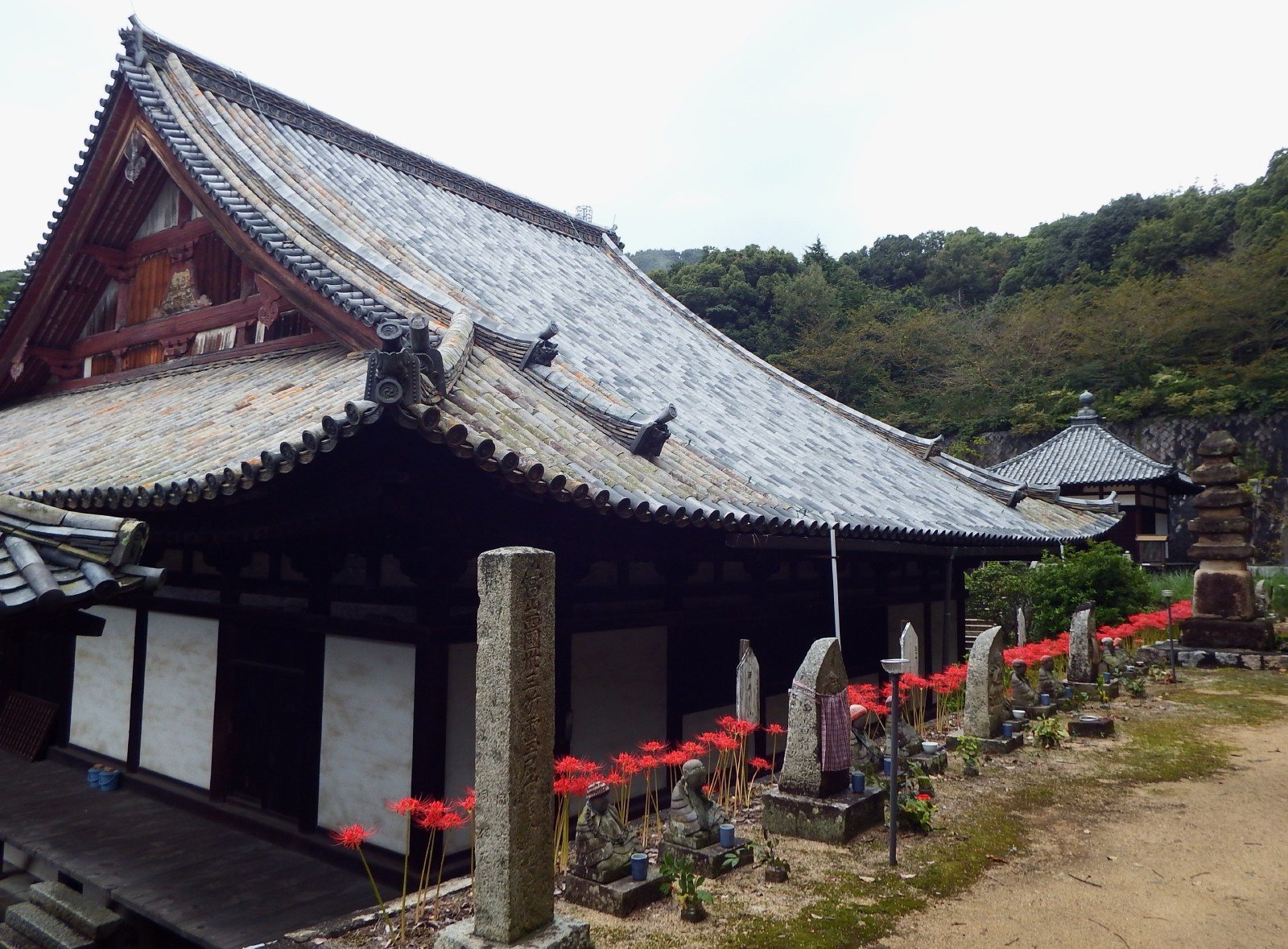
The present main hall is the third building on its site. In 1305, the Kono clan, military governors of Iyo, rebuilt it and the Niōmon, a gate associated with guardian kings. Taisan-ji later prospered under the Kato clan, whose lords governed from Matsuyama Castle. Recorded rebuilding continued in the early modern and modern periods: the bell tower in 1655, the Four Heavenly Kings Gate in 1683, the Daishi Hall in 1884, the First Gate in 1955, and the Prince Shōtoku Hall in 1971.
Pilgrimage and modern recognition
A willow memorial stone was erected in 1743 for the fiftieth anniversary of the death of Matsuo Bashō, a major Japanese haiku poet. It is described as the oldest memorial of its kind in the prefecture. A local replica of the Western 33-temple pilgrimage, a circuit associated with Kannon worship, was established in 1848.
The main hall received the designation of Specially Protected Building in 1904 and became a National Treasure in 1956. The Niōmon was also designated in 1904 and is an Important Cultural Property. The temple’s principal image was opened for public viewing in 2014.
Remains
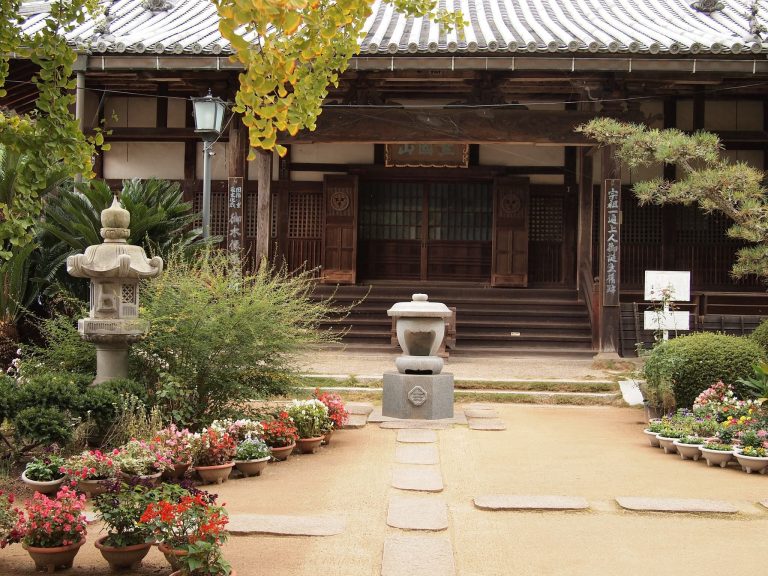
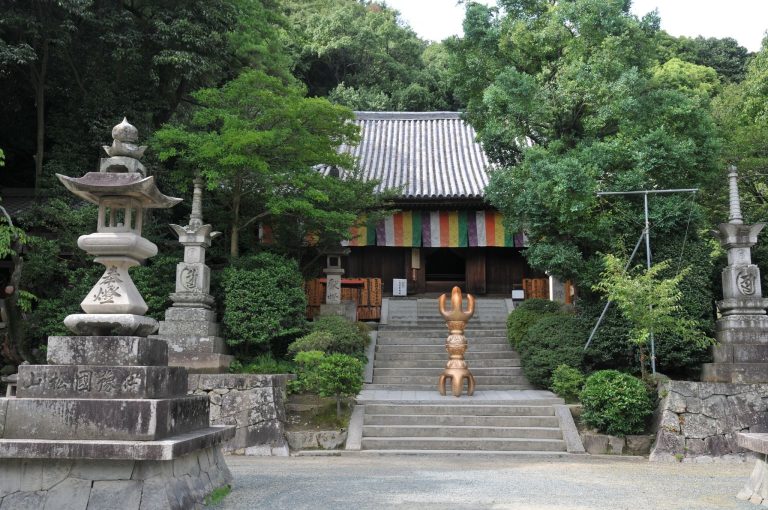
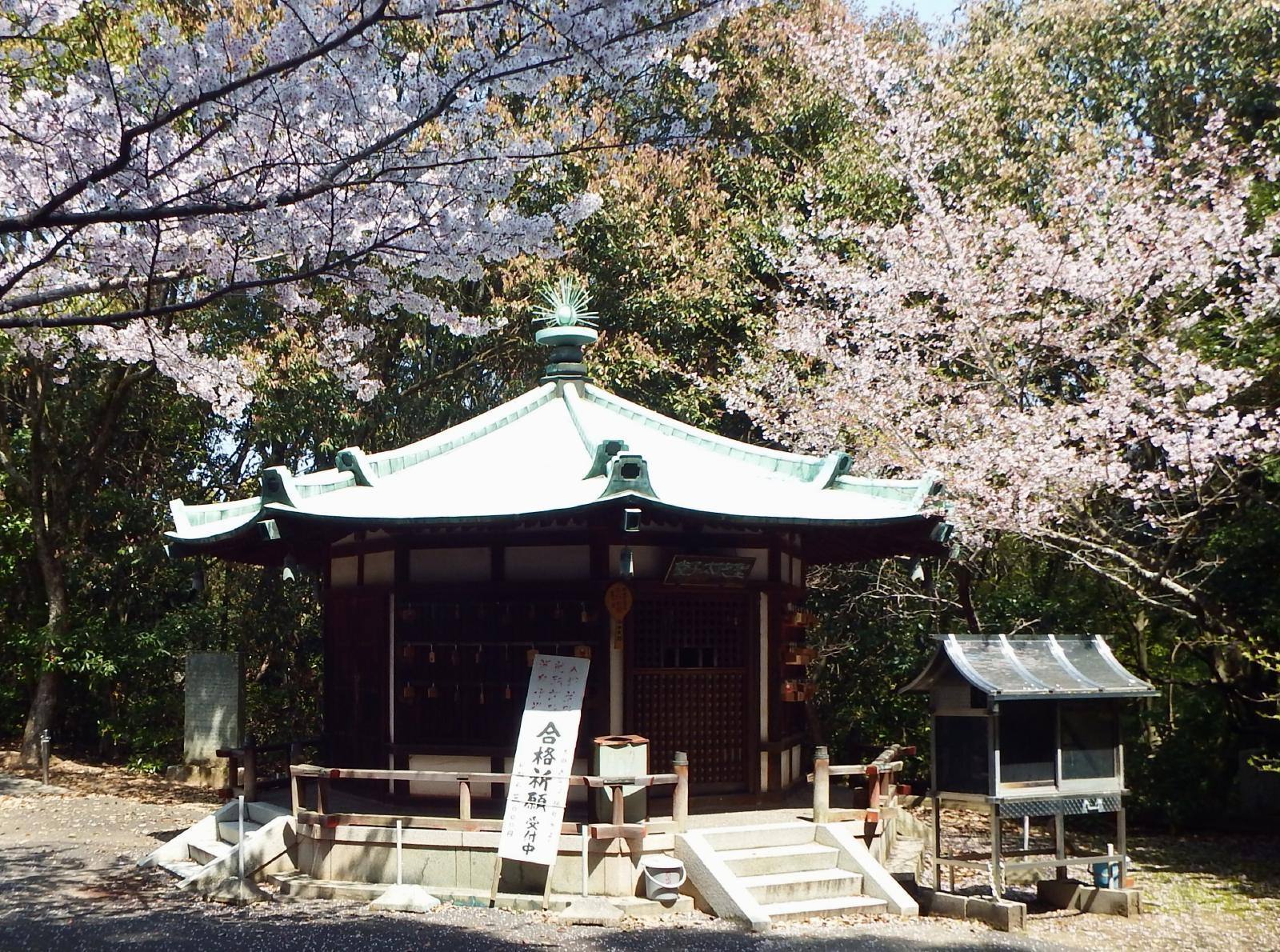
The temple’s layout follows an uphill approach extending 0.8 kilometres from the First Gate to the main hall. Four gates mark the route, which passes stone steps and service buildings before reaching the inner precinct. The complex includes halls and gates with gabled or hipped-gable roofs, alongside stone Buddhist images and carved wooden figures.
Approach and gates
Gates along the approach
The First Gate has two upright posts joined by a horizontal beam and is topped by a gabled roof. The Niōmon is an eight-legged gate with a tiled hipped-gable roof; it houses two guardian-king statues. Farther along the approach is a middle gate, while the two-storey Four Heavenly Kings Gate, whose four named guardians protect the directions, is identified as the third gate.
Buildings and stone images along the route
A Yakushi worship site, dedicated to the Medicine Buddha, and a tea room stand along the approach. A former private house has been converted into a tea shop, with twisted bamboo in its garden, and a former pilgrim inn has been adapted for hospitality. The Jizō Hall shelters a stone image associated with a local story about a teahouse girl at a mountain pass. The story says two men who desired her pulled her apart; the image was later moved from the pass.
Other stone features along the route include Dainichi, the central cosmic Buddha in esoteric Buddhism, a water-pouring Jizō, a water-offering Kannon, and more than ten other Buddhist figures, including images of Daishi, an honorific for the monk Kūkai. At the far end of the approach, a Child-rearing Kannon Hall contains a stone image. A stone Substitute Kannon, once located on the mountain summit, was restored and installed at the temple.
Inner precinct
Main hall and Buddhist images
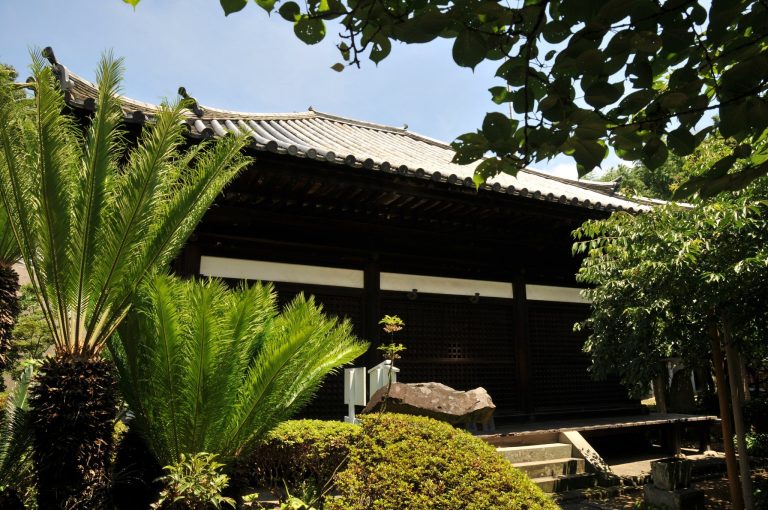
The main hall stands beyond the bell tower. Its wooden standing Eleven-faced Kannon is 155.4 centimetres tall and has an antique-colored finish. The head and torso were carved from one piece of wood; the left forearm, right shoulder and forearm, and backing panel are separate attached sections. The image is kept as a secret Buddhist image. A different Eleven-faced Kannon in the central inner shrine at the rear of the hall is traditionally identified as Empress Kōken’s donation.
Five wooden seated Wisdom Buddhas, dating to the late Heian period (794–1185), form a group centered on Dainichi of the Diamond Realm, one of the principal mandalic realms of esoteric Buddhism. The four other figures are life-size. A mathematical votive tablet, a board dedicated at a religious site with mathematical problems or solutions, is mounted in the main hall’s inner sanctuary.
Bell tower and surrounding halls
The bell tower contains paintings depicting hell and paradise. Its cast-copper bell was made in 1383 and measures 116 centimetres high and 61 centimetres across. To the right of the main hall are the Hall of Calamity-Repelling Daishi, the bell tower, a Goma Hall associated with an esoteric Buddhist fire ritual, an Inari Hall, and the Prince Shōtoku Hall. On the upper level to the left are a Daishi Hall, a hall enshrining the legendary merchant linked to the temple’s foundation, and the Substitute Kannon. A youthful statue of Daishi also stands in the precinct.
Guardian statues, inscriptions, and pilgrimage stations
The Niōmon’s two wooden guardian-king statues date to the late Heian period. They probably were made of Japanese cypress, stand 270 centimetres high, and were carved by shaping a single block into sections before joining them together. Five poetry and inscription stones stand along the approach, two on the right, another farther along on the right, and two on the left. One bears Bashō’s willow verse and a poem by an elderly member of his poetic school. Another carries the words, “I walk toward the bright, swelling clouds.” A further poem stone on the upper level reads, “Birds must fly; people must live.”
Stations 28 through 33 of the Western 33-temple pilgrimage replica are behind the main hall. The remaining stations lie along the mountain path between the Takahama entrance and the temple grounds.