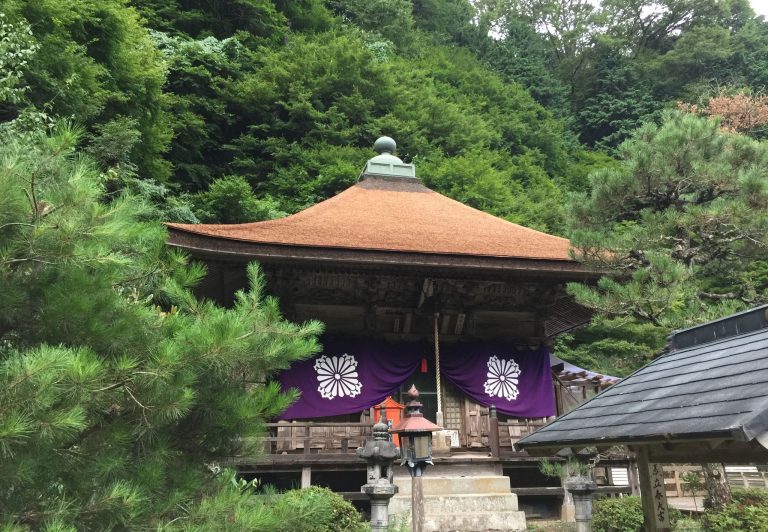
Chōkō-ji Temple: A Historic Kōyasan Shingon Buddhist Temple in Japan


Site at a Glance
- Rating
- 4.2
- Popularity
- Low
- Country
- Japan
- Primary era
- Medieval
- Eras represented
- Medieval, Early Modern, Modern
- Civilizations
- Ashikaga shogunate, Tokugawa
- Site type
- Religious
- Remains
- Temple
On this page10 sections
History
Chōkō-ji Temple is a Buddhist temple of the Kōyasan Shingon school in Japan, located in Hata, Kato, Hyōgo Prefecture. Tradition attributes its foundation to the Buddhist priest Hōdō in 651 on Mount Gongen. Hōdō is a semi-legendary priest traditionally said to have come from India to Japan on a purple cloud, and several temples in eastern Hyōgo preserve foundation traditions associated with him. The early history of Chōkō-ji remains uncertain because few historical records survive.
Relocation and Medieval Development
The temple was moved and rebuilt at its present location near Tsukubane Falls in 1189. In 1413, its main hall was rebuilt, and one of the standing Eleven-Faced, Thousand-Armed, Thousand-Eyed Kannon images from Kyoto’s Sanjūsangen-dō was installed as the western principal image. Kannon is a Buddhist bodhisattva associated with compassion, while these forms emphasize the deity’s many faces, arms, and eyes.
The temple underwent restoration during the Eishō era, approximately from 1504 to 1521, under Akamatsu Yoshimura. He also rebuilt the bell tower, an action preserved in an inscription within its framework. These works formed part of the temple’s continuing development during Japan’s Muromachi period, which lasted from 1336 to 1573.
Temple Network and Later Recognition
A record from 1787 describes a substantial religious community associated with Chōkō-ji, including three training subtemples, 21 residential hermitages, and five branch temples. The subtemples Kichiyō-in and Sōji-in survive, while the names of some former hermitages remain in local place-names.
The main hall received designation as an Important Cultural Property in 1923 and became a National Treasure in 1954. The bell tower is also a nationally designated Important Cultural Property. The tahōtō pagoda and the eastern principal Kannon are designated cultural properties of Hyōgo Prefecture, while the western principal Kannon is a nationally designated Important Cultural Property.
Remains
Chōkō-ji’s surviving buildings and objects represent several periods of construction and use. The central complex includes a large Muromachi-period worship hall, a bell tower with late Kamakura-period features, and a tahōtō, a Buddhist pagoda with a square lower level and cylindrical upper section. Historic Kannon images and dated ritual instruments add further evidence of the temple’s medieval religious life.
Main Hall
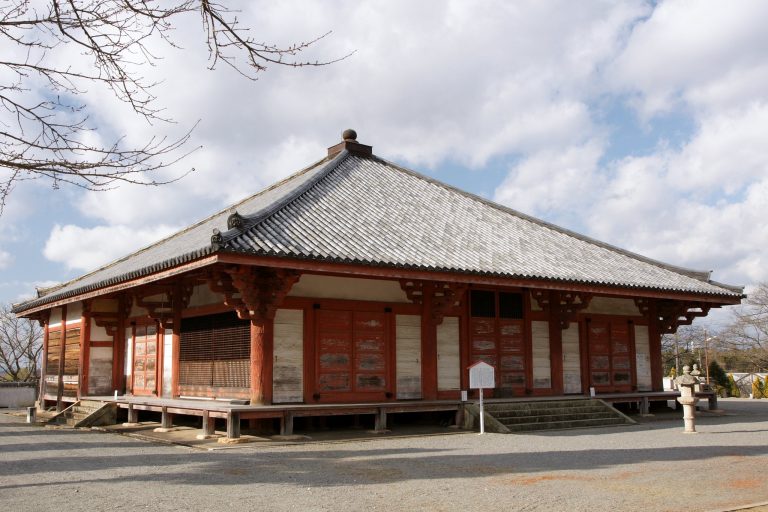
The main hall is a seven-by-seven-bay square building, measuring approximately 19.5 by 19.5 metres. A bay, or ken, is the interval between structural columns, so the dimensions describe column spaces rather than a fixed linear unit. The hall has a hipped roof covered with traditional fired tiles and combines native Japanese elements with features derived from Zen Buddhist architecture, a form of mixed-style design associated with the Muromachi period. A three-bay entrance porch was added to the front in 1829. Its bracket system uses projecting bracket arms, while paired struts support the intermediate sections.
The front portion, extending three bays in depth, forms the outer worship area. Behind it lies a central five-by-three-bay inner worship area, flanked by side sanctuaries and backed by a rear sanctuary. Lattice doors below and a diamond-lattice transom above mark the boundary between the inner and outer spaces. Lattice-panel doors cover the central five bays of the façade and occur in the second and third bays from the front on the sides. Lattice windows occupy the outermost façade bays and the frontmost bays of the side walls.
Principal Kannon Images
Two wooden standing Kannon images are venerated in the temple. The western image dates from 1254 and bears the same signature as 23 Kannon images among the 1,001 images at Kyoto’s Sanjūsangen-dō. The eastern image has no signature, but its style suggests that it belongs to the temple’s foundation period, making it the older of the two. A wooden shrine cabinet on the altar carries an inscription stating that the principal image was transferred in 1413.
Other Buildings and Ritual Objects
Bell Tower
The bell tower has a basic Japanese-style structure with features characteristic of the end of the Kamakura period. Its ridge-beam design is described as highly unusual in Japan. The framework also contains the inscription associated with its rebuilding under Akamatsu Yoshimura during the Eishō era.
Tahōtō Pagoda
The tahōtō originally dates from the Bunji era, approximately 1185 to 1190. The present pagoda was rebuilt in 1601 at the request of the daimyō Ikeda Terumasa. Its design uses a mixed architectural style characteristic of that period.
Gong and Drum
A circular, shallow wani-guchi, or flat round metal entrance gong, hangs above the entrance porch. Made in 1285, it can be rung with a rope and clapper and is described as the oldest example in Hyōgo Prefecture. The temple also preserves a taiko drum bearing an inscription dated 1298.