Hashika-ji Temple: A Buddhist Temple and Pilgrimage Site in Japan
Site at a Glance
- Rating
- 4.6
- Popularity
- Very Low
- Country
- Japan
- Primary era
- Unclassified
- Eras represented
- Unclassified
- Civilizations
- Unclassified
- Site type
- Religious
On this page13 sections
History
Hashika-ji Temple is a Buddhist temple in Kato, Japan, traditionally founded in 549 by Prince Shotoku and associated with the Koyasan Shingon school, a Japanese branch of esoteric Buddhism. Its origin tradition connects the temple with Shotoku’s visit to the area while he lectured on the Srimala Sutra. After rescuing a white deer through prayers to Yakushi Nyorai, the Buddhist Buddha of healing and medicine, he carved and enshrined an image of the deity.
Early Development
During the temple’s early period, a large complex with a tiered pagoda is thought to have stood at the foot of Hakuroku-san, the mountain name associated with Hashika-ji. In 725, the monk Gyoki visited the site. He established a hall, moved the image of Yakushi Nyorai into the mountain to its present mountain location, and carved and enshrined an image of Eleven-Faced Kannon, a compassionate form of the bodhisattva Kannon.
Medieval Reconstruction
In 1426, Akamatsu Noriyasu, the eldest son of Akamatsu Mitsusuke, arranged repairs to the main hall because of concern about its deterioration. The Akamatsu were a medieval warrior house with political and military power in the Harima region. A tahoto pagoda, a Japanese pagoda with a square lower section and circular upper section, was completed in 1435. The temple buildings were completed in March 1439.
Edo-Period Expansion and Pilgrimage
In 1648, during the rule of Tokugawa Iemitsu, the third shogun of the Tokugawa shogunate, Hashika-ji received 18 koku of shogunal land through a vermilion-seal grant. A koku measured the productive capacity of an agricultural estate. The Kannon Hall was completed in 1665, and the temple became station 22 of the newly established Harima Saigoku Thirty-Three Kannon pilgrimage.
A registry of head and branch temples of the Old Shingon school lists Hashika-ji as a branch of Koyasan Hojo-in and places 20 buildings within its precinct. Its associated subtemples included Daijo-in, with six buildings, and Nanzoin, with eight, producing a recorded total of 34 buildings.
Separation, Fire, and Loss
The Meiji government’s policy of separating Buddhism and Shinto ended Hashika-ji’s connections with three shrine-temple complexes. These were Tenjin Ichinomiya Shrine and its former associated Buddhist temple, Jisso-bo; Kurotani Wakamiya Hachiman Shrine and Iwano-bo; and Akitsu Sumiyoshi Shrine and Joju-in. The associated Buddhist temples of Hashika-ji’s subtemples were later abolished.
A fire in 1880 destroyed nearly all the temple buildings. The tahoto pagoda, bell tower, Daijo-in, and Nanzoin survived. The bell was later requisitioned for wartime use during the Pacific War. After prolonged weather damage, the bell tower was dismantled during the Heisei era, the period from 1989 to 2019. The tahoto pagoda was sold to Sayama Fudo Temple in 1964 because funds could not be secured for its dismantling and repair.
Hashika-ji remains station 22 on the Harima Saigoku Thirty-Three Kannon pilgrimage and station 22 on the Kato Shikoku Eighty-Eight-Site pilgrimage.
Remains
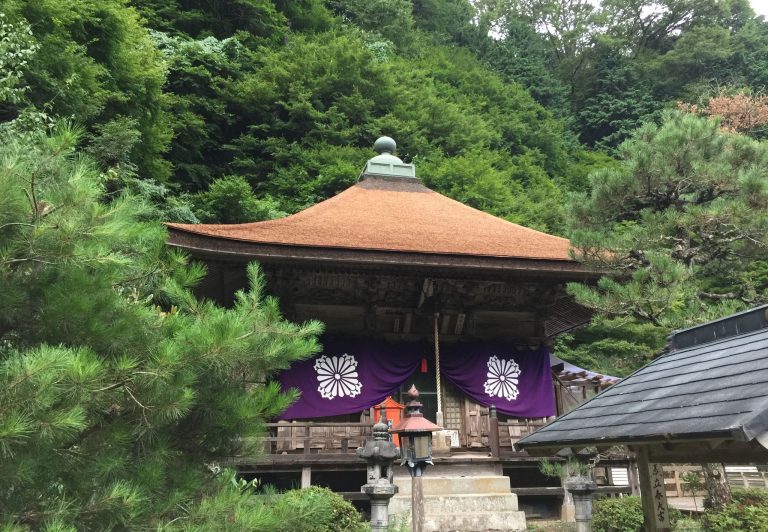
Hashika-ji’s historic complex was associated with the foot and mountain setting of Hakuroku-san. Its buildings included a main hall, a tahoto pagoda, a bell tower, a Kannon Hall, and the subtemples Daijo-in and Nanzoin. The surviving temple buildings are the main hall, Daijo-in, and Nanzoin, while the pagoda and bell tower are remembered through their later history.
Main Hall and Enshrined Images
Main Hall
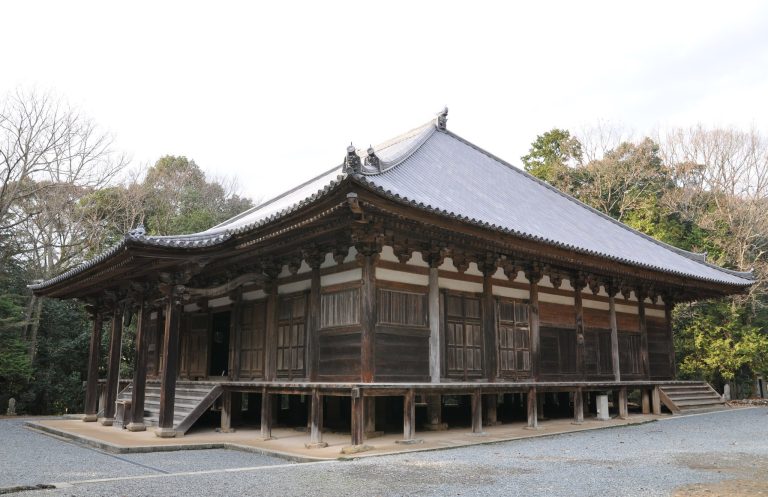
The main hall is one of the surviving buildings at Hashika-ji and houses the temple’s principal image, Yakushi Nyorai. A wooden image of a white deer is also enshrined there. The deer relates to the foundation tradition and to the origin of the mountain name associated with the temple.
Eleven-Faced Kannon
The temple also preserves the association with the image of Eleven-Faced Kannon that Gyoki carved and enshrined in 725. The image belongs to the temple’s early mountain history, when Gyoki established a hall and relocated the Yakushi Nyorai image to its present mountain location.
Former Architectural Features
Tahoto Pagoda
The tahoto pagoda was completed in 1435 as part of the medieval rebuilding of Hashika-ji. It survived the 1880 fire, but was removed from the temple grounds and sold to Sayama Fudo Temple in 1964. Its distinctive form consists of a lower square section and an upper circular section.
Bell Tower
The bell tower also survived the 1880 fire. Its bell was requisitioned during the Pacific War, and weather damage eventually led to the tower’s dismantling during the Heisei era.
Daijo-in and Nanzoin
Daijo-in and Nanzoin are surviving temple buildings from the former network of associated subtemples. The historical registry assigned six buildings to Daijo-in and eight to Nanzoin, within a wider Hashika-ji complex that contained 34 buildings when the head-and-branch temple register was compiled.