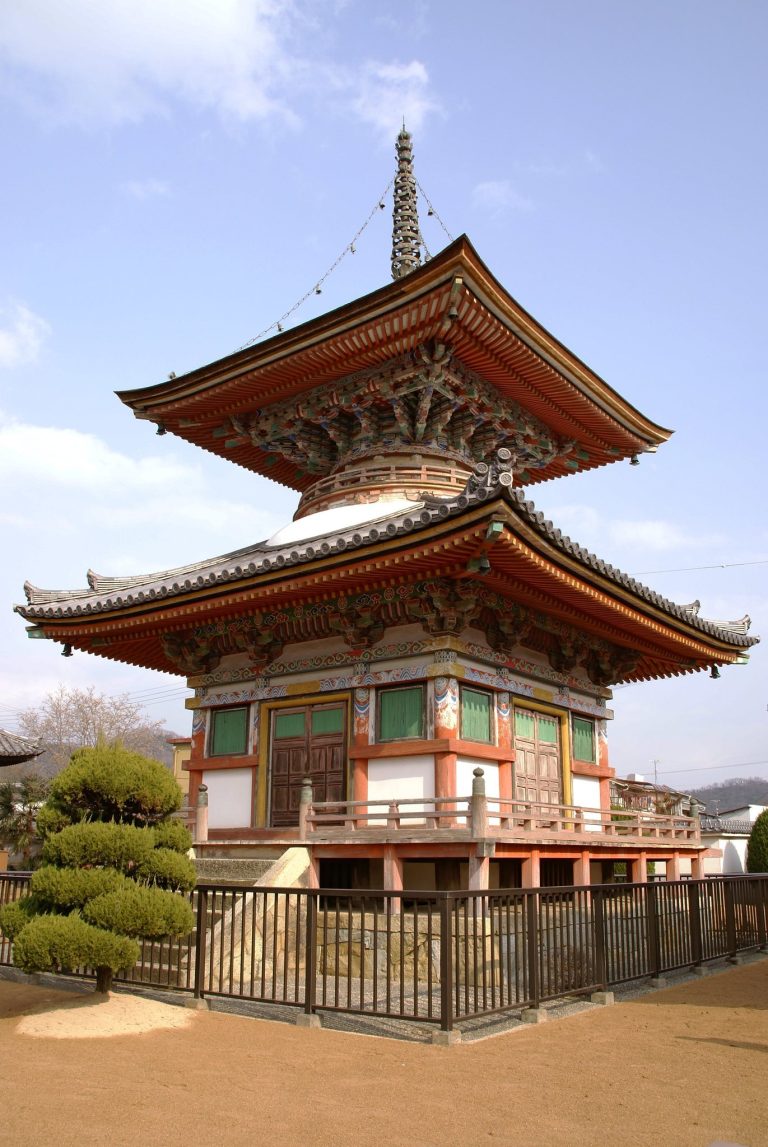
Jōdo-ji Temple: A Shingon Buddhist Temple and Daibutsuyō Monument in Ono, Japan


Site at a Glance
- Rating
- 4.3
- Popularity
- Low
- Country
- Japan
- Primary era
- Medieval
- External website
- Open
- Eras represented
- Medieval, Early Modern
- Civilizations
- Ashikaga shogunate, Kamakura shogunate, Tokugawa
- Site type
- Religious
- Remains
- Temple
On this page16 sections
History
Origins and Chōgen’s revival
Jōdo-ji Temple is a Koyasan-branch Shingon Buddhist temple in Ono, Japan, whose present complex was established in the late twelfth century in the Daibutsuyō architectural style. Its principal objects of worship are Bhaisajyaguru, the Medicine Buddha associated with healing and the Eastern Pure Land, and the Amitabha Triad, which represents the Western Pure Land. The temple also serves as an additional station on the New Saigoku Thirty-Three Kannon Pilgrimage.
Tradition places the origin of a predecessor temple about 2 kilometres west of the present site. The monk Gyōki is said to have founded it during the reign of Emperor Shōmu. Warfare later brought destruction and decline, after which the institution became the predecessor of Jōdo-ji.
The temple was revived by Chōgen, the Japanese Buddhist monk who directed the reconstruction of Tōdai-ji after the burning of Nara in 1180. Chōgen established seven regional branch temples to support that rebuilding effort, and Jōdo-ji became Tōdai-ji’s Harima branch temple within the Tōdai-ji-owned Ōbe Estate. In 1194, the predecessor was transferred to the present location and given the name Jōdo-ji. Chōgen is regarded as its effective founder.
The Yakushidō and Jōdodō were established at the new site in 1197. Their arrangement gave physical form to the temple’s Pure Land symbolism. The Yakushidō stood east of the central pond as the dwelling of Bhaisajyaguru, lord of the Eastern Pure Land, while the Jōdodō stood to the west as the dwelling of Amitabha, lord of the Western Pure Land.
Later rebuilding and religious practice
Fire and rebuilding shaped the complex during the medieval period. The Yakushidō burned in 1498 and was reconstructed in 1517. The Kaizandō was also destroyed by fire that year and rebuilt in 1520. The bell tower was reconstructed in 1632.
Jōdo-ji preserves materials connected with the medieval raigō-e, a Buddhist ritual or procession representing the descent of Amitabha and attendant bodhisattvas to welcome the dead into the Pure Land. The temple’s Amitabha imagery and bodhisattva masks remain closely associated with this practice. The temple’s use of evening light to evoke Amitabha’s arrival later influenced the Water Hall at Honpuku-ji, a twentieth-century Shingon temple designed by Tadao Ando and completed in 1991.
The temple’s heritage assets include two National Treasures of Japan, the Jōdodō and its Amitabha Triad. The Yakushidō, the Hachiman Shrine’s main sanctuary and worship hall, the sculpture of Chōgen, the 1201 Amitabha, the twenty-five bodhisattva masks, copper ritual objects, and several paintings and furnishings are Important Cultural Properties. The Kaizandō, bell tower, and two bodhisattva masks have prefectural cultural-property status. Ono City designates the traditional tomb attributed to a monk traditionally identified as Chōgen’s disciple.
Remains
Western and eastern halls
Jōdodō
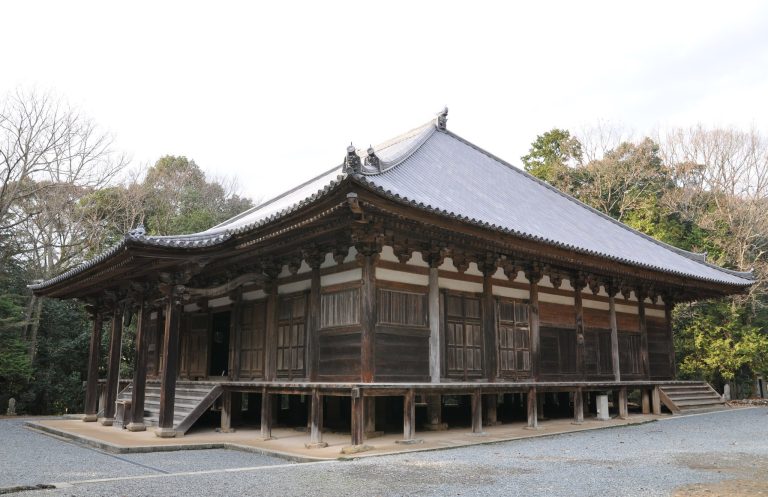
The Jōdodō, also called the Amidadō, stands on the western side of the precinct and is a National Treasure. Built under Chōgen’s direction, it was roofed in 1194, completed and consecrated in 1197, and is the only surviving Buddhist hall built entirely in the Daibutsuyō style. The style, whose name means “Great Buddha style,” uses large structural members, penetrating tie beams, exposed construction, and techniques influenced by Song China.
The hall has a simple square, three-bay plan, with four columns on each side and approximately 6 metres between the columns. This arrangement creates a large interior space beneath a low pyramidal roof covered with fired tiles. The roof lines are notably straight, and the restrained exterior contrasts with the strongly expressed structure within.
Inside, there is no suspended ceiling or enclosed attic. Beams, penetrating horizontal tie members, and other structural elements remain visible, forming both the working structure and the finished interior decoration. The Amitabha figures face east. When the rear shutters are raised, evening light enters from the west and can suffuse the interior with a deep vermilion glow. The effect evokes Amitabha’s welcome from the Western Pure Land, while the surrounding ponds appear to have been calculated to bring the western light into the composition.
Yakushidō
The Yakushidō is the temple’s main hall and occupies the eastern side of the central pond. Its original building was established in 1197 and is said to have shared the Jōdodō’s Daibutsuyō style. The present hall was reconstructed in 1517 after the fire of 1498. It has a pyramidal tiled roof and combines Japanese, Chinese-derived, and Daibutsuyō elements.
Shrine and supporting buildings
Hachiman Shrine
The Hachiman Shrine’s main sanctuary was founded in 1235, rebuilt during the middle of the Muromachi period, and given a three-bay nagare-zukuri form. Its worship hall was founded in 1239 and rebuilt during the later Kamakura period. The hall combines Japanese and Daibutsuyō features.
Kaizandō and bell tower
The Kaizandō has a pyramidal tiled roof and was rebuilt in 1520 after the fire of 1498. The bell tower, whose original construction date is unknown, was rebuilt in 1632 and has an irimoya roof covered with fired tiles. Other buildings in the precinct include the Fudōdō, Kyōzō, and Monjudō, the last of which also serves as a rest space.
Higashiyama group and subtemples
The Higashiyama group consists of stone images representing the eighty-eight sacred places of Shikoku. They were produced around the late Edo-period Bunka and Bunsei years, approximately 1804 to 1831. The precinct also includes a hydrangea garden and the subtemples Hōji-in and Kanki-in. Kanki-in enshrines an image of Mahavairocana.
Sculpture and ritual objects
Amitabha Triad
The National Treasure Amitabha Triad stands on the central altar of the Jōdodō. The sculptor Kaikei made it in 1195. Amitabha stands at the center, Avalokiteshvara stands on the viewer’s right, and Mahasthamaprapta stands on the viewer’s left. These two figures are the bodhisattva attendants commonly paired with Amitabha.
The central Amitabha is approximately 5.3 metres high, while each attendant measures approximately 3.7 metres. Including the altar, the central figure reaches approximately 7.5 metres. All three figures stand on lotus bases with clouds represented below them, and their slight forward inclination conveys their arrival from the Western Pure Land.
The central figure extends the right hand toward worshippers, an unusual gesture in comparison with the more common left-hand gesture of other Amitabha images. Its fingernails are also unusually long. The triad shows pronounced influence from the Song dynasty. Its reversed attendant arrangement has been associated either with forms used in esoteric Buddhist temples and scriptures or with Kaikei’s use of Chinese Buddhist paintings as models.
Other images and masks
Kaikei made the Important Cultural Property wooden standing Amitabha in 1201 for the raigō-e procession. The figure is 266.5 centimetres high and has an intentionally bare upper body so that an actual robe could be placed on it during the ceremony. Commonly called the “Naked Amitabha,” it is deposited on loan at the Nara National Museum.
A wooden seated image of Chōgen, made before 1234, measures 81.2 centimetres high. It was carved in Nara as a reproduction modeled on the image of Chōgen at Tōdai-ji. The temple also preserves twenty-five wooden bodhisattva masks made by Kaikei’s workshop during the Kamakura period for use in the raigō-e. Two of these masks are separately designated as cultural properties of Hyōgo Prefecture.
Copper objects and paintings
An Important Cultural Property copper ritual gong bears an inscription identifying it as belonging to Harima Jōdodō, a Tōdai-ji branch temple, and dating it to 1194. An object of identical form survives at Tōdai-ji. A copper gorintō, a Japanese Buddhist stone monument formed from five symbolic elements, was also made in 1194.
Other associated works include two early Kamakura-period black-lacquer butterfly-shaped three-legged tables, a Kamakura-period silk painting of the Buddha’s Nirvana, and a silk painting of the eight patriarchs of Shingon Buddhism. Further designated objects include an early Kamakura-period wooden standing Amitabha attributed to the Kaikei workshop, a plaque bearing the inscription “Jōdodō” traditionally attributed to Ono no Michikaze, former Jōdodō wooden wall panels covered with numerous ink graffiti inscriptions, and two versions of the Great Perfection of Wisdom Sutra. One of those versions was donated in 1796 by Ichiyanagi Suehide, lord of the Ono domain.
Stone memorials
The traditional tomb attributed to a monk identified by temple tradition as a disciple of Chōgen consists of a stone gorintō and a stone six-tiered pagoda. A further temple tradition places a cemetery northwest of Jōdo-ji, with a nine-tiered pagoda and a gorintō.