Miki Castle: Stronghold of the Bessho Clan in Japan
Site at a Glance
- Rating
- 3.8
- Popularity
- Low
- Country
- Japan
- Primary era
- Medieval
- External website
- Open
- Eras represented
- Medieval
- Civilizations
- Oda regime
- Site type
- Military
- Remains
- Castle
On this page14 sections
History
Miki Castle was a Japanese hilltop castle in Miki, Japan, and the principal stronghold of the Bessho clan in eastern Harima. Also known as Kamayama Castle and Bessho Castle, it stood near the Yuyama Road, an established route between Kyoto and Arima, on the south bank of the Minogawa River. Its foundation is traditionally placed around 1492, although another interpretation holds that an earlier fort at Kimigamine was moved to the present site. The castle had a hirayamajo form, meaning a castle built on a hill beside flatter ground, with the defensive character of a mountain castle.
Rise of the Bessho power
The castle’s founder, Bessho Noriharu, became a powerful retainer of the Akamatsu clan after helping Akamatsu Masanori recover his position as head of the family in 1484. In return, Noriharu received control of eight districts. He became one of the strongest figures among the Akamatsu retainers, second in influence only to the Uragami clan, and the Bessho territory gradually developed into an independent regional power.
Under Noriharu’s grandson, Bessho Nariharu, Miki Castle was drawn into repeated conflicts. In 1530, forces associated with Hosokawa Takakuni and Uragami Muramune captured it, temporarily driving Nariharu into exile. He returned after Muramune’s defeat and Takakuni’s suicide in 1531. Amago Haruhisa attacked the castle in 1538 and again in 1539. Although many eastern Harima warriors submitted to the Amago army, Miki remained the principal Bessho stronghold in the region.
The Miyoshi clan captured seven subsidiary forts belonging to Miki Castle in 1554. Nariharu later submitted to the Miyoshi coalition, but the Bessho regained their independence after the death of Miyoshi Nagayoshi. They destroyed the rival Yorifuji clan in 1559. In 1568, Bessho Yasuharu abandoned the Miyoshi alliance and joined Oda Nobunaga, a warlord who began the military unification of central Japan. Bessho Nagaharu subsequently defeated the Arita clan and expanded the Bessho domain into a regional state during the Sengoku period, an era of political fragmentation and warfare that lasted from the fifteenth to the late sixteenth century.
The Siege of Miki
In March 1578, Nagaharu unexpectedly refused to support Nobunaga’s campaign against the Mōri clan, a powerful warlord family based in western Japan. He shut himself inside Miki Castle against Hashiba Hideyoshi, Nobunaga’s principal commander in the campaign against western Japan. The decision has been associated with a dispute at the Kakogawa conference, although another interpretation holds that Nagaharu had already reached an agreement with Mōri Terumoto.
The resulting Siege of Miki lasted from spring 1578 until January 1580 and became known as the “Miki starvation.” Oda forces burned the castle town, built garrison forts, and gradually captured castles supporting the Bessho side. The Bessho were also supported by eastern Harima castles including Kanki, Shikata, Ōgo, Takasago, and Hatatani. Hideyoshi faced further difficulties because of the Bessho alliance with the Mōri and threats elsewhere, especially after Araki Murashige, lord of Itami Castle, rebelled in 1578.
The defeat of the Mōri navy and the later defection of the Ukita clan deprived Miki of effective outside relief. Hideyoshi completed the encirclement and cut the castle’s food supplies in 1579. In January 1580, his forces captured the Miyano-ue and Takaoyama positions and the Shinjō fort. Nagaharu agreed to surrender on the condition that the castle soldiers would be spared. On 2 February 1580, he, his uncle Bessho Kaga, and his brother Bessho Tomoyuki committed suicide, after which the castle opened its gates.
Later administration and abandonment
After the siege, Hideyoshi placed a castellan at Miki while using Himeji Castle as his principal residence. Nakagawa Hidemasa entered Miki Castle in 1585, and his brother Nakagawa Hidenari succeeded him after Hidemasa was killed during the Korean campaign in 1592. Hidenari was transferred to Bungo in 1594, after which the castle became a direct possession of the Toyotomi government and was administered by castle guards.
Following the Battle of Sekigahara, Ikeda Terumasa became lord of Harima and made Miki one of six castles subordinate to Himeji. His senior retainer Igi Tadatsugu held Miki with a fief of 30,000 koku, followed by Igi Tadashige. The castle was abandoned and demolished in 1615 under the One Castle per Province policy, a Tokugawa measure that restricted each province to a single officially maintained castle. The old timber was reportedly reused in the construction of Akashi Castle, although this claim remains unconfirmed.
Archaeological investigations have identified about 30 siege forts and approximately 10 kilometers of earthwork lines built by Hideyoshi around Miki Castle. The castle ruins and associated siege works received protection as a National Historic Site in 2013.
Remains
The surviving castle area occupies a plateau south of the Minogawa River. Steep cliffs, valleys, mountains, and other natural barriers protected the site, while the southeast formed its most exposed approach. The original castle extended into what is now central Miki, but the area around the main enclosure preserves the principal remains. Uenomaru Park, created on the main enclosure in 1897, now covers part of the site, while a city museum, a former city library, a nursery, and Inari Shrine occupy other sections of the former castle grounds.
Main enclosure
Main enclosure
The main enclosure stood at an elevation of 58.2 meters, about 20 meters above the surrounding ground. Steep scarps enclosed it, and dry moats lay to the north and south. Several wells have been identified within the enclosure, which formed the principal elevated defensive area of the castle.
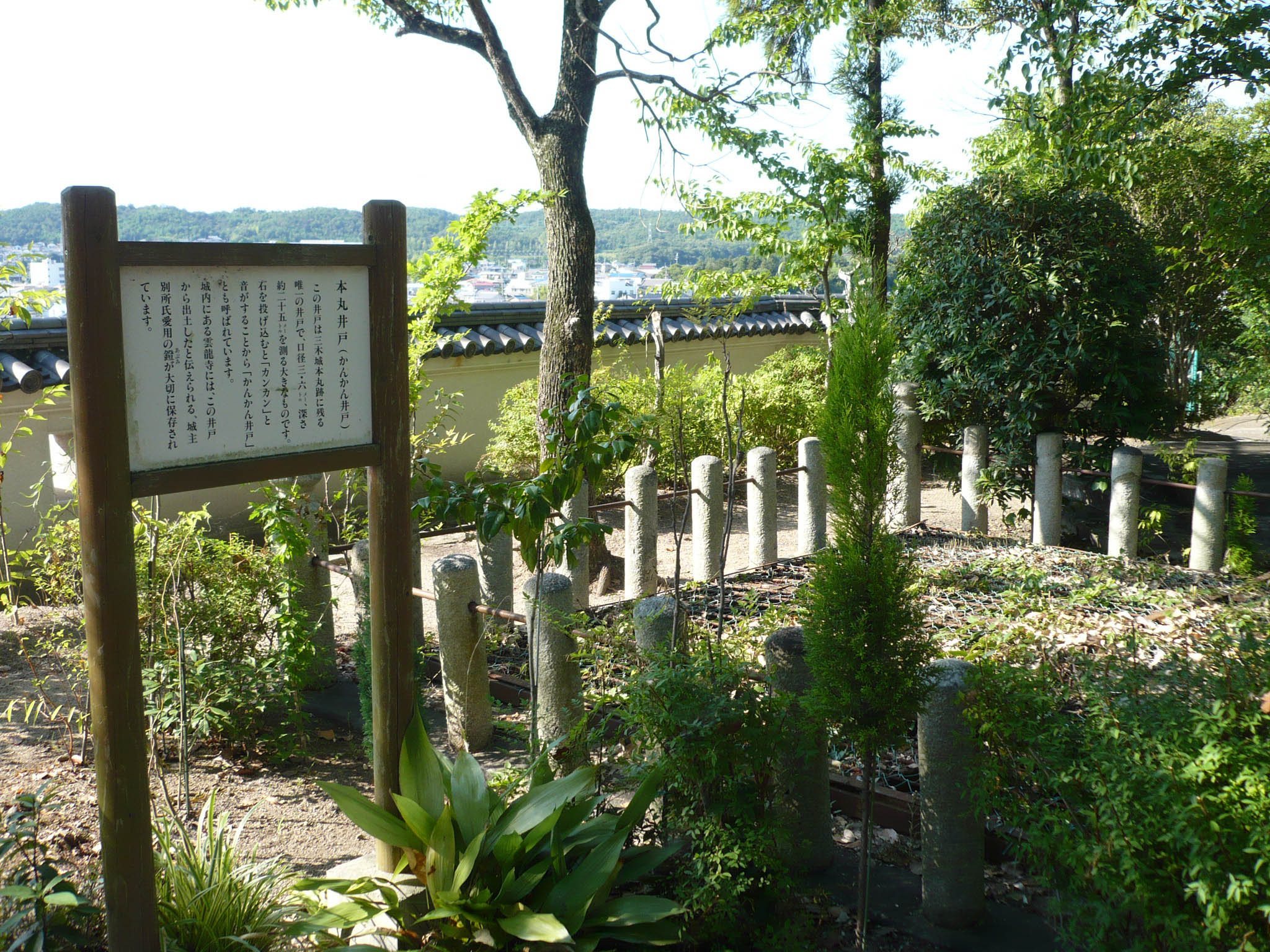
Kankan Well
Kankan Well lies on the northern side of the main enclosure. It measures approximately 3.6 meters across and reaches a depth of about 25 meters. The well was re-dug in the early Showa period. A stirrup traditionally associated with the Bessho family was recovered from it and is preserved at Unryuji Temple.
Palace and tower features
A location in the main enclosure is traditionally identified as the castle’s keep platform, while a reconstruction plan labels it as a yagura, a fortified tower or tower-like structure. The same plan places the palace area beneath the present nursery. Construction there exposed a line of stones interpreted as foundation stones together with a large quantity of charcoal, supporting the identification of a former palace location. A separate enclosure is labelled as the keep on the plan, while another interpretation places the construction of a keep after the lifetime of Bessho Nagaharu. The function of this feature therefore remains uncertain.
Western enclosure
Enclosure and defensive works
The western enclosure, also called the second enclosure, stands at approximately 57 meters above sea level. By the Edo period, a tower stood beside the main enclosure in this area. An earthen rampart about 3.5 meters high protected it, and dry moats probably surrounded three sides. The present historical museum and Horimitsu Art Museum occupy ground where excavations previously identified parts of the enclosure.
Storehouse remains
Excavation in the western enclosure revealed a storehouse, gates, buildings, inner and outer moats, pottery, round roof tiles, copper coins, and animal bones. Twenty-one large Bizen ware jars came from the presumed storehouse area. Carbonized cereal grains adhered to the jars, indicating their use for food storage. Reconstructed examples are displayed in the former city library building.
Shinjō enclosure
The Shinjō enclosure was probably built relatively late, possibly after the Siege of Miki. Its east and south sides had earthen ramparts about 3.5 meters high, with a surrounding dry moat. The southern rampart may have risen about 9 meters from the bottom of the moat to its highest point. An entrance on the southwest included a break in the rampart fitted with a concealed earthen barrier. The enclosure retained much of its original form until 1960, when its moats were filled, its ramparts dismantled, and the area converted to roads and housing.
Unryuji Temple and commemorative features
Unryuji Temple is believed to have formed part of the castle complex. Its grounds contain the burial mounds of Bessho Nagaharu and his wife, Teruko. The temple also preserves objects traditionally said to have been given to its abbot by Nagaharu when the castle surrendered.
The surviving site includes traces of enclosed sections, earthen ramparts, dry moats, wells, a feature resembling a keep platform, and foundations and excavated remains of former buildings. A concrete imitation castle wall was erected to commemorate the four-hundredth anniversary of Nagaharu’s death. It represents an early-modern castle wall rather than accurately reproducing the walling of Nagaharu’s period, which is thought to have combined earthen ramparts with fencing.