Ryuzo-ji Temple (Tambasasayama): A Tendai Buddhist Mountain Temple in Japan


Site at a Glance
- Rating
- 4.1
- Popularity
- Very Low
- Country
- Japan
- Primary era
- Medieval
- External website
- Open
- Eras represented
- Medieval, Early Modern, Modern
- Civilizations
- Ashikaga shogunate, Japanese, Kamakura shogunate, Tokugawa
- Site type
- Religious
- Remains
- Monastery
On this page17 sections
History
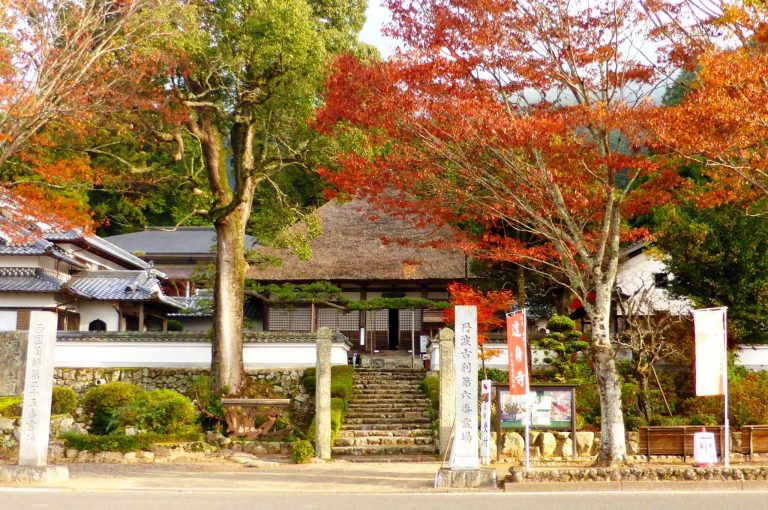
Ryuzo-ji Temple is a Tendai Buddhist temple in Japan, on Mount Taiheizan in Tambasasayama, traditionally founded in 645 during the reign of Emperor Kotoku. Its principal image is Senju-sengen Kannon, the thousand-armed and thousand-eyed form of the Buddhist bodhisattva of compassion. The temple is also popularly called Atago-san because Victorious Army Atago Jizo is enshrined in the Atago Hall on the mountain.
Foundation and mountain traditions
The foundation is traditionally attributed to Hodo Sennin, a legendary Buddhist holy man associated with the establishment of religious sites in the mountains of western Japan. Before Buddhism reached the mountain, Taiheizan was regarded as a place of mountain worship and ascetic practice. Temple tradition relates that Hodo practiced at Shinobu Waterfall on Mount Atago, where Kurikara Great Dragon King appeared and showed him a dragon jewel. The deity instructed him to conceal it permanently in the mountain as a sacred place for protecting the state and bringing peace to the people. The name Ryuzo-ji, meaning Temple of the Dragon Store, derives from this tradition.
Another tradition says that Emperor Tenchi granted the mountain the name Taiheizan in recognition of Hodo’s prayers for peace throughout the realm. The local history of Taki preserves a related dragon story. It says that the Sasayama Basin was once a lake inhabited by a dragon, and that Suwa Myojin defeated it while opening fields for cultivation. The dragon then became Eleven-Headed Kannon, another manifestation of the bodhisattva of compassion, and hid in a southern mountain where Ryuzo-ji was established. The dragon deity was believed to continue blessing the three mountains of Taki.
Growth as a Tendai center
Ryuzo-ji later adopted Tendai teachings, a major Japanese school of Mahayana Buddhism based on the Chinese Tiantai tradition. It developed halls and training places and became one of the three major mountains of the Taki area, together with Kosen-ji and Bunpo-ji. At the height of its prosperity, the complex contained 72 temple buildings and served as a training center for monks in the Tamba region.
In 1183, during the late Heian period, wartime fire destroyed the temple and reduced it to ashes. Six years later, Eshin-in Ichijo of Mount Hiei rebuilt 36 buildings, beginning a major restoration. The reconstructed complex included a main hall associated with Yakushi Nyorai, the Buddha of healing, and apparently modelled on the principal hall of Enryaku-ji, the Tendai headquarters on Mount Hiei. Stone retaining walls halfway up the mountain are identified with this former main hall, also called the Root Yakushi Hall.
Atago Jizo and sixteenth-century conflict
In 1503, tradition relates that Victorious Army Jizo, also called the Atago Great Avatar, appeared at Tenguiwa on Mount Atago and ordered the construction of a hall dedicated to him as a protector of the people. Atago Jizo is a protective Buddhist deity associated particularly with preventing fires and with military protection. His cult attracted worship throughout the Banshu region.
During the sixteenth century, a Tendai monk and high priest from Kaoin on Mount Hiei came to Ryuzo-ji and restored the temple. In 1556, troops commanded by Miyoshi Nagayoshi attacked and overran it while campaigning against Yagami Castle. After Enryaku-ji was destroyed in the wars of 1571, many Tendai temples in the Taki district converted to Zen or Pure Land Buddhism. Ryuzo-ji retained its Tendai tradition and still had more than 20 monastic buildings. When Mount Hiei was restored, Ryuzo-ji was recognized among the four central Tendai temples of Tamba.
Early modern patronage and decline
During the late sixteenth and early seventeenth centuries, a mountain ascetic associated with Shugendo, a Japanese tradition of mountain-based religious practice, moved to Ryuzo-ji with paintings of the Buddhas of the Three Ages and the Three Thousand Buddhas. He donated the paintings to the temple, where they remain enshrined. The same period saw the installation of the Zao deity at the summit of Mount Atago. Successive lords of Sasayama Castle venerated Zao and ordered rainmaking rites during droughts. The associated image is now enshrined at Dainichi-ji in Ikegami, Tambasasayama, currently identified as Mitoshiro Shrine.
During Toyotomi Hideyoshi’s unification of Japan, Ryuzo-ji received a vermilion-seal grant document. In 1619, Shogun Tokugawa Hidetada donated the whole of Mount Atago, described as 100 cho of land, to the temple as a fief. The Matsudaira and Aoyama families, among the lords of Sasayama Castle, subsequently used Ryuzo-ji for prayers.
Throughout the Edo period, the temple maintained exchanges with Mount Hiei, trained numerous Tendai monks, and preserved documentary evidence of its relationship with Keisoku-in at Yokawa. Its decline began later in the period. Records from 1831 to 1845 list only slightly more than ten halls and three temple institutions. An Edo-period document also records a request from the settlement of Hafu, beyond the mountain in present-day Sanda, to carry bundles of thatch through the temple grounds. The mountain pass between Hafu and Sasayama later fell out of use.
In 1800, Aoyama Tadayasu, the lord of the Sasayama domain, began constructing a reservoir on temple land to counter drought. A stone monument beside Taguchi Pond commemorates the work. A record from 1869 lists the main hall, Kannon Hall, Jizo Hall, Amida Hall, Atago Hall, Sanno Gongen Shrine, Zao Hall, two bell towers, a treasure storehouse, a guardian shrine, Jisho-in, and Josho-in among the surviving buildings.
Loss of lands and modern revival
The transfer of temple and shrine lands in 1871 deprived Ryuzo-ji of its 100-cho mountain forest, its principal source of income. Because it had no parishioner base and functioned as a monastic training center, maintenance became difficult. Eighteen affiliated temples were almost entirely converted into shrines. In 1875, most of the 63 cho of precinct land became state-owned land, and the temple entered a severe period of decline.
In 1918, the mountain forest was returned as forest held in the temple’s custody. A monk began construction and improvements in 1921, establishing the foundation for revival. He later moved the Kannon Hall and study hall and built living quarters at the site of the present monks’ hall. During the Second World War, most of the remaining forest was felled for military-use timber. After the war, another monk promoted reforestation and worked toward rebuilding the temple.
Kyoto University operated the Tannan observation room of the Abuyama Earthquake Observatory within the precincts from 1966, in cooperation with the temple. Ryuzo-ji erected a bronze Child-Rearing Jizo in 1967 and built a training hall in 1968 based on the teaching of Dengyo Daishi, the posthumous title of Saicho, founder of Japanese Tendai, that one should “illuminate one corner.” The building was also used as a youth hostel and for various activities. From around 1985, the temple supported activities for people with physical and mental disabilities in cooperation with Suisen Fukushikai. From around 1998, it organized activities concerning food safety and protection of the natural environment.
In September 1988, a new temple bell was cast and work began on rebuilding the bell tower lost during the temple’s decline. Torrential rain on 27 and 28 August 1996 caused landslides that filled and destroyed the monks’ hall beside the main hall, which also served as living quarters, together with a storehouse. The rivers in the Mukogawa headwaters were severely damaged. A replacement monks’ hall was built between September 2008 and October 2009, and the Child-Rearing Jizo was moved to its present location during the work.
Ryuzo-ji remains a Tendai center for training and worship without a traditional parishioner base. It continues to conduct goma fire rituals, in which offerings are burned before a Buddhist fire altar while prayers are recited, along with esoteric Buddhist rites. The temple is the first temple on the Tamba Fifteen Ancient Temples pilgrimage and remains associated with several regional pilgrimage circuits. Its observances include the spring and summer grand festivals of Victorious Army Atago Jizo on 24 February and 24 August, as well as rites for Kannon, Jizo, the Buddha’s birth, the Hungry Ghosts, and other Buddhist occasions.
Remains
Ryuzo-ji occupies a mountain site at the headwaters of the Mukogawa River. The precinct and surrounding slopes retain traces of the former monastic complex, ascetic paths, historic retaining walls, religious buildings, and features connected with water management and mountain cultivation. The surviving landscape reflects the temple’s long development as both a Tendai training center and a place of mountain worship.
Principal halls and religious buildings
Main hall
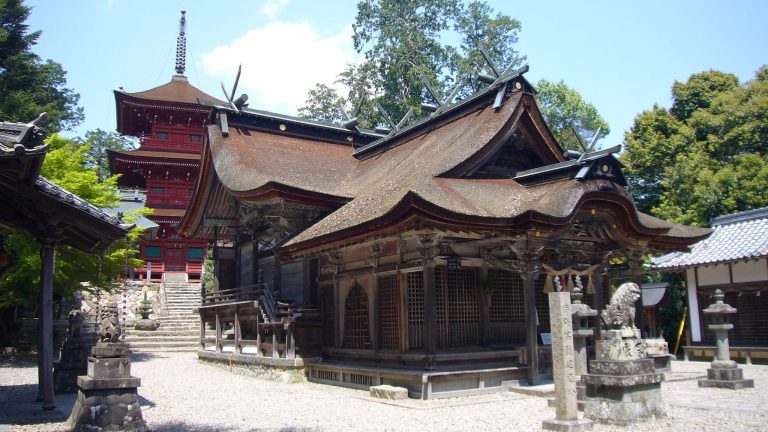
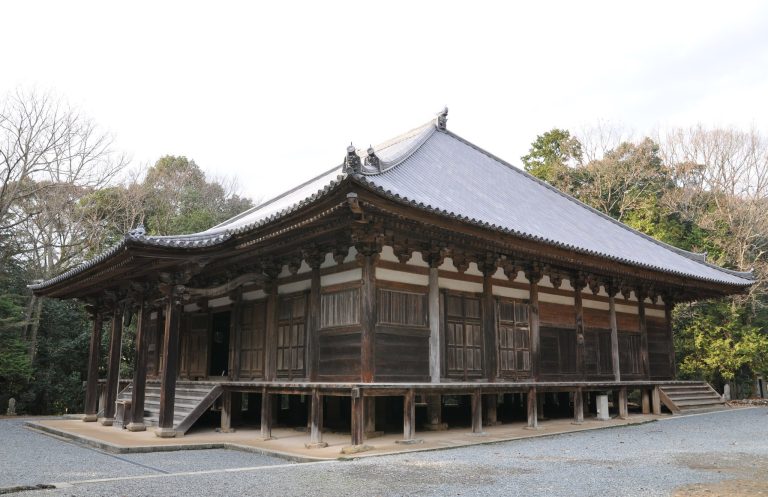
The principal surviving building is the main hall, also identified as the Kannon Hall. It houses the temple’s central Buddhist focus, Senju-sengen Kannon. The building has a cypress-bark roof, and deterioration caused holes to appear in 2018. The roofing was then replaced for the first time in 60 years, with the work completed in August of that year.
Atago Hall
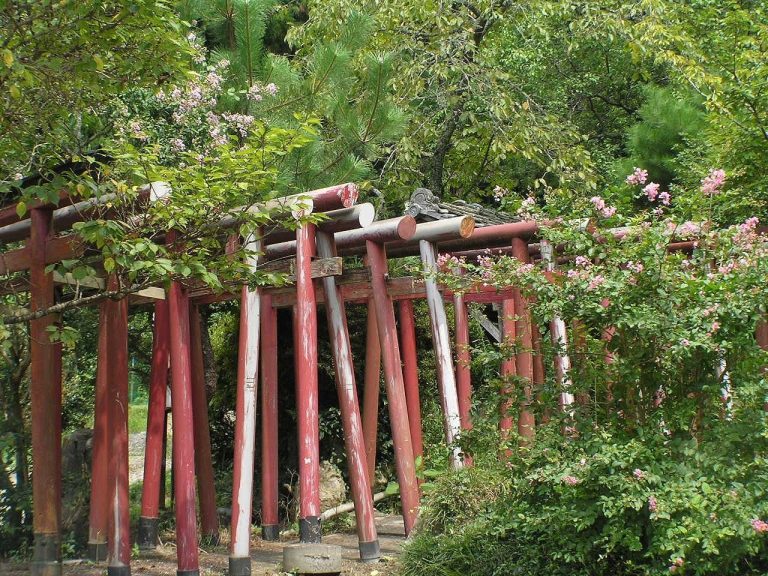
Atago Hall stands within the mountain precincts and houses Victorious Army Atago Jizo. Its approach rises by 223 stone steps, a number traditionally associated with warding off misfortune. Stone lanterns stand before the hall: one was donated in 1683 in front of the torii at the foot of the approach, and another was donated in 1690 before the hall.
Former Zao Hall and historic complex
A Zao Hall once stood at the summit of Mount Atago. Zao, a powerful mountain deity associated especially with Shugendo, was venerated by the lords of Sasayama Castle, while the associated image is now enshrined at Dainichi-ji in Ikegami. The historical complex also included Jizo, Amida, and Kannon halls, Sanno Gongen Shrine, two bell towers, a treasure storehouse, a guardian shrine, Jisho-in, and Josho-in. Paintings of the Buddhas of the Three Ages and the Three Thousand Buddhas continue to be enshrined at the temple.
Stonework and earlier monastic remains
Retaining walls and Root Yakushi Hall
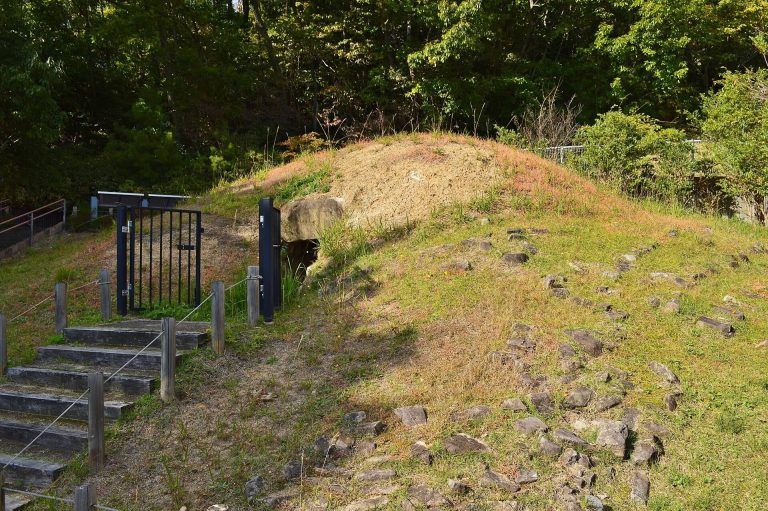
Stone retaining walls survive along the approach to Atago Hall. They date from the pre-Edo period or the later Kamakura period and use Anou-style masonry, a technique that builds retaining walls from carefully fitted natural stones, generally without regular horizontal courses. Among these remains are the walls identified with the former Root Yakushi Hall, the main hall rebuilt in 1189 and associated with Yakushi Nyorai.
Paths and mountain estate
Former ascetic paths and traces of monastic buildings extend through the mountain. Shinobu Waterfall remains associated with the traditional account of Hodo’s practice, while the Mukogawa headwaters form part of the temple’s mountain environment. The former pass between Hafu and Sasayama crossed the temple grounds and followed the headwater valley. Large, mature tea plants also remain on Mount Atago. They are understood as remnants of tea cultivation by resident ascetic monks, and an old map marks tea gardens across approximately three-fifths of the temple’s mountain estate.
Water management and later structures
Taguchi Pond
Taguchi Pond was constructed within the temple grounds in 1800 as a reservoir to counter drought. A stone monument beside the pond records its construction and preserves the connection between the pond and the Sasayama domain administration of Aoyama Tadayasu.
Monks’ hall and bell tower
The monks’ hall and adjacent storehouse beside the main hall were destroyed by landslides during the torrential rains of August 1996. A replacement monks’ hall was constructed from 2008 to 2009, and the bronze Child-Rearing Jizo erected in 1967 was moved during that project. The bell tower, lost during the temple’s decline, began to be rebuilt after a new bell was cast in 1988.