Ryōsen-ji Temple: A Historic Buddhist Temple in Nara


Site at a Glance
- Rating
- 4.2
- Popularity
- Medium
- Country
- Japan
- Primary era
- Medieval
- External website
- Open
- Eras represented
- Medieval, Early Modern, Modern
- Civilizations
- Ashikaga shogunate, Japanese, Kamakura shogunate
- Site type
- Religious
- Remains
- Monastery
On this page17 sections
History
Ryōsen-ji Temple is a Buddhist temple in Nara, Japan, traditionally founded through the work of the Nara-period monk Gyōki and the Indian monk Bodhisena. Its formal name is Tomisan Bikō Ryōsen-ji, and it is also associated with the names Tomiin and Ryūfukuin. The temple stands on Mount Tomi, where traditions of healing, mountain worship, and Buddhist practice developed around Yakushi Nyorai, the Buddha of medicine.
Origins on Mount Tomi
Ryōsen-ji’s earliest traditions center on Ono no Tobito, the son of Ono no Imoko. After resigning as a minister because of his involvement in the Jinshin War of 672, he is said to have withdrawn to Mount Tomi. There he established public baths and enshrined Yakushi. In 684, after retreating at Kumano Hongu Taisha, he reportedly received a revelation of Yakushi, understood there as the Buddhist manifestation of the Kumano Hayatama deity. He then established a Yakushi triad, cultivated medicinal herbs, and developed medicinal baths at Mount Tomi. The tradition subsequently remembered him as the Tomi, or Bikō, hermit.
In 728, Gyōki, an influential Japanese Buddhist monk who organized religious communities and public works, prayed at Mount Tomi after Emperor Shōmu’s daughter, Princess Abe, fell ill. A dream in which the Bikō hermit revealed the healing power of the local Yakushi preceded her reported recovery. In 734, Emperor Shōmu ordered Gyōki to build a hall at the site. Bodhisena, an Indian Buddhist monk who arrived in Japan in 736 and later officiated at the eye-opening ceremony of the Great Buddha of Tōdai-ji, is said to have compared Mount Tomi’s landscape with Vulture Peak in India. The hall consequently received the name Ryōsen-ji, and Emperor Shōmu reportedly presented it with a plaque bearing the name Bikō Ryōsen-ji.
The temple therefore traditionally attributes its foundation to Gyōki and Bodhisena, although the imperial foundation account is not confirmed by official chronicles. The circumstances of Ryōsen-ji’s early history remain uncertain. Its surviving buildings and Buddhist images nevertheless indicate that the institution had flourished from an early period.
Changing Buddhist affiliations
During the Heian period, Kūkai, the founder of Japanese Shingon Buddhism, is said to have perceived a dragon deity on Mount Tomi. He enshrined the deity at the temple’s Oku-no-in, or remote inner sanctuary, as Daibenzaiten-nyoson. Benzaiten, a Buddhist-Shinto deity associated with eloquence, music, learning, prosperity, and water, became an important focus of worship. Ryōsen-ji, formerly a Hossō institution, consequently came to practice both Hossō, a Buddhist school concerned with consciousness and reality, and Shingon, an esoteric Buddhist tradition.
In the medieval period, Ryōsen-ji was a branch temple of Kōfuku-ji and later became part of Kōyasan Shingon Buddhism. It had 21 monastic quarters during the Kamakura period. In the early-modern period, Toyotomi Hideyoshi granted the temple lands assessed at 100 koku, a historical measure based on rice yield and used to assess estates and stipends. The temple retained a considerable institutional scale through land grants from the Tokugawa shogunate.
Decline and revival
Ryōsen-ji declined after the Meiji-period separation of Buddhism and Shinto, a policy accompanied in many places by anti-Buddhist actions against Buddhist institutions, buildings, and images. Many of the temple’s monastic quarters were abandoned, and more than 200 images were burned. Jūrokusho Shrine, now an independent Shinto shrine, had previously served as Ryōsen-ji’s tutelary shrine. Its main sanctuary, dated 1384, and the main sanctuaries of the associated Sumiyoshi and Ryūō shrines, dated 1386, are Important Cultural Properties.
In 1935, the temple built the Daibenzaiten-dō after inviting the Benzaiten deity from the Oku-no-in into the main grounds. Many additional halls and facilities are traditionally attributed to the nun Enshō, who reportedly constructed them in response to revelations from Benzaiten. The temple was restored in 1940 and subsequently revived. In 1951, it became independent and adopted the name Ryōsen-ji Shingon Buddhism. It is now a head temple of that tradition and is also associated with the Tōzan branch of Shugendō, a Japanese mountain-ascetic tradition.
Since the Shōwa period, worship at Ryōsen-ji has centered on both Yakushi Nyorai and the Benzaiten of the Oku-no-in, located in the mountains about 1 kilometer west of the principal complex. The temple is the second site on the Saigoku Yakushi pilgrimage and belongs to several regional pilgrimage networks, including the Eighteen Buddhist Pagoda and Ancient Temple Deities pilgrimage, the pilgrimage associated with En no Gyōja, the Yamato Thirteen Buddhas pilgrimage, the Northern Yamato Eighty-Eight Sites pilgrimage, the Yamato Jizō pilgrimage, and a Buddhist-Shinto pilgrimage route. Its principal hall is a National Treasure, while other buildings and cultural properties have Important Cultural Property status.
Remains
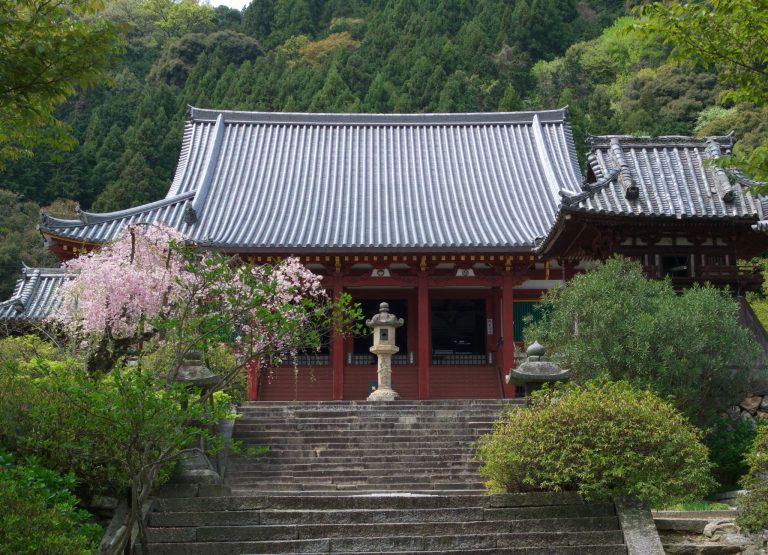
Ryōsen-ji occupies hills on the northern and southern sides of the Yuyagawa. The main worship hall stands above stone steps on the northern side, while the three-story pagoda rises above steps on the southern side. The eastern entrance is marked by a vermilion torii, a Shinto gateway, rather than a conventional Buddhist temple gate, reflecting the approach to the Daibenzaiten-dō. A site near the pagoda identified as the South Gate remains suggests that the original principal approach may have come from the south, as at other ancient Buddhist complexes.
Medieval buildings
Main worship hall
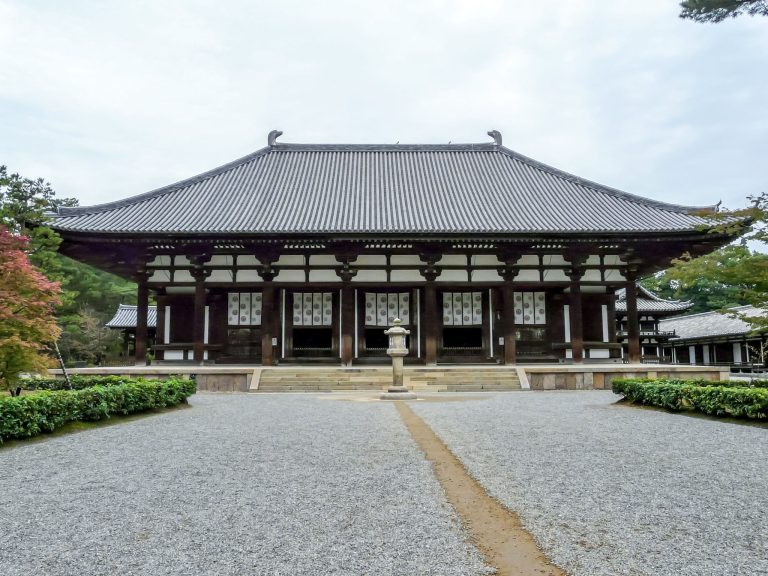
The Hondō, or main worship hall, was rebuilt in 1283. It is a five-by-six-bay structure, with each bay forming a structural interval between columns, and has an irimoya-zukuri roof. This Japanese roof form combines a central gable with sloping hipped sides. The building has a tiled roof and is designated a National Treasure.
Three-story pagoda
The three-story pagoda dates from 1356 and stands on the southern hill. Its roof is covered with Japanese cypress bark, and the building is designated an Important Cultural Property. A wall painting inside the pagoda dates from the late Kamakura to Nanbokuchō periods. Seated statues of Gyōki and Bodhisena are also associated with the temple.
Niōmon gate
The Niōmon, a gate associated with guardian figures, dates from 1516. It has three bays and a single doorway and is designated an Important Cultural Property.
Bell tower
The Shōrō bell tower dates from the middle of the Muromachi period. It is a single-bay structure with an irimoya-zukuri roof covered in Japanese cypress bark and is designated an Important Cultural Property.
Temple grounds and associated features
Daibenzaiten area
The approach to the Daibenzaiten-dō is marked by the eastern torii. On the northern side of this approach are the rose garden, Tenryūkaku, the Daibenzaiten-dō, Kogane-den, and Hakkin-den. The rose garden contains roses collected from around the world, while the golden Kogane-den and Hakkin-den form part of the later religious complex.
Yakushi and southern grounds
The southern side includes Sennin-tei, Yakushi-yu, medicinal baths, and a golf-practice facility. A large cemetery and other facilities are also part of the grounds. These later installations stand alongside the surviving medieval buildings and the temple’s continuing religious functions.
Buddhist images and ritual objects
Yakushi triad
The principal object of worship is Yakushi Nyorai. The temple’s principal Yakushi triad dates from the late Heian period and is designated an Important Cultural Property. Other associated images include a seated Yakushi Nyorai, statues of Nikkō Bosatsu and Gakkō Bosatsu, and statues of the Twelve Heavenly Generals from the Kamakura period. A Buddhist-triad plaque from the Hakuhō period is also associated with Ryōsen-ji.
Other sculptures
The temple’s wider group of Buddhist images includes a seated Amida Nyorai from the twelfth century, a seated Dainichi Nyorai from the late Heian period, an Eleven-Headed Kannon from the early Heian period, Bishamonten from the twelfth century, Jikokuten and Bishamonten from the late Kamakura period, and a Jizō Bosatsu dated 1256.
Relics and pendants
Associated ritual objects include a Buddhist reliquary dated 1285, a pendant depicting the Yakushi triad dated 1366, and another pendant from the Kamakura period. Together with the surviving architecture and sculpture, these objects preserve material evidence of the temple’s long religious history.