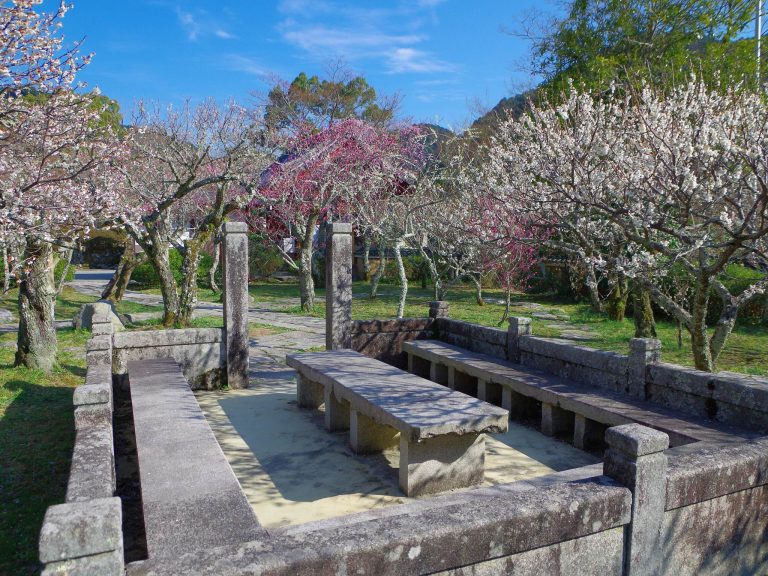
Suda Hachiman Shrine: A Hachiman Sanctuary in Hashimoto, Japan


Site at a Glance
- Rating
- 4.2
- Popularity
- Low
- Country
- Japan
- Primary era
- Early Modern
- External website
- Open
- Eras represented
- Early Modern
- Civilizations
- Tokugawa
- Site type
- Religious
- Remains
- Sanctuary
On this page11 sections
History
Suda Hachiman Shrine is a Hachiman shrine in Hashimoto, Japan, traditionally associated with a site connected to Empress Jingu and a shrine reportedly established during the Jogan era, around 859–877. Hachiman is a Japanese religious cult associated especially with martial protection and the imperial lineage, and its principal deity is commonly identified with Emperor Ojin. The shrine’s main sanctuary is built in the nagare-zukuri style, whose roof extends forward to form a projecting entrance canopy.
Traditional origins and the Kii Suda Estate
Local tradition places the shrine at a site where Empress Jingu, a legendary ruler in early Japanese tradition, stayed while returning to Yamato from Chikuzen Province. Her route was said to pass through Enaura, in present-day Yura, after the campaign against the Three Han. During the Jogan era, a Hachiman shrine was reportedly established at the site.
In 986, Regent Fujiwara no Kaneie donated Suda Village in Ito District, Kii Province, as an estate whose income supported the Sanmido Hall at Iwashimizu Hachimangu in Yamashiro Province. A medieval estate was a defined revenue-holding institution that supported an aristocratic, religious, or imperial establishment. This donation created the Kii Suda Estate. Another tradition identifies Suda Hachiman as the estate’s guardian shrine, established by inviting the deities of Iwashimizu Hachimangu, a major Hachiman shrine historically located at Otokoyama near Kyoto. Suda Hachiman later became a detached shrine of Iwashimizu Hachimangu, meaning an affiliated sanctuary established separately from the principal shrine.
The Suda family and the medieval shrine
In 1110, Fujiwara no Tadanobu, an ancestor of the Suda family and a local magnate of the estate, became both lay deputy administrator and estate registrar of Suda Hachimangu. The first office handled the practical management of the religious institution, while the second managed its administrative records and affairs. The Suda family subsequently held both offices hereditarily.
During the Heian period, Otakanoji Temple was established within the shrine precinct as its associated administrative temple. Such a Buddhist temple supported and administered a shrine before the modern separation of Shinto and Buddhism.
Destruction and rebuilding
Matsunaga Hisahide’s invasion of Kii Province in 1560 caused the shrine buildings to be burned. They were rebuilt during the Keicho era, from 1596 to 1615, and were destroyed by fire again in 1819. Reconstruction followed in 1822.
Modern religious and cultural status
The Meiji-period separation of Shinto and Buddhism divided Suda Hachiman Shrine from Otakanoji Temple, which remains immediately west of the shrine precinct. In November 1916, the shrine was classified as a former prefectural shrine, a rank within the pre-1945 State Shinto system.
Several traditions continue to define the shrine’s religious heritage. A fire-burning rite is held on January 14, followed on January 15 by a porridge-divination rite practiced since the Edo period. Azuki beans and rice are cooked with a perforated bamboo tube immersed in the porridge, and the quantity entering the tube is used to divine the expected rice harvest. Hashimoto City designates this rite an intangible folk cultural property, while Wakayama Prefecture designates the autumn festival as an intangible folk cultural property. The shrine’s mirror received National Treasure designation in 1916 under the former Law for the Preservation of Ancient Shrines and Temples and again in 1951 under the Law for the Protection of Cultural Properties.
Remains
The surviving site consists of the shrine precinct, its main sanctuary, the associated Otakanoji Temple immediately to the west, and the Suda Hachiman Shrine Burial Mound farther west. The sanctuary follows the nagare-zukuri form, while the adjoining temple and burial mound preserve physical evidence of the religious and historical landscape associated with the shrine.
Shrine precinct and western features
Main sanctuary
The main sanctuary is built in the nagare-zukuri style. Its principal roof slope projects forward over the entrance, creating a covered canopy. The present building belongs to a site repeatedly rebuilt after the destruction of the shrine buildings in 1560 and the later fire of 1819, followed by reconstruction in 1822.
Otakanoji Temple
Otakanoji Temple stands immediately west of the shrine precinct. Established during the Heian period as the shrine’s associated administrative temple, it remained physically beside the shrine after the Meiji separation of Shinto and Buddhism divided the two institutions.
Suda Hachiman Shrine Burial Mound
The Suda Hachiman Shrine Burial Mound lies west of the shrine and is designated a historic site by Hashimoto City. A kofun is an ancient Japanese burial mound, generally formed from earth and sometimes surrounded by a moat.
Jinbutsu Gazokyo bronze mirror
The shrine holds the bronze mirror known as the Jinbutsu Gazokyo, regarded as one of Japan’s oldest metal inscriptions. The mirror is deposited with the Tokyo National Museum. Its inscription states that, in the eighth month of a cyclical year identified as AD 503, Shima sent a Kawachi official and a person from Ye to obtain 200 units of white copper and make the mirror while Ototo King was staying at Oshisaka Palace, with the purpose of praying for his longevity. A metal inscription is writing engraved or cast on an object such as a mirror.
The inscription’s historical interpretation remains uncertain. Shima is increasingly identified with King Muryeong of Baekje, while Ototo King may correspond to the figure known as Ohodo, understood in that reading as Emperor Keitai, an early sixth-century Japanese sovereign. Other interpretations assign the cyclical year to AD 443. The readings of the personal names and the inscription’s wider historical implications therefore remain disputed.