Goryō Shrine: A Shrine for the Pacification of Vengeful Spirits in Japan

Site at a Glance
- Rating
- 4.2
- Popularity
- Very Low
- Country
- Japan
- Primary era
- Early Modern
- External website
- Open
- Eras represented
- Early Modern
- Civilizations
- Tokugawa
- Site type
- Religious
- Remains
- Sanctuary
On this page8 sections
History
Goryō Shrine is a Shinto shrine in Gojo, Nara Prefecture, Japan, whose principal sanctuary was erected in 1637 in the Momoyama style. Also called Goryō Hongū and by several other local names, the shrine venerates deceased imperial figures whose spirits were believed to have caused disasters when angered. Princess Inoue is the principal deity, while Prince Osabe, Prince Sawara, and Honoikazuchi are enshrined in associated sanctuaries.
Princess Inoue and Prince Osabe
Princess Inoue was born in 717 as a daughter of Emperor Shomu. At the age of five, she entered service at Ise Grand Shrine as a Saiō, an imperial princess appointed to perform religious duties there. She remained in that position until her dismissal in 744. In 747, she married Prince Shirakabe, who became Emperor Konin in 770, making Inoue empress.
The couple’s son, Prince Osabe, was born in 761 and became crown prince in 771. In 772, Princess Inoue and Prince Osabe lost their titles after accusations involving imprecations and sorcery. The following year, they were accused of cursing Emperor Konin’s elder sister and confined in a confiscated residence in Uchi District, the area corresponding to present-day Gojo. Both died there on April 25, 775, although April 27 is also given as a possible date.
After their deaths, disasters, famine, and epidemics affected the capital. The court feared that the troubles had been caused by the angry spirits of the mother and son. In 776, it ordered 600 monks to recite prayers for them. These rites reflect the meaning of a goryō, a powerful spirit believed capable of causing illness or disaster and therefore requiring pacification and reverence.
Prince Sawara and the foundation of the shrine
Prince Sawara was removed from the succession in 785 after being implicated as the main instigator of the assassination of Fujiwara no Tanetsugu. He died in anger while being exiled to Awaji. In 800, Princess Inoue was restored posthumously as empress, and Prince Sawara received the posthumous title Emperor Sudō.
A Buddhist temple called Reian-ji was established in the area to pacify the spirits of the imperial family, and Goryō Shrine is thought to have been founded around the same period. In 805, 150 monks in the capital recited the Great Perfection of Wisdom Sutra, a major body of Mahayana Buddhist scriptures, for the repose of Princess Inoue and Prince Osabe. Reian-ji received 3,000 bundles of rice and 150 kin of each of two kinds of cotton. In 816, an official order assigned 4,000 bundles of rice to Reian-ji and Goryō Shrine.
A goryō-e, a rite intended to appease and pacify vengeful spirits, was held at Shinsen-en in Kyoto in 863. The Great Perfection of Wisdom Sutra was deposited in 1112, and 530 volumes are now held by Mangan-ji. These connections show how Buddhist scripture and ritual were associated with the shrine’s veneration of the imperial dead.
Local divisions and modern observances
In 1238, a dispute between the Yoshihara and Makino local clans led to the shrine being divided into ten shrines. Further divisions followed, and more than twenty Goryō Shrines were established across Uchi District during the next four centuries. The separation of Buddhism and Shinto in 1872 transferred Buddhist images, scriptures, and related materials formerly held at the shrine to Mangan-ji. A memorial festival marking 1,100 years of the enshrined deity was held in 1875. The shrine was designated a prefectural shrine in 1944 under Japan’s prewar shrine-ranking system.
Annual observances continue to express the shrine’s connections among its enshrined figures. A Daidaikagura festival, featuring an elaborate form of Shinto ritual music and dance, takes place every other year on the fourth Sunday of April. The traditional Setsuku Festival is held in October, when Honoikazuchi makes an annual procession to meet his mother, Princess Inoue, and receive ceremonial rites. The main festival, held on the fourth Sunday of October, includes processions through Gojo and Reian-ji followed by a return-to-seat ceremony.
Remains
The surviving shrine complex is organized around a principal sanctuary, side sanctuaries for the associated imperial figures, and a separate sanctuary for Honoikazuchi. Its principal building combines a three-bay plan with the nagare-zukuri form, in which the main roof extends forward to create a projecting entrance canopy. The building is in the Momoyama style, associated with Japan’s late sixteenth and early seventeenth centuries.
Sanctuaries and sacred object
Principal sanctuary
The principal sanctuary was erected in 1637. A ridgepole tablet, a wooden inscription placed at a building’s ridge to record construction details, survives together with related historical documents from its construction. Princess Inoue occupies this main sanctuary, which forms the central architectural focus of the shrine.
Auxiliary sanctuaries and sacred image
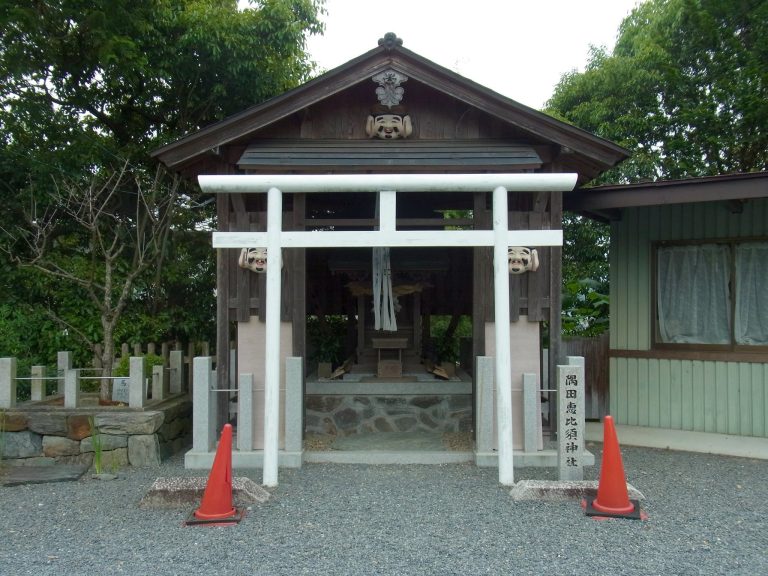
Prince Osabe is enshrined in the southern auxiliary sanctuary, while Prince Sawara occupies the northern auxiliary sanctuary. Honoikazuchi, identified at this shrine as a child of Princess Inoue, has a separate sanctuary. The shrine’s sacred object is a seated wooden image of the Goryō deity dating from the late Heian period.