Zuigan-ji Temple: A Rinzai Zen Temple in Matsushima, Japan


Site at a Glance
- Rating
- 4.4
- Popularity
- Medium
- Country
- Japan
- Primary era
- Early Modern
- External website
- Open
- Eras represented
- Medieval, Early Modern
- Civilizations
- Tokugawa
- Site type
- Religious
- Remains
- Monastery
On this page20 sections
History
Zuigan-ji Temple is a Rinzai Zen Buddhist temple in Matsushima, Japan, rebuilt between 1604 and 1609 under Date Masamune in the richly decorated Momoyama style. Its formal name is Shōtō Seiryūzan Zuigan Enpuku Zenji, and it is affiliated with the Myōshin-ji school, one of the principal branches of Rinzai Zen. The temple became the Date family’s family temple and developed into one of the major religious institutions of the Sendai domain.
The uncertain Tendai beginnings
Tradition places the foundation of Enpuku-ji, the temple’s earlier name, in 828 during the Heian period. It describes the temple as an imperial prayer temple established for Emperor Junna, a ninth-century Japanese ruler, and identifies the monk Ennin as its founder. Ennin, also known as Jikaku Daishi, was a leading monk of the Tendai tradition whose name became associated with the foundation of many temples in northeastern Japan.
This account is preserved mainly in the medieval Tendai-ki, but its details remain uncertain. The Heian-period Enpuku-ji stood at a different, unknown location from the present temple. Excavations at the current precinct uncovered a ninth-century salt-making furnace, indicating that the site could not have been a temple at that time.
The same tradition connects Enpuku-ji with the Northern Fujiwara, the ruling family of the Hiraizumi region in northern Japan during the late Heian period. It states that the temple received their protection and that Yorihira, identified as the son of Fujiwara no Hidehira, made a major donation of land after Hidehira’s death. The account’s details are considered unreliable, although it reflects the temple’s association with powerful regional patrons.
Conflict and the change to Zen
In 1189, Minamoto no Yoritomo led a campaign against his younger brother, Minamoto no Yoshitsune, and the Northern Fujiwara. Yoritomo was the founder of the Kamakura shogunate, while Yoshitsune was a celebrated military commander. Monks associated with Enpuku-ji were said to have performed curses against Yoshitsune during the campaign. The details cannot be established with certainty, but the tradition is considered plausible in relation to the temple’s regional setting.
The temple also preserves a letter attributed to Hōjō Masako, Yoritomo’s wife and an influential figure in the early Kamakura shogunate, together with a Buddhist relic traditionally said to have been donated by her. The letter is not in Masako’s handwriting, and the authenticity of both the letter and the donation remains disputed.
During the Kamakura period, Enpuku-ji changed from Tendai Buddhism to Rinzai Zen. The change is traditionally attributed to Hōjō Tokiyori, a regent of the Kamakura shogunate, who was said to have expelled the Tendai monks by force and installed a Zen abbot. The dramatic form of this story is regarded as legendary or embellished. The monk who led the Zen refoundation had studied in Song China and later left the temple. Rankei Dōryū, the Chinese-born founder of Kenchō-ji, then became its second abbot, and his disciples continued to reside at Enpuku-ji.
The Zen institution was initially ranked among the provincial temples subordinate to the Five Mountains and Ten Monasteries, a state-supported system for ranking major Zen temples. It later became one of the Kantō Ten Temples and received protection from the Hōjō family. It was also designated a Kantō prayer temple, an institution protected by the shogunal government and associated with prayers for the ruling house.
Competing traditions and decline
Tendai monks continued to operate in Matsushima after their expulsion and disputed control of the temple with the Zen community during the Nanboku-chō period, an era of rival imperial courts and political conflict. In a document from 1350, the Zen monk Kagegai claimed an uninterrupted Zen succession from the founding abbot. Tendai activity, however, appears to have continued into the early Edo period, showing that the temple’s religious history remained contested for centuries.
By the end of the Sengoku period, an era of political fragmentation and warfare before the Tokugawa shogunate, Enpuku-ji had declined almost to ruin after a fire. Around 1573, during the tenure of its ninety-third abbot, Jitsudō, it became affiliated with the Myōshin-ji school of Rinzai Zen.
Date Masamune’s reconstruction
Date Masamune, the early Edo-period lord of the Sendai domain, decided to restore Enpuku-ji after encouragement from the Zen monk Kosai Sōitsu. A complete reconstruction undertaken from 1604 to 1609 created the principal surviving temple buildings and brought the institution its name, Matsushima Seiryūzan Zuigan Enpuku Zenji.
The Date family thereafter protected the temple as its family institution and controlled it through the successive lords of the Sendai domain. Godai-dō, which had previously been separate, also came under Zuigan-ji’s administration. The complex flourished under Date patronage. After Masamune’s death in 1636, Ungo Zenji continued its development, and subsidiary temples including Entsū-in, Yōtoku-in, Tenrin-in, and Tendō-an were established. The precinct reportedly contained about thirty buildings and more than seventy affiliated branch temples.
One theory holds that Masamune partly designed Zuigan-ji as a hidden fortress and intended to receive the emperor there after overthrowing the Tokugawa shogunate. The existence of an imperial reception room has been cited in support of this interpretation, but the political theory remains unproven.
Modern changes and conservation
The Meiji government’s confiscation of temple land after the Meiji Restoration, together with the policy of separating Buddhism and Shinto, deprived Zuigan-ji of much of its income. Associated buildings fell into disrepair and many disappeared. A grant from Emperor Meiji during his 1876 tour of northeastern Japan helped the temple gradually recover from its financial difficulties.
The Crown Prince visited in 1918 and planted an asunaro sapling. In 1947, as Emperor Hirohito, he returned during a postwar tour of Miyagi Prefecture. Local residents funded a memorial mound for eels caught in Matsushima Bay in September 1923. The main hall became a National Treasure in 1953, a large reception hall was completed in 1958, and a treasure museum opened in 1974.
Major conservation and repair work, known as the Heisei Great Repairs, took place from November 2008 through 2018. The 2011 Tōhoku earthquake and tsunami affected the precinct, causing salt damage to the cedar avenue and other garden areas. Matsushima Bay’s protected position helped the principal buildings avoid severe damage, while later repairs addressed the affected grounds and fabric.
Zuigan-ji and Godai-dō were recognized in 2016 as component cultural properties of Japan Heritage. The temple forms part of the Shiji-kairō pilgrimage route with Chūson-ji and Mōtsū-ji in Hiraizumi and Risshaku-ji in Yamagata, and it is associated with the Ōshū Thirty-Three Kannon pilgrimage. Its religious and cultural traditions also include an association with the poet Matsuo Bashō’s visit in 1689, an annual Bashō Festival, and New Year’s Eve fire-prevention and bell-ringing ceremonies.
Remains
The surviving complex is principally the result of Date Masamune’s early Edo reconstruction. Its buildings reflect Momoyama architecture, a late sixteenth- and early seventeenth-century style known for vivid colors, elaborate interiors, and extensive use of gold. Materials were brought from Mount Kumano, and craftsmen from Kyoto, the Kii region, and Osaka were employed. The precinct includes the main hall, the kitchen and service buildings, entrance gates, Godai-dō on an island near the shore, temple grottos, a museum, the Hossin hall or tomb, and a mausoleum associated with Mego-hime, Masamune’s wife of the Tamura family.
The principal temple buildings
Main hall
Completed in 1609, the main hall formerly served as the abbot’s residence. Its roof was completed in March 1619. The building contains ten rooms with gold-leaf sliding doors and decorative wall niches. The painted interiors include pine trees, peacocks, red and white camellias, flying apsaras and kalavinka birds, plum and bamboo, flowers and trees, cherry blossoms, peonies, Chinese guardian lions, eagles, birds, chrysanthemums, landscapes, dragons, tigers, Buddhist arhats, wisteria, plantain, cranes, monkeys, egrets, willows, and autumn grasses.
The designated group of screen paintings comprises 161 works, supplemented by twenty-two associated screens and twenty-eight painted cedar-panel doors. The decoration combines colored painting on paper with gold grounds and monochrome ink painting. Some motifs are raised against golden clouds, giving the rooms a particularly elaborate visual character. The main hall’s designation as a National Treasure reflects the importance of both its early Edo fabric and its painted interiors.
Kitchen and service buildings
The kuri, the temple’s kitchen and food-service building, and its connecting corridor are National Treasure structures. The kitchen included an associated area for storing food and formed part of the working core of the reconstructed temple complex.
Approach and gates
Entrance gates
The Sōmon Gate forms the outer entrance, the Middle Gate the intermediate entrance, and the Onarimon is identified as an imperial gate. These Edo-period structures are linked by the approach path, or sandō, which leads through the temple precinct.
Cedar avenue
The sandō is a tree-lined approach. During the Edo period, subsidiary temples stood along both sides of it. The former avenue contained about 300 cedar trees. Many were felled after the 2011 tsunami because salt damage caused extensive dieback, and subsequent repair work addressed the damaged grounds.
Godai-dō and its sacred images
Island hall
Godai-dō is a small Buddhist hall on an island near the shore. It was restored in 1604 and contains an altar shrine. The building is dedicated to the Five Wisdom Kings, protective deities in esoteric Buddhist tradition, and is associated with five wooden statues carved from single blocks of keyaki wood.
Five Wisdom Kings
The images are kept from ordinary view and opened publicly once every thirty-three years. The central figure, Fudō Myōō, is seated and has features resembling Kūkai, the Japanese monk who founded the Shingon school. The other figures follow established iconographic conventions. Their association with Godai-dō gives the small hall its principal religious focus.
Grottos, trees, and memorial features
Temple grottos
Grottos cut into the stone wall within the precinct were made during the Kamakura period. They served both for meditation and for audiences between temple leaders and high-ranking visitors. In later use, they were converted into chambers for storing the cremated ashes of monks. The grottos remained in use until the Edo period.
Plum trees and cedars
Two plum trees in the precinct, one with white flowers and one with red flowers, are collectively called Garyū-bai. Tradition attributes their planting to Date Masamune and says that he brought them from his Korean campaign. The trees are designated as a prefectural natural monument. Four old cedar trees in the precinct are individually designated as town natural monuments.
Archaeological remains and collections
The medieval temple buildings no longer survive, but part of the Kamakura-period Enpuku-ji remains. Numerous artifacts were excavated in 1991, while a ninth-century salt-making furnace was uncovered within the present precinct in 1992. The furnace confirms that the current site had a salt-making use during the ninth century rather than serving as the location of the Heian-period temple described in tradition.
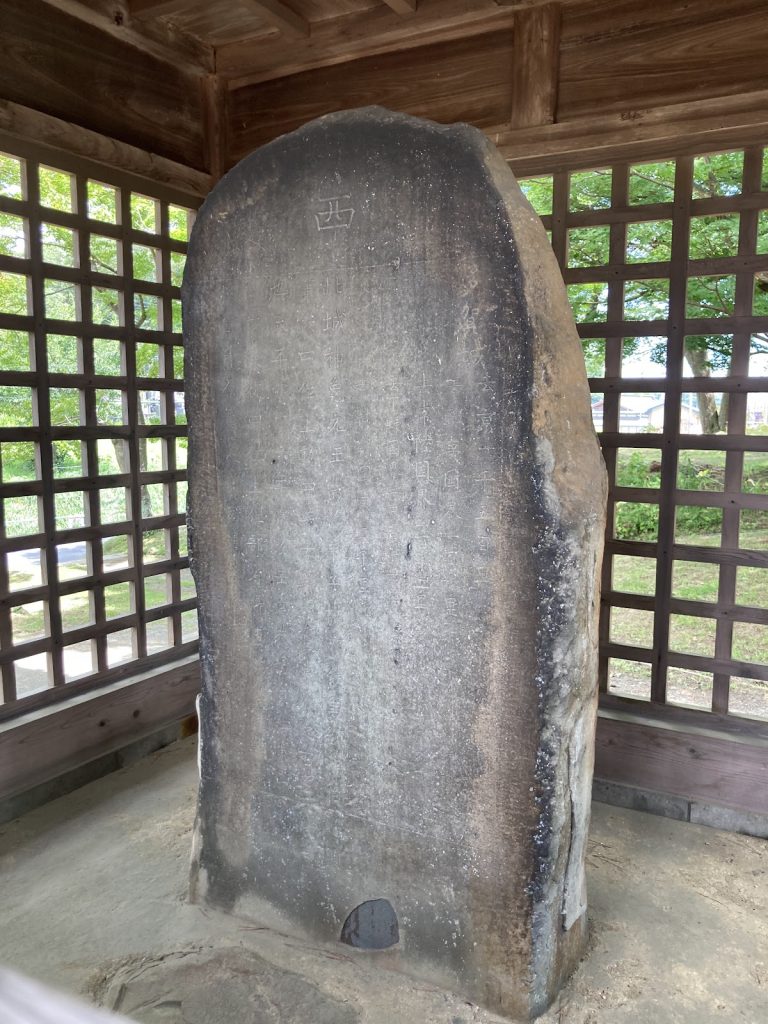
A cloud-shaped gong from 1326 is preserved as an associated cultural property. This suspended metal instrument was used in Buddhist monasteries to mark communal activities and ceremonies. Another object is the Ōshū Mishima Raiken Monument from 1307, which bears an inscription composed and written by the monk Issan Ichinei.
The temple also transmits a Buddhist relic kept in a crystal, six-sided, stupa-shaped container. Its traditional connection with Hōjō Masako remains contested, and the form of the container has been used to argue for a later Kamakura-period date. The treasure museum preserves excavated artifacts from the Enpuku-ji period and other temple objects, including calligraphy, painted sliding doors, tea-ceremony objects, and portraits.