Jison-in Temple: The Administrative Gateway to Koyasan


Site at a Glance
- Rating
- 4.4
- Popularity
- Medium
- Country
- Japan
- Primary era
- Medieval
- External website
- Open
- Eras represented
- Medieval
- Civilizations
- Ashikaga shogunate
- Site type
- Religious
- Remains
- Temple
On this page17 sections
History
Jison-in Temple is a Japanese Buddhist temple of the Koyasan Shingon school in Japan, traditionally founded by Kukai in 816 at the entrance to the Koyasan pilgrimage route. Kukai, also known as Kobo Daishi, was the monk traditionally regarded as the founder of Shingon, an esoteric Buddhist tradition. The temple originally served as Koyasan’s administrative office, a lodging place for pilgrims, and a site for winter retreat and religious practice.
Foundation at the foot of Koyasan
After Emperor Saga granted Kukai the land of Koyasan in 816, Kukai is said to have established a temple complex at the foothills of Mount Amabiki. The original institution was called Jishi-ji, a name associated with Maitreya, the Buddha expected to appear in the future. South of Jishi-ji, Kukai also established a guardian shrine for Koya Myojin and his mother, Niu Myojin. The Maitreya platform of Jishi-ji and the deity platform of the guardian shrine later became known together as Jison-in.
Kukai’s mother came from Sanuki Province to see the Koyasan founded by her son. Women were prohibited from entering the roughly seven-ri-wide area of Koyasan, so she remained at the administrative office and devoted herself to its Maitreya image. Tradition says that Kukai descended the mountain road to visit her nine times each month. The number expresses the frequency of his journeys rather than a precise count, and the tradition is associated with the origin of the place-name Kudoyama.
The origin of Jison-in’s religious identity
Kukai’s mother died on February 5, 835. According to tradition, Kukai then experienced a visionary appearance of Maitreya, built a mausoleum, and enshrined both an image of Maitreya made by himself and his mother’s spirit. Maitreya is also known as Jison in the temple’s religious tradition, and the administrative office consequently came to be called Jison-in.
The belief that Kukai’s mother became united with the principal Maitreya image helped establish Jison-in as a place where women sought a religious connection. It became known as “Women’s Koyasan” and served as the customary starting point for women visiting Koyasan.
Records, relocation, and loss
The earliest known documentary appearance of the name Jison-in in connection with Koyasan’s administrative office occurs in Fujiwara Saneyuki’s record of Emperor Toba’s pilgrimage to Koyasan in 1124. The record says that Emperor Toba visited the site and asked about the origin of its name. In 1380, the expression “Koyasan administrative office” appeared in a record concerning forces aligned with the Southern Court, a rival imperial government that fought the Muromachi shogunate. These forces are understood to have been the four estate-administrator families that managed Koyasan’s estates and maintained local warrior forces.
The mausoleum was moved to its present location in 1474. In 1540, flooding of the Kinokawa River swept away most of Jison-in’s buildings. The temple was then moved to the Miroku platform at its present site, while Koyasan transferred the administrative work to the mountain and moved the temple’s treasures there. Another Kinokawa River flood, in July 1544, destroyed all buildings that had remained at the former location.
Pilgrimage and heritage status
Jison-in stands at the lower end of the Choishimichi, the “stone-marker road” leading toward Koyasan. Its precinct forms part of the Choishimichi section of the nationally designated Koyasan pilgrimage routes historic site. The Maitreya Hall was included in the UNESCO World Heritage property “Sacred Sites and Pilgrimage Routes in the Kii Mountain Range” in 2004, within the Koyasan component.
The temple is also associated with several pilgrimage networks, including the Eighteen Buddhist Pagodas and Ancient Temples pilgrimage, the Kii Province Thirteen Buddhas pilgrimage, the Ito District Shikoku Eighty-eight-temple pilgrimage, and the Pilgrimage Route of the Sacred Sites and Temples.
Remains
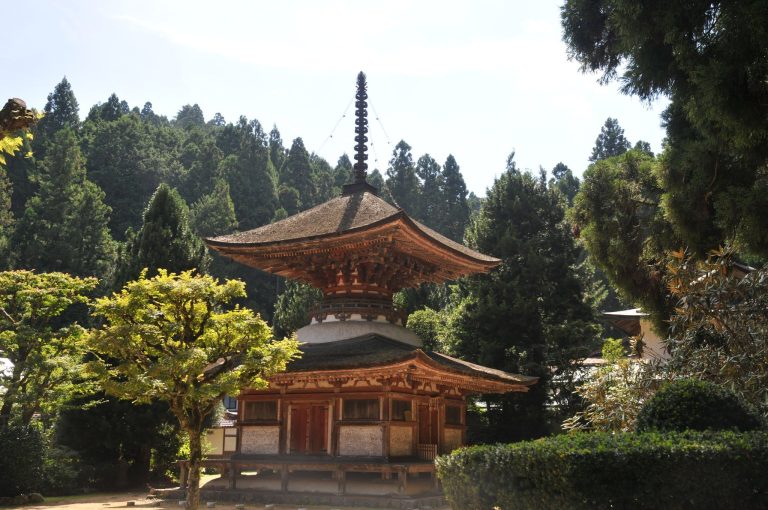
Jison-in’s precinct lies at the entrance to the Koyasan pilgrimage route in Kudoyama, Wakayama Prefecture. Its principal elements include a main gate, the Maitreya Hall, a tahoto pagoda, Kishimojin Hall, a Kobo Daishi Hall, and statues of Kukai and the guide dog Gon. A staircase on the southern side rises toward Niukanshofu Shrine, creating an approach that links the temple precinct with the shrine.
Approach and enclosure
Stone-marker approach
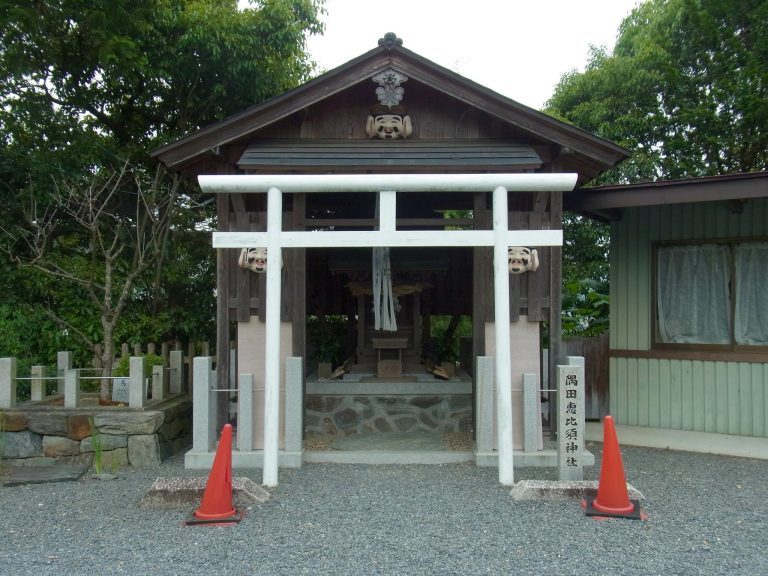
Near a torii beside the southern staircase stands a 180-cho stone. The staircase and marker belong to the approach connecting Jison-in with Niukanshofu Shrine and express the temple’s position at the lower end of the Choishimichi pilgrimage route.
Gates and earthen walls
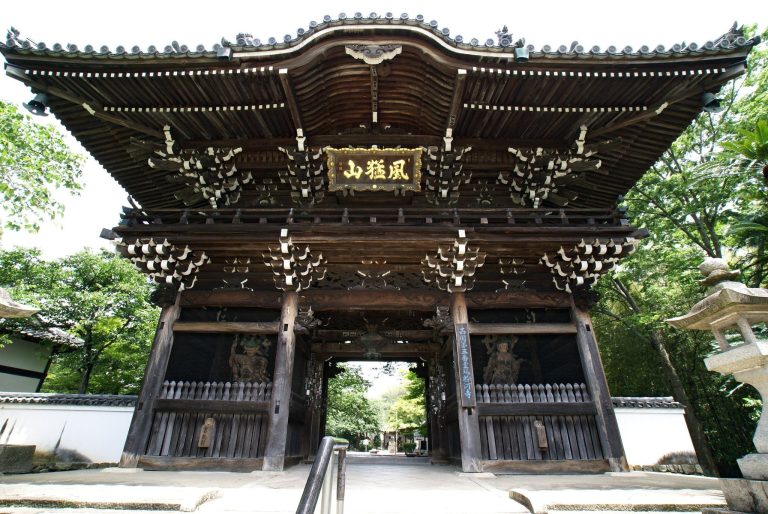
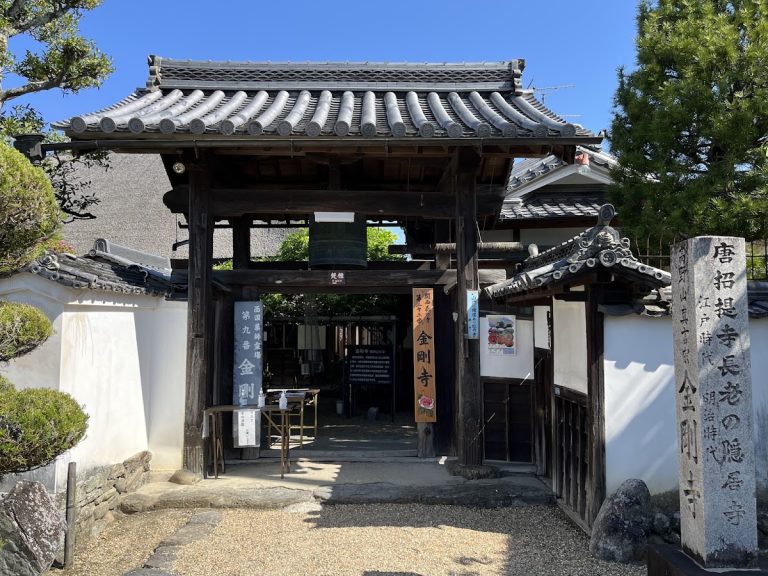
The western gate and four sections of the earthen-walled enclosure date from the Muromachi period. A separate northern gate also survives. The walls are unusually thick and are described as the oldest earthen walls in Wakayama Prefecture.
Buildings and images
Maitreya Hall
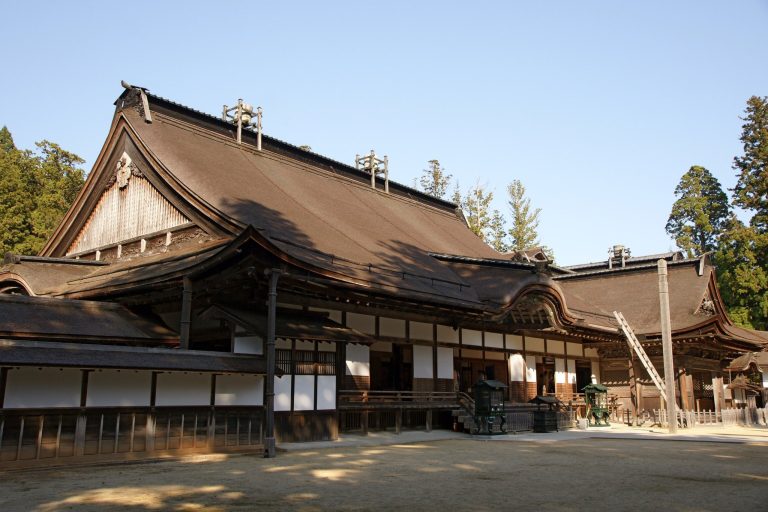
The Maitreya Hall is the temple’s main hall and a surviving historic building associated with the World Heritage Koyasan property. It is accompanied by one stone finial and seventeen ridge tablets. A ridge tablet is a wooden plaque that records information about a building or its construction.
Wooden Maitreya Buddha
The principal image is a wooden seated Maitreya Buddha measuring 91 centimeters in height. It is represented in the form of a Buddha rather than an ornamented bodhisattva. The raised right hand makes a gesture of protection, while the left rests on the knee in a gesture associated with granting wishes.
The image has a broad, heavy head, a weighty expression, a strongly rounded body, and large wave-patterned folds in the robe. These features reflect sculpture of the early Heian period. An ink inscription dated 892 appears on the robe hem before the crossed legs. Although that section of the robe was replaced later, the inscription is regarded as a faithful transcription of the original, and the image is dated to 892.
The image was transmitted for many years as a hidden Buddha, preserving its original halo and pedestal. Scholarly examination began only after the Second World War. The sculpture was designated an Important Cultural Property in 1962 and a National Treasure in 1963. It is traditionally shown only once every twenty-one years, in reference to the twenty-first day of the month associated with Kukai’s death.
Maitreya Bodhisattva painting
A badly damaged silk painting of Maitreya Bodhisattva belongs stylistically to the late Heian period. The seated figure holds a pagoda in both hands, which form the meditation gesture, and is surrounded by forty-nine manifested Buddhas associated with Maitreya’s heavenly realm. Seed syllables of four inner-offering bodhisattvas from the Diamond Realm Mandala appear in the four corners. The work is described as the only known independent Heian-period image of Maitreya Bodhisattva.
Four Heavenly Kings
Four standing wooden figures of the Four Heavenly Kings date from the Kamakura period. They form part of the temple’s surviving religious imagery alongside the Maitreya sculptures and the buildings of the precinct.
Other religious features
Stone memorials
The precinct contains one stone lantern associated with the Maitreya Hall, two gorinto stone towers, and one sotoba-shaped dismounting stone. A gorinto is a five-element memorial stone tower. A sotoba is a stupa-shaped Buddhist memorial marker. The dismounting stone was erected by a Buddhist priest during the Heian period and is now partly buried.
Votive tablets
Jison-in’s votive tablets are shaped like breasts and have cloth breasts attached to them. Their form relates to the temple’s religious association with women, motherhood, and the story of Kukai’s mother.