Hitachinokuni Sōshagū: The Provincial Shrine of Ancient Hitachi


Site at a Glance
- Rating
- 4.3
- Popularity
- Medium
- Country
- Japan
- Primary era
- Early Modern
- External website
- Open
- Eras represented
- Early Modern
- Civilizations
- Tokugawa
- Site type
- Religious
- Remains
- Sanctuary
On this page13 sections
History
Hitachinokuni Sōshagū is a Shinto shrine in Ishioka, Ibaraki, Japan, serving as the Sōja of the former province of Hitachi, where the province’s principal kami, or deities and sacred spirits, were worshipped collectively. Shrine tradition places its foundation in the Tenpyō period, around 729–749, although this early date is questioned because the Sōja system appears to have become established only in the late Heian period, the era of Japan’s classical court culture.
Origins and relocation
The shrine was originally called Kokufu no Miya. During the Engi period, around 901–923, six heavenly and earthly kami were enshrined there, and the institution became known as Rokusho no Miya. It was later renamed Sōja, a name historically pronounced “Sōja.” A Sōja brought together the worship of a province’s principal deities so that the provincial governor could perform a collective rite rather than visit every shrine separately.
The original site is traditionally placed near the ruins of the Hitachi Kokubun-niji convent. During the Tengyō period, around 938–947, the Ōjō clan, represented by Taira no Akinikuni, built a castle at Hitachi-Fuchū, present-day Ishioka. The shrine was then moved to its present location as the castle’s tutelary shrine. Its hereditary chief priests belonged to the Kiyohara family.
The shrine’s principal deities are now Izanagi, Ōkuninushi, Susanoo-no-Mikoto, Ninigi-no-Mikoto, Omiyanome, and Futsunomitama. Izanagi is a primordial creator deity, while Ōkuninushi is associated with the ordering of the land and prosperity. Susanoo is linked with storms, Ninigi with the imperial mythic lineage, Omiyanome with court and communication, and Futsunomitama with a sacred sword. A 1791 ritual record instead names Ōnamuchi, another name for Ōkuninushi, as the enshrined deity and describes seven wooden images, six of them in unusual forms.
Medieval authority and obligations
By at least June 1179, a draft construction requisition had been issued, showing that the shrine precinct was being developed. Until the end of the Kamakura period, the era of Japan’s first shogunate, various shrines and villages in Hitachi, including Yoshida Shrine and Mount Tsukuba Shrine, were assigned obligations to contribute to construction.
In the early fourteenth century, hereditary estate stewards refused those obligations. Hitachinokuni Sōshagū appealed to the Kamakura shogunate, which ordered the contributions to be fulfilled and requested written statements about earlier precedents. Around six of these statements survive among the shrine’s papers, and each declares that no such construction precedent existed. The dispute reveals resistance by Kantō retainers to the shogunate’s strengthened protection of shrines and temples. It has also been interpreted as a challenge to the Sōja’s authority and as evidence of the transformation and dissolution of provincial-government functions. By the late Kamakura period, members of the Ōjō family were exercising control over farmland belonging to the shrine.
During the medieval period, representatives of the provincial governor conducted offering rituals on March 3 and July 16. The shrine retained authority to conduct and lead religious rites throughout Hitachi at least until the Sengoku period, an era of widespread political and military conflict. It also possessed enough influence to intervene in Buddhist affairs. Seven Buddhist monks known as monks serving the Sōja were associated with its religious administration.
Military associations and Edo-period rebuilding
In May 1440, Ōta Dōkan, a fifteenth-century military leader and castle builder, visited the shrine before traveling to Ōshū to pray for military success. After returning victorious, he donated one military command fan and two poetry slips, and composed a waka poem connected with the visit. In May 1668, his descendant Ōta Sukemune presented a gold pear-skin-finish box made for the fan. The lid preserves an account of the fan’s provenance.
During the Edo period, the long era of Tokugawa shogunal rule before the Meiji Restoration, the complex contained a main hall, an offering hall, a worship hall, and an associated Buddhist temple. It administered the subsidiary shrines of Takafusa Myōjin and Inari Myōjin. In 1627, Minagawa Takatsune, lord of the Hitachi-Fuchū domain, rebuilt the shrine buildings. The Edo shogunate fixed the shrine’s estate at 25 koku that year, a measure of agricultural production and land income. Matsudaira Nobusada repaired the worship hall in 1683.
In June 1886, parishioners repaired the worship hall and shrine gate and replaced the main hall’s roofing with copper. After the Meiji Restoration, the shrine was first ranked as a village shrine and was raised to prefectural-shrine status in September 1900 under Japan’s modern shrine-ranking system. To commemorate the elevation, residents of Ishioka collected donations for a shrine fund and commissioned Sanjō Sanetomi to write the shrine name for a plaque displayed on the buildings.
Modern community and heritage
The area around the shrine received the place-name Sōsha in 1978 and was divided into first and second wards. The reading “Sōsha” was formally selected, and the shrine became part of Sōsha Second Ward. Its major annual festival takes place in September and is also called the Ishioka Festival. It is regarded as one of the three major festivals of the Kantō region. During the Edo period, its religious rite differed from the modern celebration because the sumo tournament alone was performed as the rite.
In 1994, the shrine community comprised approximately 2,500 parishioner households, with parishioners’ associations organized by neighborhood. The Sōshagū historical documents, which include shrine records and materials concerning the provincial government, became an Ibaraki Prefecture tangible cultural property in 1983. The main hall received designation as an Ishioka City tangible cultural property on April 14, 2005.
Remains
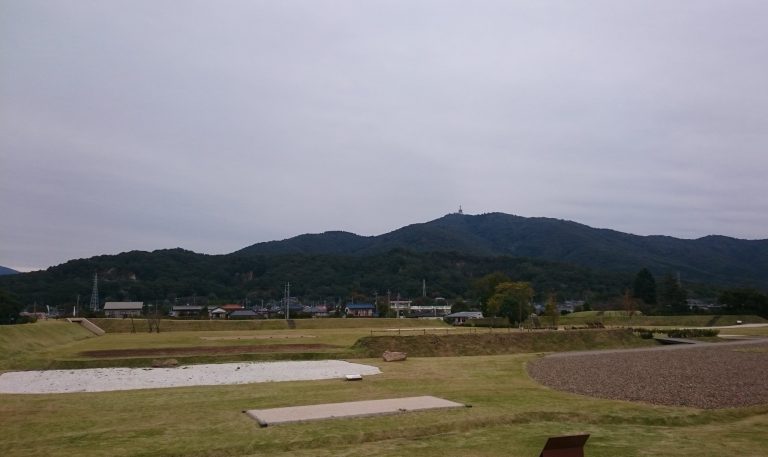
The shrine stands at the edge of a hill overlooking the lowlands of the Koise River to the west and south. Its grounds adjoin the former site of the Hitachi provincial government and cover approximately 2,513.26 tsubo, a traditional Japanese unit of area. The principal buildings are arranged within this precinct, while a sumo ring stands outside the shrine gate.
Principal buildings and grounds
Main hall
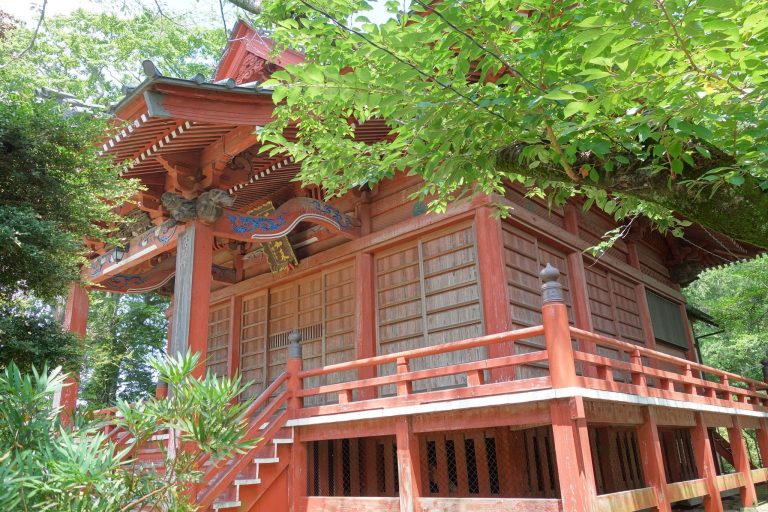
The main hall is a three-bay square structure in the nagare-zukuri style, a traditional shrine form whose front roof slope projects beyond the wall to create a covered entrance. It has a total area of 292 square meters and a copper roof. Rebuilding and repair work during the Edo and Meiji periods shaped the present group of principal buildings. The main hall is designated as an Ishioka City tangible cultural property.
Worship hall and shrine gate
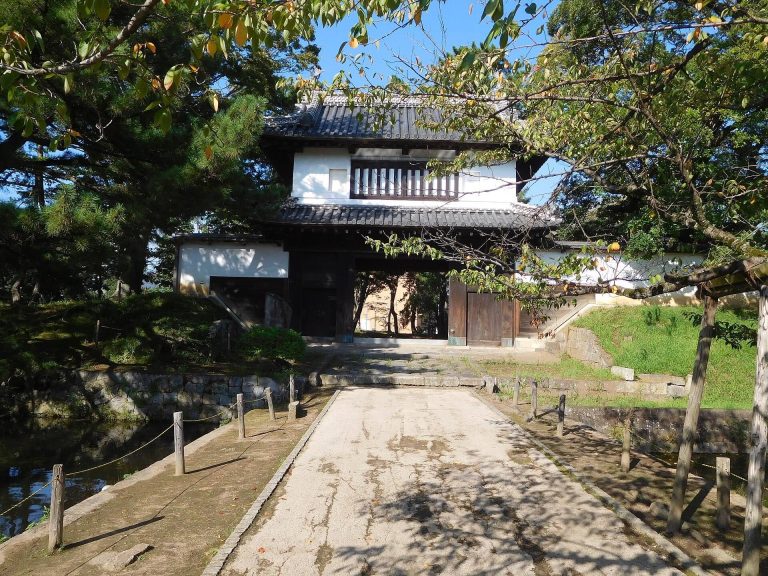
The worship hall and shrine gate were repaired in June 1886, when parishioners also arranged for the main hall’s roof to be replaced with copper. A stone beside the worship hall is identified as the place where Yamato Takeru rested. Outside the shrine gate, the sumo ring is used for competitions held in conjunction with the annual major festival.
Paintings, ritual objects, and festival equipment
Thirty-Six Immortal Poets plaque
A framed plaque dated 1503 carries paintings of the Thirty-Six Immortal Poets. It was donated by Chiyomasu, daughter of the lord of Ogawa Castle, and identifies the artist as Narita Kojirō Taira no Masuchika. The plaque became an Ibaraki Prefecture tangible cultural property in 1983.
Military command fans and box
The shrine preserves lacquered-leather military command fans attributed to donations by Ōta Dōkan and Satake Yoshinobu, a prominent lord of the Satake family during the late sixteenth and early seventeenth centuries. Together they form part of the group known as the “three military commanders’ fans,” and both fans were designated Ibaraki Prefecture tangible cultural properties in 1983. The associated gold pear-skin-finish box made for Dōkan’s fan has a lid bearing the account of its provenance.
Wooden images and festival lion head
The seven wooden images described in the 1791 ritual record are among the shrine’s associated objects. A cypress-wood lion head made around 1715–1764 is used by Dobashi district in the annual festival procession to clear the way. It was designated an Ibaraki Prefecture tangible folk-cultural property in 1992.