Aekuni Shrine: The Principal Shrine of Former Iga Province


Site at a Glance
- Rating
- 4.2
- Popularity
- Low
- Country
- Japan
- Primary era
- Early Modern
- External website
- Open
- Eras represented
- Early Modern
- Civilizations
- Tokugawa
- Site type
- Religious
- Remains
- Sanctuary
On this page16 sections
History
Aekuni Shrine is a Shinto shrine in Iga City, Japan, traditionally founded in 658, although another shrine tradition gives 685. Historically regarded as the Ichinomiya, or principal shrine, of former Iga Province, it is also identified as the sole Engishiki taisha, a major shrine listed in the tenth-century compilation of court regulations and shrine institutions known as the Engishiki.
Origins and Early Recognition
The foundation story connects Prince Ohiko with the Abe and Ahe clans of the former Ahae District, while Sukunahikona is associated with the Hata clan. The earliest worship is understood to have centered on Aekuni-tsu-kami, a local deity, and possibly on sacred Mount Nangū itself. The Ahe clan regarded the district as its ancestral homeland and was closely connected with this worship.
The shrine originally stood near the summit of Mount Nangū before being transferred to its present position at the mountain’s foot. A separate sanctuary for Kanayamahime, invited from Nangū Taisha, was established at the former mountaintop site. In 977, words were traditionally said to have appeared on a sacred tree before this sanctuary, directing that Kanayamahime be enshrined together with the Abe-kuni deity. She was consequently transferred and jointly enshrined at Aekuni Shrine.
Early records may identify the shrine through several related names. The deity called Tsu-kami received the rank of Junior Fifth Rank, Lower Grade in 850, while the deity called Abe-kami received the same rank in 864. The identification of Abe-kami with Aekuni Shrine remains disputed. Later records use the names Aekuni-tsu-kami and Aekuni-tsu-taisha-kami, whose rank rose to Junior Fifth Rank, Upper Grade in 867, Senior Fifth Rank, Lower Grade in 873, and Senior Fifth Rank, Upper Grade in 891.
Completed in 927, the Engishiki lists Aekuni Shrine as a major shrine in Ahae District. Tradition also holds that the shrine buildings were repaired with imperial support between 923 and 931. Another tradition assigns the shrine the rank of Senior First Rank in 969, although both the date and attribution of that promotion are uncertain.
Changing Identities and Provincial Status
From the medieval period, the identity of the principal deity became a matter of competing interpretation. Kanayamahime and Sukunahikona were proposed as forms of the original regional deity, while Koga Saburo was later added in traditions connected with the spread of Suwa worship. Two-deity and three-deity interpretations took shape between the late Muromachi and Edo periods.
In 1713, Watarai Nobutsura argued that the principal deity was Prince Ohiko, drawing on traditions that identified Ohiko as the ancestor of the Ahe clan. The shrine later adopted this interpretation. Koga Saburo was removed, and after the Meiji period the modern arrangement of Prince Ohiko, Sukunahikona, and Kanayamahime became established.
Prince Ohiko, a figure in early Japanese imperial tradition, is regarded at Aekuni Shrine as the ancestral deity of the Abe, Ahe, and related clans, as well as of local residents. He is associated with safe travel, traffic protection, health, and longevity. Sukunahikona is connected with medicine, sake brewing, commerce, and abundant fishing. Kanayamahime is associated with mining, metallurgy, machinery, and other modern industries.
Medieval records call the shrine Nangū or Nangū Daibosatsu. It was also known as Iga’s provincial Ichinomiya and general shrine. The name Nangū appears by the early twelfth century, while the designation as Iga’s Ichinomiya belongs to the medieval record. During the Nanboku-cho period, Emperor Go-Murakami of the Southern Court visited the shrine, remained there for several days in religious retreat, and increased its estate.
Destruction and Reconstruction
During the Tenshō Iga War, a late sixteenth-century conflict in which forces advancing under Oda Nobunaga attacked Iga, the shrine buildings were burned. Many records were lost and sacred objects were scattered. One sacred object reached the Fushimi area of Yamashiro Province before Mizuguchi Saemon recovered and returned it. The Mizuguchi family thereafter received a seat of honor at festivals held at Ichinomiya.
The shrine remained in ruins when the yamabushi Kotenku Seizo, an ascetic practitioner of the Shugendo mountain tradition, began rebuilding it in 1593 by raising the main roof frame. In 1598, he dedicated two iron hot-water cauldrons. After Todo Takatora took control of Iga, the shrine received renewed domain patronage as the spiritual protector of the vulnerable northeast, or demon-gate, direction of Iga Ueno Castle.
The main sanctuary was rebuilt in 1609, with its roof frame completed in January 1610, and a bell tower was later added. In 1611, deputy commissioners and district magistrates appealed for assistance with reconstruction. The shrine received an estate assessed at 107.4 koku in 1612. The priestly families at that time were the Azuma, Minami, and Nakanishi families.
Modern Status and Ritual Traditions
In 1871, under the modern system of ranked Shinto shrines, Aekuni Shrine became a National Shrine of the Second Rank, or Kokuhei Chūsha. After the state shrine system was abolished, it became a Beppyo Shrine of the Association of Shinto Shrines in 1946.
The main annual festival takes place on December 5. Lion kagura, a ritual performance of music and dance offered to kami, is held on January 3, April 17, and December 5. Traditionally dated to the Keichō period, the performance is regarded as the model for lion kagura at shrines throughout Iga. Its tradition circulated widely during the Kyōhō period and continued until the beginning of the Shōwa period. Mie Prefecture designated the shrine’s lion dance an Intangible Folk Cultural Property in 1954. Aekuni Shrine is also included in the Japan Heritage story “The Ninja Village of Iga and Koka” and in the Iga Treasures selection.
Remains
Mountain Setting and Precinct
Aekuni Shrine occupies a precinct of approximately 5,759 tsubo, about 19,038 square meters, at the foot of Mount Nangū. The mountain is treated as the shrine’s sacred mountain and is also known as Iga Kofuji. The precinct includes the principal sanctuary complex, auxiliary and branch shrines, a purification pavilion, an ema pavilion, the rock called Momotaro-iwa, and a monument bearing a haiku by Basho.
Former Oishi Cult
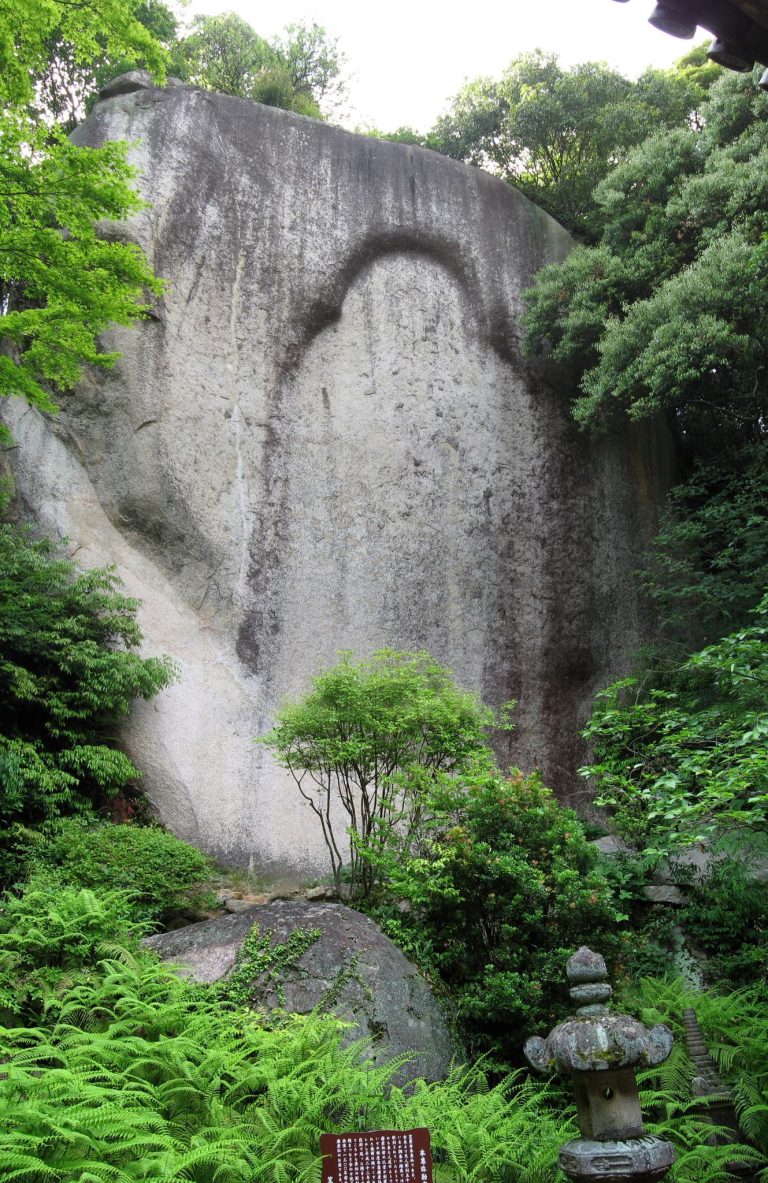
Approximately 200 meters south of the shrine, and in some descriptions 200 to 400 meters away, there was formerly a large boulder called Oishi Myojin or Kuroiwa. It was regarded as an iwakura, a natural rock associated with the presence or worship of a kami, from which Mount Nangū could be viewed or ritually approached. The boulder is now lost. A nearby kofun, or ancient burial mound, and evidence of large-stone worship have been reported, while the associated Oishi or Kuroiwa cult is represented within the precinct by Oishi-sha.
Principal Sanctuary Group
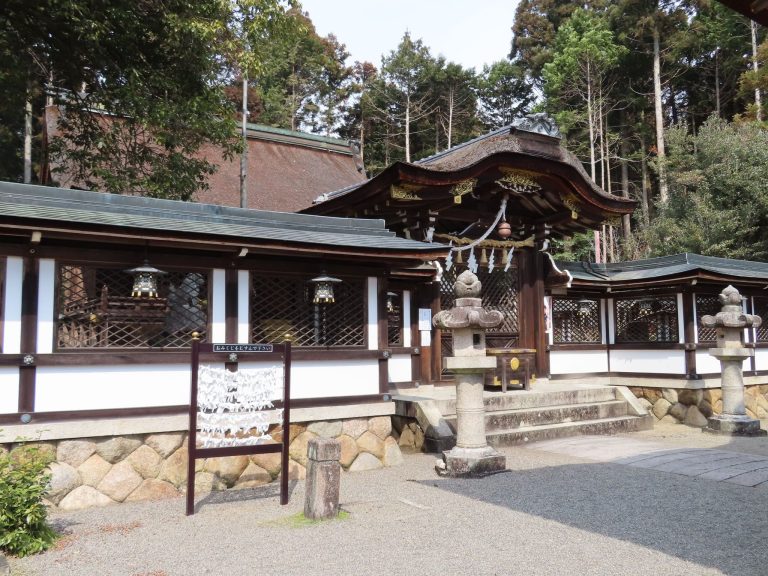
Main Sanctuary
The main sanctuary is a nagare-zukuri structure, a shrine form with a roof extending forward over the entrance, and has a cypress-bark roof. In the early Meiji period it measured 9.89 tsubo, approximately 32.69 square meters. Rebuilt in March 1852, it has red wooden projecting members and vivid polychrome carvings within its frog-leg-shaped bracket ornaments.
Worship Hall
The worship hall measures 28.5 tsubo, approximately 94.21 square meters, and has an irimoya roof, a hipped roof combined with gabled sections. It was rebuilt in 1854.
Prayer and Offering Halls
The norito hall, used for reciting prayers, measures 6 tsubo, approximately 19.83 square meters, and also has an irimoya roof. It was rebuilt in 1866. The offering-food hall measures 3.46 tsubo, approximately 11.44 square meters. The surrounding sacred fence is approximately 30.03 meters long.
Auxiliary and Branch Shrines
Auxiliary Shrines
Kusho-sha stands to the west of the main sanctuary and Rokusho-sha to the east. Rokusho-sha enshrines Izanagi, Izanami, the sun deity, the moon deity, Hiruko, and Susanoo. A sacred image of Koga Saburo was formerly kept there.
Branch Shrines
The branch shrines are Wakamiya Hachiman-sha, Musubi-sha, Kosazuke-sha, Shinmei-sha, Oishi-sha, Ichikishimahime-sha, Kusunoki-sha, and Asama-sha. Wakamiya Hachiman-sha is dedicated to Emperor Nintoku, Musubi-sha to Takamimusubi and Tamanotenjin, Kosazuke-sha to conception, and Shinmei-sha to Amaterasu.
Oishi-sha is dedicated to Susanoo, Kanayamahiko, Amaterasu, and Oyamatsumi and occupies approximately 70 tsubo, about 231.4 square meters. Ichikishimahime-sha is dedicated to Ichikishimahime, while Kusunoki-sha honors Kusunoki Masashige and Todo Genpo. Asama-sha, an outer branch shrine on Mount Nangū, is dedicated to Konohanasakuyahime and occupies approximately 58 tsubo, about 191.74 square meters.
Paintings and Dedicated Objects
The shrine preserves twelve framed panels containing thirty-six paintings of the Thirty-Six Immortals of Poetry, with three poets shown on each panel. The paintings are attributed to Kano Sanraku, while the accompanying poem cards are attributed to the brushwork of Konoe Nobutada. A 1609 attribution to “Yamatoku” is regarded as an error. Mie Prefecture designated the paintings a Tangible Cultural Property in 2005.
Two iron hot-water cauldrons dedicated in 1598 and a stone lantern also survive among the shrine’s notable objects. The cauldrons became Tangible Cultural Properties of Iga City in 1958, and the stone lantern received the same designation in 2004.