Yoshino Mikumari Shrine: A Historic Water Shrine on Mount Yoshino


Site at a Glance
- Rating
- 4.3
- Popularity
- Low
- Country
- Japan
- Primary era
- Early Modern
- External website
- Open
- Eras represented
- Early Modern
- Civilizations
- Toyotomi regime
- Site type
- Religious
- Remains
- Sanctuary
On this page17 sections
History
Yoshino Mikumari Shrine is a Shinto shrine in Japan, located in the Kamisenbon area of Mount Yoshino in Nara Prefecture. Its foundation date is unknown, but an entry dated April 29, 698, records an offering of a horse to the deity of Yoshino Mikumari Peak during a prayer for rain. The shrine was established as a place of worship for Ame-no-mikumari-no-kami, a water deity whose name refers to the distribution or apportionment of water.
Origins as a water shrine
The shrine was originally believed to stand on the summit of Aonegamine, near the boundaries of Yoshino, Kurotaki, and Kawakami. Several streams rise there, including the Otonashi, Kisadani, and Akino rivers, making the mountain an appropriate location for a deity associated with distributing water. A former shrine site remains about one kilometre northwest of the summit, and the old sacred area continued to be revered after the shrine was moved.
Yoshino Mikumari Shrine was transferred to its present location around 806, reportedly to make worship more accessible. It became one of the four major water-distribution shrines of the former province of Yamato. The shrine received one household of tax-exempt shrine lands in 806, the rank of Junior Fifth Rank in 840, and Senior Fifth Rank in 859. In the Engishiki, a tenth-century register of court institutions and rites completed in 927, it appears as the principal Yoshino water-distribution shrine. It was entitled to offerings at monthly and first-fruits festivals and was included among shrines connected with imperial rainmaking rites.
The worship of Ame-no-mikumari-no-kami also developed associations with fertility, safe childbirth, and the protection and upbringing of children. Traditional sound changes connected the name Mikumari with expressions related to pregnancy and child care, giving rise to the alternate name Komori-no-miya. Fujiwara no Michinaga, a powerful court noble of the Fujiwara regency, recorded an offering of gold, silver, and five-colored materials to the Komori deity on Mount Kinpu in 1007. The account reflects the deity’s reputation as a bringer of children.
Buddhist-Shinto worship and Mount Yoshino
From around the twelfth century, the shrine participated in syncretic Buddhist-Shinto worship, in which Buddhist and Shinto beliefs and institutions were understood together. The water deity was regarded as a manifestation of Jizo Bodhisattva. Yoshino Mikumari Shrine also became associated with the Zao Gongen faith of Kimpusenji, a major Buddhist institution on Mount Yoshino, and with Shugendo, a Japanese mountain religious tradition combining ascetic practice, pilgrimage, and elements of Shinto and Buddhism.
The shrine is identified as the seventy-second practice site among the seventy-five stations of the Omine Okugake pilgrimage route. It was traditionally associated with Emperor Go-Daigo, the fourteenth-century emperor who sought to restore direct imperial rule. A shrine record states that Go-Daigo granted it the rank of Senior Second Rank in 1337.
Toyotomi reconstruction and later devotion
Toyotomi Hideyoshi visited the shrine during his 1594 cherry-blossom viewing excursion to Yoshino, staying for five days at Yoshimizuin, now Yoshimizu Shrine. Tradition holds that he prayed at Yoshino Mikumari Shrine for a child and later fathered Hideyori. In 1605, Hideyori rebuilt the shrine buildings in continuation of his father’s intention. Tatebe Mitsushige, a Toyotomi retainer and administrator of Amagasaki, supervised the construction.
The reconstruction date is sometimes given as 1604 or 1605. Inscriptions on a portable shrine, hanging lanterns, brushwood-fire lanterns, and the main hall’s tie beam refer to 1604, while the ridge plaque of the main hall gives 1605. The latter date is used for the reconstruction of the shrine buildings.
The shrine’s associations with childbirth and children continued into the early modern period. The parents of Motoori Norinaga, an eighteenth-century scholar of classical Japanese literature and Shinto thought, prayed there for his birth. Norinaga later described himself as a child granted through the water deity’s favor in his travel diary, wrote poems about the shrine, and visited it three times.
Rites, protection, and modern recognition
A tradition relates that raft workers donated a flight of sixty-one stone steps in 1767 after repeated deaths at the dangerous Zatabuchi section of the Kinokawa River. No further drowning was then reported, and the shrine came to be revered among raft workers as their protective deity.
The long-standing Onda rice-planting rite has been performed at the shrine since approximately the Muromachi period, or about seven centuries. It is a celebratory ceremony intended to ensure an abundant harvest, even though Mount Yoshino has no rice paddies. The rite reflects the water deity’s role in conveying water to settlements below. For about 300 years it was performed by the Higakimoto Sarugaku troupe, a family tradition within the medieval performance culture that contributed to the development of Noh theater. Government control of the Yamato theatrical schools led the troupe’s family to move to Edo and join the related Kanze troupe. Later, performance by shrine priests was prohibited, so local amateurs continued the rite.
The ceremony was traditionally held at New Year or in February. During the Taisho period, a shrine-maiden kagura performance learned from the rice-planting rite at Kasuga Taisha also influenced its development. The present April 3 festival continued after these changes. Locally called Onda, it is regarded as a seasonal ceremony announcing spring on Mount Yoshino. Since about 1995, transmission of the rite has been entrusted to the Yoshino Mountain youth organization, and it is now maintained by the Onda-ko preservation association. Yoshino Town designated the Onda rite an intangible folk cultural property in 1978.
During the Meiji separation of Shinto and Buddhism, Yoshino Mikumari Shrine became independent of Kimpusenji and was classified as a village shrine. The shrine buildings were repaired under Nara Prefecture’s supervision from 1926 to 1928, followed by a major dismantling and repair project in 1986 and 1987. The buildings were designated Important Cultural Properties in 1901. The precinct lies within the Historic Site and Place of Scenic Beauty designation for Mount Yoshino, made in 1924. In 2004, the shrine and Mount Yoshino became components of the UNESCO World Heritage property Sacred Sites and Pilgrimage Routes in the Kii Mountain Range, within the sacred area of Yoshino and Omine.
Remains
Precinct and approach
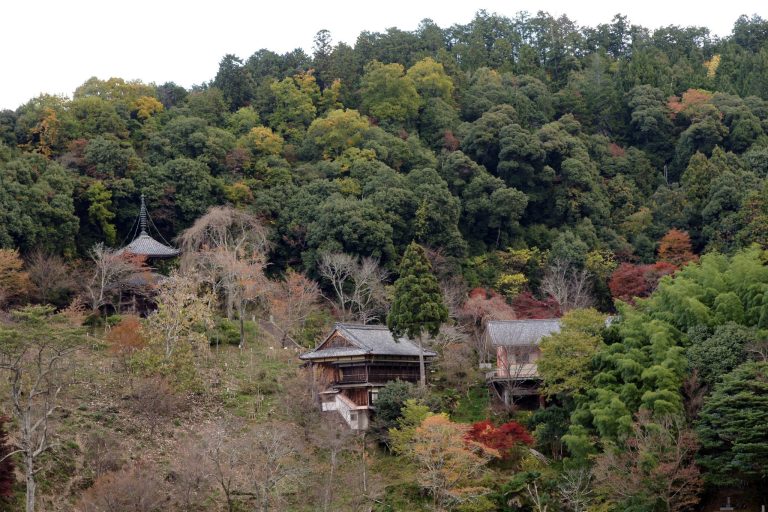
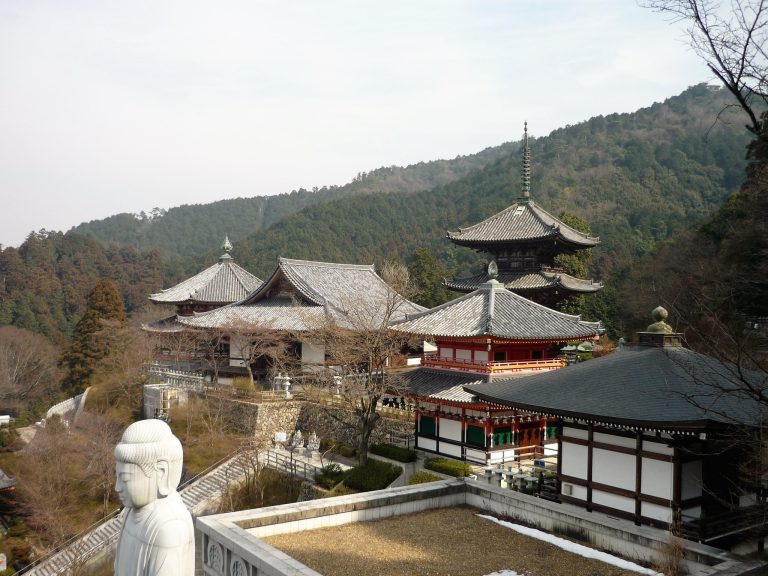
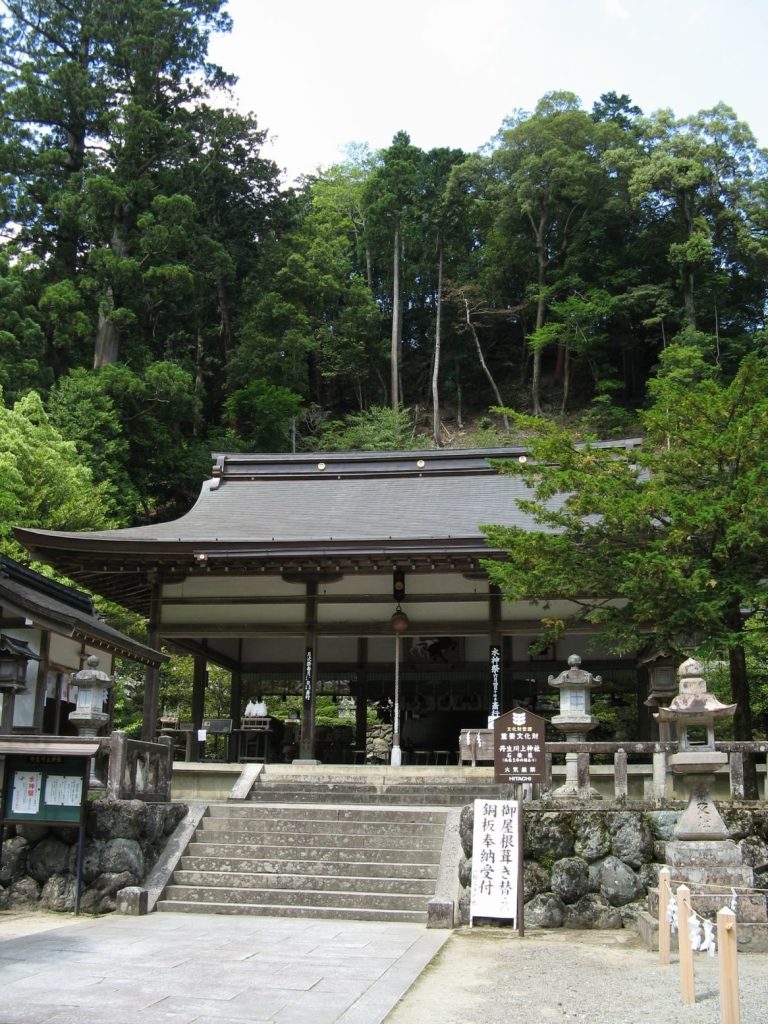
The precinct occupies a level area cut artificially into a steep northeast-facing slope. Its entrance lies on the western side beside the Omine Okugake route leading toward Mount Omine. A stone stairway rises from the entrance to the shrine buildings, which are arranged around a central ceremonial courtyard in a roughly U-shaped plan. The entrance torii is followed by the stairway and a two-story-style gate, or romon. Covered corridors extend north and south from the gate, helping define the arrangement of the principal buildings.
Main shrine buildings
Romon gate
The romon is three bays wide and has a hipped-gabled roof covered with wooden shingles. Its northern and southern connections lead to covered corridors, each three bays long and two bays wide. The corridors have single-story gabled roofs with wooden shingles.
Haiden worship hall
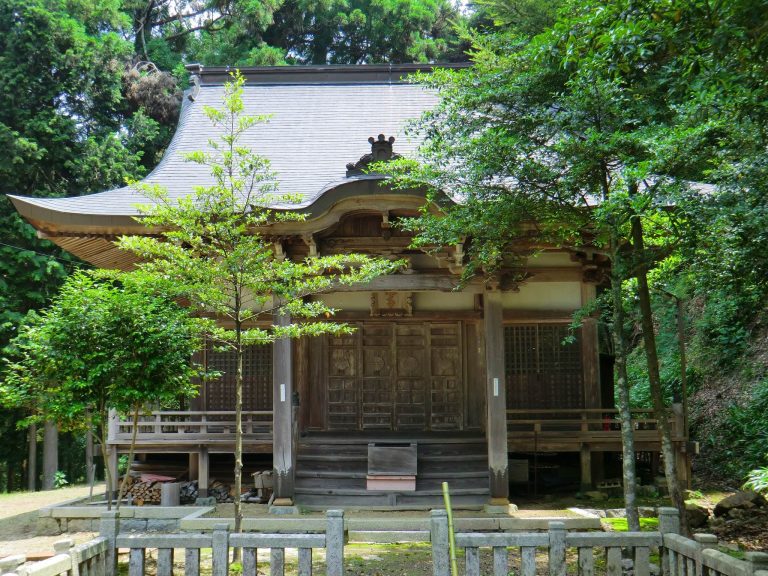
The haiden, or worship hall, stands to the left when entering the courtyard. It is a single-story structure supported like a stage, measuring ten bays in length and three or four bays in width on its eastern and western sides. Its hipped-gabled roof is covered with wooden shingles.
Heiden offering hall
The heiden, or offering hall, stands at the rear of the courtyard. It measures six bays in length and four bays in width and has a single-story gabled roof covered with wooden shingles. A lean-to addition with a shingle-covered roof extends from the rear. The hall contains a black-lacquered, gilt-bronze-fitted portable shrine modeled on the ancient octagonal imperial throne. It is 223.5 centimetres high and 396 centimetres long, and an inscription attributes its production to Tatebe Mitsushige. The portable shrine became a Nara Prefectural tangible cultural property in 2017.
Honden sanctuary
The honden, or main sanctuary, stands opposite the haiden on the right side of the courtyard. It measures nine bays in length and two bays in width. Its central one-by-one-bay unit follows the Kasuga style, a compact sanctuary form with a projecting gabled front, while the two side sanctuaries are three-bay structures in the Nagare style, whose front roof extends in an asymmetrical slope. The three sanctuaries stand beneath one extended roof with three gables and are linked at the rear by wooden walls.
The honden retains individual eave components known as kayaoi, kioi, and nokitsuke. Its bracket complexes, curved beams, and tie beams carry brilliant polychrome decoration. Carved frog-leg struts and projecting nose-like ends of beams preserve features associated with the Azuchi-Momoyama period. Other objects linked with Hideyori’s foundation include a ritual brushwood fire and a taro-leaf lantern. The portable shrine, brushwood fire, and lantern are designated cultural properties.
Subsidiary shrines and sacred images
Okami Shrine
Okami Shrine is a subsidiary shrine within the precinct. It enshrines deities associated with protecting practitioners who undertake Shugendo for the first time, linking the local shrine complex with the mountain religious traditions of Yoshino.
Shiba Shrine
Shiba Shrine enshrines Okuninushi and Sukunahikona and is revered as a guardian of children’s skin. Its associations continue the precinct’s wider religious connection with childhood and protection.
Statue of Tamayori-hime
A wooden seated statue of Tamayori-hime measures 82.4 centimetres in height. Ink inscriptions on its back and on the inner ends of its sleeves give the date October 16, 1251. They also record its donation by thirty-seven people led by the Buddhist monk Jiren, with the retired imperial consort Sen’yōmon-in as principal donor. The statue was designated an Important Cultural Property in 1901 and became a National Treasure in 1956.
Other wooden images
The shrine preserves a wooden seated statue of Ame-no-Yorozu-Takuhata-Chichihime carved in the Heian period. It also houses a group of approximately twenty wooden images of deities. Artificially formed ground surfaces and divisions of the precinct remain, while archaeological remains and artifacts connected with the shrine’s historical and religious changes are buried in parts of the grounds.