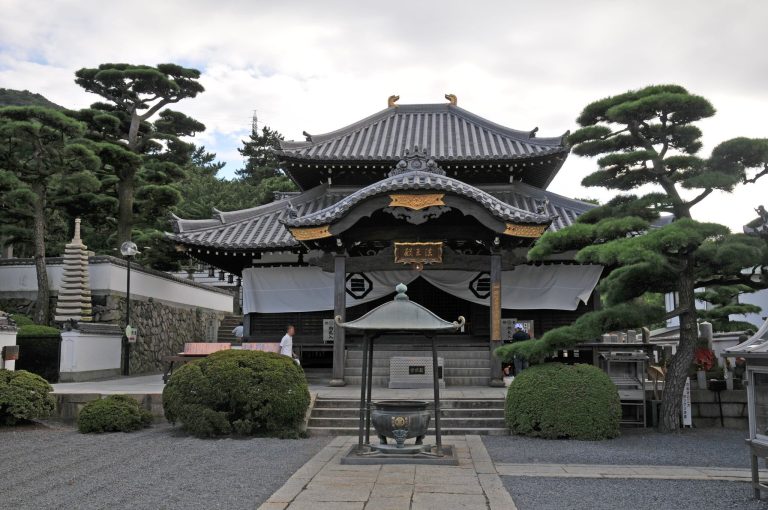
Shiromine-ji Temple: A Buddhist Pilgrimage Temple in Japan


Site at a Glance
- Rating
- 4.2
- Popularity
- Low
- Country
- Japan
- Primary era
- Early Modern
- External website
- Open
- Eras represented
- Medieval, Early Modern, Modern
- Civilizations
- Japanese, Kamakura shogunate, Tokugawa, Toyotomi regime
- Site type
- Religious
On this page25 sections
History
Shiromine-ji Temple is a Buddhist temple in Sakaide, Kagawa Prefecture, Japan, belonging to the Omuro School of Shingon Buddhism. Tradition dates its foundation to 815, when Kūkai visited Mount Shiramine and established sacred practices at the site. The temple is the 81st stop on the Shikoku 88-Temple Pilgrimage, a circuit associated with Kūkai, and holds the status of a special head temple. Its formal mountain name is Ryōshōzan, its institutional name is Dōrin-in, and its principal deity is Senju Kannon Bosatsu, the thousand-armed form of Kannon, the Buddhist bodhisattva of compassion.
Foundation traditions
The foundation tradition places Kūkai on Mount Shiramine in 815. He is said to have buried a wish-fulfilling jewel at the summit, dug a sacred well, and used its water for Buddhist offerings while praying for the salvation of all sentient beings. The summit associated with this account is given as 357 meters above sea level, while the temple grounds occupy the slopes below.
Another tradition concerns Enchin, who climbed the mountain in 860 after seeing an auspicious light above its summit. Following an oracle from a white-haired local guardian deity, he carved an image of the thousand-armed Kannon from a fragrant tree that had appeared in the Seto Inland Sea. He then founded the temple’s Buddhist hall. The image became revered as a “Substitute Kannon,” believed to bear the suffering of worshippers.
Emperor Sutoku and the memorial complex
Shiromine-ji’s identity became closely connected with Emperor Sutoku after his exile in Sanuki Province. Sutoku, a retired emperor whose defeat in the Hōgen conflict led to his exile, died in 1164. In accordance with his final wishes, his body was cremated on Chigo-dake above the temple, where a mausoleum was built. Three years later, the Buddhist monk and poet Saigyō visited the site to pray and conduct memorial rites.
In 1191, Emperor Go-Toba ordered the relocation of the Kinomarudono, the residence at Tsutsumigaoka where Sutoku had spent his final six years, to a place near the mausoleum. The building was reconstructed as a memorial Hall of the Lotus Sutra. Sutoku’s self-portrait, painted during his confinement at Ninna-ji in Kyoto, was enshrined there.
The memorial complex helped the temple prosper, and Shiromine-ji eventually possessed twenty-one sub-temples. Most of the complex was destroyed by fire in 1382. In 1415, Emperor Go-Komatsu donated a wooden imperial plaque bearing the inscription “Tonshō-ji” in his own calligraphy, praying for Sutoku’s salvation. The memorial complex subsequently became known as Tonshō-ji-dono.
Reconstruction and imperial association
Tonshō-ji-dono and its Imperial Plaque Gate were reconstructed in 1680 by Matsudaira Yorishige and Matsudaira Yoritsune, lords of the Takamatsu Domain. The rebuilt memorial precinct included the Imperial Plaque Gate, a worship hall, and three buildings forming the inner sanctuary.
During the political turmoil of the late Edo period, Emperor Kōmei wished to transfer Sutoku’s spirit to Kyoto in order to calm it. He died in 1866 before the plan could be carried out. Emperor Meiji fulfilled the wish in 1868, after the Meiji Restoration, by sending imperial envoys to Shiromine-ji. They recited a Shinto ritual prayer before Sutoku’s mausoleum and took Sutoku’s self-portrait and cherished mouth organ to Kyoto. Emperor Meiji worshipped before the image the following day, and the era name changed from Keiō to Meiji on the next day.
Meiji-era disruption and recovery
After the Meiji Restoration, administration of Sutoku’s mausoleum passed from the temple to the Ministry of the Imperial Household. The 1870 Decree on the Surrender of Temple Lands confiscated the temple estate apart from its immediate precincts, removing its income. The sub-temples Ichijō-bō, Hōshaku-in, and Enpuku-in were abolished, leaving Dōrin-in as the surviving main residence.
The head priest left the priesthood in 1873, and the temple had no resident priest. Parishioners petitioned for a replacement to prevent its dissolution, and Keidō Tachibana became head priest in 1878. That same year, the Imperial Plaque Gate and Tonshō-ji-dono were transferred to Shiramine Shrine, an auxiliary shrine of Kotohira-gū, together with temple treasures. Shiromine-ji won a lawsuit challenging the transfer in 1884, but the buildings did not return until 1898, when Tonshō-ji-dono was restored to the temple. Only a very small portion of the transferred treasures came back. In 1965, local youth-association volunteers brought another lawsuit against Kotohira-gū to recover the treasures, but lost the case.
Continuing religious life
Shiromine-ji continues to function as a pilgrimage temple. The guardian deity Shiramine Daigongen Sagamibō is associated with good fortune, commercial prosperity, and success in contests. Emperor Sutoku is venerated in connection with severing harmful ties and achieving success in performing arts and scholarship. All twelve Chinese-zodiac guardian deities are enshrined in separate halls across the precincts.
The annual memorial ceremony for Emperor Sutoku takes place at his mausoleum on September 21. Other principal observances include the New Year prayer service, the New Year fire ritual, the festival of the principal deity, Great Prajna ceremonies, regular fire rituals, and memorial services. A goma ritual is an esoteric Buddhist fire ceremony in which offerings are burned before a sacred fire.
The temple complex, including nine buildings, two stone thirteen-story pagodas, and the wooden imperial plaque, has nationally designated cultural-property status. The pagodas received designation in 1954, the imperial plaque in 1901, and the nine temple buildings in 2017. The pilgrimage route known as the Negoroji Path is also a designated associated cultural property.
Remains
Shiromine-ji occupies ascending ground on the slopes of Mount Shiramine in the Goshikidai highlands, at approximately 271 to 284 meters above sea level. The grounds rise from the lower approach toward the main religious buildings, with the Main Hall reached by ninety-nine stone steps. Gates, halls, shrines, memorial structures, pagodas, and sacred landscape features extend from the temple precincts toward the mausoleum and surrounding pilgrimage approaches.
Approach and principal religious buildings
Gates and stepped approach
The lower approach begins at the First Gate, a pillar-style gate connected with the vehicular approach from Prefectural Road 180. A dismounting stone behind the gate was moved from near the Shiramine Observatory in December 1958, repaired, and erected again. Another dismounting stone, dated March 1794, remains at the observatory plaza. The Mountain Gate, also called the Seven-Roof Gate, dates from the late eighteenth century. It is a gabled gate with an additional roofed wing on each side. The Imperial Messenger Gate was built in the early nineteenth century, while the Lord’s Gate dates from 1724.
Main Hall
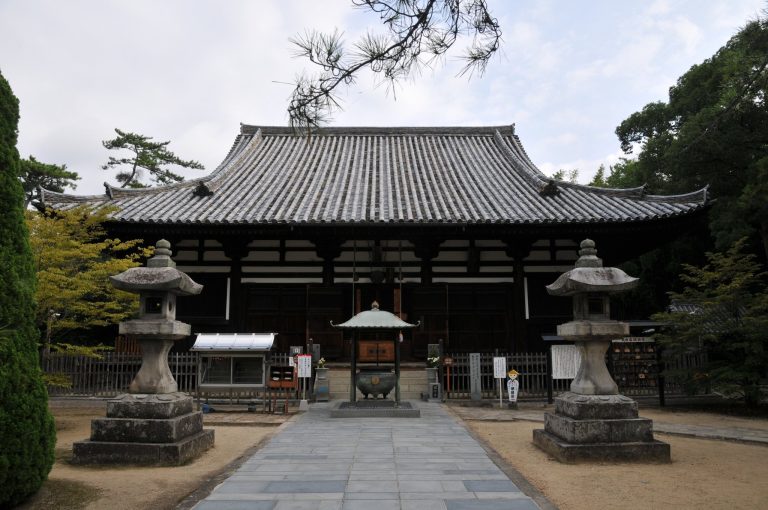
The Main Hall was rebuilt in 1599 and enshrines the thousand-armed Kannon. Its attendant images, Aizen Myōō and Bato Kannon, are secret images, meaning sacred figures normally kept hidden from public view. The principal image is publicly unveiled each year on the Sunday nearest July 10 during the memorial service.
Daishi and related halls
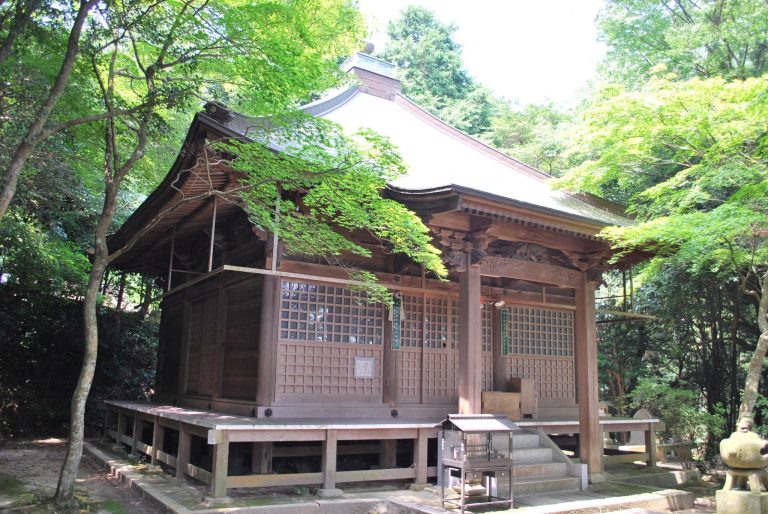
The Daishi Hall was rebuilt in 1811 and contains images of Kōbō Daishi, Chigo Daishi, and Shōmen Kongō, all kept as secret images. Between the Main Hall and Daishi Hall stands a Buddha’s Footprint Stone erected in 1999. A stone Yugi pagoda, erected in 1829, stands to the left of the Main Hall and is described as resting on a mythical supporting creature.
Amida and Gyōsha halls
The Amida Hall was built in 1661. Inside, Amida Nyorai is flanked by Seishi and Kannon Bodhisattvas, while one thousand small images of Amida are arranged behind them. The Gyōsha Hall was rebuilt in 1779. Its central image is En no Gyōja, accompanied by Enma, the Ten Kings of Hell, Jizō Bodhisattva, and Kokūzō Bodhisattva.
Yakushi Hall and other shrines
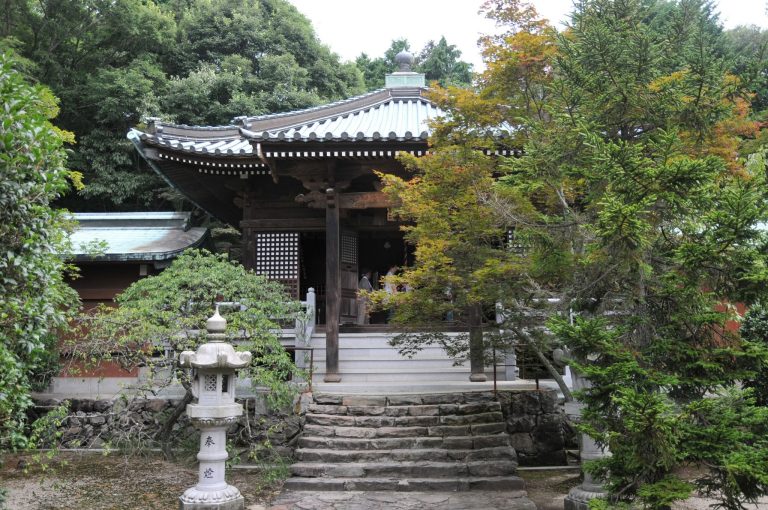
The Yakushi Hall is a two-story building from the early nineteenth century. It contains Yakushi Nyorai with Nikkō and Gakkō Bodhisattvas, and the Twelve Divine Generals in front. Dainichi Nyorai of the Diamond Realm stands to the left and Dainichi Nyorai of the Womb Realm to the right. These images are secret images. Nearby are the Jizō Shrine, with its stone statue of Jizō Bodhisattva, the Zennyo Ryūō Shrine rebuilt in 1777, and a Kyūsha Myōjin Shrine.
Later buildings and religious facilities
Memorial and ritual buildings
The Ekō-dō was built in 2003. Its central image is Amida Nyorai, and side niches hold the spirits of people receiving perpetual memorial services. A perpetual memorial tomb and a general cemetery lie behind the building. The Fire Ritual Hall, built in 1986, enshrines the Five Great Wisdom Kings and Bishamonten at the center. Fugen Bodhisattva, Kōbō Daishi, and Zao Gongen stand on the left, while Amida Nyorai, memorial tablets for successive Takamatsu lords, and tablets for former head priests stand on the right. A sutra-reception office is incorporated into the hall. A replica of the principal deity and an image of the Great Master provide a place of prayer for worshippers unable to climb the main steps.
Bell tower, shrines, and garden structures
The Bell Tower was reconstructed during the Meiji era, and the Benzaiten Shrine was built in the early nineteenth century. The Mizuko Jizō was erected in 1981 and has an attached purification pavilion incorporating a stone water basin dating from before the Edo period. The Guest Hall was built between 1673 and 1681 and received a large entrance vestibule around the middle of the eighteenth century. A granite five-story pagoda, 2.15 meters high and dating from the Kamakura period, stands in its rear garden and is not open to the public. The Tea Pavilion was built in 1909.
Treasure buildings and associated monuments
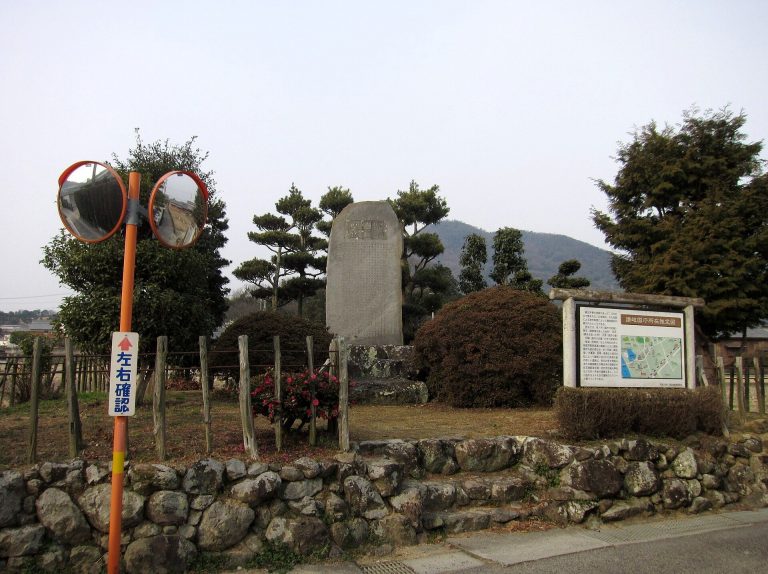
The Treasure Hall, built in 2003, displays temple treasures and designated cultural properties, including the wooden imperial plaque. The Treasure Repository preserves sacred texts and documents belonging to successive abbots, together with books connected with the temple. The Shiramine Gosha Inari Shrine was built in 1951. A standing statue of the Great Master in Training, erected in 1984, stands beside a stone monument bearing a pilgrim haiku. Stone statues representing the Saigoku 33 Kannon pilgrimage are distributed along the vehicular approach to the parking area.
Tonshō-ji and the mausoleum
Tonshō-ji memorial precinct
The Tonshō-ji memorial precinct was constructed in 1680. Its Imperial Plaque Gate, worship hall, and three inner-sanctuary buildings form a separate memorial complex associated with Emperor Sutoku. The inner sanctuary enshrines Sutoku in the center, Shiramine Daigongen Sagamibō on the left, and Sutoku’s personal Eleven-faced Kannon on the right. The worship hall contains an image of Manjushri.
The Imperial Plaque Gate was also constructed in 1680. The original plaque is preserved in the Treasure Hall, while a replica hangs on the gate. Warrior statues of Minamoto no Tameyoshi and Minamoto no Tametomo flank the entrance, whose doors are normally closed. The present figures replaced statues transferred to Kotohira-gū and Shiramine Shrine in 1898. The gate opens for certain New Year and Great Prajna ceremonies.
Worship area and Saigyō memorials
The Tonshō-ji worship area includes a place for distant worship of Sutoku’s mausoleum. A stone monument there bears a waka poem by Sutoku, and a Tonshō-ji-style stone lantern stands beside it. A stone seated statue of Saigyō rests on a stone traditionally identified as the place where he sat while paying homage to Sutoku. A nearby monument carries a Saigyō poem carved in sanukite.
Sutoku’s mausoleum and pagodas
Emperor Sutoku’s mausoleum lies approximately 100 meters beyond the rear entrance, behind the Tamazusa tree, and about 20 meters behind Tonshō-ji-dono. It consists of a square earthen mound enclosed by a worship area. Matsudaira Yoriyasu donated the front pair of stone lanterns, while Matsudaira Yorishige donated the rear pair. Memorial stupas for Minamoto no Tameyoshi and Minamoto no Tametomo stand on the lower terrace, made respectively of granite and tuff.
Two stone thirteen-story pagodas line the approach to the mausoleum. Tradition attributes them to Minamoto no Yoritomo as memorial monuments for Emperor Sutoku. The East Pagoda is granite, 5.95 meters high, and dates from 1278. The West Pagoda is made of tuffaceous breccia, measures 5.62 meters, and dates from 1324. A hexagonal granite stone lantern, 1.9 meters high and dated 1267, stands to the left of the Tonshō-ji worship hall.
Collections and surrounding sacred landscape
Historic objects
The wooden imperial plaque for Tonshō-ji was made during the Muromachi period. It measures 139 by 115 centimeters and bears Emperor Go-Komatsu’s calligraphy. A single-block Japanese nutmeg-wood statue of Kichijōten, including its pedestal, dates from the Heian period. The figure is 44 centimeters high and the pedestal is 6 centimeters high.
The associated cultural-property collection includes Azuchi-Momoyama-period donation deeds and letters, Heian- to Kamakura-period Diamond Realm and Womb Realm mandalas, a Kamakura-period painting of the Eleven-faced Thousand-armed Kannon, a Kamakura-period standing Eleven-faced Kannon, a Kamakura-period seated Fudō Myōō, and a Heian-period Lotus Sutra written in gold ink on indigo paper. A mandala is a symbolic diagram representing a Buddhist sacred realm, and the Diamond Realm and Womb Realm are the two principal mandala systems of Shingon Buddhism.
Stone monuments and pilgrimage routes
A stone umbrella stupa, also called a prayer-wheel tower, was erected in 1321 by the esoteric Buddhist monk Kongō Busshi Sōmyō. Made of tuffaceous breccia, it stands beside a dismounting stone approximately 500 meters east of the temple along the pilgrimage route. Saigyō’s Path extends 1.34 kilometers from Aomi Shrine to Sutoku’s mausoleum. Developed in 2003, it contains eighty-eight stone poetry monuments and ninety-three stone lanterns.
The surrounding approaches include the Inner Sanctuary, also known as Bishamon Cave, the sacred well associated with Kūkai, the Lone Pine, the Child’s Waterfall, the Matchmaking Jizō, and the Cemetery of Past Abbots. The Jizō and spring-water site at Shakushidani contains a stone image of Kōbō Daishi, three stone Jizō images, and a small spring that continues to produce water.
Three stone Jizō statues known as Naka-no-Jizō were moved from beside a former teahouse on the Takaya approach to the roadside near the Aomi approach when the prefectural road was developed. Their base bears an inscription dated 1810 and names Dōrin-in Zomei as the votary. Other approach monuments include a torii inscribed for Emperor Sutoku and a stone lantern inscribed for Shiramine Daigongen at the entrance to Takaya Shrine. Both were moved when the old approach was widened into a prefectural road. A torii transferred from near Hayashida Port was placed on Saigyō’s Path in 2003, while a torii, two lanterns, and a small Jizō shrine remain at Kozai-Nishimachi.
Trees and associated sacred sites
The present Tamazusa tree was planted in memory of an older tree associated with a legend about Emperor Sutoku and a lesser cuckoo. The ancient predecessor was donated to the Goshikidai Youth Nature Center. Listed preserved trees include a fir approximately 35 meters high with a trunk circumference of about 3.5 meters at breast height, a ginkgo approximately 20 meters high with a four-meter trunk circumference, and a camphor tree approximately 17 meters high with a three-meter trunk circumference.
Shiromine-ji is associated with Aomi Shrine and Takaya Shrine, nearby sacred sites connected with the veneration of Emperor Sutoku. The surrounding sacred landscape also includes Chigo-no-Taki waterfall and the old approach routes through the Shiramine area.