Negoro-ji Temple: A Tendai Buddhist Pilgrimage Temple in Japan


Site at a Glance
- Rating
- 4.2
- Popularity
- Low
- Country
- Japan
- Primary era
- Early Modern
- External website
- Open
- Eras represented
- Early Modern
- Civilizations
- Tokugawa
- Site type
- Religious
- Remains
- Sanctuary
On this page14 sections
History
Negoro-ji Temple is a Tendai Buddhist temple in Takamatsu, Kagawa Prefecture, Japan, traditionally counted as the 82nd station on the Shikoku 88-temple pilgrimage. The temple’s origins are associated with Kukai and Enchin, and its main foundation tradition belongs to the ninth century, during the Heian period, an era of classical Japanese court culture conventionally dated from 794 to 1185.
Foundations on Mount Aomine
Temple tradition holds that Kukai visited the Goshikidai plateau between 810 and 824 and recognized it as suitable for esoteric Buddhist practice. On Mount Aomine, the plateau’s principal peak, he established Hanazō-in, enshrined the Five Wisdom Kings, and performed goma rites, consecrated fire rituals intended to aid the salvation of living beings. The Five Wisdom Kings are fierce Buddhist guardians who protect Buddhist teachings and overcome obstacles.
In 832, Kukai’s nephew Enchin, also known as Chishō Daishi, came to the site. According to the temple tradition, the local guardian deity Ichinose Myojin appeared as an old man and instructed Enchin to carve an image of Kannon from a sacred tree in Lotus Valley. Kannon is the Buddhist bodhisattva associated with compassion. Enchin carved the thousand-armed image and founded Senju-in as its sanctuary.
Hanazō-in and Senju-in were later brought together under the name Negoro-ji. The tradition connects the name with the fragrant wood used for the Kannon image, whose stump was said to continue giving off a pleasant scent. The temple later flourished as a site of imperial prayer under the patronage of the retired Emperor Go-Shirakawa, who exercised considerable political and religious influence in the late Heian period.
Destruction and early-modern rebuilding
Temple records state that widespread pirate uprisings beginning in the Eishō era led to the burning of temple buildings and other parts of the complex. The Eishō era belonged to the sixteenth century in Japan’s traditional era-name calendar. Restoration took place during the Keichō era under Ikoma Kazumasa, the lord of Takamatsu Castle, and the temple was rebuilt again in 1664 by Matsudaira Yorishige, the first lord of the Takamatsu domain.
The 1664 rebuilding also marked a change in religious affiliation. Negoro-ji moved from Shingon Buddhism to the Tendai school. Tendai is a major Japanese Buddhist tradition founded in the ninth century and associated with the Lotus Sutra, while Shingon is a separate school centered on esoteric teachings and ritual.
An early Edo-period tradition tells of an Ushi-oni, a bull-headed legendary creature, that harmed people and livestock in the surrounding area. The archer Yamada Kurodo is said to have killed it with three bows, cut off one horn, and dedicated the horn at Negoro-ji while praying for the creature’s repose. The temple preserves the object traditionally identified as the horn and a hanging scroll depicting the Ushi-oni. The creature’s image is also treated as a protective talisman.
In 1718, a fire destroyed the goma hall, guest hall, entrance, sleeping quarters, and priests’ quarters. Rebuilding after the fire created the basis of the early-modern precinct that survives today. The Godaido dates from 1754, while the Daishido, bell tower, and Niomon are also described as buildings rebuilt after the eighteenth-century destruction.
Pilgrimage and heritage recognition
Negoro-ji is traditionally linked with a pilgrimage route from Shiromine-ji. Known as the Negoro Road, the approximately 5-kilometre route retains numerous guideposts and distance markers. Some of these markers form part of the protected historic site, preserving the material framework of the pilgrimage as well as the temple precinct.
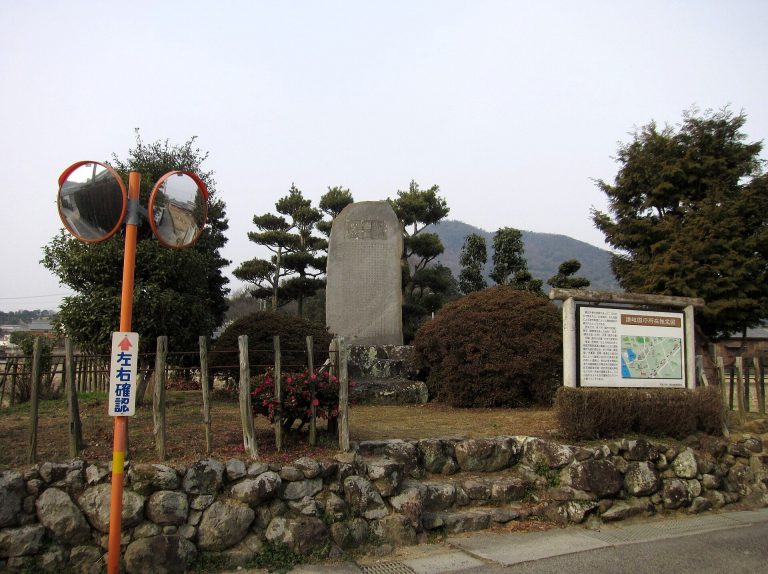
The Negoro-ji section of the Sanuki Pilgrimage Route received national historic-site designation in 2013. On September 18, 2025, the temple precinct was added to the same designation in recognition of its connection with the pilgrimage route and its surviving buildings from the period after the fire.
Remains
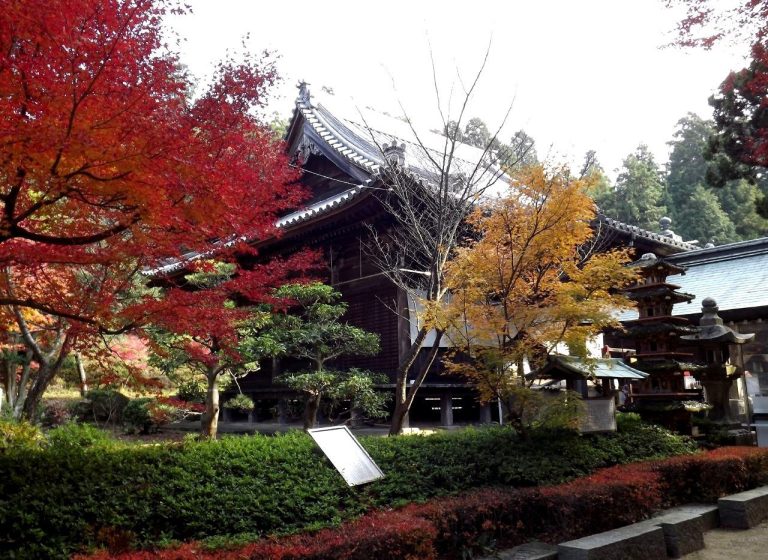
Negoro-ji occupies Mount Aomine, the main peak of the Goshikidai plateau, and the pilgrimage station stands at an elevation of 357.9 metres. The approach passes through a forested setting and follows a stairway more than 100 metres long. After the Niomon, the route descends 25 steps before rising again toward the inner precinct. The priests’ quarters and guesthouse stand to the left of the approach, while the bell tower is on the right.
Approach and precinct buildings
At the entrance, the Sanmon is built as a Niomon, a temple gate guarded by two muscular guardian figures. Farther along the ascent are the Daishido, or hall dedicated to Kukai, and the temple office. Another rise leads to a covered passage containing 33,000 small Kannon figures. Beyond this passage, a courtyard gives access to the main hall.
Main hall
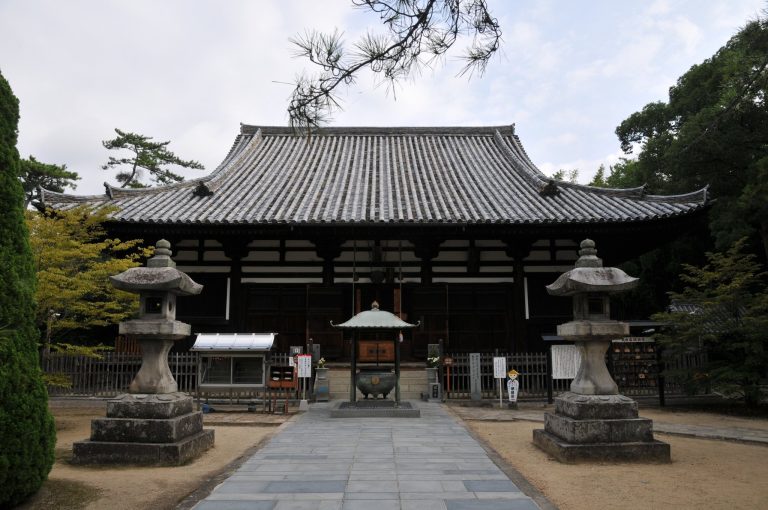
The main hall houses Negoro-ji’s principal image, a wooden standing Thousand-Armed Kannon. The sculpture was carved as a single piece of cherry wood, then finished with lacquer and gilding. It measures 163.3 centimetres in height and was made during the Heian period. The Thousand-Armed Kannon is understood as a compassionate manifestation with many arms for aiding living beings. As a hidden image, it is normally kept from public view and is displayed once every 33 years. The next scheduled opening is in 2036.
The main hall’s left side altar contains a seated image of Chishō Daishi, while the right altar holds a standing Bishamonten. The Chishō Daishi statue was made in 1331 by a sculptor and painted by a painter, both of whom held the Buddhist title Hokkyo, a historical rank granted to Buddhist artists and clerics. The hall has been moved from its earlier position but retains early-modern materials and design elements.
Hall of the Five Wisdom Kings
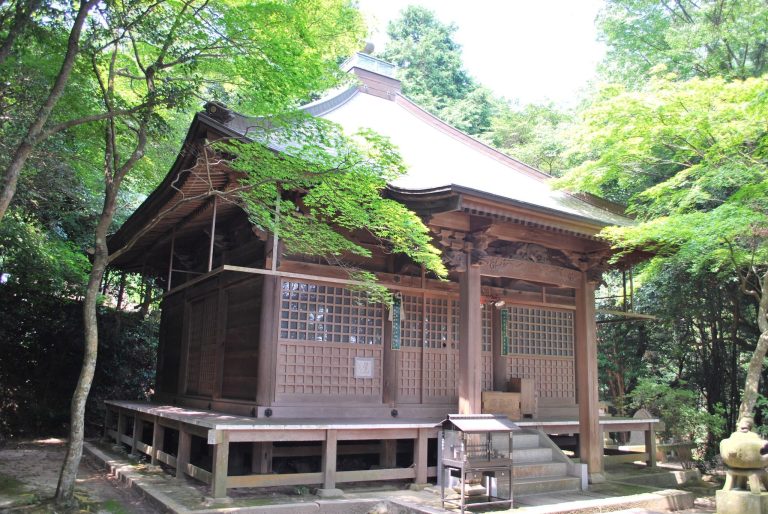
The Godaido, or Hall of the Five Wisdom Kings, houses five guardian images arranged from the viewer’s left as Daiitoku Yasha Myoo, Kongo Yasha Myoo, Dainichi Daisei Fudo Myoo, Gozanse Yasha Myoo, and Gundari Yasha Myoo. Fudo Myoo, the best-known of the group and a figure associated with immovable resolve, was made in 1286 for prayers intended to subdue the Mongol invasions. The other four images were commissioned from Buddhist sculptors in Kyoto by the lord of the Takamatsu domain in 1683. The group underwent repairs between 2004 and 2008. The present Godaido dates to 1754.
Daishido and Jizo structures
The Daishido contains an image of Kukai. Nearby, the Rokkaku Jizodo, built in 1979, houses a stone image of Enmei Jizo. The Ryugu Jizodo contains another stone Jizo image, which is said to have been hauled from the sea in a fishing net. Jizo is a bodhisattva especially associated with protection and the care of vulnerable beings.
Sacred images, monuments, and natural remains
Jizo images and related monuments
Harakuwari Jizo is a Jizo image dated to 1556. It was moved from the mountain behind the main hall to the corridor of that building. Local tradition holds that cutting down trees around the image causes stomach pain. The bronze Mizukake Jizo was installed in 1925 to commemorate the two-hundredth anniversary of the death of Ryukai, the monk associated with the temple’s restoration. A former ceramic Ushi-oni statue is said to have stood at that location.
A stone image of En no Gyoja was installed in 1931. En no Gyoja is a traditionally revered ascetic associated with the origins of Shugendo, a Japanese mountain religious practice. A stone image of Gozu Kannon was installed in 1985. Outside the gate, on the left side in the woodland, stands a bronze Ushi-oni with a bull-like head and horns.
Memorial rock
A rock to the right of the Daishido bears an inscription giving Matsudaira Yorishige’s death date as April 12, 1695. He is traditionally said to have been commemorated by a wooden image buried beneath the rock.
Hakko Keyaki
Hakko Keyaki was an ancient zelkova tree traditionally estimated to have been about 1,600 years old and formerly designated a natural monument of Kagawa Prefecture. After the tree died and was cut down, its roots were cut away in 1991 and placed over the spot where the trunk had grown. A roof now protects the surviving remains. Its name derives from the tradition that a white monkey descended through the tree and helped Enchin during the establishment of the temple.
Negoro Road
The protected Negoro-ji Road preserves three sections totaling 2.234 kilometres between Shiromine-ji and Negoro-ji. One runs from the 50-chome marker before Shiromine-ji’s main compound to the 41-chome marker with a stone shrine. Another extends from the 19-chome pilgrimage-road junction toward the vicinity of the 14-chome marker before the Ashio Daimyojin area at the prefectural-road junction. The third runs from around the 9-chome marker at that junction to the 1-chome marker before the parking area above the Niomon. Approximately 1.2 kilometres of the designated length lies in Sakaide.