Gorōyama kofun: A Decorated Kofun Burial Mound in Japan


Site at a Glance
- Rating
- 4.5
- Popularity
- Low
- Country
- Japan
- Primary era
- Medieval
- External website
- Open
- Eras represented
- Medieval
- Civilizations
- Yamato
- Site type
- Burial
- Remains
- Burial Mound
On this page9 sections
History
Gorōyama kofun is a Decorated kofun burial mound in Chikushino, Japan, dating from the latter half of the sixth century during the Kofun period, the era of large elite burial mounds and expanding political authority in the Japanese archipelago. The identity of the person buried within it is unknown. Its painted chamber places it among the kofun whose burial spaces bear pigments, paintings, or carved decoration.
Discovery and protection
The mound’s existence was confirmed in 1947 after a tunnel made by grave robbers collapsed. Investigations by the Fukuoka Prefectural Board of Education followed that year, and the mural paintings were discovered in 1948. Most of the original grave goods had already been taken through looting, although several objects were later excavated or recovered.
Gorōyama kofun became a National Historic Site of Japan on July 13, 1949. Part of the protected area was released from that designation on July 25, 1984. The Gorōyama Kofun Museum opened in 2001, providing a full-scale and precise model of the stone chamber with reproductions of its mural paintings.
Funerary interpretations
The mural imagery has been interpreted as a representation of funerary rites. Boats carrying coffin-like objects may relate to an idea known since the Yayoi period, the earlier archaeological era associated with wet-rice agriculture, metallurgy, and settled communities, in which boats conveyed the souls of the dead. Horses may also have been understood as vehicles for the soul. This funerary concept has been connected with ideas from northern China that reached Japan during a limited period in the latter half of the sixth century.
Bows, quivers, and arm guards, the last being protective equipment worn on the forearm or wrist during archery, have been interpreted as objects intended to repel evil spirits. Concentric circles may represent the sun, moon, and stars, as well as the other world. The figure apparently praying toward a funerary building, together with mounted figures and other imagery, has been read as part of a funeral ceremony. The large Y-shaped motif was once understood as a bird, but it has also been interpreted as a ceremonial parasol or a spiral fern motif.
Remains
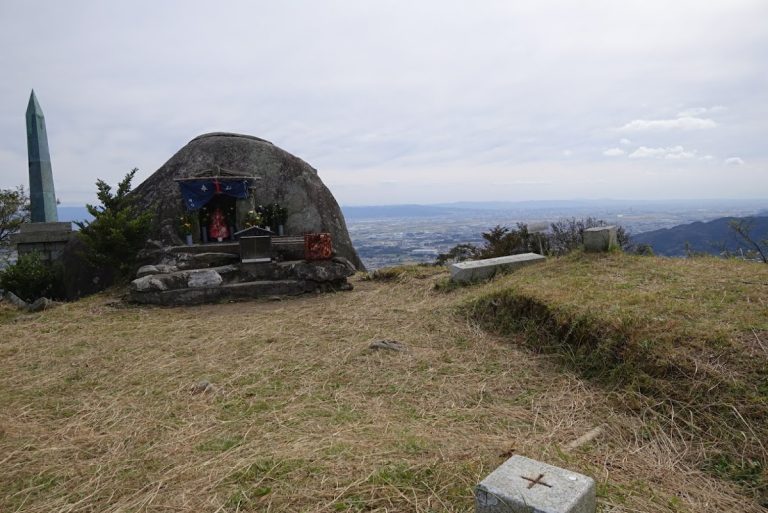
Gorōyama kofun is a circular mound on a hill identified as Mount Gorō. It measures approximately 32 metres across and stands about 5.5 metres high. Its burial facility is a horizontal-passage stone chamber, meaning that the chamber is entered through a passage running horizontally into the mound rather than through a vertical shaft. The entrance faces southwest.
Stone chamber
The chamber has a passage, an anterior chamber, and a posterior chamber, forming a multi-chamber arrangement with a total length of 11.2 metres. The two-room arrangement within the inner chamber is described as a distinctive form in northern Kyushu. The posterior chamber is approximately 3 metres wide, 4.5 metres deep, and 4 metres high.
Mural paintings
Paintings cover the passage between the anterior and posterior chambers and extend across the rear and both side walls of the posterior chamber. Red, green, and black pigments were used, although many images have faded and are difficult to decipher. Rather than relying mainly on geometric decoration, the murals principally depict people, ships, mounted riders, horses, a dog-like animal, a funerary building, archery equipment, concentric circles, and a Y-shaped motif.
Rear wall
On the lower stone of the rear wall, a ship occupies the lower central area. Concentric circles and a bow, quiver, and arm guard appear on the right. On the left, a figure apparently prays toward a funerary building, while an archer fits an arrow to a bow and a mounted figure is led by what appears to be a dog. A higher stone shows a mounted archer, a figure apparently dancing with one hand raised, and further concentric-circle designs.
Side walls
The side walls of the posterior chamber also carry ships. Viewed from the front, one ship is shown on the left wall and two on the right wall.
Grave goods and interpretation
Excavated or recovered grave goods include Sue ware, a high-fired wheel-made pottery associated with continental Korean ceramic technology, as well as beads, gold rings, tubular beads, magatama beads, and swords. The museum’s full-scale chamber model reproduces the mural paintings and offers a physical representation of the decorated burial space.