Dazaifu Tenmangū: A Shinto Shrine Dedicated to Tenjin


Site at a Glance
- Rating
- 4.5
- Popularity
- Very High
- Country
- Japan
- Primary era
- Early Modern
- External website
- Open
- Eras represented
- Medieval, Early Modern
- Civilizations
- Ashikaga shogunate, Toyotomi regime
- Site type
- Religious
- Remains
- Sanctuary
On this page17 sections
History
Dazaifu Tenmangū is a Shinto shrine in Japan dedicated to Sugawara no Michizane, the Heian-period scholar and court official worshipped as Tenjin, the deity associated with learning, literature, and culture. Its origins as Michizane’s mausoleum date to the early tenth century, and it is regarded, together with Kitano Tenmangū, as one of the principal shrines of the Tenjin tradition.
Michizane’s Exile and the Shrine’s Foundation
Michizane, formerly the right minister, was exiled to Dazaifu in 901 after a political conspiracy involving Fujiwara no Tokihira. He died there in 903. The shrine’s foundation tradition relates that the ox carrying his remains stopped near Anrakuji, where his follower Umasake no Yasuyuki buried him.
Umasake established a mausoleum in the grounds of Anrakuji in 905. In 919, Fujiwara no Nakahira, acting on the order of Emperor Daigo, built a shrine over Michizane’s grave. This completed foundation is identified with the origin of Anrakuji Tenmangū, the institution later known as Dazaifu Tenmangū.
The Cult of Tenjin
A series of disasters at the imperial court was interpreted as evidence of Michizane’s vengeful spirit. Fujiwara no Tokihira died in 909, Crown Prince Yasuakira died in 923, and the crown prince’s five-year-old successor died in 925. In 930, lightning struck the Seiryōden, causing deaths and injuries. Emperor Daigo abdicated afterward and died soon afterward. Michizane’s rank was restored after his death, and further honors, including the title of grand minister of state, were granted to appease his spirit.
The name Tenmangū, ordinarily associated with shrines venerating emperors or members of the imperial family, began to be used for Michizane’s shrine around 990. His great-grandson, Sugawara no Sukemasa, is associated with the beginning of the Onisube rite in 986. Onisube is a fire-related purification and demon-expulsion ceremony.
Imperial recognition grew after Emperor Ichijō visited Kitano Tenmangū in 1004 and sent an imperial envoy to Dazaifu. The shrine’s rites were reportedly made more elaborate after Ōe no Masafusa became governor-general of Dazaifu in 1097. By the medieval period, fear of Michizane’s spirit had diminished, while his reputation as an outstanding scholar had encouraged his worship as a deity of learning. Artistic offerings connected the shrine with literature, calligraphy, poetry, linked verse, theater, painting, and other arts.
Medieval Destruction and Early Modern Renewal
The linked-verse poet Sōgi described the shrine in an account of his journey through Tsukushi in 1480. In 1578, troops commanded by Akizuki Tanemi burned the main shrine. Kobayakawa Takakage rebuilt it in 1591, producing the present Momoyama-period main building.
After the Kuroda family became regional rulers in the early Edo period, the precinct and its buildings underwent repeated repairs, development, and reconstruction. These interventions supported a renewed period of prosperity for the shrine.
Separation of Shinto and Buddhism
The Meiji government’s policy of separating Shinto and Buddhism brought the dissolution of Anrakuji. Buddhist clergy living at the institution were forced to return to secular life, while the lecture hall, Niō Gate, Hokke Hall, Buddhist statues, and other Buddhist elements were destroyed or sold. A handwritten Lotus Sutra by Michizane, formerly treated as the shrine’s sacred object, was also burned.
Under the modern shrine-ranking system, the institution became a National Shrine of the Lower Rank in 1871 and was renamed Dazaifu Jinja. It became an Imperial Shrine of the Lower Rank in 1882 and an Imperial Shrine of the Middle Rank in 1895. After state control of shrines was abolished, the name Dazaifu Tenmangū was restored in 1947. It is now a Specially Listed Shrine of the Association of Shinto Shrines.
Religious and Cultural Continuity
The principal annual festival takes place on September 25. The Usokae and Onisube rites are held on January 7, and the shrine belongs to the pilgrimage known as the Twenty-Five Sacred Sites of Sugawara no Michizane. Usokae involves exchanging symbolic wooden bullfinch figures and seeking the transformation of misfortune.
Enjuō-in, at the upper end of the approach, was associated with political activity during the late Tokugawa and Restoration period. Five court nobles, including Sanjō Sanetomi, stayed there for more than three and a half years. Tosa activists Hijikata Hisamoto and Nakaoka Shintarō also stayed there, while Saigō Takamori, Itō Hirobumi, Etō Shinpei, and Sakamoto Ryōma were recorded as visitors.
Since the Meiji period, religious devotion at Dazaifu Tenmangū has continued alongside poetry, theater, visual art, musical offerings, and the display of votive tablets. The Noh play Oimatsu connects Anrakuji with Michizane’s plum tree and an old pine. Later songs and literary works have also used Dazaifu Tenmangū as their setting.
The main shrine began its first major renovation in 124 years in May 2023. During the approximately three-year project, Michizane’s spirit was transferred to a temporary hall. A re-enshrinement ceremony returned the spirit to the main shrine on May 16, 2026. The shrine’s cultural-property status includes Important Cultural Property designation for the main shrine and the auxiliary Shiga Shrine. Its wider historical and documentary heritage includes a National Treasure manuscript and nationally designated shrine documents and associated materials.
Remains
The precinct covers more than approximately 12 square kilometers and contains the main shrine, auxiliary and branch shrines, two ponds, a bridge, and a treasure house. Its buildings and landscape combine the shrine’s central sacred hall with associated worship spaces, gardens, trees, ritual objects, and documentary collections.
Main Shrine and Associated Buildings
Honden
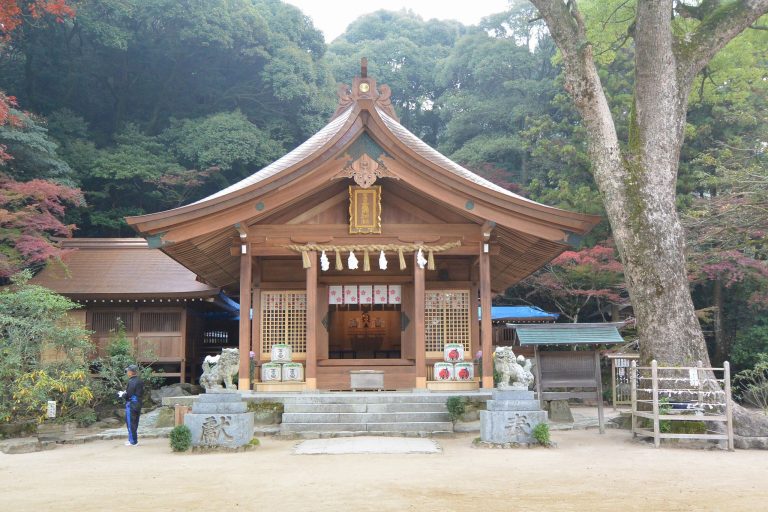
The honden, or sacred main hall, is a five-bay nagare-zukuri building. This shrine style uses a gabled roof whose front slope extends forward to create a covered worship space. The honden has a cypress-bark roof, a one-bay karahafu projecting worship porch on the front, and matching one-bay carriage entrances on both sides. Corridors extend forward from the building to the tower gate.
The present honden was rebuilt in 1591 during the Momoyama period, the late sixteenth-century era associated with powerful warlords and elaborate religious architecture. It was designated a protected historic structure in 1907 and became an Important Cultural Property under the 1950 Cultural Properties Protection Law. Nine ridgepole tablets and two wooden tablets are designated as appurtenances to the building.
Auxiliary Shrines and the Sorinto
The honden of the auxiliary Shiga Shrine was constructed in 1458, during the middle Muromachi period. The precinct also includes the honden of Oimatsu Shrine and the Sorinto, a pillar-like Buddhist architectural monument. These structures form part of the built landscape surrounding the principal shrine.
Ponds, Trees, and Ritual Features
Shinji-ike and the Plum Trees
One of the precinct’s ponds is a traditional shinji-ike, or heart-shaped pond, whose plan resembles the character for “heart.” A bridge and the treasure house are also part of the grounds. Approximately 6,000 Asian plum trees representing 167 varieties grow across the precinct. Tobiume, the “flying plum,” stands immediately to the right of the honden. Tradition holds that it flew from Kyoto to join Michizane after his exile.
A camphor tree and a broad-leaved hackberry tree associated with the former Dazaifu Shrine are designated natural monuments. An ichii oak within the precinct is designated a Dazaifu municipal natural monument.
Votive-Tablet Hall and Ox Statue
The votive-tablet hall serves as a gallery for a large and varied collection of votive tablets from Kyushu. The shrine also retains a traditional association with plum wine served as sacred wine. An ox statue near the shrine commemorates the tradition that an ox carrying Michizane’s remains stopped at the place where he was buried.
Documentary and Temporary Structures
Historical Manuscripts
The shrine’s documentary holdings include the Kan’en, a tenth-century historical and ethnographic manuscript designated a National Treasure. Nationally designated documents comprise 78 scrolls, 25 booklets, and one hanging scroll, together with a colored plan of the Dazaifu Tenmangū grounds. The materials range from the Heian period to the Edo period and concern the history of Dazaifu and Kyushu.
Temporary Renovation Hall
The temporary hall used during the 2023–2026 renovation was designed by architect Sou Fujimoto. It had a predominantly black design and a contemporary roof planted with a grove that included plum trees. The roof incorporated 46 plant varieties.
Approach and Associated Craft
Shops along the approach prepare and sell umegae mochi, a grilled cake filled with azuki beans. It is associated with Michizane’s legend and carries a plum-blossom pattern.