Kaidan-in Temple: Japan’s Western Buddhist Ordination Hall


Site at a Glance
- Rating
- 4.3
- Popularity
- Low
- Country
- Japan
- Primary era
- Early Modern
- External website
- Open
- Eras represented
- Early Modern
- Civilizations
- Tokugawa
- Site type
- Religious
- Remains
- Monastery
On this page9 sections
History
Kaidan-in Temple is a Rinzai Buddhist temple in Dazaifu, Japan, whose institution was established in the Nara period as a formal ordination hall. Monks and nuns received the Buddhist precepts required for ordination there, giving the temple an important role in the religious organization of western Japan.
Foundation and the Nara-period ordination institution
Kaidan-in was formerly part of Kanzeon-ji and is also known as Chikushi Kaidan-in and the Western Ordination Hall. During the Nara period, it was one of Japan’s three official ordination halls, together with Tōdai-ji in Nara and Yakushi-ji in Shimotsuke. The three institutions were associated with the western, central, and eastern regions of Japan.
Temple tradition connects the site with Ganjin, an eighth-century Chinese Buddhist monk who helped transmit formal monastic ordination and Buddhist learning to Japan. It holds that Ganjin reached Dazaifu on December 26, 753, and conducted the first ordination there. The foundation is also dated to 761, when an ordination hall was established by imperial vow in the southwestern part of the Kanzeon-ji precinct. Ganjin had already reached the capital and entered Tōdai-ji by January 754, so his connection with the 761 foundation belongs to the temple’s foundation tradition rather than to a direct contemporary sequence of events.
Western ordinations and institutional change
The institution continued as the ordination hall for western Japan and became known locally as a temple of “learning in the eight schools.” This name reflected the ideal associated with Ganjin, that monks from different Buddhist schools should be welcomed for study and ordination. Its institutional monopoly ended in 822, when Enryaku-ji received permission to establish an ordination platform. Four further Tendai platforms were established during the fourteenth century.
Dōgen, who later founded the Sōtō school of Zen Buddhism, is recorded as having received the ten monastic precepts at Kaidan-in’s ordination pavilion in 1213, when he was thirteen.
Medieval decline and early-modern revival
Kaidan-in declined repeatedly during the medieval period. In 1669, Chigen, a monk of Shofuku-ji, repaired the principal Buddhist image. Kuroda Mitsuyuki, lord of the Fukuoka domain, and his retainer Kamata Masakatsu supported the revival of the buildings. The present main hall is traditionally regarded as a reconstruction commissioned by Mitsuyuki in 1680 and carried out by the wealthy merchant Tennoji Ryomu.
The temple separated from Kanzeon-ji and became independent in 1703. It is now a branch temple of Shofuku-ji, a Rinzai temple in Hakata, Fukuoka. The temple and associated cultural properties have received national, prefectural, and municipal protection. The seated Vairocana is a nationally designated Important Cultural Property. The main hall and three other items have prefectural designations, while the seated image of Ganjin, the images of Manjushri and Maitreya, and the bodhi tree have municipal designations.
Remains
Main hall and ordination platform
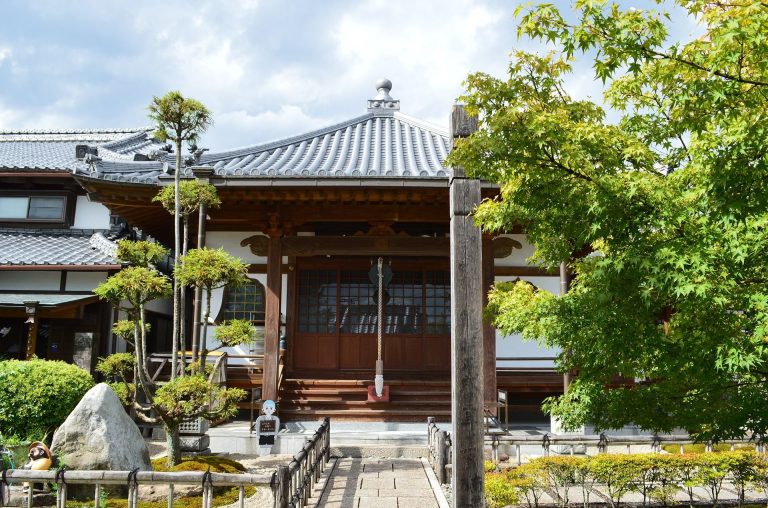
Kaidan-in occupies the southwestern corner of the Kanzeon-ji precinct, a position regarded as unchanged since the Nara period. The present main hall dates from the seventeenth century and contains the ordination platform, a consecrated place where Buddhist monks and nuns receive monastic precepts. The platform measures approximately 5 by 5 metres and is traditionally said to contain soil from India, China, and Yamato, identified here with Nara.
Sacred images
The principal image is a wooden seated Vairocana, also called Rushana Buddha, the cosmic Buddha associated with the universal body of buddhahood. It dates from the late Heian period, an era lasting from 794 to 1185. Standing images of Manjushri and Maitreya flank it. These figures date from the Edo period, which lasted from 1603 to 1868, and retain their halos, lotus bases, and square stands.
Bell and donor tradition
The temple’s bronze bell was cast in 1701 by a metal caster from Hakata. A Hakata merchant who prospered through sake brewing in the Edo period donated it in accordance with his deathbed wish. A wooden plaque in front of the bell tower identifies him as the donor.
The merchant was the son of a nephew of Kuriyama Daizen, a samurai official. After Kuriyama was exiled to Tsugaru for denouncing his lord to the shogunate, the merchant’s father became a masterless samurai in Kasuya District and died of illness. Orphaned at one year old, the future donor was raised by a farming couple in Munakata. He later returned to Fukuoka and succeeded in sake brewing with assistance from a family in Yakuin, commissioning the bell in gratitude to his adoptive parents.
Stone monuments and precinct features
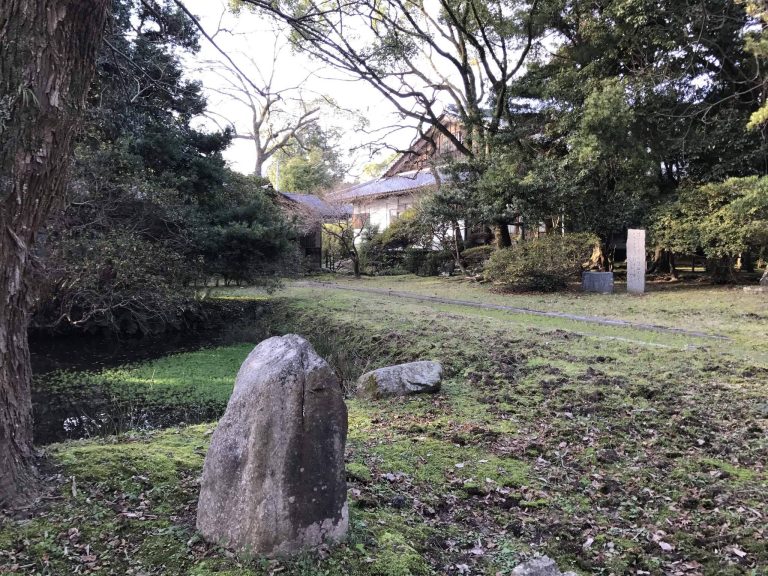
A stone stele at the entrance bears the inscription, “No pungent foods, alcohol, or meat may enter the precinct.” West of the temple stands a stone five-story pagoda commemorating a merchant who contributed to the early-modern revival. A stone gorintō, a five-part Buddhist memorial monument representing earth, water, fire, air, and space, is dedicated to Ganjin.
A densely wooded bodhi tree grows in the northeastern part of the precinct. Tradition holds that Ganjin brought it from Tang China, and it is designated as a municipal natural monument. The grounds also contain a wooden seated image of Ganjin with its rear screen and seated base.