Kii Castle: A Seventh-Century Korean-Style Fortress in Japan


Site at a Glance
- Rating
- 4.2
- Popularity
- Low
- Country
- Japan
- Primary era
- Medieval
- External website
- Open
- Eras represented
- Medieval
- Civilizations
- Baekje, Yamato
- Site type
- Military
- Remains
- Fort
On this page6 sections
History
Kii Castle is a Korean-style mountain fortress in Japan, built by the Yamato court in 665 during the late seventh century. The early Japanese imperial government constructed it after the defeat of the combined Baekje and Yamato forces by the Silla-Tang alliance at the Battle of Hakusukinoe in 663. Its position on Mount Kizan made it part of a wider system of defenses intended to guard against possible invasion from Tang China or Silla.
Construction after Hakusukinoe
The defeat of Baekje, one of the three ancient Korean kingdoms, brought refugees and specialists to Japan. Engineers, generals, and artisans from Baekje assisted the Yamato court in building fortifications that followed Korean defensive practices. Construction at Kii Castle was carried out largely by Baekje exiles, alongside work at Ono Castle and another fortress in Nagato Province whose location has not been identified.
The Nihon Shoki, an early Japanese historical chronicle, places the construction in the fourth year of Emperor Tenchi’s reign, corresponding to 665. The castle’s purpose was closely linked to the military preparations that followed the defeat at Hakusukinoe. Its elevated position and control of approaches through northern Kyushu gave it a role within the court’s defensive planning.
Repairs, abandonment, and rediscovery
The Shoku Nihongi, another early Japanese chronicle, records repair work at Kii Castle in 698. The fortress was later abandoned and had fallen into ruins before the end of the Nara period. Its remains were rediscovered in 1912. The site became a National Historic Site in 1937 and was elevated to Special Historic Site status in 1954.
The name kogoishi, meaning “stones of divine protection,” was applied during the Meiji period by the archaeologist Tsuboi Shogoro to fortifications of this general type. Later scholarship treated such structures primarily as practical military defenses, although the precise purpose and religious associations of these remains are not fully settled.
Remains
Mountain enclosure and defenses
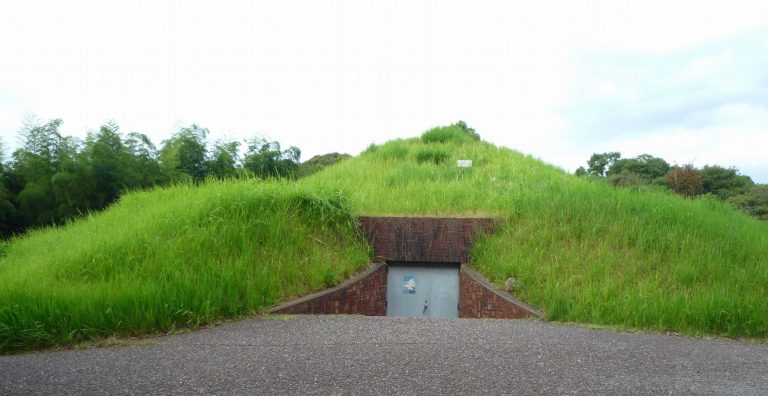
Kii Castle occupies the eastern summit of Mount Kizan at an elevation of 404 metres, on the boundary between Chikushino in Fukuoka Prefecture and Kiyama in Saga Prefecture. Its defenses extend for approximately 3.9 kilometres and enclose about 60 hectares, including three valleys. The main fortification system consists of earthen ramparts, while stone walls strengthened the valleys. From this elevated position, the fortress commanded views toward Hakata Bay to the north, the Ariake Sea to the east, and the Serifu Mountains to the west.
The site lies approximately eight kilometres south of the ruins of the Dazaifu Government Office, a major administrative and military center in northern Kyushu. It also overlooks the branching point of an ancient government highway leading toward the historical provinces of Higo and Chikugo. These geographical relationships help define the fortress’s position within the communications and defense network of the period.
Buildings, gates, and excavated materials
Archaeological excavations have identified traces of approximately 40 buildings within the fortified area. Roof tiles and pottery are among the excavated materials. The investigations also revealed four castle gates, with two in the northern section and one each in the southern and southeastern sections. Together with the long ramparts and valley walls, these remains show how the fortress combined earthen and stone construction across the mountain terrain.