Kongōjō-ji Temple (Fukusaki): A Shingon Buddhist Temple


Site at a Glance
- Rating
- 4
- Popularity
- Very Low
- Country
- Japan
- Primary era
- Modern
- External website
- Open
- Eras represented
- Classical, Medieval, Modern
- Civilizations
- Ashikaga shogunate, Japanese, Yamato
- Site type
- Religious
- Remains
- Monastery
On this page12 sections
History
Kongōjō-ji Temple is a temple of the Kōyasan branch of Shingon Buddhism in Fukusaki, Japan, traditionally founded in 597. Its mountain name is Nagusa-san, and its principal image is an Eleven-Faced Kannon, a form of the bodhisattva of compassion. The temple is traditionally counted as the 30th temple of the New Saigoku Thirty-three-Temple Pilgrimage and the 12th temple of the Harima Saigoku Thirty-three-Temple Pilgrimage.
Traditional foundation
The foundation tradition places the temple’s beginnings during the reign of Empress Suiko, when Prince Shōtoku visited the area and climbed Nagusa Mountain. He considered the mountain’s sacred atmosphere suitable for a temple devoted to prayers for the security of the state. Prince Shōtoku died in 622, before the planned institution was complete.
Ekan, a Korean monk associated with the transmission of the Sanron school to Japan, is said to have continued Shōtoku’s intention. Near the Nagusa Waterfalls on the mountainside, he founded a temple called Shigeoka-ji, regarded as the predecessor of Kongōjō-ji. The name is linked by tradition to Shigeoka Sennin, a religious ascetic who gave seven kinds of seed to people during a drought, with the supply said never to have run out.
Donations from people across the country eventually allowed a seven-building complex to be completed. An opening ceremony took place on May 18, 633, after Hōdō, a religious ascetic associated in Japanese Buddhist tradition with the opening of temples, had been invited there.
Rebuilding and Shingon affiliation
The temple burned in 732 and was rebuilt by imperial order under Emperor Shōmu. During the reign of Emperor Saga, Kūkai visited the site and performed a goma, an esoteric Buddhist fire ritual in which offerings are burned before a sacred fire. The temple subsequently became associated with Shingon Buddhism and adopted the name Kongōjō-ji. Shingon is an esoteric Buddhist tradition centered on ritual, mantra, mandala, and consecrated practice.
Wartime fire destroyed the temple in 1350. Ashikaga Takauji, founder of the Ashikaga shogunate, ordered its reconstruction and granted it the Nagara-no-shō estate in Kanzaki District as permanent temple land. A second wartime fire destroyed the institution in 1474, after which it entered a period of decline.
Early modern revival and modern relocation
A Buddhist cleric revived the institution in 1601, beginning its restoration under the name Sakumon-ji. Ikeda Terumasa, the lord of Himeji Castle, donated the forests of Nagusa Mountain as permanent support. In 1604, Tokugawa Ieyasu, founder of the Tokugawa shogunate, granted the entire mountain as the domain of its tutelary deity, Nagusa Gongen, through a vermilion-seal grant. Gongen refers to a deity understood in Japan’s traditional Buddhist-Shinto syncretism as a manifestation of a Buddha or bodhisattva.
In 1870, an anti-Buddhist movement led the state to confiscate the temple’s land, and the precinct moved from the mountainside to its present location. In 1897, the temple brought a lawsuit seeking the return of more than 110 chōbu of the former Nagusa Mountain forest, with a chōbu being a historical Japanese unit of land area. It won the case in 1902. The institution resumed the name Kongōjō-ji in 1928. Its precinct is crossed by the approach to Taga Shrine, which lies to the east.
Remains
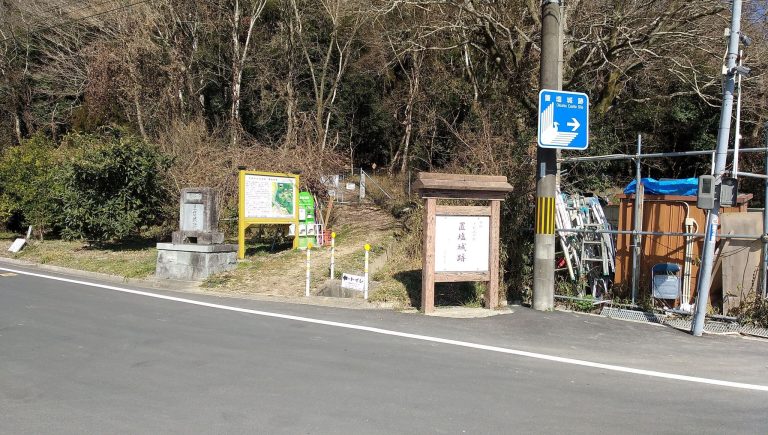
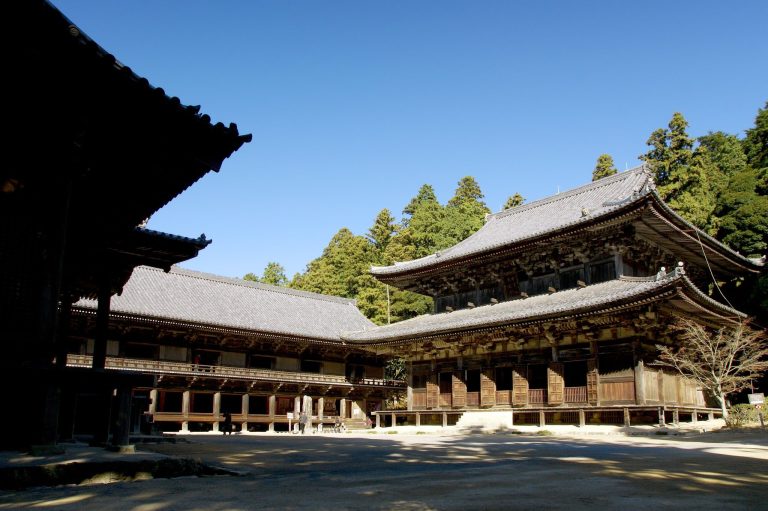
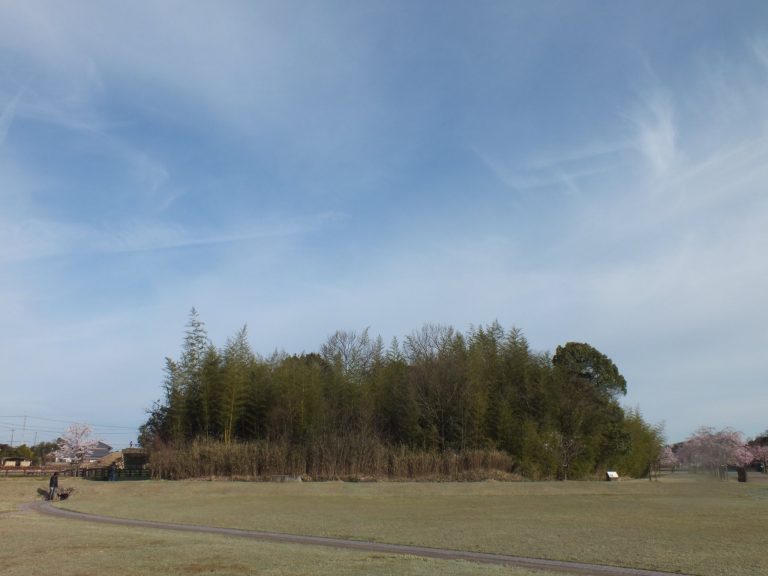
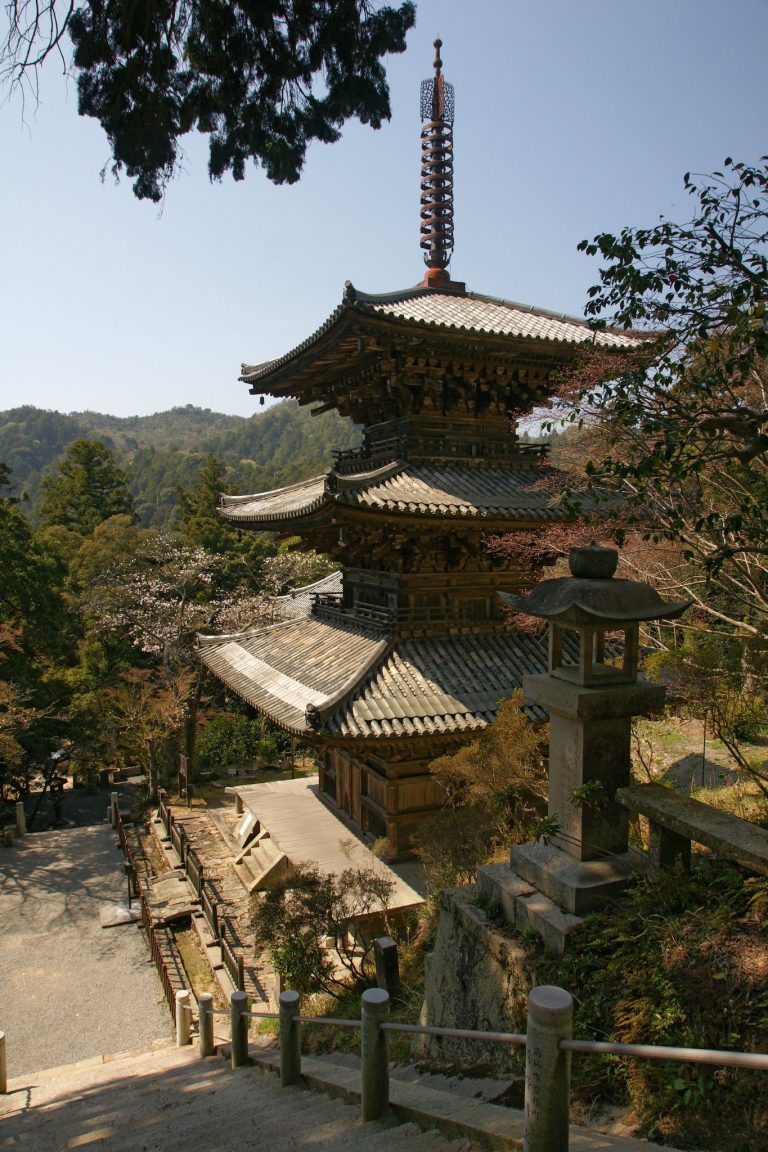
The present precinct stands at the western edge of the Nagusa River, while traces of the earlier temple complex remain in the mountains. The current buildings include a tower-style gate, a main hall, a bell tower, and an Amida Hall. The abbot’s and monks’ quarters occupy the northern side of the precinct, and the cemetery lies to the south.
Temple buildings
Gate and guardian figures
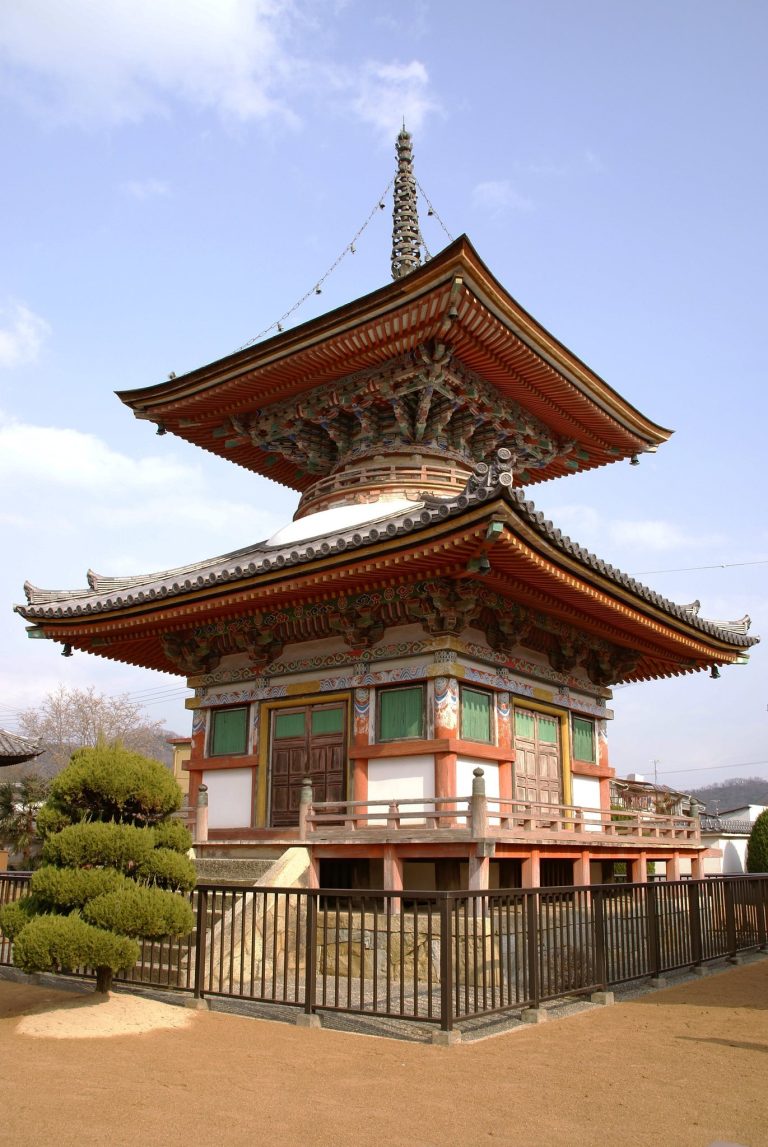
The present temple gate was constructed in 1932 as a tower-style gate. Two Niō, paired Buddhist guardian figures, stand on either side of the passage. They came from the former gate, preserving a connection between the current entrance and an earlier phase of the temple.
Main hall and supporting buildings
The main hall dates from 1912. A bell tower and an Amida Hall, dedicated to Amida, the Buddha of the Pure Land tradition, form part of the present group of buildings. The northern quarters serve the abbot and monks, while the cemetery occupies the southern part of the precinct.
Religious images and mountain landscape
Eleven-Faced Kannon
The principal image is an Eleven-Faced Kannon, whose multiple faces represent different aspects of compassion. Tradition regards it as a work by Ekan, made through a process described as one cut followed by three ritual bows. Another tradition says that Shigeoka Sennin carved the image himself and entrusted it to Ekan. The image was saved whenever the temple suffered fire.
Jizō statue
A stone statue of Jizō stands among the temple’s religious remains. Jizō is traditionally associated with the protection of travelers, children, and the dead. The statue is designated as a tangible cultural property of Fukusaki Town.
Nagusa Waterfalls
Nagusa Mountain contains numerous waterfalls, traditionally counted as 48. They include Kannon Waterfall, Female Waterfall, Rainbow Waterfall, and Male Waterfall. Male Waterfall has a drop of 72 meters, and the scene of Male Waterfall with Kongōjō-ji was selected by the Kobe Shimbun as one of Hyogo Prefecture’s scenic Eight Views.