Danjōzan Kofun: A Fifth-Century Burial Mound in Himeji, Japan
Site at a Glance
- Rating
- 3.6
- Popularity
- Very Low
- Country
- Japan
- Primary era
- Classical
- External website
- Open
- Eras represented
- Classical
- Civilizations
- Yamato
- Site type
- Burial
- Remains
- Burial Mound
On this page12 sections
History
Danjōzan Kofun is a monumental burial mound in Himeji, Japan, constructed by a regional chiefly society during the first half of the fifth century, in the middle Kofun period. The Kofun period, spanning roughly the third to sixth centuries, was marked by powerful local rulers, large earthen tombs, clay funerary objects, and the growing influence of the Yamato polity, the early centralizing authority based around modern Nara and Osaka. Danjōzan Kofun stands on a fluvial terrace beside the left bank of the Ichikawa River, and its scale reflects the importance of the person buried there, although that individual is unknown.
Tradition and the Middle Kofun Period
Local tradition associates the mound with Empress Jingū, a legendary ruler in early Japanese historical tradition whose historicity and chronology remain uncertain. She is said to have built a ceremonial platform at the site and prayed there. The name Danjōzan derives from this tradition. The burial mound itself belongs to the fifth century rather than to the period traditionally associated with Jingū.
The occupant has been proposed as a kuni no miyatsuko, a hereditary local governor or chiefly ruler who administered a regional area within the developing Yamato political order. Danjōzan Kofun’s size and its long chest-shaped stone coffin have been interpreted as signs of a status comparable to that of Kumobeguruma Kofun. They also point to a close relationship with the Yamato polity, whose connections with regional rulers are assessed through tomb plans, dimensions, burial facilities, and grave goods.
A Succession of Regional Tombs
Danjōzan Kofun formed part of a succession of chiefly tombs in Harima. This sequence is thought to have moved eastward from Koshizuka Kofun in western Harima to Danjōzan and then to Yamanokoshi Kofun. Yamanokoshi, also called Koyama Kofun, lies about 150 meters northwest of Danjōzan on the main mound’s axis. Once regarded as a subsidiary mound, it is now interpreted as the succeeding chiefly tomb, constructed around the middle of the fifth century.
The change from Danjōzan’s keyhole-shaped plan to Yamanokoshi’s square plan has been taken to indicate that the local ruler had become more subordinate to Yamato authority. This interpretation places the two tombs within a changing political relationship rather than treating them as isolated monuments.
Subsidiary Mounds and Heritage Protection
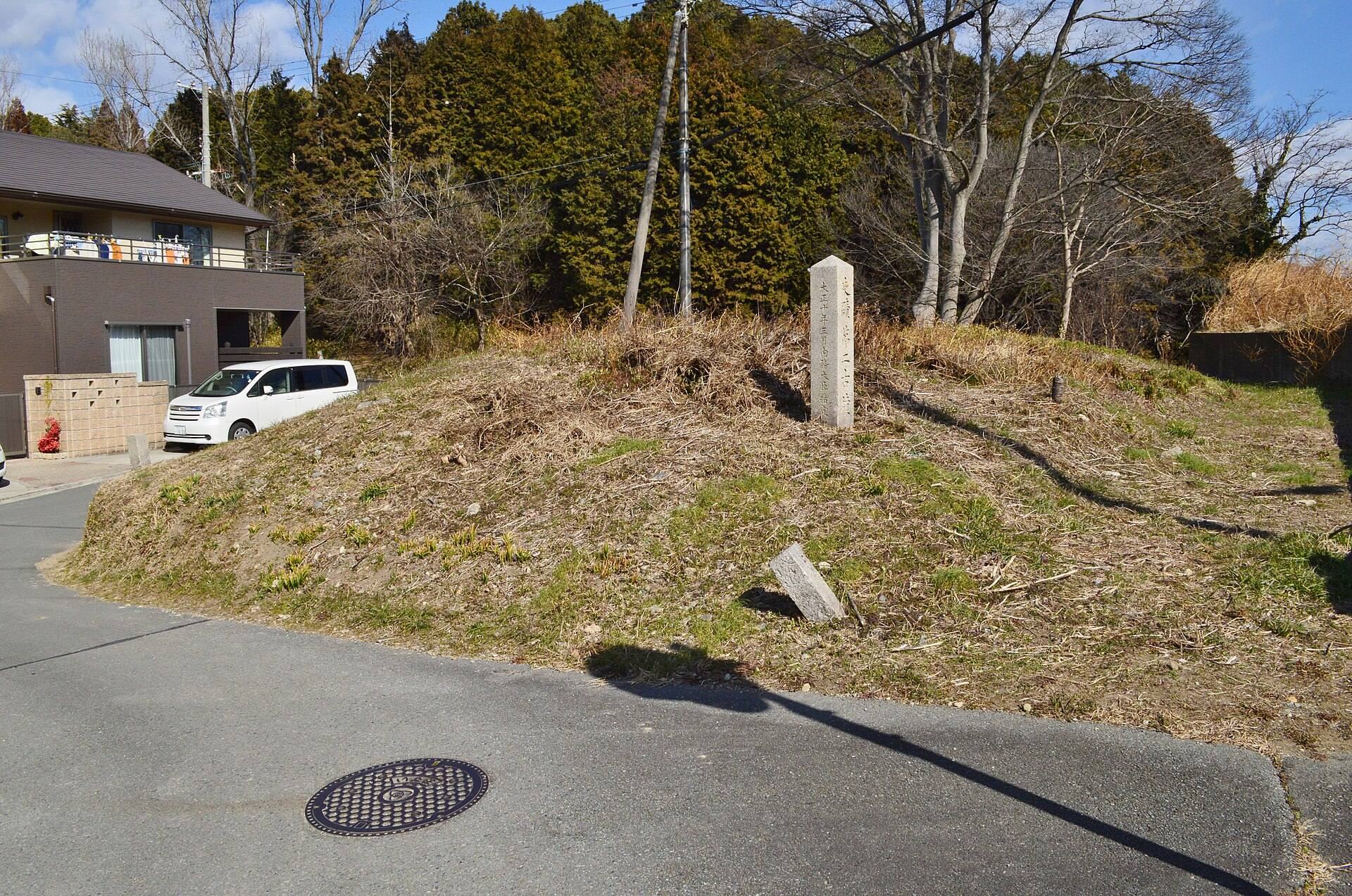
About ten subsidiary mounds once surrounded Danjōzan Kofun. Eight were destroyed, largely during the conversion of the surrounding area to housing. Rindō Higashizuka Kofun and Kushinodō Kofun survive as the remaining subsidiary mounds, although both have been heavily damaged by the removal of much of their earthworks.
The Danjōzan Kofun group, consisting of the main mound, Rindō Higashizuka Kofun, Kushinodō Kofun, and Yamanokoshi Kofun, became a National Historic Site on March 3, 1921. The designation is titled “Danjōzan Kofun First, Second, and Third Kofun.” Rindō Higashizuka is the First Kofun, Kushinodō is the Second, and Yamanokoshi is the Third. Nearby are the remains of Harima Kokubunji and Harima Kokubun-niji. The main mound has been surveyed and measured, while its mound body and burial facilities remain unexcavated.
Remains
Danjōzan Kofun is a three-level keyhole-shaped mound formed by cutting and filling the existing terrace. Its rectangular front section points northwest from a circular rear section. A dry moat, an outer strip of ground, stone surfacing, and clay funerary objects define the monument’s physical setting, while the associated mounds extend the archaeological group beyond the principal tomb.
The Main Mound
Keyhole Plan and Earthworks
The main mound measures about 142.8 to 143 meters in length. Its posterior circular section is approximately 83 meters in diameter and 13.2 meters high. The front section measures about 76 meters long, 87 meters wide, and 11.4 meters high. Projecting platforms extend from both sides of the narrowed central area. The exterior was covered with fukiishi, stones laid over a burial mound to protect its earthwork and create a finished surface. Cylindrical haniwa, along with shield-shaped, house-shaped, cuirass-shaped, and umbrella-shaped examples, have been found around the mound.
A shield-shaped moat about 10 to 20 meters wide surrounded the mound, giving the site an overall extent of approximately 170 meters. The section beside the posterior circular area was cut into the terrace and is considered to have been a dry moat rather than a channel that continuously held water. A parallel strip of ground along the western side of the moat measures about 170 meters long and 23 meters wide, forming an outer boundary.
The mound’s exterior plan is regarded as a half-scale version of the similar plan of Nakatsuyama Kofun, a large imperial tomb in Fujiidera, Osaka. At about 143 meters long, Danjōzan is the largest kofun in the central and western Harima areas and the third-largest in Hyōgo Prefecture, after Goshikizuka Kofun and Kumobeguruma Kofun.
Burial Facility and Coffin
The principal burial facility is thought to have been a composite long chest-shaped stone coffin buried directly in the posterior circular section. This type of coffin is a stone sarcophagus shaped like a wooden chest. It was made from layered rhyolitic hyaloclastite, known as Tatsuyama stone, quarried in the Kakogawa River basin about eight kilometers southeast of the mound. The coffin lay perpendicular to the mound’s main axis.
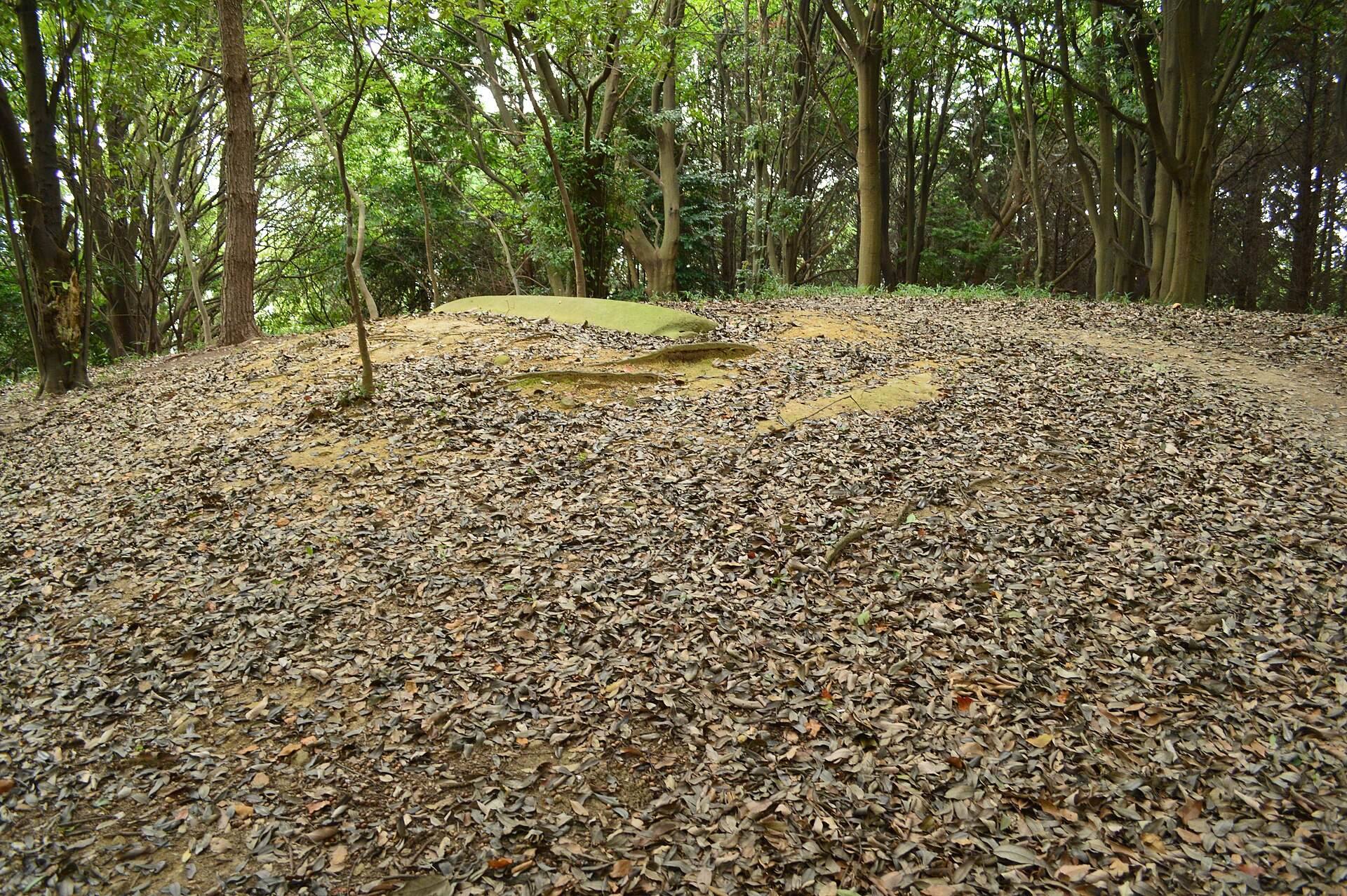
A coffin lid remains exposed at the summit of the posterior circular section. It is 2.7 meters long and 1.2 meters wide, with eight rope-hanging projections, two on each side. Whether the coffin was opened is uncertain. More than 200 iron arrowheads and more than ten swords were reportedly found northwest of it in 1910. Their relationship to the exposed coffin or to another burial facility is unknown. Because the coffin is not centrally positioned in the circular section, an additional burial facility has been suggested.
The use of Tatsuyama stone connects the main mound with Kushinodō and Yamanokoshi, where long chest-shaped coffins also occur. Control of the nearby stone quarries may have made this material relatively accessible to the tomb’s occupant. Stone-coffin components preserved at nearby shrines and temples cannot be securely assigned to a particular original tomb.
Associated Tombs
Rindō Higashizuka Kofun
Rindō Higashizuka Kofun lies east of the posterior circular section of the main mound. As the First Kofun in the national designation, it forms part of the protected Danjōzan group. Much of its mound has been shaved down, leaving its detailed original form uncertain.
Kushinodō Kofun
Kushinodō Kofun lies southwest of the main mound’s posterior circular section and is identified as the Second Kofun in the national designation. Its earthwork has also been heavily shaved down, and its original shape is unknown. Slightly west of the mound’s center, a short-side section of a long chest-shaped stone coffin remains exposed, showing that the coffin was buried directly in the mound. The name Kushinodō comes from the perceived resemblance of the coffin to the body of a comb.
Yamanokoshi Kofun
Yamanokoshi Kofun, or Koyama Kofun, is a square mound about 60 meters on each side and approximately seven meters high. It is the largest square kofun in Hyōgo Prefecture. Most of its northern half has been destroyed, and the surviving portion is badly deteriorated. The mound probably had stepped construction. Its exterior is thought to have been faced with fukiishi, fragments of cylindrical haniwa have been found, and a moat approximately 17 meters wide once surrounded it.
A composite long chest-shaped coffin is exposed at the summit of Yamanokoshi. Its form and the absence of traces of a vertical stone burial chamber indicate that it was probably buried directly in the mound. Made from the same layered Tatsuyama stone as the coffin at Danjōzan, it is shorter and stylistically somewhat later.
The coffin was opened in 1897. The deceased lay extended with the head toward the north on a bed of white river stones. Grave goods included a bronze animal-band mirror 16.4 centimeters in diameter, magatama, tubular beads, and swords, with cinnabar adhering to the objects. The beads later became dispersed, while the surviving mirror and swords are severely damaged. Swords and other objects were also reportedly placed outside the coffin, but their details are unknown.