Ishi-no-Hōden: A Megalithic Monument and Sacred Object in Japan


Site at a Glance
- Rating
- 4.4
- Popularity
- Low
- Country
- Japan
- Primary era
- Unclassified
- Eras represented
- Unclassified
- Civilizations
- Unclassified
- Site type
- Religious
On this page6 sections
History
Ishi-no-Hōden is a megalithic monument in Japan, located at Ōshiko Jinja in Takasago, Hyōgo Prefecture. Its date, maker, and original purpose remain unknown. The monument is associated with Shinto traditions and legends, and it is enshrined as a shintai, a sacred object believed to embody or receive a deity.
Shrine traditions and local legends
Shrine tradition identifies Ishi-no-Hōden with a stone palace built by Ōkuninushi and Sukunabikona after the two kami, or deities, came from Izumo to Harima. Ōkuninushi is associated with the creation and governance of the land, while Sukunabikona is linked with founding, healing, and civilization. According to the legend, the kami of Harima rebelled before the palace was completed and overturned the construction. Ōkuninushi and Sukunabikona nevertheless vowed to remain at the site and protect the land.
Another tradition appears in the Harima Kokudo Fudoki, an early-eighth-century geographical record of the Harima region compiled around 713–717. It describes a stone south of a plain that resembled a house and attributes its construction to Mononobe no Moriya, acting on the orders of Prince Shotoku. The account contains a chronological contradiction because Mononobe no Moriya had already died by the time Prince Shotoku is traditionally said to have become regent.
The medieval geographical work Minsōki preserves a different explanation. It says that heavenly beings tried to create a stone shrine but abandoned the attempt when they could not raise it before dawn. These traditions connect the monument with sacred activity while leaving its historical origin unresolved.
Archaeological interpretations and modern study
One influential interpretation, presented by the writer Seicho Matsumoto, links Ishi-no-Hōden with Masuda Iwa-fune, a megalith in Kashihara, Nara Prefecture. Matsumoto understood Ishi-no-Hōden as an unfinished stone burial chamber intended for a kofun, a monumental burial mound of the period from approximately the third to the sixth centuries. This interpretation has shaped discussion of the monument, but its purpose remains academically unresolved.
During the late Edo period, Philipp Franz von Siebold visited Ishi-no-Hōden and made three detailed sketches. They were published in the first volume of his 1832 work Nippon. Much later, from 2005 to 2006, the Takasago City Board of Education worked with the Otemae University Research Institute to make detailed three-dimensional laser measurements of the monument and the surrounding bedrock. The survey examined the monument’s form and its relationship to the rock from which it was carved.
Ishi-no-Hōden and the nearby Tatsuyama Stone Quarries are protected together as the National Historic Site “Ishi-no-Hōden and the Tatsuyama Stone Quarry Sites.” The monument is also traditionally grouped with the Shiogama, or salt cauldron, of Shiogama Shrine and the Ama-no-Sakahoko of Kirishima Higashi Shrine as one of Japan’s Three Strange Sights.
Remains
The carved megalith
Ishi-no-Hōden is an artificial megalith cut into the middle slope of Hodenyama. It measures approximately 6.4 metres wide, 5.7 metres high, and 7.2 metres deep, with an estimated weight of more than 500 tonnes. The stone is Tatsuyama stone, a rhyolitic hyaloclastite formed from lava that broke apart during an eruption beneath or in contact with water. It was once described as a similar-looking tuff, but later research identified the material more precisely as hyaloclastite.
Unworked bedrock encloses three sides of the monument. A passage approximately wide enough for one adult runs between the carved stone and the surrounding rock, allowing the megalith to be circled. Its principal form is made up of two tall, flat rectangular blocks with a smaller rectangular block between them. One side carries a projection shaped like the truncated top of a pyramid, while a central projection on the rear resembles a truncated square pyramid. The overall shape has been compared with a house lying on its side. The rear projection has also been likened to the section containing the electron gun on an old cathode-ray television.
The bedrock below the monument is deeply hollowed out, creating a pond at its base. A narrow, pillar-like connection remains beneath the stone, although it is hidden from someone standing at eye level. This arrangement creates the appearance that the enormous block floats above the water, which helps explain the alternative name Ame no Ukiishi, or “Floating Stone.” Shrine tradition holds that the pond does not dry even during drought and that its water level rises and falls with the sea tide. Trees and scrub now cover much of the upper rock; tradition and observation hold that this growth was not present when the carving was made.
Tatsuyama quarry landscape
The protected quarry landscape extends beyond the monument. Quarry traces occur at 162 locations across Takasago and cover approximately 670,000 square metres. Thirty-one locations in the Tatsuyama and Hodenyama districts, covering about 110,000 square metres, were selected for protection with Ishi-no-Hōden.
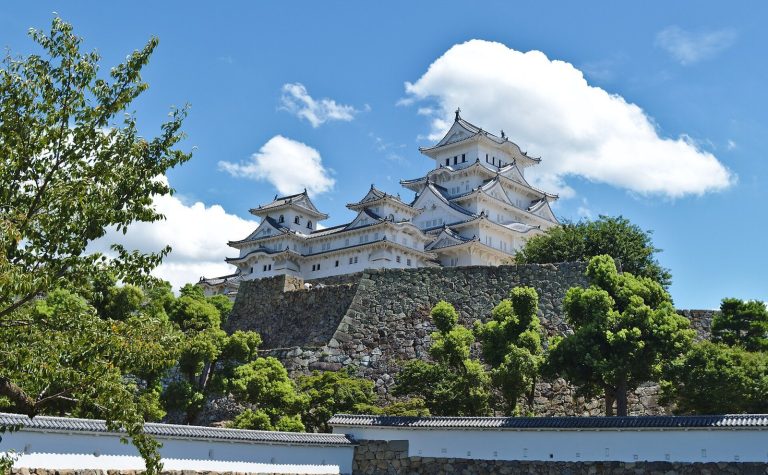
The quarries exploited a thick deposit of volcanic stone created by pyroclastic flows during late Cretaceous volcanic activity approximately 100 million years ago. Their stone-working history extends for more than 1,700 years, from the Kofun period to the present. Tatsuyama stone was used for sarcophagi in the middle and late Kofun period, for foundation stones at Heijo Palace and temples in the Yamato region, and later for the walls of Himeji Castle, the Tokyo Imperial Palace, the National Diet Building, and other structures. Stone was transported by boat along the nearby Hokkesantani River and was also used for buildings and Buddhist images carved from stone.