Ichijō-ji Temple: A Tendai Buddhist Pilgrimage Temple in Japan


Site at a Glance
- Rating
- 4.2
- Popularity
- Medium
- Country
- Japan
- Primary era
- Medieval
- External website
- Open
- Eras represented
- Medieval, Early Modern
- Civilizations
- Japanese, Tokugawa
- Site type
- Religious
- Remains
- Temple
On this page18 sections
History
Ichijō-ji Temple is a Tendai Buddhist temple in Kasai, Japan, traditionally founded in 650 during the reign of Emperor Kōtoku. Tendai, a Japanese Buddhist tradition founded by Saichō in the early ninth century, emphasizes the Lotus Sutra and includes esoteric practices. The temple’s formal name is Hokke-san Ichijō-ji, and its principal image is Shō-Kannon Bosatsu, a form of Kannon, the bodhisattva of compassion. Ichijō-ji is the 26th temple on the Saigoku Kannon Pilgrimage and is also linked with several regional networks of Buddhist and Shinto sacred sites.
Foundation and early Buddhist traditions
The foundation tradition attributes the temple’s establishment to the Indian sage Hōdō, said to have been commissioned by Emperor Kōtoku. According to the legend, Hōdō reached Japan on a purple cloud after travelling through China and Baekje. He discovered a sacred mountain shaped like an eight-petaled lotus and named it Mount Hokke after the sacred mountain of the Lotus Sutra. His reputed power to send a bowl through the air to receive offerings gave rise to the title “Empty Bowl Sage.”
Hōdō’s historical identity remains uncertain, but traditions about him are concentrated in eastern Hyōgo, a region with early Buddhist remains. At Ichijō-ji, six gilt-bronze Buddhist statues date from the seventh or eighth centuries, and three are Important Cultural Properties. Nearby temple ruins and stone Buddhist images point to an early flourishing of Buddhist culture in the area.
The temple is believed to have first stood at the foot of Mount Kasamatsu, slightly north of its present position. The date of its relocation is unknown, although the complex had probably been established at its current site by 1171, when its three-story pagoda was built. The Nara-period Furubokke Stone Buddha Triad, located nearby, is believed to mark the earlier temple site.
Medieval religious center
During the medieval period, Ichijō-ji contained a prominent Shingon Ritsu monastic institution. Shingon Ritsu combined esoteric Buddhist practice with strict monastic discipline. From about 1283, senior monks repeatedly invited Eison, the principal founder of the tradition, to visit Mount Hokke. After delays caused by his appointment as superintendent of Shitennō-ji in Osaka, Eison arrived in July 1285 and conducted Buddhist activities at the temple. On August 7, he reportedly bestowed the bodhisattva precepts on 2,124 people.
In 1290, Monkan Kōshin entered the Shingon Ritsu community at Ichijō-ji as a thirteen-year-old novice. He became a disciple of Ganchi and was ordained under Keison, an important disciple of Eison and a leading Shingon Ritsu missionary in Harima. Monkan later became an imperial prayer monk, a cleric appointed to perform Buddhist rites for the protection of the emperor. His connection with Ichijō-ji is also associated with a stone memorial monument made in 1316 for the imperial line, although the inscription does not identify its intended recipient with certainty.
Destruction and rebuilding
Fires repeatedly altered the temple during the medieval and early-modern periods. In 1523, warfare during the Sengoku period, an era of widespread conflict among military powers, destroyed the complex apart from the three-story pagoda. The Harima warlord Akamatsu Yoshitsuke rebuilt many of the buildings in 1562. A further fire in 1628 again left the pagoda standing while destroying the rest of the complex. The main hall was rebuilt in the same year with support from Honda Tadamasa, lord of Himeji Domain, and the bell tower was completed in 1629.
Several buildings and monuments preserve evidence of the temple’s long development. The three-story pagoda and a group of ten silk paintings depicting Prince Shōtoku and nine high priests associated with the transmission of Tendai are National Treasures. The main hall, Gohō-dō, Myōmi-dō, Benten-dō, the stone gorintō, and other features have Important Cultural Property status, while further buildings and monuments are designated or registered at prefectural or municipal level.
Modern conservation and continuing use
Ichijō-ji remains an active Buddhist temple and pilgrimage institution. The main hall suffered extensive typhoon damage in 1998. Between 1999 and 2009, a careful semi-dismantling repair addressed structural deterioration, including termite damage and rotting beams, while retaining as much original material as possible. The temple grounds also remain associated with seasonal displays of spring cherry blossoms and autumn foliage.
Remains
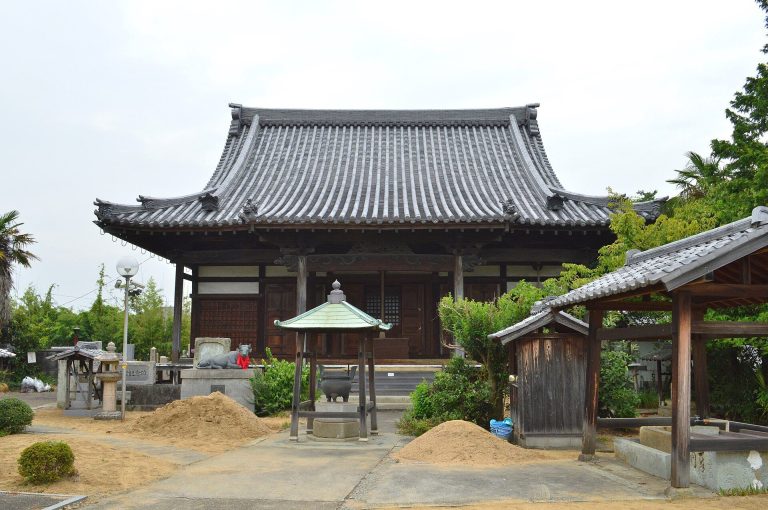
The mountain precinct occupies a sequence of levelled terraces linked by long flights of stone steps. At the road-facing entrance, a stone kasatōba, a memorial monument with an umbrella-like top, stands before the approach. The Treasure Museum and the Jizō-in headquarters lie to the left, while the Taishi-dō, a pond belonging to the hōjō, and a shrine occupy the park-like area to the right. The Jōgyō-dō stands on the left side of the first narrow terrace. Higher up, the three-story pagoda is on the left and the Hōrin-dō, or sutra repository, is on the right. The main hall rises above the pagoda, with its projecting veranda allowing the pagoda to be viewed from above.
Main hall and principal images
Main hall
The main hall, also called the Great Compassion Hall or Kondō, is an Important Cultural Property rebuilt in 1628. It is a single-storey building measuring nine bays by eight bays, with an irimoya roof covered in hongawarabuki tiles. Its kake-zukuri construction supports the building on projecting timber framing over the slope. Inside, a broad outer worship area leads to a more enclosed inner sanctuary, side sanctuaries, and a rear sanctuary, a plan characteristic of esoteric Buddhist halls.
The outer sanctuary is unusually spacious for a pilgrimage temple and retains a large quantity of wooden prayer plaques attached by pilgrims. A three-bay image cabinet in the inner sanctuary houses the secret principal image, a standing Shō-Kannon in the central bay. Secret images of Fudō Myōō, a deity associated with immovable spiritual resolve, and Bishamonten, a guardian of Buddhist law, occupy the side bays. Images of the Twenty-Eight Attendants and the Wind and Thunder Deities stand outside the cabinet.
Bronze Kannon images
The principal standing Kannon is a gilt-bronze image 72.7 centimetres high. Its accompanying front image, now kept in the Treasure Museum, measures 80.3 centimetres. Both date from the late Asuka to early Nara period, probably the latter seventh century. Their upright poses, restrained facial expressions, and finely rendered ornaments characterize the group. The principal image is normally secret, but it was shown publicly in November 2009 and May 2010, the first such openings in twenty-two years.
Pagoda and upper precinct
Three-story pagoda
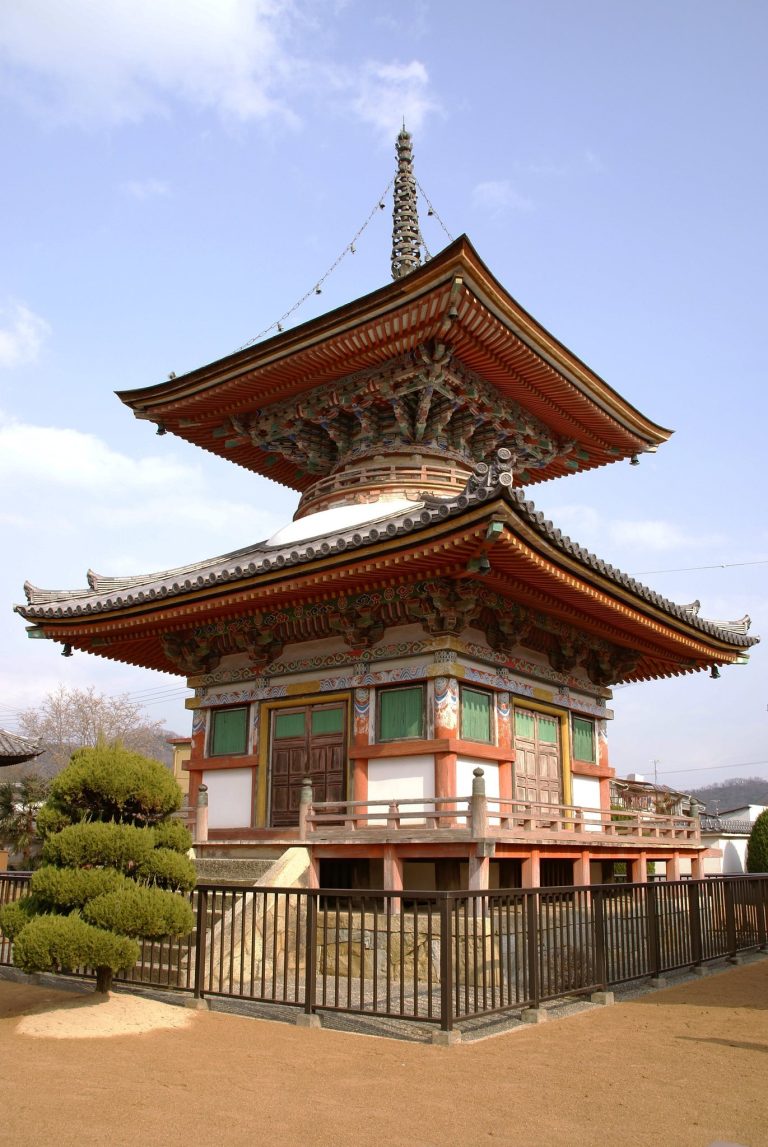
The three-story pagoda is a National Treasure and a major example of wayō, the Japanese style of Buddhist architecture developed during the Heian period. An inscription on its finial gives the date of its construction as 1171. Its three-by-three-bay body narrows markedly toward the upper storeys, and its hongawarabuki roof uses broad concave tiles whose joints are covered by semicylindrical convex tiles. A central pillar rises through the building and continues into the spire, representing Mount Sumeru, the center of the Buddhist cosmos.
Jōgyō-dō
The Jōgyō-dō is traditionally connected with an imperial foundation associated with Emperor Shōmu. It burned during the Kakitsu disturbance and was rebuilt in 1533 before burning again. The present building was reconstructed in 1868.
Gohō-dō, Myōmi-dō, and Benten-dō
Behind the main hall and above the stairway stands Gohō-dō, an Important Cultural Property from the Kamakura period. It is a one-bay shrine building in the Kasuga-zukuri form. Myōmi-dō, also behind the main hall, dates from the Muromachi period and is a three-bay shrine building in the Nagare-zukuri form. To its left, Benten-dō is a smaller one-bay Kasuga-zukuri building of the same period.
The early-Edo bell tower was rebuilt in 1629. Other structures within the precinct include the Hōrin-dō sutra repository, Gyōja-dō, Taishi-dō, Awashima-dō, the Jizō-in headquarters, and the subtemples Kanki-in and Rinshō-in. A separate gate stands east of the main precinct.
Stone monuments and inner precinct
Memorial monuments
Two late-Kamakura stone hōtō pagodas stand beside the path leading toward the inner precinct. A gorintō, a Buddhist stone monument formed from five symbolic sections representing the elements, stands farther back on the right below the entrance steps. Its inscription gives the date as 1321.
Kasatōba and nine-story pagoda
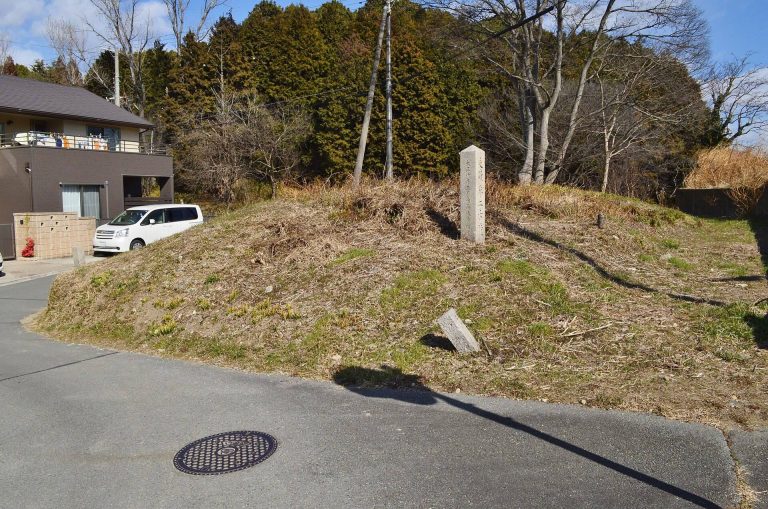
The entrance kasatōba was made on December 21, 1316, under Monkan Kōshin’s supervision. Its inscription dedicates the monument to a “sacred imperial lord,” but the precise recipient is uncertain. Possible identifications include the retired Emperor Go-Uda and Crown Prince Takaharu, who later became Emperor Go-Daigo.
The inner precinct contains the Sainokawara, a Buddhist folkloric place associated with the afterlife and traditionally linked with the spirits of children. A stone nine-story pagoda from the Nanboku-chō period stands there and is designated a Kasai City Tangible Cultural Property. The Founder’s Hall, dedicated to Hōdō, is registered as a Tangible Cultural Property by Hyōgo Prefecture.
Paintings and early Buddhist heritage
Silk paintings
The National Treasure painting group consists of ten coloured silk portraits produced around the latter part of the eleventh century. One depicts Prince Shōtoku, the early imperial prince traditionally associated with the promotion of Buddhism in Japan. The other nine depict Nāgārjuna, Śubhakarasiṃha, Huìwén, Huìsī, Zhìyǐ, Guàndǐng, Zhānrán, Saichō, and Ennin, figures associated with the transmission of Tendai teaching.
Each painting measures approximately 125.6 to 131.6 by 74.7 to 75.8 centimetres. The figures occupy most of the compositions and appear in varied standing, seated, frontal, oblique, and profile poses. Warm-toned pigments give colour to the robes, whose patterns are painted rather than made with cut-gold decoration. Replacement silk, retouching, and repainting affect parts of the group, but much of its original condition survives. Labels on the paintings of Huìwén and Guàndǐng refer to “Hokke-ji,” strongly linking the set with the temple from the time of its production. The paintings are deposited at the Tokyo National Museum, Osaka City Museum of Fine Arts, and Nara National Museum.