Hiromine Shrine: A Historic Center of Gozu Tenno Worship in Japan


Site at a Glance
- Rating
- 4.3
- Popularity
- Low
- Country
- Japan
- Primary era
- Medieval
- External website
- Open
- Eras represented
- Medieval, Modern
- Civilizations
- Ashikaga shogunate, Japanese
- Site type
- Religious
- Remains
- Sanctuary
On this page17 sections
History
Hiromine Shrine is a Shinto shrine on Mount Hiromine in Himeji, Japan, traditionally regarded as the grand head shrine of Gozu Tenno worship in the country. Gozu Tenno was a Buddhist-Shinto deity associated with protection from epidemics and disasters, and was commonly identified with Susanoo, a major Shinto deity linked with storms, purification, and protection from calamity. The shrine is also known as Hiromine Gozu Tenno.
Early foundation traditions
The shrine’s beginnings are preserved through several traditions. The Harima Kagami says that a sacred enclosure was established on Mount Hiromine during the reign of Emperor Sujin, a traditionally early emperor of Japan. Another account places the foundation in 734. According to this tradition, Kibi no Makibi, an eighth-century court scholar and statesman who had studied in Tang China, recognized divine power at the mountain after returning to Japan in 733. He reported what he had experienced to Emperor Shomu, after which the shrine was founded on Shirahatayama.
A different tradition associated with Susanoo Shrine in Fukuyama says that Kibi no Makibi brought the deity from Bingo Province. The connection between Kibi no Makibi and the shrine also appears alongside traditions about onmyodo, a system of calendrical calculation, divination, cosmology, and ritual influenced by Chinese theories of yin and yang and the five phases.
The shrine was moved from Shirahatayama to the summit of Mount Hiromine in 972. An entry in the Nihon Sandai Jitsuroku, a ninth-century imperial chronicle, records the granting of the junior fifth court rank in 866 to an otherwise unranked Susanoo deity in Harima. This entry is generally understood as referring to Hiromine Shrine.
Gozu Tenno and Gion traditions
At Hiromine, worship of Gozu Tenno developed beyond prayers to avert epidemics and other disasters. It became especially associated with abundant rice cultivation, forming what came to be called the Hiromine faith and establishing the shrine as a center of agricultural worship.
One tradition says that Gozu Tenno, identified with Susanoo, was divided from Hiromine Shrine and enshrined at the Gion temple complex in Kyoto in 869. A document from 1223 calls Hiromine the original shrine of Gion, and the shrine is therefore regarded as the original shrine and grand head shrine of Gion worship. Yasaka Shrine in Kyoto makes the same claim, leaving the competing traditions unresolved. Related accounts connect the deity’s journey with shrines in Kobe, Osaka, and Kyoto, where the deity was said to have rested, as well as with later divisions and enshrinements at places including Owase Shrine in Mie.
Medieval military and religious institution
From the Kamakura through the Muromachi periods, Hiromine’s priests also served as warrior vassals and estate stewards. They participated on the side of the Northern Court in the Battle of Minatogawa in 1336, a major conflict in the fourteenth-century struggle between rival imperial courts. Hiromine Masatoshi, the shrine’s great administrator of shrine affairs, is traditionally said to have killed Kusunoki Masauji, a nephew of Kusunoki Masashige, during that battle.
The shrine was supported by a hereditary network of religious families. Tradition speaks of seventy-five families, but warfare during the Eiroku era weakened the institution. By the Edo period, thirty-four families were known as the Hiromine Thirty-Four Lodges. Their number later fell to thirty-three during the Kanbun era and twenty-five during the An’ei era, while the formal framework of thirty-four responsibilities continued through arrangements with other families.
The Hiromine family held the hereditary office of great administrator of shrine affairs until effectively the beginning of the Edo period. It was regarded as descended from the poet and Kokin Wakashu compiler Oshikochi no Mitsune. The Koetsuka and Kaneda families were considered descendants of Kamakura-period vassals who had moved from eastern Japan to Harima. The Uozumi, Komatsubara, and Taniguchi families were thought to have entered the shrine establishment from retainers of the Akamatsu family between the later Muromachi and Toyotomi periods. From the Hoei era onward, five of these families held the junior fifth court rank and related court offices.
Early-modern administration and pilgrimage
Before the Meiji government separated Shinto and Buddhism, the institution was called Zofukuji of Tennozan or Zofukuji of Hirominezan. During the Edo period it was under the authority of Kaneiji, the Tokugawa shogunate’s family temple. In 1714, Hiromine became an imperial prayer institution. Until the government ended this arrangement in 1871, members of the shrine families sent a representative and several priests to Kyoto each year from late January to mid-February to pray for the imperial court.
The priests also served as oshi, religious intermediaries who provided devotional services and maintained congregations. Their communities were organized mainly by natural village across a broad area that included Harima, Tajima, Awaji, Settsu, Tamba, Tango, Wakasa, Bizen, Bitchu, Bingo, Mimasaka, Inaba, and Hoki. They distributed talismans for household altars, rice seedbeds, and field water inlets, receiving offerings in return.
This network helped sustain Hiromine even though its Edo-period estate amounted to seventy-two koku, a unit used to estimate agricultural production. Village territories could be sold between shrine families when a family became impoverished or withdrew from shrine service. About fifty subordinate priestly families, known as tedai, assisted the shrine families. They accompanied them to the imperial court and to village congregations, while usually supporting themselves by cultivating fields owned by the shrine families on Mount Hiromine.
From the early-modern period until the beginning of the Showa era, pilgrims from Harima visited Hiromine Shrine before setting out on the Ise pilgrimage and again after returning. This custom was known as the two-circuit pilgrimage. The rice-planting festival, the Epidemic-Deity Festival, and the Pillar Festival were among the shrine’s historically important observances, while its principal annual festival is held on April 18.
Meiji transformation and later history
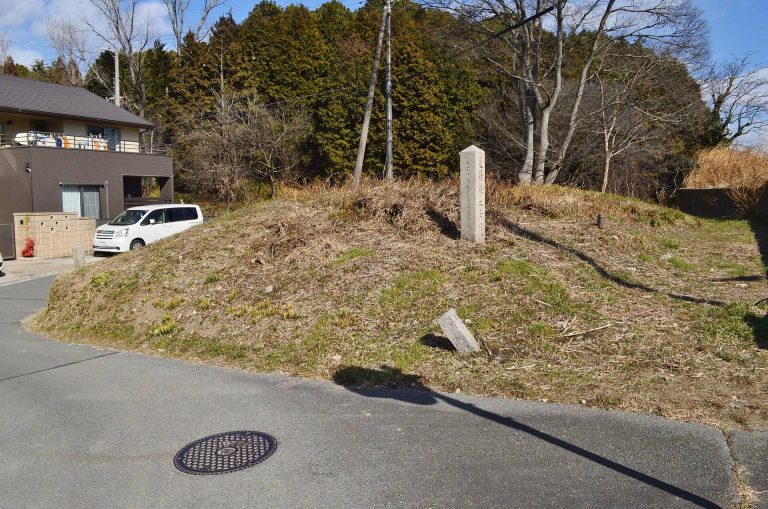
In 1871, the government confiscated the shrine’s seventy-two-koku estate and abolished hereditary shrine offices. Government-appointed officials replaced the hereditary priests, causing many shrine families and tedai to lose their positions and move down the mountain. Former members became teachers, priests at other nearby shrines, or businesspeople. A monument at the former Taniguchi family residence commemorates this transformation.
The decline became more pronounced after the Second World War, as agricultural technology advanced and the regional economy shifted from farming toward commerce and industry. Most shrine personnel left Mount Hiromine, and many former priestly residences fell into disrepair. The Koetsuka and Uozumi residences are said to survive in nearly complete form.
Hiromine Shrine was formerly a prefectural shrine and is now a Beppyo shrine, a shrine included in the Association of Shinto Shrines’ special listing of prominent shrines. It is also listed among shrines appearing in historical records and is number 74 on the Pilgrimage of Shrines and Temples of the Sacred Sites of Japan route, where it is the ninth pilgrimage site in Hyogo.
Deities and continuing traditions
The principal deities are Susanoo and Isotakeru, a deity associated with the spread and cultivation of trees and vegetation. The left sanctuary enshrines Kushinadahime, Ashinazuchi, and Tenazuchi. The right sanctuary enshrines the three Munakata deities, Ame no Oshihomimi, Ame no Hohi, and others.
Before the Meiji separation of Shinto and Buddhism, the principal deity was identified as Gozu Tenno, while Yakushi Nyorai was worshipped in the main hall as the deity’s Buddhist “true form.” In 2018, the shrine announced plans for a sanctuary dedicated to Kuroda Yoshitaka, the sixteenth-century warrior, strategist, and feudal lord better known as Kanbei and Josui. Kanbei Shrine was established in autumn 2019.
A tradition connects Hiromine with Kuroda Shigetaka, Yoshitaka’s grandfather. Similar family crests and personal-name characters among some Edo-period tedai families once suggested a relationship with the Kuroda house of Fukuoka, but no connection has been established. Those families are instead thought to have originated in Kurodasho in Taka District and to have belonged to a different lineage from the Kuroda family of Omi. Historical records do establish that Inokuchi, a senior Kuroda retainer, served at Hiromine as a monk and religious instructor.
Remains
Hiromine Shrine occupies the summit of Mount Hiromine, with the earlier sacred area of Shirahatayama to the west and Tenso Shrine on the eastern peak. The main precinct contains the principal shrine buildings and a group of subsidiary shrines. Kibi Shrine and Kogen Shrine stand on Shirahatayama, while Kumano Gongen Shrine, Inari Shrine, Tenjin Shrine, Kanjadono Shrine, Daiki Shrine, Koshin Shrine, Sanno Gongen Shrine, Ebisu Shrine, Gunden Hachiman Shrine, and Chiyoshi Shrine are arranged around the main hall.
Main shrine buildings
Main hall
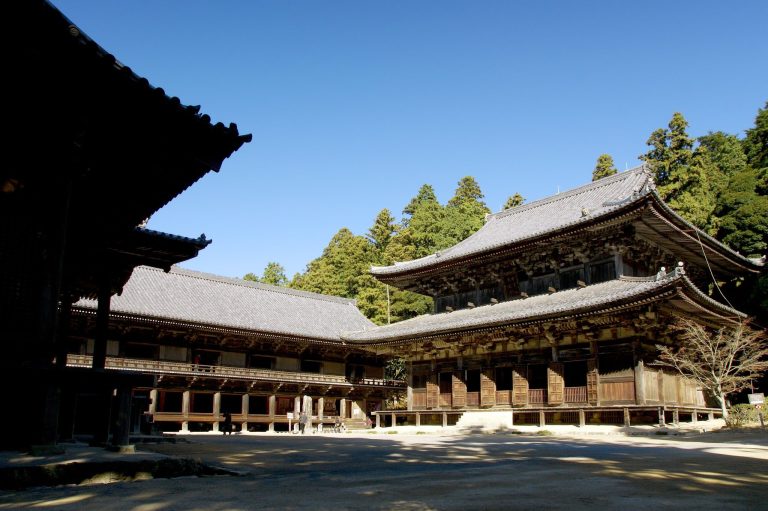
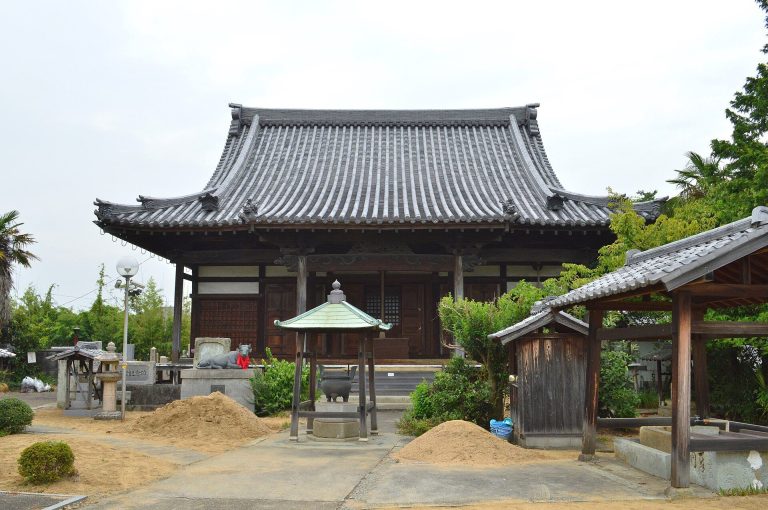
The main hall was built during the Muromachi period and rebuilt in 1444. Its roof is an irimoya, or hip-and-gable roof, a form widely used for important religious and elite buildings in Japan. The building measures eleven bays across the front and four bays along the side. It is divided into inner and outer sections, while the deep rear section contains separately arranged central, right, and left halls. This arrangement gives the building an unusual internal plan.
Worship hall and reliquary pagoda
The main hall and worship hall, together with a hōkyōintō, a Buddhist stone reliquary pagoda made of stacked architectural sections, are designated Important Cultural Properties of Japan. Their protected status reflects the architectural and religious history preserved within the summit precinct.
Yakushi Hall
Yakushi Hall stands behind and to the northwest of the shrine buildings. Built in recent years, it houses the image of Yakushi Nyorai traditionally said to have been worshipped in the main hall before the Meiji separation of Buddhism and Shinto. The hall therefore preserves the memory of the shrine’s earlier combined Buddhist and Shinto religious setting.
Kanbei Shrine
Kanbei Shrine stands behind the main hall and is dedicated in part through a piece of fossilized katsura wood from the mausoleum of Kuroda Mototaka in Mega, Himeji. The wood was discovered during the Edo period and donated by Daicho-ji, the Fukuoka temple that served as Mototaka’s family temple.
Mountain-top residences and memorial remains
Former Taniguchi residence
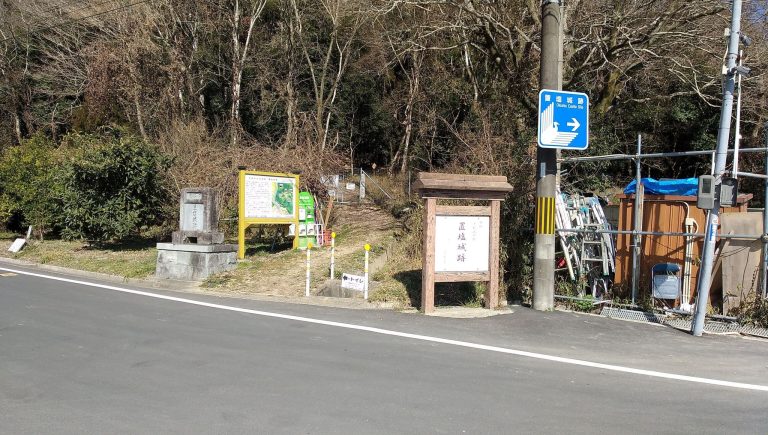
The former Taniguchi family residence has been incorporated into a park called the Resting Plaza. A monument there records the transformation of the hereditary shrine families after the 1871 abolition of their offices and confiscation of the shrine estate.
Koetsuka and Uozumi residences
The Koetsuka and Uozumi residences remain as nearly complete examples of the former priestly residences on Mount Hiromine. They preserve the domestic setting associated with the hereditary families who served the shrine, although they are not open to the public.
Fire damage and ritual setting
On February 3, 2012, fire used during a fire-walking ritual spread to the roof of the main hall. Approximately thirty square meters of roofing were damaged. The event forms part of the recent physical history of the Muromachi-period building and its continuing ritual use.