Mimuroto-ji Temple: A Buddhist Pilgrimage Temple in Uji, Japan


Site at a Glance
- Rating
- 4.1
- Popularity
- Medium
- Country
- Japan
- Primary era
- Medieval
- External website
- Open
- Eras represented
- Medieval, Early Modern
- Civilizations
- Ashikaga shogunate, Tokugawa
- Site type
- Religious
- Remains
- Monastery
On this page14 sections
History
Mimuroto-ji Temple is a Buddhist temple in Uji, Kyoto, Japan, traditionally founded in 770 during the Hoki era. It belongs to the Honzan Shugenshu school of Shugendo, a Japanese mountain-based religious tradition combining Buddhist, kami-related, and ascetic practices, and holds the status of a special head temple. Known formally as Myojozan Mimuroto-ji, it is the tenth temple on the Saigoku Kannon Pilgrimage, a circuit of thirty-three Kansai temples devoted to Kannon, and the 124th temple on the Shinbutsu Reijo Pilgrimage route.
Legendary Foundation and Early Associations
The temple’s foundation tradition attributes its establishment to Emperor Konnin, who commissioned Gyohyo, a monk of Daian-ji. The circumstances of the origin remain uncertain, and the foundation story is strongly legendary. It tells of a golden spiritual light appearing each night at the Imperial Palace. Shirakabe no Omi, who later became Emperor Konnin, ordered Fujiwara no Inukai, a minor court official, to investigate it.
Inukai followed the light upstream along the Shizu River, a tributary of the Uji River, and found an image of Senju Kannon in a basin below a waterfall. Senju Kannon is the thousand-armed form of Kannon, the Buddhist bodhisattva associated with compassion. According to the legend, a lotus petal changed into a smaller, two-armed Kannon image. Emperor Konnin enshrined it, and Gyohyo established a temple originally called Omuroto-ji. The story further says that Emperor Kanmu later made a larger Kannon image and placed the smaller figure inside it.
The earliest historical evidence connecting the temple with the Saigoku pilgrimage places Omuroto-ji at the thirty-third and final station when Gyoson undertook the pilgrimage around the end of the eleventh century. During the Kanpei era, from 889 to 898, Enchin of Onjo-ji stayed at the temple. These associations helped place Omuroto-ji within the religious networks that shaped the pilgrimage tradition.
Imperial Patronage and the Name Mimuroto-ji
Cloistered Emperor Kazan later established a villa at the site and designated the temple as the tenth station when the Saigoku pilgrimage was revived. During the Chowa era, from 1012 to 1017, Emperor Sanjo established a Hokke Sammai-do, a hall for a Buddhist practice centered on the Lotus Sutra. Emperor Shirakawa established a Jogyo Sammai-do for another form of Buddhist practice and gave the temple a shoen estate, a medieval estate whose revenues supported a religious institution.
During the Kowa era, from 1099 to 1103, Ryumei, a senior monk and chief abbot of Onjo-ji, restored the temple. He transferred the sub-temple Raku-in from Onjo-ji to Omuroto-ji and lived there. Raku-in had been founded at the request of Emperor Shirakawa, and Ryumei subsequently became known as the Omuroto prelate.
Emperor Horikawa, a devoted follower of Ryumei, enlarged the temple complex and granted an official estate-holder position in Nakakuki, in Musashi Province. The revenue supported ritual offerings connected with Raku-in’s principal deity. The site was associated with the villas of Emperors Konnin, Kazan, and Shirakawa, and its name consequently changed from Omuroto-ji to Mimuroto-ji. When Emperor Shirakawa made a pilgrimage to Kumano, a seventeen-day goma ritual was performed at Mimuroto-ji. A goma is a Buddhist fire offering ceremony. Afterward, a seventeen-day retreat at the temple became customary when the Kumano Kengyo entered the mountains.
Fire, Political Reversal, and Reconstruction
Imperial support gradually expanded the precinct and increased the number of buildings and monks’ residences. On December 13, 1462, a fire that began in the dining hall spread through the shell-trumpet hall, Kannon hall, Higan hall, Saito-in, Jogyo hall, and treasure storehouse. The blaze destroyed the major complex. Ichia of Onjo-ji’s Amida-in rebuilt the main hall in 1487 under an imperial order from Emperor Go-Tsuchimikado.
In 1573, Mimuroto-ji supported Ashikaga Yoshiaki, the last shogun of the Ashikaga shogunate, after he took refuge at Makishima Castle in opposition to Oda Nobunaga. Nobunaga’s campaigns formed part of the military struggles that helped unify Japan. As a consequence of its support for Yoshiaki, the temple lost all of its estate lands and entered a period of decline.
Prince Doko restored Mimuroto-ji in 1639. He was a cloistered son of Emperor Go-Yozei and the head of Shogoin, a monzeki temple traditionally headed by an imperial prince or aristocratic member. The main hall later fell into disrepair around the Meiwa era, from 1764 to 1772. The monk Ninko planned its reconstruction, but the work was not completed until 1814, when the hall was rebuilt under Honyo.
Religious Status and Modern Recognition
The principal image of Mimuroto-ji is a hidden statue of Senju Kannon. A hibutsu is a sacred image kept from ordinary view. The statue was opened for a special pilgrimage viewing from October 1 to November 30, 2009, as part of the 2008 to 2010 opening of principal images at all Saigoku pilgrimage temples. This was the first opening of the image since 1925, an interval of eighty-four years.
Mimuroto-ji and its associated buildings and objects include nationally designated Important Cultural Properties, as well as tangible cultural properties designated by Kyoto Prefecture and Uji City. The principal site-wide designations include the main hall, three-story pagoda, Amida hall, bell tower, and the main hall of Juhachi Shrine. The shrine building belongs to Juhachi Shrine rather than to Mimuroto-ji.
Remains
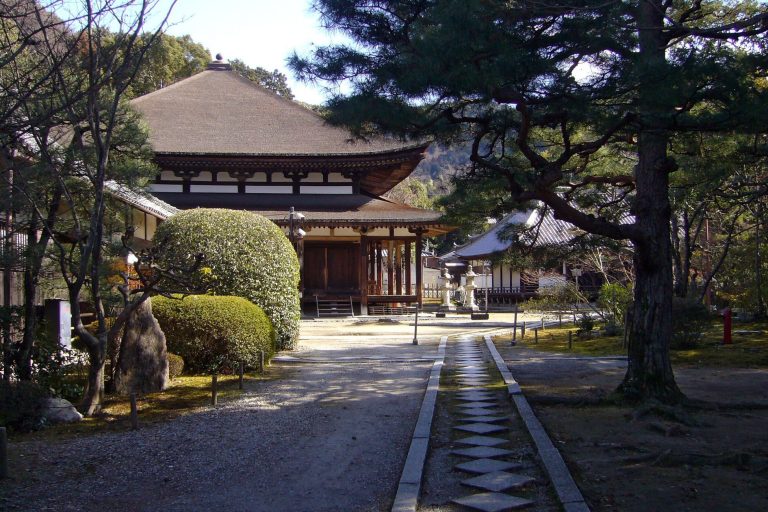
The surviving precinct combines a central group of Buddhist buildings with a shrine, relocated pagoda, commemorative stones, religious images, and the Yoraku-en garden. Its buildings represent several periods of construction, from the late fifteenth century to the nineteenth century, while later additions and relocated features contribute to the present arrangement.
Main Buddhist Buildings
Main Hall
The main hall was rebuilt in 1814 as a substantial two-storied building in the irimoya-zukuri style. This roof form combines a gabled central section with hipped roof slopes. The hall enshrines the hidden standing image of Senju Kannon. The principal image has no officially released photograph, and its date and other details are unknown because it is not a designated cultural property.
A large-crowned, two-armed Kannon stands before the shrine cabinet as a substitute image. It has an Asuka-style form, with the hands joined before the chest and celestial robes spreading symmetrically beside the body in fin-like shapes. The former main hall’s wooden struts are also included among the site’s associated architectural cultural properties.
Amida Hall
The Amida hall stands over the former grave of Hino Arinori, the father of Shinran. Shinran’s daughter Kakushinni restored the grave and established the hall for memorial observances. The temple’s associated Important Cultural Properties include wooden seated images of Amida Nyorai with the attending Kannon and Seishi. The group follows the refined late-Heian sculptural manner associated with Jochō, and the two attendants kneel in a way comparable to those in the Amida triad at Sanzen-in.
Bell Tower and Associated Features
The bell tower has a hanging arrangement described as a streamer-style form. Nearby features include the treasure storehouse, monks’ quarters, the mountain gate, and a thirteen-tier stone pagoda. A stone monument beside the bell tower marks the Ukifune historic site, associated with the character Ukifune in the Uji chapters of The Tale of Genji.
Pagoda and Shrine
Three-Story Pagoda
The three-story pagoda was built in 1704 and rises 16 metres. It originally stood at Kozō-ji in former Mikazuki Village, Sayo District, in Hyogo Prefecture. Mimuroto-ji purchased the structure and moved it to a hill west of the approach in 1910. In 1977, it was moved again to its present position beside the bell tower.
Juhachi Shrine
Juhachi Shrine stands behind and to the left of the main hall. Its main building was rebuilt in 1487 as a three-bay nagare-zukuri structure, a shrine form with a flowing asymmetrical roof extending over the entrance. Although the shrine lies within the temple precinct, it is independent and is not owned by Mimuroto-ji.
The shrine originated as the tutelary shrine of Mimuro Village. Tradition holds that Enchin enshrined fifteen deities associated with Sanno belief there in 840, after which it became known as Juhachi Shrine. Its main building is one of the principal site-wide cultural property designations associated with the precinct.
Images, Garden, and Commemorative Features
A stone image of Ugajin stands before the main hall, its body represented as a coiled snake. The image is a recent work. Handprints of the yokozuna wrestlers Wakanohana and Takanohana are also displayed within the precinct. Other associated cultural properties include a standing Shaka Nyorai from the Kamakura period. It is identified as the oldest surviving example of the Seiryo-ji-style Shaka image, modeled on the principal image of Seiryo-ji. A late-Heian standing Bishamon-ten and a Kamakura-period silk painting of Nyoirin Kannon are also associated with the site, the latter as a tangible cultural property designated by Uji City.
The Yoraku-en garden covers approximately 5,000 tsubo and contains a dry landscape garden, a stroll garden with ponds, and an open garden area. Kinsaku Nakane designed it in 1989. The planting includes approximately 20,000 azaleas and 1,000 rhododendrons, together with hydrangeas, lotuses, and areas noted for autumn foliage.