Kamado Shrine: A Shinto Mountain Shrine in Dazaifu, Japan


Site at a Glance
- Rating
- 4.4
- Popularity
- Medium
- Country
- Japan
- Primary era
- Modern
- External website
- Open
- Eras represented
- Medieval, Early Modern, Modern
- Civilizations
- Japanese, Tokugawa
- Site type
- Religious
- Remains
- Sanctuary
On this page20 sections
History
Kamado Shrine is a Shinto shrine in Japan, located at Dazaifu in Fukuoka Prefecture, whose traditional foundation is dated to 673 during the reign of Emperor Tenmu. It developed on Mount Homan within Japan’s indigenous Shinto tradition and later became a combined Shinto-Buddhist institution, a major Tendai center, and an important site of Shugendo mountain practice.
Traditional Foundation and Early Worship
The shrine’s foundation traditions connect its origins with the relocation of Dazaifu to its present location in 664. Because Mount Homan lay to the northeast, a direction traditionally regarded as vulnerable, one tradition says that thousands of kami, sacred beings or presences associated with places and natural forces, were dedicated on the mountain to protect the new center.
Another tradition places the decisive event in 673, when the Buddhist monk Shinren encountered the female kami Tamayori-bime while practicing in the mountains. Tamayori-bime is associated with divine lineage and water-related fertility in Japanese mythology. After Shinren reported the manifestation to the court, an upper sanctuary was built. These accounts preserve the shrine’s religious memory, while archaeological evidence indicates that a substantial complex existed by the latter eighth century rather than conclusively establishing the traditional foundation story.
Material from the lower sanctuary includes late Nara-period tiles of the Korokan type. Finds from the upper sanctuary include Haji pottery and imperial coins dating from the ninth century through the medieval period. Together, these remains point to early ritual activity and possible connections with Dazaifu and the embassies sent to Tang China.
The Shrine and Temple Complex
The earliest documentary reference to the associated Buddhist temple, Kamadoyama-dera, dates to 803. By the Heian period, the shrine and temple had formed a shinbutsu-shugo institution, meaning that Buddhist and kami worship were historically combined. The temple was also called Oyama-dera, Uchiyama-dera, or Uchiyama-dera, although it is uncertain whether these names always referred to one institution.
The deity Kamado-no-kami first appears in records in 840, when the court raised the deity from Junior Fifth Rank, Lower Grade, to Junior Fifth Rank, Upper Grade. Court offerings followed in 842. A record from 850 gives the deity the Senior Fifth Rank, Upper Grade, although that entry may be erroneous. Further promotions followed in 859, 879, and 896, ending with the Senior Fourth Rank, Upper Grade.
The shrine was listed as a Myojin-taisha in the 927 Engishiki, a tenth-century compendium of court laws, regulations, and shrine rites. A Myojin-taisha held especially high ritual standing in the ancient court classification. Kamado Shrine had a chief administrator by 979 and reached Senior First Rank, the highest rank, in 1106. By then, Mount Homan and its shrine-temple complex had attained considerable influence, and tradition described the shrine as the protector of Kyushu’s nine provinces.
Tamayori-bime is the shrine’s principal deity. Emperor Ojin and Empress Jingu were added later, and the shrine was associated with the Hachiman tradition by at least the early twelfth century. Hachiman was a deity linked with warfare, protection, and the imperial lineage. In medieval and early-modern usage, the deity was also called Homan Daibosatsu or Homan Myojin. Another interpretation identifies the original deity with Sanbo-Kojin, a syncretic hearth and household-protection deity, but this remains a scholarly theory.
Fire, Dispute, and Tendai Influence
The upper sanctuary and its sacred image were destroyed by fire in 1105. Later records discuss divination and plans to transfer the sanctuary, but another fire in 1155 destroyed the shrine complex again. By the late eleventh or early twelfth century, the Buddhist abbot of Oyama-dera appears to have administered the mountain institution as a whole. The temple’s appointment and jurisdiction became matters of dispute involving Enryaku-ji and Iwashimizu Hachimangu.
Oyama-dera belonged to the Tendai school, a major Japanese Buddhist tradition centered institutionally on Enryaku-ji on Mount Hiei, and became one of the principal Tendai institutions in western Japan. It held estates in Chikugo and Hizen, collected income for lamp oil, and maintained connections with other Buddhist establishments. Disputes over its appointments, jurisdiction, and economic resources sometimes reached the central authorities in Kyoto.
Shugendo on Mount Homan
From the late Kamakura period through the Muromachi period, Mount Homan developed as a major center of Shugendo, a tradition of ascetic mountain practice involving ritual training, pilgrimage, and supernatural discipline. Its practitioners, known as yamabushi, trained in mountain environments. Together with Mount Hikosan, Mount Homan formed a ritual system in which Hikosan represented the Womb Realm, associated with compassion, and Mount Homan represented the Diamond Realm, associated with wisdom and indestructible insight.
From the Muromachi period onward, the shrine was increasingly called Homan-gu. Warfare and the construction of nearby castles then undermined the temple complex. In 1557, the Kyushu warlord Otomo Sorin surveyed the land, imposed obligations on religious establishments, demolished halls and shrines, and converted their land to fields. Religious personnel became farmers and ceremonies declined. A tradition says that the mountain once contained 370 monastic lodgings, a number reduced to 25 yamabushi lodgings by the beginning of the early modern period.
Revival and Edo-Period Reconstruction
The complex was revived under the Kobayakawa family from 1587 as a Shugendo training center. Kobayakawa Takakage provided 100 koku of rice in 1593 for prayer expenses, and reconstruction began that year. A koku was a historical measure of agricultural yield conventionally associated with the rice needed to support one person for a year. By 1597, the sanctuary, worship hall, lecture hall, ascetic-practice hall, subsidiary shrines, and monastic lodgings had been rebuilt.
In 1600, the shrine declined a donation of 300 koku from Kuroda Nagamasa and instead requested exemption from labor obligations. The Fukuoka domain later supported tea cultivation by providing ten koku of tea seed. In 1618, the shrine received a 25-koku estate in Dazaifu and exemption from public service.
A fire in 1641 destroyed most of the lecture hall and other buildings, together with Buddhist images and ritual equipment. In 1650, Kuroda Tadayuki, the second lord of the Fukuoka domain, rebuilt the sanctuary, worship hall, lecture hall, kagura hall, bell tower, and ascetic-practice hall. Kagura is ritual music and dance performed for kami. During the Edo period, the shrine’s estate amounted to 50 koku.
Mount Homan’s affiliation with Shogoin, a major center of the Honzan branch of Shugendo, caused a dispute with Hikosan that was settled in 1696. In 1699, the abbot Ryoga-in Kanmasa revived large-scale mountain-entry practice. Eighty yamabushi took part in one recorded observance, regarded as the first such practice since 1554.
Meiji Reorganization and Later Status
The Meiji government’s policy of separating Shinto and Buddhism in 1868 ended the institutional arrangement that had united the shrine and temple. The mountain’s 25 yamabushi lodgings divided into nine anti-Buddhist and sixteen Buddhist factions. In 1870, the kagura hall, bell hall, ascetic-practice hall, goma hall, Hokke pagoda, and finial tower were destroyed or dismantled. A goma rite is a Buddhist fire ritual. In 1871, the yamabushi became Shinto priests, and the government confiscated the forests previously administered by their lodgings.
Kamado Shrine was classified as a village shrine in 1872 and as an Imperial Shrine, Minor Rank, in 1895. This rank, known as kanpei-shosha, belonged to the modern state system of ranked Shinto shrines established during the Meiji period. After the Second World War, the shrine became a Beppyo Shrine, a shrine included in the Association of Shinto Shrines’ special administrative category. Kamado Shrine is its formal name, while Homan-gu and Kamado-gu remain established alternatives.
Mount Homan, including the shrine precincts, is a National Historic Site. The shrine also forms part of the former Japan Heritage designation titled “The Ancient Japanese Western Capital: A Base for Exchange with East Asia.” Wooden guardian lions and materials relating to Mount Homan’s mountain worship are designated cultural properties of Fukuoka Prefecture. Approximately forty shrines in Fukuoka Prefecture are said to have been established through the transfer of Kamado Shrine’s worship.
The traditional Sixteen-Year Pilgrimage brought sixteen-year-old men and women from surrounding villages to the upper sanctuary to pray for auspicious marriages and give thanks for reaching adulthood. The practice ceased after the Second World War as the school system and the age of adulthood changed. It was revived in 2014 in connection with the shrine’s traditional 1,350th anniversary and the designation of Mount Homan as a historic site.
Remains
Kamado Shrine is arranged across Mount Homan in three principal levels: the upper sanctuary at the summit, the remains of a former middle sanctuary on the mountainside, and the lower sanctuary at the foot of the mountain. The upper sanctuary stands at approximately 829 to 829.6 meters, the middle-sanctuary remains at about 725 meters, and the lower sanctuary at about 175 meters. An external worship site lies at Kitadani, north of the lower sanctuary.
Upper Sanctuary
Main Sanctuary and Worship Area
The upper sanctuary’s present main sanctuary and worship hall follow the Shinmei-zukuri form, a simple raised-floor structure with a straight, gabled roof. The earlier wooden main sanctuary burned in 1952, and a reinforced-concrete replacement was built in 1957. The replacement occupies approximately 15 tsubo, or 49.59 square meters. On western level ground, another structure uses kake-zukuri, a method that supports a building or platform on projecting timber posts, often on sloping ground.
Stones and Former Office
The upper sanctuary includes a worship stone inscribed with characters meaning “the beginning of blessing” and a stage stone. Yoshitsugu Haizan wrote the inscription on 9 May 1913. A former shrine office was auctioned publicly in 1945 and no longer exists. Tradition places a sanctuary on the summit as early as 724, and until the Edo period the upper sanctuary was regarded as the shrine’s principal sanctuary. Earlier regulations prohibited cutting trees near it, even when they had died or fallen.
Middle-Sanctuary Ruins
Stone Shrines and Homan-san Monument
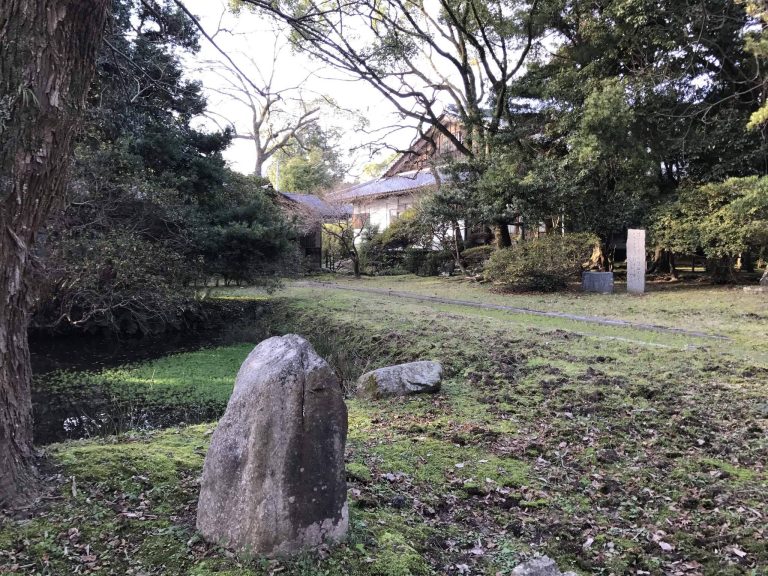
The middle-sanctuary site contains two stone shrines, the remains of an upper torii, and the Homan-san monument. A torii is a gateway marking the entrance to a Shinto sacred precinct. The monument commemorates the shrine’s elevation to Imperial Shrine, Minor Rank. It was erected in May 1923, with an inscription by the chief priest Okubo Choto.
Former Temple Buildings
The former middle-sanctuary complex included a lecture hall, halls associated with Gion and Monju worship, a hall for Kojin, a bell tower, and a kagura hall. The lecture hall was the principal building and reportedly housed an image of Eleven-Headed Kannon attributed to Saicho. Other features included a Bishamon hall, a shrine to Prince Kanenari, Matsuo-do Hall, a Gion hall, the former lecture-hall site, Jizo and Monju images, a three-story pagoda, a Jodo-in, or Pure Land hall, site, and rock-cut Buddhist images.
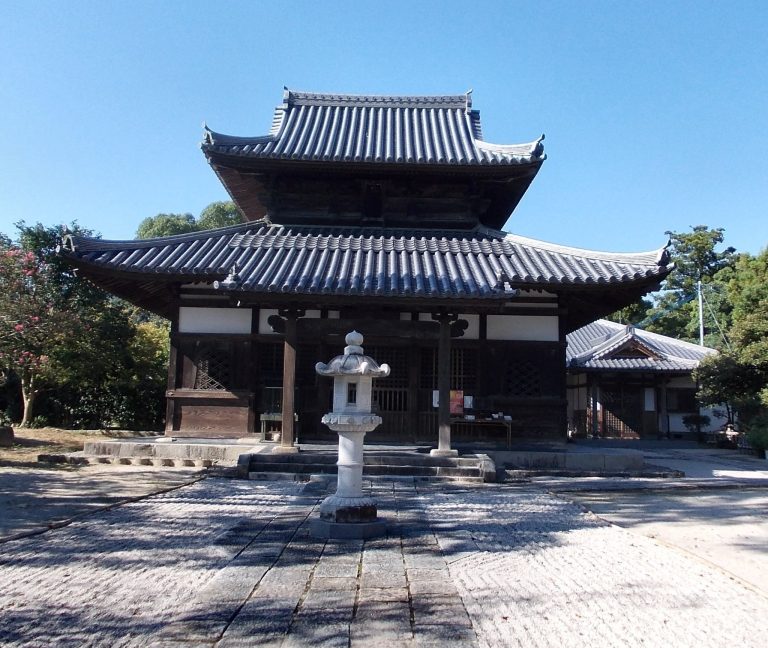
The former lecture hall still stood in 1892 under the name Shingi-den. It was a three-bay, hipped-gable building with entrances on both the eave side and the gable end. It measured approximately 7.2 meters wide, 5.8 meters long, and 4.2 meters high, and had a projecting worship porch. The former Jodo-in site contains a monument bearing a verse by Basho, dated 1798.
Lower Sanctuary
Principal Buildings
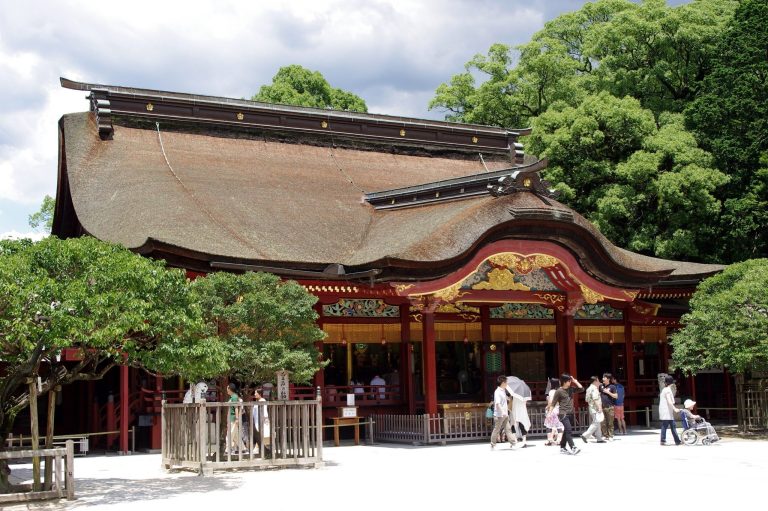
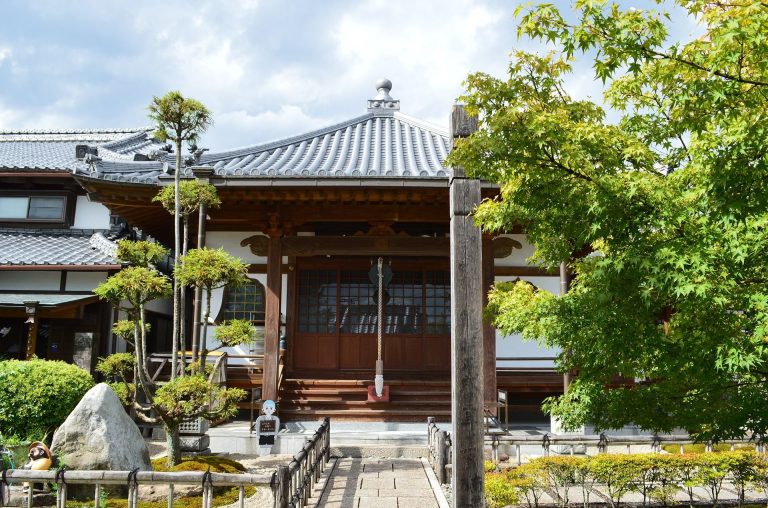
The lower sanctuary’s main sanctuary is a Nagare-zukuri building, a shrine form whose front roof slope extends forward to create a covered worship space. Built in 1927, it occupies approximately 15.8 tsubo, or 52.23 square meters, and received roof resurfacing in 2013. The connecting hall covers four tsubo, approximately 13.22 square meters. The worship hall, also in the Nagare-zukuri style, occupies about 13.4 tsubo, or 44.3 square meters. The connecting hall and worship hall were built in 1930, and all three principal buildings have copper-sheet roofs.
Sacred Grove and Archaeological Area
Behind the lower sanctuary’s main sanctuary is a sacred grove dominated by Japanese chinquapin trees approximately 80 centimeters in diameter. Akagashi oak, red-fruited elaeocarpus, evergreen oak, sakaki, Japanese privet, Mitsukashiwa, and camellia also grow there. Together they form an evergreen broad-leaved forest designated by the Ministry of the Environment as a plant community of special significance.
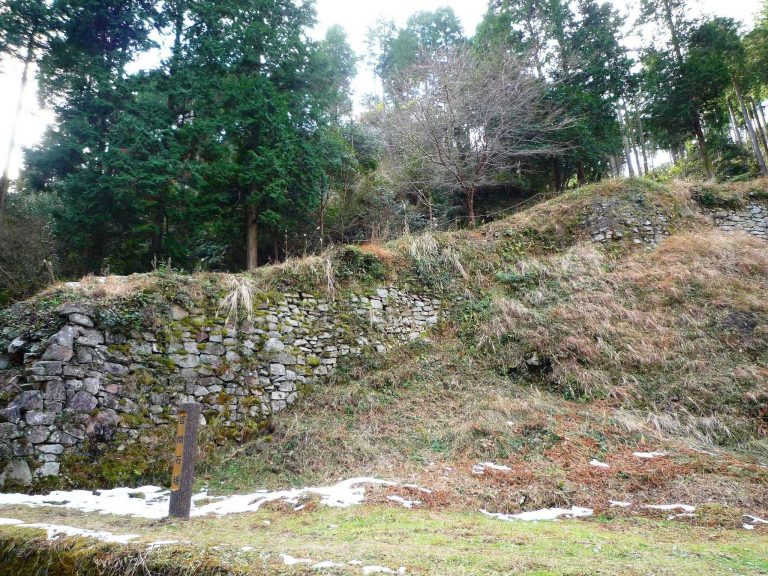
An archaeological area at the lower sanctuary contains a foundation complex measuring approximately seven bays from north to south and four bays from east to west. It is regarded as the central facility of the former Kamadoyama temple site. Tiles dating from the eighth through twelfth centuries have been excavated there, linking the physical remains with the early development of the mountain institution.
Gates, Subsidiary Shrines, and Ritual Objects
Torii and Subsidiary Shrines
The second torii from the parking area is a granite Myojin torii funded by Aso Takichi in 1928. A Myojin torii has slightly curved upper members and supporting posts. The third torii was erected in the eleventh month of the An’ei era by Kato Ichijun and measures approximately 4.29 meters high and 2.74 meters wide. A torii at the trailhead was built in 1927 by the Kaijima Partnership Company.
The first torii on the Uchiyama mountain route was solicited by the abbot Hiraishi-bo Koyu in 1679, with Kuroda Mitsuyuki as its principal donor. Made of granite in the Myojin style, it is approximately 7.1 meters high and 4.5 meters wide. The stone lanterns beside it were erected by Kuroda Nariyasu in May 1814. Subsidiary shrines include Gokoku Shrine, Muso Gonnosuke Shrine, Susa Shrine, and Shikibu Inari Shrine. Muso Gonnosuke is traditionally said to have practiced on Mount Homan before defeating Miyamoto Musashi.
Guardian Lions and Mountain-Worship Materials
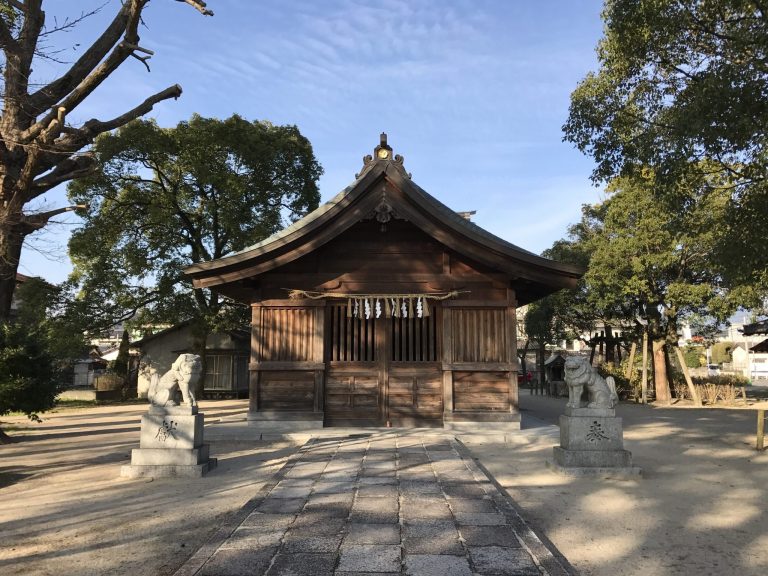
A pair of wooden guardian lions was found beneath the worship hall floor in 1978. The open-mouthed and closed-mouthed figures were carved from single blocks of camphor wood, stand approximately 90 centimeters high, and are attributed to the second half of the fifteenth century. Known as komainu, such paired figures traditionally guard shrine entrances or worship spaces. The two forms conventionally represent the beginning and end of a sacred utterance. The lions are held by Dazaifu Tenmangu.
The shrine holds 307 materials connected with Mount Homan’s mountain worship. They include equipment for Shinto and Buddhist rites, talismans and protective amulets, objects offered or used in prayer, paintings, and records. Among them are inscribed ritual mirrors donated by Kuroda Tadayuki in 1641. The mirrors represented the three deities of Kamado Shrine as Homan-gu, Seibo-gu, and Hachiman-gu. The Homan-gu mirror was destroyed by fire in 1853, while the surviving Seibo-gu and Hachiman-gu mirrors each measure slightly less than 45 centimeters in diameter and 0.7 centimeters in thickness.