Hashihaka Kofun: An Early Keyhole-Shaped Burial Mound in Japan


Site at a Glance
- Rating
- 4.2
- Popularity
- Low
- Country
- Japan
- Primary era
- Classical
- External website
- Open
- Eras represented
- Classical
- Civilizations
- Yamato
- Site type
- Burial
- Remains
- Burial Mound
On this page15 sections
History
Hashihaka Kofun is an exceptionally large keyhole-shaped burial mound in Japan, located at Sakurai in Nara Prefecture. Built in the early Japanese kofun tradition, it is commonly placed between the middle and later third century, although its date remains disputed. A kofun is a monumental Japanese burial mound, and the Kofun period began in the third century, when such large structures became prominent. Hashihaka is associated with the emergence of Yamato kingship, the early political authority that developed in the Nara region and later formed the basis of the Japanese imperial state.
Origins and disputed chronology
Hashihaka Kofun stands within the Makimuku Kofun Group and the Hashinaka district of the wider Makimuku site. It is regarded as the principal burial mound of the alluvial-fan zone at the northwestern foot of Mount Miwa in the southeastern Nara Basin. Its early date, great scale, formal design, and connection with related mound plans found across Japan have led to the view that it helped establish a model for later kofun.
Archaeological estimates for its construction range from about AD 240 to 260, AD 260 to 280, or AD 280 to 290. Other interpretations place the mound in the mid-fourth century or later. These differences reflect limitations in radiocarbon dating and disagreements over whether the mound matches the description of Himiko’s tomb in the Account of the Wa People. Pottery from the surrounding moat was dated by the Archaeological Institute of Kashihara to approximately AD 280 to 300, with an uncertainty of plus or minus 10 to 20 years. Because the pottery came from the moat rather than directly from the mound, this result does not establish the date of construction.
The wider Makimuku site contains remains ranging from the Jomon period through the Kofun period, adding to the difficulty of assigning a single date to material found around Hashihaka. In 2018, pottery analysis also pointed to a connection with the Kibi region, broadly corresponding to present-day Okayama Prefecture and eastern Hiroshima Prefecture. The findings indicate that Kibi may have played an important part in the mound’s construction and may have supplied finished ritual vessels for its rear section.
Burial identity and traditions
The Imperial Household Agency manages Hashihaka as the mausoleum called Oichi no Haka and identifies it as the tomb of Princess Yamato Totohi Momoso, traditionally regarded as a daughter of the legendary Emperor Kōrei. Her actual burial identity remains unknown. The agency’s management of the mound as an imperial mausoleum also means that free access to it is prohibited, and archaeological investigation has remained limited.
Since the research of Shinya Kasai, Hashihaka has been proposed as the tomb of Himiko, the queen of Yamatai. The argument draws on the mound’s early date and scale, as well as an approximate correspondence between the diameter of its rear circular section and the “one hundred or more paces” given for Himiko’s tomb. The identification remains unresolved. Objections include the possibility that Hashihaka was built after Himiko’s death, differing interpretations of the ancient unit of distance, the unexplained size of the large front section, and differences between the mound and the reported burial arrangements. Some researchers have instead connected it with Himiko’s successor Taiyo or with another early Yamato ruler.
The name Hashihaka, meaning “Chopstick Tomb,” comes from a tradition preserved in the Chronicles of Japan. In the legend, Princess Yamato Totohi Momoso became the wife of the deity Ōmono-nushi, who appeared only at night in the form of a serpent. After he departed, she died by stabbing herself with a chopstick, and her burial at Oichi was said to have given the mound its name. Another tradition in the same chronicle says that people carried stones from Mount Osaka to the tomb by day while gods built it at night. A separate interpretation links the name with the Haji clan, traditionally associated with the construction of ancient burial mounds.
Later history and investigation
In AD 672, Hashihaka became one of the battle sites of the Jinshin War, a conflict over imperial succession. Miwa no Takaichimaro and other local allies of Prince Ōama defeated forces supporting Prince Ōtomo at the mound. The Chronicles of Japan refers to the location as Hashi Misasagi.
The mound also acquired later secular associations. During the rule of the Oda clan, a tea house was reportedly built on it. In the Edo period, a tea stall near the southeastern foot was operated by a local proprietor known as Hashinaka Chōja, who sold sweets and candy to travelers making the pilgrimage to Ise. A path crossing the boundary between the mound’s front and rear sections was formerly used by local villagers.
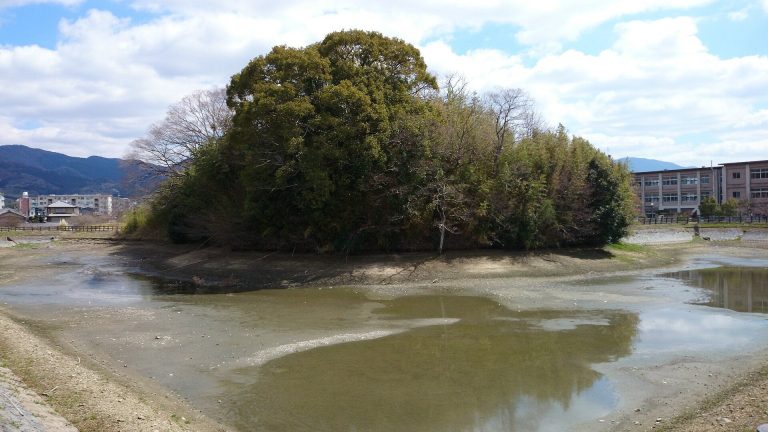
The first on-site survey took place on February 20, 2013, after the Imperial Household Agency granted access following requests from the Japanese Archaeological Association and other organizations. The surrounding moat and related area were designated Hashihaka Kofun Peripheral Moat, a National Historic Site, on February 9, 2017. Part of the surrounding pond area is also known as Hashinaka Great Pond and is included among Japan’s selected reservoirs.
Remains
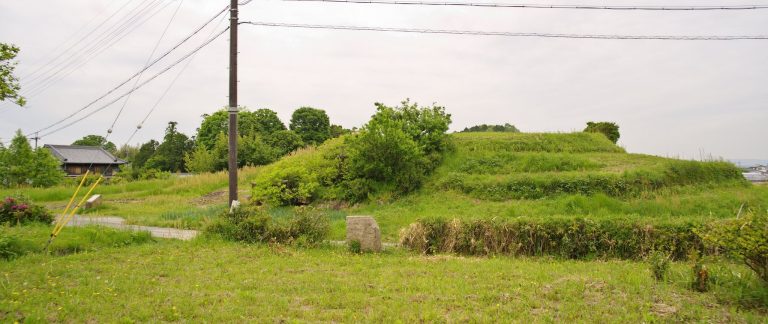
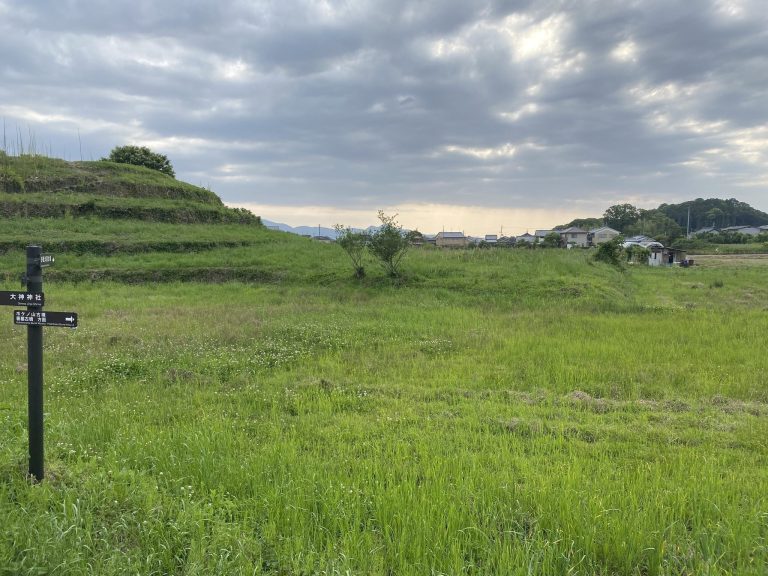
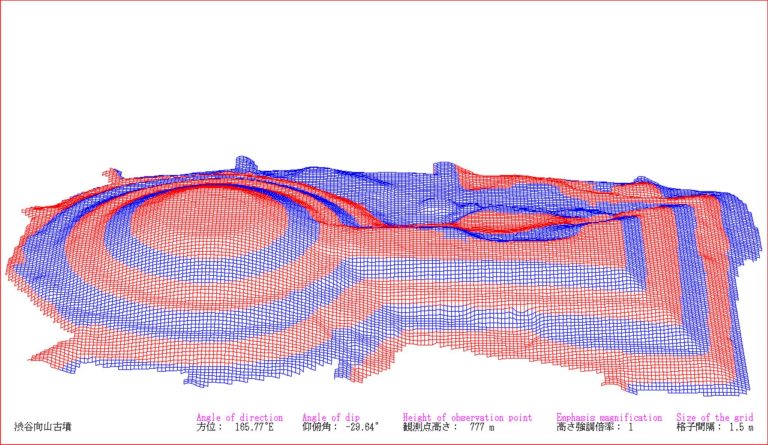
Hashihaka Kofun is arranged as a keyhole-shaped mound, combining a circular rear section with an expanded rectangular front section. Its present length is approximately 278 metres. The rear section measures about 150 metres across and 30 metres high, while the front section is about 130 metres wide and 16 metres high. Its estimated volume is approximately 370,000 cubic metres, and survey contours indicate that the mound may originally have been larger. The front end opens outward in a distinctive fan-like form associated with early keyhole mounds.
Main mound
Rear circular section
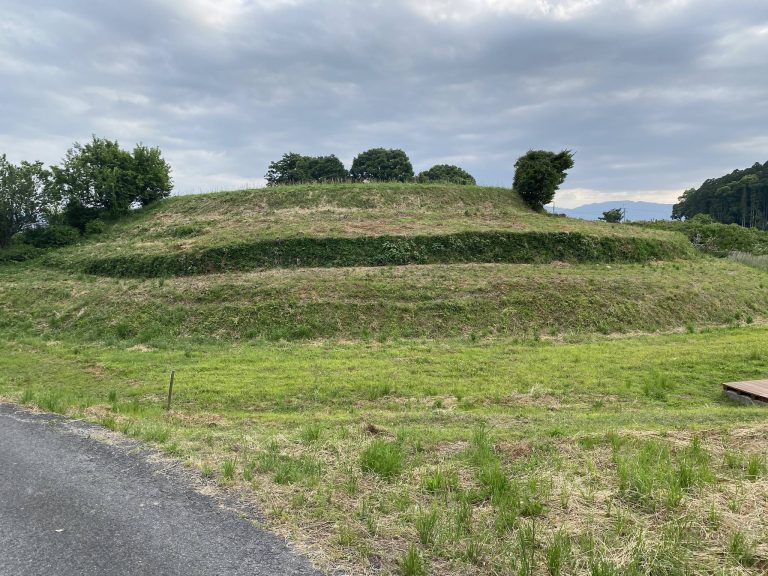
The rear section is generally understood to have been built in four stages. Some researchers identify a smaller circular mound or platform on its summit, approximately 44 to 46 metres in diameter and 4 metres high. Special vessel stands may have been placed on this upper feature. The burial facility itself is unknown, although basalt slabs found near the mound’s foot suggest that a pit-style stone chamber may once have existed.
Front rectangular section
The front section has four visible stages on its front face, while the form of its side terraces remains unclear. Survey contours show that it was formerly wider than it is today. Double-rimmed, jar-shaped pottery with a hole in its base was found on this part of the mound, indicating that vessel types may have been assigned to different areas of the monument.
Moat and outer works
Moat and causeway
Investigations outside the mausoleum boundary identified a moat approximately 10 metres wide along the mound’s foot. On the southeastern side of the rear section, a causeway crossed the moat. Facing stones, known as fukiishi, were piled along both sides of the crossing. Fukiishi are stones laid over mound slopes or related surfaces as protective facing.
Outer bank and soil-removal area
Part of an outer bank at least 15 metres wide was also identified. Excavations in 1994 and 1995 revealed a large depression beyond it, approximately 2 metres deep and about 50 metres wide. This feature, called the outer-moat-like structure, appears to surround the mound, moat, and outer bank. It is interpreted as an area from which soil was removed during construction.
Surface coverings and ritual pottery
Stone revetment and early haniwa
A river-stone fukiishi revetment survives on the northern slope near the tip of the front section. Regular rows of haniwa, clay objects placed around or on burial mounds, had not yet become established when Hashihaka was built. Instead, special vessel stands, special jars, and early cylindrical haniwa were placed on the mound.
Kibi-associated vessels
Miyayama-type special vessel stands and special jars have been identified on the rear section. These objects were probably brought from the Kibi region. In 2018, 26 jar-shaped vessels and haniwa from the front section were examined alongside 54 fragments of funerary-ritual pottery from the top of the rear section. The front-section pottery was made from local clay, while the rear-section material closely resembles clay from Kibi. This distribution supports the interpretation that finished vessels made in Kibi were arranged on the rear section.
Burial evidence and later deposits
The basalt slabs near the mound’s foot were identified as coming from Shibayama in Kashiwara, Osaka Prefecture, rather than from Mount Osaka or Mount Nijō, the locations named in the construction tradition. Other investigations have reported stonework in the upper part of the rear section using stone from the northern foothills of Mount Nijō. This has been interpreted as a possible relationship between the archaeological evidence and the account in the Chronicles of Japan, although the burial arrangement remains uncertain.
A wooden ring stirrup was recovered in 2000 from plant-rich upper fill in the moat during the 109th excavation of the Makimuku site. Associated Furu I pottery places the deposit around the beginning of the fourth century, but the stirrup entered the moat after it had ceased functioning and begun to fill. It therefore does not directly date construction of the mound. Its lower part is missing, while the surviving portion has an elongated handle and an angular handle head. Comparisons with early stirrups from continental East Asia have led to proposals that this example may date no earlier than the later fourth or fifth century.