Nirengi Castle: A Sengoku-Period Japanese Stronghold in Toyohashi


Site at a Glance
- Rating
- 3.2
- Popularity
- Very Low
- Country
- Japan
- Primary era
- Medieval
- Eras represented
- Medieval
- Civilizations
- Ashikaga shogunate
- Site type
- Military
- Remains
- Castle
On this page10 sections
History
Nirengi Castle is a Sengoku-period Japanese castle in Toyohashi, Japan, built in 1493 during an era of political fragmentation and prolonged warfare. Toda Munemitsu established it as a forward base in northern Atsumi, where it supported the Toda family’s struggle for control of eastern Mikawa.
The Toda advance into Mikawa
In 1465, Toda Munemitsu, a regional retainer of the Ashikaga shogunate, received orders to advance from Kyoto into Mikawa Province. The Ashikaga shogunate was the military government of the Muromachi period, whose authority relied partly on retainers such as Munemitsu. His mission was to suppress the Maruyama and Ohira families and bring the region under control.
Munemitsu established Otsu Castle in 1479 and Tahara Castle in 1480 before continuing eastward. In 1492, Tame Matasaburo built the mountaintop Funagatayama Castle. Munemitsu responded by constructing Nirengi Castle the following year as a base against Tame’s eastern forces. Nirengi became one of the principal Toda positions in northern Atsumi, alongside Tahara Castle, which Munemitsu assigned to his son Norimitsu.
Norimitsu later succeeded Munemitsu and moved his residence to Nirengi. From about 1508, he directed the affairs of the Mikawa-Toda house from the castle. The Toda had secured an alliance with the Saigo clan through marriage during the 1490s, and later intermarriage made the Toda a branch house of the Matsudaira. The Matsudaira and Tokugawa were closely related warrior houses, with Tokugawa Ieyasu later founding the shogunate that ruled Japan.
Conflict with Yoshida Castle
In 1505, Makino Kohaku built Imabashi Castle about two kilometres from Nirengi. The fortress was later renamed Yoshida Castle, and its proximity created a persistent point of conflict. Repeated battles took place between the two castles until Munemitsu compelled the head of the Makino family to become a Buddhist priest and formed an alliance with the Makino.
Further struggles followed. In 1529, Matsudaira Kiyoyasu, then aged 19 and head of the Matsudaira house, captured Imabashi Castle after a fierce battle. He then directed his attention toward other fortifications, including Nirengi. After Yoshida Castle entered Tokugawa control, Nirengi served as a supporting or branch castle under its command because of its strategic position and short distance from Yoshida.
The relationship changed again in 1564, when Nirengi’s lord, Toda Shigesada, recovered his mother from captivity at Yoshida Castle and transferred his allegiance to Tokugawa Ieyasu. Nirengi and Yoshida consequently became hostile once more. The conflict ended in 1565, when Yoshida Castle surrendered to Ieyasu.
Takeda attack and abandonment
In 1571, Takeda Shingen, head of the Takeda house, invaded territories held by the Tokugawa with an army of about 25,000 men. During this campaign, Takeda forces attacked Nirengi Castle and captured it. The defenders withdrew toward Yoshida Castle.
The castle’s final phase came after the Siege of Odawara in 1590, when control of the area passed to Toyotomi Hideyoshi and Ieyasu moved to the Kanto region. Hideyoshi was the military ruler who controlled Japan immediately before Ieyasu’s shogunate. Toda Yasunaga, the last lord of Nirengi, relinquished the castle and followed Ieyasu east. East Mikawa was assigned to Ikeda Terumasa, who resided at Yoshida Castle. With the nearby fortress serving the area, Nirengi was abandoned.
Later land use
During the Edo period, lower-ranking and impoverished samurai used locally available elm wood to make wooden pestles called surikogi. Selling these utensils to merchants provided additional income beyond their stipends. The castle’s name, Nirengi, means “Two Elm Trees” and referred to elm trees that once grew abundantly in the surrounding area.
After the Meiji Restoration, the former castle lands passed to the state. In 1911, Toyohashi’s first mayor, Ōguchi Kiroku, acquired the property and planted orchards. After the Second World War, members of the Ōguchi family lived there for a time in a small house called Kazaki-an, measuring six by three tatami mats.
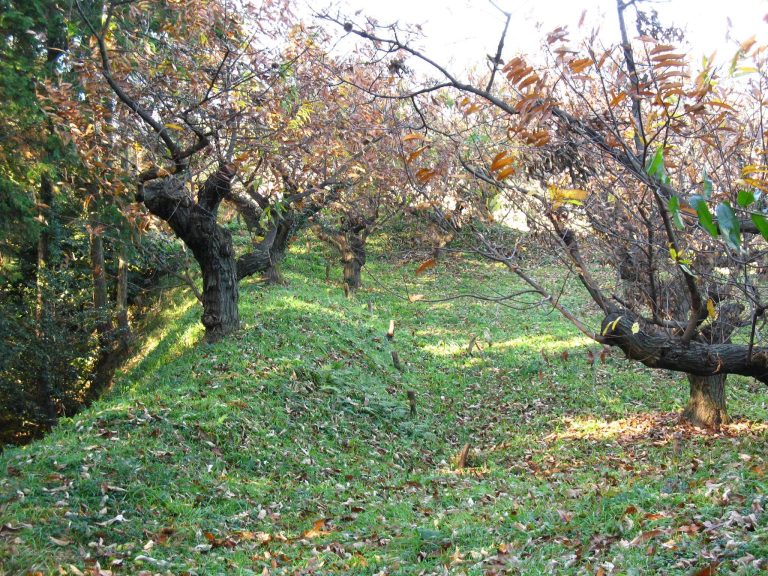
Toyohashi acquired the property in 1961 and established Ōguchi Park. The grounds were renovated in 1977 for seasonal plum and fragrant-herb plantings, and Ōguchi Park opened on the site in 1985. The castle is not designated as a cultural property. The municipality has installed a stone monument and explanatory signboards.
Remains
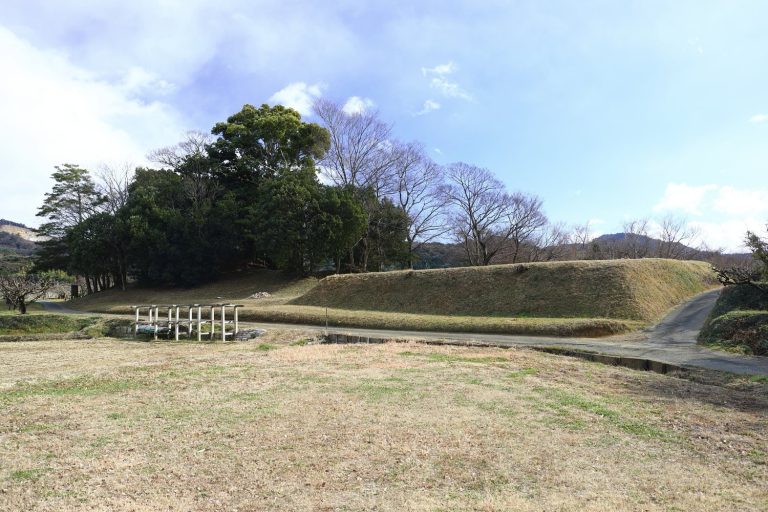
Nirengi Castle occupied a terraced rise beside the south bank of the Asakura River, near its confluence with the Toyogawa. Its position formed a higher point in the immediate area when viewed from the north. The compact site was organized around a principal courtyard and a secondary courtyard, with earthen ramparts and moats separating the courtyards and their enclosures. Earth, wood, and stone formed the castle’s construction, and its defenses did not include a keep.
Courtyards and defensive earthworks
Main courtyard
The principal fortified courtyard, or hon-maru, covered about 600 square metres. Earthen ramparts remain around this area, and part of the original dry moat survives at the foot of the slope below it. A dry moat is a defensive ditch without standing water, while an earthen rampart is a defensive embankment made mainly from compacted soil. The present park occupies the former main courtyard, and surviving stone-wall remnants add to the fragmentary physical evidence of the castle’s defenses.
Secondary courtyard and enclosures
The secondary courtyard, or ni-no-maru, lay east of the main courtyard and was bounded by the East and South Enclosures. The family’s official residence stood in the North Courtyard. These areas were divided by earthen ramparts and moats, creating a layered arrangement of fortified spaces. The former secondary-courtyard area is now occupied by a Senior Citizens’ Welfare Center.
Surviving traces and the castle name
No castle buildings survive, but the remaining ramparts, dry-moat section, and stone-wall fragments preserve parts of the site’s defensive layout. The later history of elm use also remains connected to the place name. Elm wood from the surrounding area supplied the material for the wooden pestles made by impoverished samurai during the Edo period, linking the name “Two Elm Trees” with a later local craft.