Fumon-ji Temple: A Historic Shingon Buddhist Temple in Toyohashi


Site at a Glance
- Rating
- 4.1
- Popularity
- Low
- Country
- Japan
- Primary era
- Early Modern
- External website
- Open
- Eras represented
- Medieval, Early Modern, Modern
- Civilizations
- Tokugawa
- Site type
- Religious
- Remains
- Monastery
On this page18 sections
History
Fumon-ji Temple is a Koyasan Shingon Buddhist temple in Japan, located in Toyohashi, Aichi. Traditionally founded in 727 during the Nara period by the monk Gyoki, it is associated with Funagata-san, or Mount Funagata, and enshrines Shokannon Bosatsu, one of the principal forms of Kannon, the Buddhist bodhisattva of compassion. The temple is also known as Toyohashi’s maple temple.
Foundation and early development
Fumon-ji’s foundation story says that Gyoki encountered an apparition of Kannon on the mountain. He received instructions to name the mountain Funagata-san and the temple Fumon-ji, then carved an image of the deity. After reporting the revelation to Emperor Shomu, an eighth-century ruler who promoted state-supported Buddhism, Gyoki is said to have received an imperial order for the construction of halls and pagodas.
The same tradition divides the ancient institution into an Eastern Valley and a Western Valley. The Eastern Valley was associated with the Five Great Wisdom Kings, powerful Buddhist deities believed to protect Buddhist teachings and overcome obstacles, while the Western Valley was connected with Kannon. The Five Great Wisdom Kings were traditionally attributed to Emperor Tenchi, and Emperor Shomu was said to have granted the temple the territory visible from two nearby peaks.
Archaeological investigation by the Toyohashi City Board of Education from 2004 demonstrated that the temple’s beginnings extend into antiquity. Relics from the mid-tenth century were found at Motomoto-do, the former main-hall site on the mountainside. The principal Kannon image dates from the eleventh century, and a standing bodhisattva image belongs to the tenth or eleventh century.
Medieval destruction and reorganization
According to temple tradition, the ancient complex grew to more than 3,000 monastic buildings before forces from Mount Hiei attacked and burned it between 1169 and 1171. It was traditionally revived between 1181 and 1182 by an uncle of Minamoto no Yoritomo, the founder of Japan’s Kamakura shogunate.
During the late Heian period, Fumon-ji underwent substantial reorganization. The monk Shoi established a sutra mound in 1156. Such a mound was a ritual deposit for Buddhist scriptures or related objects, intended to preserve them and support the Buddhist teaching. In 1160, a bell originally bestowed by the consort of Emperor Nijo was recast with additional copper donated by local people. The monk Eii established a formal pledge of support for the renewed temple in 1161. These activities accompanied the rebuilding of Fumon-ji as a center for the independence and collective organization of newly formed local communities.
In the Kamakura period, the temple held an extensive estate centered on Unokaya and Iwasaki, with part of it extending into Totomi. Unokaya and other surrounding areas were treated as part of the temple precinct, tying Fumon-ji closely to communities at the foot of the mountain.
Yoritomo tradition and regional conflict
A temple tradition states that Minamoto no Yoritomo prayed at Fumon-ji for the defeat of the Taira, the rival military family that contested his rise to power, and commissioned a life-sized image of Fudo Myoo. Fudo Myoo is the best known of the Five Great Wisdom Kings and is associated with protection and immovable resolve. After the Taira were defeated, Yoritomo is said to have stopped at Fumon-ji while traveling to Kyoto, donated extensive estates, and called the temple the foremost of the seven great temples of Mikawa. Contemporary records also indicate strong protection by the Kamakura shogunate.
Fumon-ji was drawn into conflicts among the Imagawa, Toda, and Makino families during the Warring States period, an era of prolonged warfare among regional powers. In 1517, Imagawa and Toda forces fought over Funagata-yama Castle, which stood on the mountain behind the temple. The entire mountain temple is said to have been burned during warfare in 1533.
Restoration and the Edo-period temple
Restoration began during the Warring States period and continued into the early Edo period as efforts were made to reunite the temple’s regional community. Around 1540, a large communal memorial service was held for all spirits, including those killed in the conflict over Funagata-yama and related wars. Contributors and mourners came from eastern Mikawa and western Totomi.
Successive regional lords, including the Imagawa family, Tokugawa Ieyasu, and Ikeda Terumasa, supported the restoration. In 1603, during the tenure of the reviving abbot Ryuyu, Ieyasu granted Fumon-ji 100 koku of officially recognized estate land. Koku was a historical measure of rice-based land income, so the grant provided the temple with a confirmed revenue base.
Major construction under the abbots Niyo and Choshin during the later seventeenth century included the Nio Gate and the Main Hall. These works established the basic appearance of the temple complex that survives today. Fumon-ji continued to attract worshippers as a Kannon pilgrimage site and as a place associated with Minamoto no Yoritomo. During the Edo period it was also known for cherry-blossom viewing.
The temple suffered two major fires but continued to transmit Buddhist images, craftworks, and historical documents. Its buildings, collections, and former precinct on Funagata-yama have made it a representative archaeological site of a medieval mountain temple. Fumon-ji holds the largest number of cultural-property holdings in Toyohashi, and its remains have attracted academic attention.
Traditional observances continue to shape the temple’s religious and cultural identity. They include the Koyasan founder’s birth ceremony, the opening of the Daishi Hall, and a pilgrimage ritual using sand from the eighty-eight temples of Shikoku. Summer observances include earthenware-plate moxibustion and a cucumber blessing rite, while the autumn maple festival and New Year’s Eve bell ringing continue the seasonal ritual calendar.
Remains
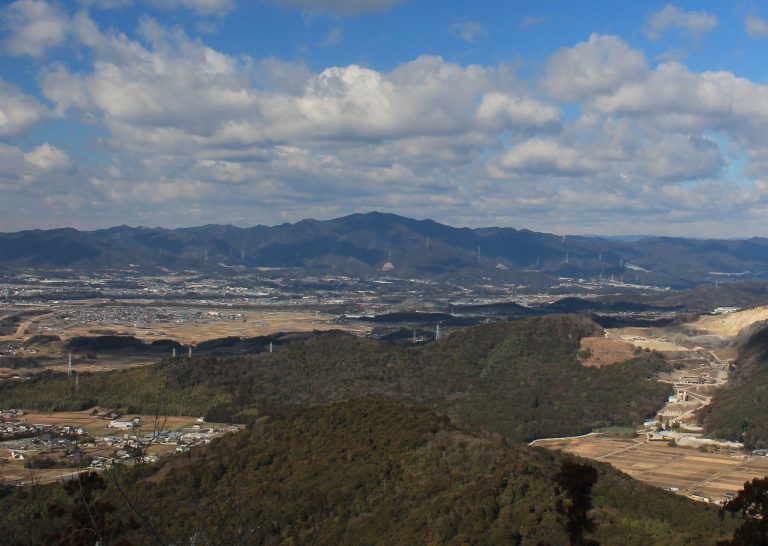
The surviving site combines the later temple complex with the former mountain precinct on the slopes of Funagata-yama. More than 200 artificially levelled areas remain in the former precinct, showing how the medieval institution was arranged across the mountainside. Particularly large terraces at Motomoto-do and Moto-do preserve foundations of former main halls. Both areas underwent extensive preparation during the late Heian period, and together the terraces and foundations preserve the physical layout of the medieval mountain temple.
Former mountain precinct
Motomoto-do
Motomoto-do is identified with the former main hall of the Western Valley, the part of the ancient temple associated with Kannon. Its broad terrace retains the foundations of the former hall and produced relics from the mid-tenth century. The terrace belongs to the mountain complex’s late Heian preparation and helps define the earlier arrangement of halls and residences on the slope.
Moto-do
Moto-do is thought to correspond to the Eastern Valley, whose principal image was traditionally the Five Great Wisdom Kings. Like Motomoto-do, it occupies a large artificially prepared terrace with surviving main-hall foundations. The two areas preserve the physical division between the Eastern and Western Valleys described in Fumon-ji’s foundation tradition.
Later temple complex
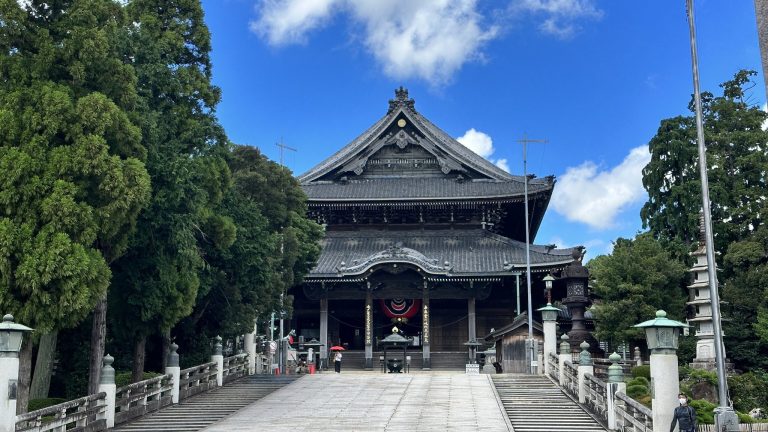
Main Hall
The present Main Hall was built in 1693 and enshrines Shokannon Bosatsu. Its construction belongs to the period when Fumon-ji was being restored under regional protection, and it forms part of the Edo-period complex that established the temple’s surviving appearance.
Nio Gate
The Nio Gate was completed in 1688. It houses two Kongorikishi, muscular guardian figures traditionally placed as a pair at Buddhist temple gates. The figures were made in 1687, one year before the gate was completed.
Bell-Tower Gate
The Bell-Tower Gate was completed in 1707 and is identified as the oldest surviving bell-tower gate in Toyohashi. It represents the continuing importance of the temple’s bell within its religious complex and seasonal observances.
Benten Hall
The Benten Hall, formerly the Ryujin Shrine, was built in 1714. Its earlier identity as a shrine and its later place within the temple grounds reflect the complex’s accumulated religious history.
Ten Kings Hall
The Ten Kings Hall was built in 1852. The Ten Kings are the judges of the dead in East Asian Buddhist religious tradition, and the hall forms part of the nineteenth-century buildings that remain within the complex.
Daishi Hall
The Daishi Hall was built in 1854 and enshrines Kukai, also known as Kobo Daishi, the founder of the Shingon school of Japanese Esoteric Buddhism. The hall remains connected with the temple’s Koyasan Shingon identity and with the ceremony marking the founder’s birth.
Guest Hall and other facilities
The Guest Hall contains the life-sized Fudo Myoo image traditionally associated with Minamoto no Yoritomo. The grounds also include a Buddhist Image Hall used as a repository for cultural properties and the Komyo Hall, a columbarium.
Sculpture, deposits, and natural features
Fumon-ji preserves wooden seated images of Amida Nyorai and Shaka Nyorai, together with standing images of the Four Heavenly Kings, Buddhist guardian deities assigned to protect the four directions. All date from the late Heian period. A standing Fudo Myoo with two attendants is designated as an Aichi Prefecture cultural property. The principal Kannon is an eleventh-century sculpture, while the standing bodhisattva associated with the temple dates from the tenth or eleventh century.
A bronze sutra container was placed inside a tile jar and bears an inscription dated 1156. A bronze mirror enclosed in a tile jar alongside it carries a design of a mandarin duck and floral arabesques. These objects, together with the surviving sculptures and hall foundations, connect the material remains of Fumon-ji with its medieval rituals and historical development.
A large cedar more than 450 years old stands within the grounds and is designated as a Toyohashi municipal natural monument. Alongside the later halls, the tree, the artefacts, and the terraced remains on Funagata-yama form the physical and cultural landscape of Fumon-ji.