Inuyama Castle: A National Treasure Castle in Japan


Site at a Glance
- Rating
- 4.4
- Popularity
- High
- Country
- Japan
- Primary era
- Early Modern
- External website
- Open
- Eras represented
- Early Modern
- Civilizations
- Tokugawa, Toyotomi regime
- Site type
- Military
- Remains
- Castle
On this page13 sections
History
Inuyama Castle is a Japanese castle in present-day Inuyama, Aichi Prefecture, Japan. Built on a hill beside the Kiso River, it developed into its present form through successive phases from the 15th century to the early modern period. Its surviving tenshu, the principal tower of a Japanese castle, is one of twelve pre-modern Japanese castle towers that remain and is designated a National Treasure.
Origins and the Oda family
A fortification is traditionally said to have been established at Inuyama in 1469, during the Onin War, by Oda Hirochika, the younger brother of Oda Toshihiro, head of the Iwakura Oda clan. In 1537, Oda Nobuyasu, an uncle of Oda Nobunaga, abandoned his residence at Kinoshita Castle and built a castle at the present location. The new stronghold developed from the earlier Iwakura Oda fortification and became Nobuyasu’s residence.
Nobuyasu was killed in 1544 during the conflict with Saito Dosan, after which his son Oda Nobukiyo became lord. Nobukiyo opposed Oda Nobunaga and, during the fighting, seized Inuyama with support from Saito Yoshitatsu. Nobunaga recaptured the castle in 1564 after defeating Nobukiyo. Inuyama was subsequently held by figures including Ikeda Tsuneoki and Oda Katsunaga.
Military stronghold in the late sixteenth century
Following the 1582 Honnoji Incident, in which Oda Nobunaga was killed in a coup, Inuyama came under his son Oda Nobukatsu. Nobukatsu was represented at the castle by his retainer Nakagawa Sadanari. In 1584, Ikeda Tsuneoki, then lord of Ogaki Castle and aligned with Hashiba Hideyoshi, suddenly seized Inuyama from the Oda side.
The castle became an important western military base during the Battle of Komaki and Nagakute, a conflict between Hashiba Hideyoshi and Tokugawa Ieyasu during the struggle for political control after Nobunaga’s death. Hideyoshi established his headquarters at Inuyama while confronting Ieyasu at Komakiyama Castle. Inuyama was returned to Oda Nobukatsu in 1587.
After Nobukatsu was dispossessed in 1590, Inuyama became part of Toyotomi Hidetsugu’s domain. Hidetsugu’s father, Miyoshi Yoshifusa, served as castle administrator. Following Hidetsugu’s death by seppuku, ritual suicide, in 1596, Ishikawa Sadakiyo, also known as Mitsuyoshi, became lord and carried out major rebuilding.
Inuyama also served as an important western army base before the Battle of Sekigahara in 1600, the campaign that established Tokugawa Ieyasu’s political supremacy. Ishikawa abandoned the castle to join the battle and was defeated. His release of Kiso retainers allied with the eastern army helped him avoid execution. The long-standing tradition that he dismantled and transferred every building from Mino Kanayama Castle to Inuyama was rejected after no evidence of such a relocation was found during the later dismantling and repair of the tower.
Tokugawa rule and the Naruse family
Ogasawara Yoshitsugu became lord of Inuyama in 1601. Hiraiwa Chikayoshi entered the castle as lord under the Owari Tokugawa domain in 1607, while his nephew Hiraiwa Yoshinori served as castellan. After Hiraiwa Chikayoshi’s death in 1612, the castle temporarily had no lord. Naruse Masanari became its lord in 1617.
Naruse Masanari was an attached senior retainer, or fudai karo, a high-ranking hereditary vassal serving directly under a feudal lord, of the Owari domain. The Naruse family then occupied Inuyama for nine generations while ruling the Inuyama domain as vassals of the Owari Tokugawa family. Alterations made by Naruse Masanari around 1617 substantially shaped the castle’s present appearance, and the tenshu underwent a major renovation in 1620.
Abolition, preservation, and modern ownership
Inuyama was abolished as a castle in 1871, when Japan ended its feudal domains and established prefectures. Most of the yagura, defensive or storage towers, gates, and other buildings were demolished. Several gates were sold and moved for reuse as temple gates. The castle initially became property of Aichi Prefecture.
The Nobi Earthquake damaged the southeastern attached turret of the tenshu in 1891. In 1895, the former lord Naruse Masahide received the castle from the prefecture without payment on the condition that the Naruse family repair and maintain it. Inuyama consequently remained privately owned by the Naruse family longer than any other castle in Japan.
The tenshu was designated an old National Treasure under the former National Treasure Preservation Law in 1935 and became a National Treasure under the 1950 Cultural Properties Protection Law in 1952. The Isewan Typhoon caused major damage in 1959. Dismantling-based repairs followed from 1961 to 1965, with further partial repairs in 2014 and seismic work in 2019.
Until 2004, the castle remained privately owned by the head of the Naruse family. On 1 April 2004, ownership passed to the Inuyama Castle Hakutei Bunko Foundation, established with Naruse Junko, sister of the thirteenth family head Naruse Masahiro, as its chair. The foundation became a public-interest foundation in 2013. Inuyama Castle Ruins became a National Historic Site in 2018, with Inuyama City as its designated managing body. The castle was selected as number 43 on the Japan Top 100 Castles list in 2006.
A lightning strike damaged the tower’s roof ornament in 2017. A replacement was installed in February 2018, and the damaged original body was found about 30 metres northeast of the tenshu in 2020. Excavations begun south of the castle in 2021 revealed a well-preserved outer moat corresponding closely to seventeenth-century plans. In 2025, the former Otemon square area was proposed for additional National Historic Site designation as a detached part of the historic site, with plans to interpret its former moat and earthworks.
The alternative name Hakutei Castle is traditionally attributed to the Confucian scholar Ogyu Sorai. He compared the castle’s hilltop position beside the Kiso River with White Emperor City on the Yangtze and associated the name with Li Bai’s poem Departing Early from White Emperor City. Inuyama and its surviving tower have also been discussed as possible parts of a future World Heritage serial nomination of surviving early-modern wooden castle towers.
Remains
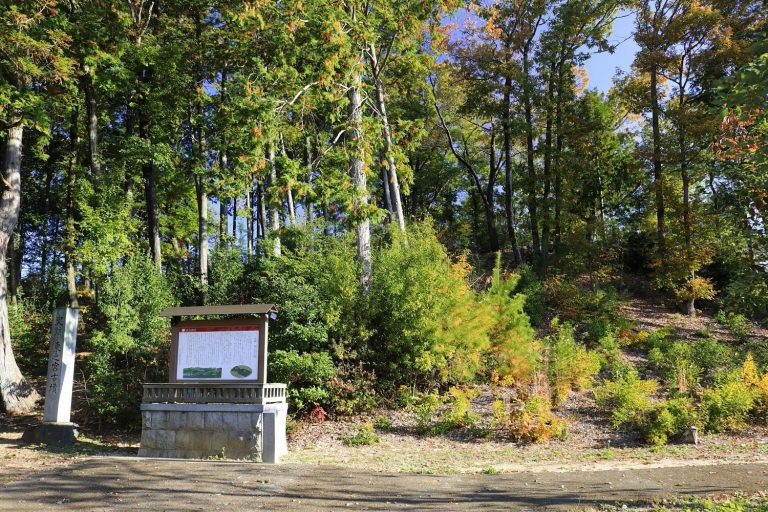
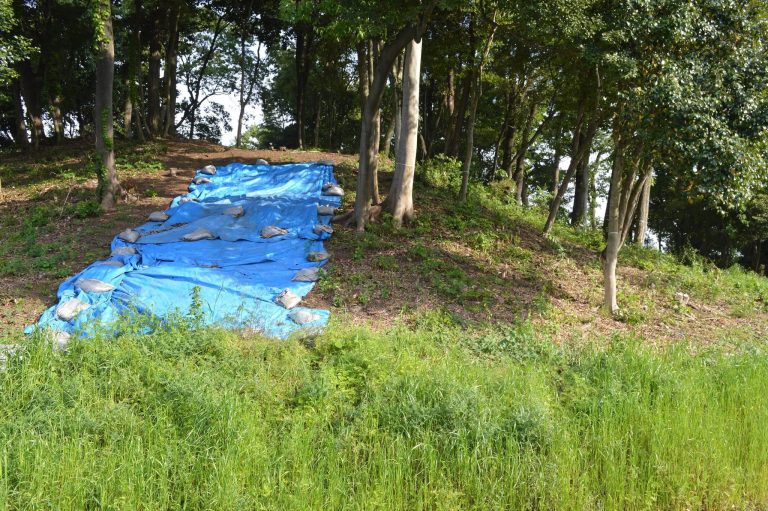
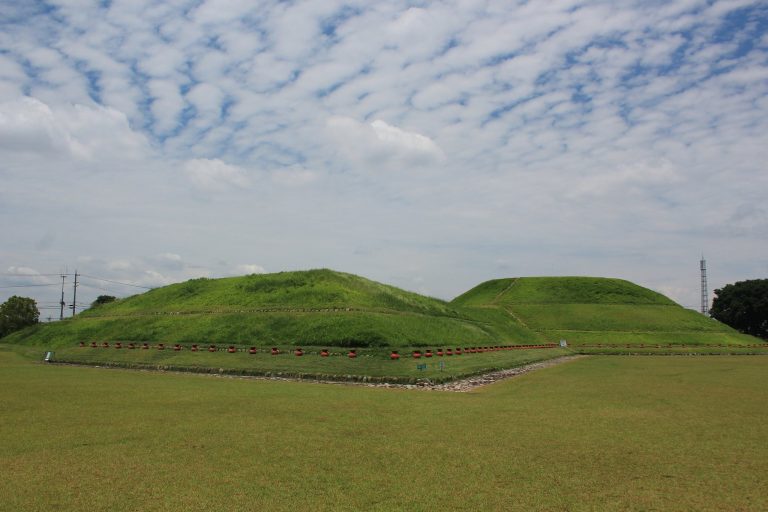
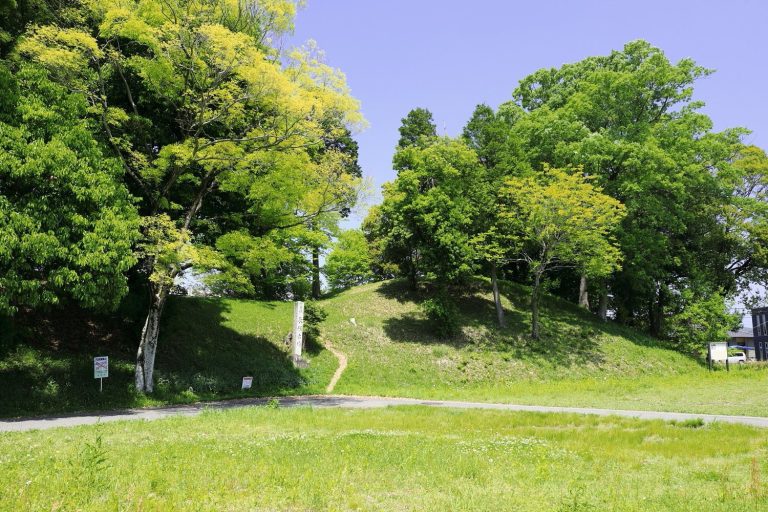
Inuyama is a hirayama-style castle, combining a hilltop position with lower areas extending toward level ground. It occupies a hill about 88 metres high on the south bank of the Kiso River, opposite the former Mino Province and near the modern Aichi-Gifu boundary. The hill rises from the riverbank and is backed by a cliff. The main enclosure stood above Sugi-no-maru, Momi-no-maru, Kiri-no-maru, and Matsu-no-maru, which descended in steps toward the south. The surviving remains include the tenshu, stone walls, earthworks, and a former dry moat.
The surviving tower
Structure and construction
Inuyama’s tenshu is externally three stories but internally four stories, with two underground levels that include an underground landing area. It is a compound watchtower with one-story attached turrets on its south and west sides. The upper watchtower section measures three bays by four bays and stands above a two-story lower structure with an irimoya roof, a form combining a hipped lower section with a gabled upper section.
The tower has a total floor area of 698.775 square metres, including the entrances to the underground levels, and is 19 metres high. The first-floor storage room measures nine bays east to west by eight bays north to south and covers 282.752 square metres. The second-floor arms room has the same dimensions and covers 246.006 square metres. The third-floor gable room and fourth-floor balustrade room each measure three bays by four bays, covering 81.936 and 49.835 square metres respectively.
Upward-opening windows, bell-shaped windows, and double-leaf windows punctuate the tower. Its roof is tiled, while the stone foundation is about five metres high and uses rough, unshaped stones stacked in the nozura-zukuri technique. Naruse Masanari’s alterations around 1617 added a karahafu, a curved projecting gable. Carpeting on the highest floor is traditionally associated with Naruse Masahisa, the seventh Naruse family head, who was close to the head of the Dutch trading post. The carpeting was recreated during twentieth-century repairs.
Dating and repairs
The tower’s construction history remains subject to different interpretations. Earlier investigations proposed that the two-story lower structure was built either in 1537 or 1601, with the third and fourth floors added around 1620 and later additions producing the present form. Tree-ring analysis commissioned by Inuyama City from 2019 found that the main columns, beams, and floorboards were felled between 1585 and 1587. This led to the interpretation that the tower may originally have been built in substantially its present four-story form.
The tenshu is regarded as one of Japan’s oldest surviving castle towers, although Maruoka Castle is also advanced as a candidate for the oldest surviving tower. It is one of five National Treasure tenshu in Japan. The 2017 lightning strike damaged its tiled roof ornament. The replacement installed in 2018 was 1.3 metres high and weighed 62 kilograms.
Moats, earthworks, and relocated gates
The former outer moat
The former outer moat south of the castle was excavated as a dry moat without lining, and its form provides evidence about the southern defensive boundary. Excavation measured it at 17.5 metres wide and at least 6.5 metres deep. Seventeenth-century plans indicate a width of about 18 metres and a depth of 7.2 metres. Analysis of the fill identified four episodes of infilling, during the castle’s abolition, the later Meiji period, the period between the Taisho and early Showa periods, and the years after the Second World War.
Gates reused elsewhere
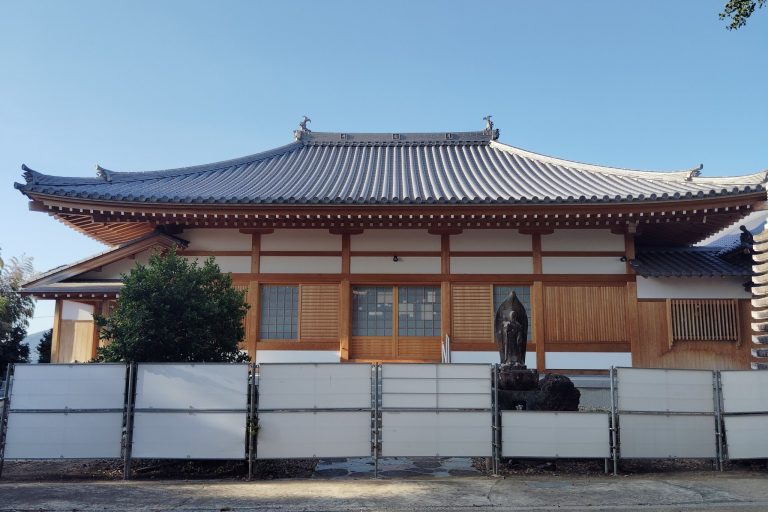
The former Matsu-no-maru main enclosure gate was moved to Jorenji Temple and reused as a temple gate. A gate of uncertain original position was moved to Unzenji Temple, where it was reused as the entrance. After collapsing in the 1891 earthquake, it was rebuilt in 1993 in a form closer to the original. The Ninomaru Yarai Gate was moved to Senshuin and reused as its east gate, while the Otemichi Kuro-mon Gate was moved to Tokurinji and reused as a temple gate.
The gate traditionally identified as the Uchida rear gate was moved to Zuisenji and reused as its temple gate. Other former castle gates of uncertain origin survive at additional locations, including a private residence. These surviving elements preserve parts of the castle’s dismantled perimeter beyond the hilltop enclosure.
Collections and historical imagery
The Inuyama Castle Hakutei Bunko History and Culture Museum houses artworks, swords, manuscripts, maps, and other materials associated with the castle. A short sword dated to 1357 bears the inscriptions “Made by Sa Yasuyoshi” and “Second month of 1357.” It is 29.4 centimetres long, with a base width of 2.7 centimetres, and is classified as a short sword by its cultural-property designation.
A six-panel paired battle screen depicting the Battles of Nagashino and Komaki-Nagakute contains imagery connected with Inuyama’s history. The left screen shows Naruse Masakazu, father of the first lord of the Inuyama domain, Naruse Masanari. The right screen depicts Masanari during his first campaign in two places.